wayground logo

Free Printable Worksheets

Font size

S
M
L
XL
Worksheets

Unit 4 Test Review

Total questions: 50

Worksheet time: 55mins
Name
Class
Date
1.
As you move down a group, atomic radius increases because -
a)
you add more and more neutrons
b)
you add more electrons and more shells (energy levels)
c)
you add more and more protons
d)
you add more atomic mass
2.
The atom with the largest atomic radius in Group 18 is -
a)
Ar
b)
Kr
c)
He
d)
Rn
3.
The atom with the largest atomic radius in Period 4 is
a)
K
b)
Kr
c)
Fe
d)
Fr
4.
Francium (Fr) has the lowest ionization energy in Group 1 because -
a)
it has the smallest number of valence electrons
b)
it has the greatest atomic mass
c)
it has the greatest number of protons, so it attracts its electrons the strongest
d)
its 1 valence electron is very far from the nucleus, so little energy is needed to remove it
5.
The element with the smallest ionization energy in Period 6 is -
a)
Rn
b)
Cs
c)
Tm
d)
Os
6.
The energy required to remove electrons is the definition of:
a)
Electronegativity
b)
Atomic Radius
c)
Atomic Number
d)
Ionization Energy
7.
Groups 3-12 are known as the:
a)
Inner Metals
b)
Weirdos
c)
Transition Metals
d)
Changelings
8.
Families all have the same or similar
a)
Names
b)
Atomic Numbers
c)
Properties
d)
Atomic Masses
9.
Electronegativity is...
a)
the ability of an atom to attract/ accept electrons
b)
the energy required to remove an electron from a specific atom
c)
the ability of an atom to lose electrons
d)
how easy it is to make friends.
10.
Which has the greater Electronegativity:
a)
C
b)
N
c)
B
d)
Mg
11.
Electronegativity __________ from left to right within a period and __________ from top to bottom within a group.
a)
decreases, increases
b)
increases, decreases
c)
increases, increases
d)
stays the same, increases
12.
Which element has the greatest electronegativity: Nitrogen (N) or Arsenic (As)?
a)
Nitrogen
b)
Arsenic
13.
Which element has the greatest ionization energy: Aluminum (Al) or Chlorine (Cl)?
a)
Aluminum
b)
Chlorine
14.
Which element has the smaller atomic radius: potassium (K) or bromine (Br)?
a)
Potassium
b)
Bromine
15.
Which element in Period 2 has the greatest atomic radius?
a)
Be
b)
N
c)
C
d)
Li
16.
Of the halogens, which has the smallest radius?
a)
F
b)
Ts
c)
Br
d)
At
17.
Which of the following will have a lower ionization energy than Scandium (Sc)?
a)
Helium (He)
b)
Titanium (Ti)
c)
Calcium (Ca)
d)
Magnesium (Mg)
18.
Which of the following will have a higher electronegativity than arsenic (As)?
a)
Carbon (C)
b)
Antimony (Sb)
c)
Neon (Ne)
d)
Germanium (Ge)
19.
Name group 2 on the periodic table.
a)
alkali metals
b)
alkaline earth metals
c)
noble gases
d)
transition metals
20.
Which has the highest ionization energy?
a)
Ca
b)
As
c)
Br
21.
Which has the smaller ionization energy?
a)
P
b)
Mg
22.
Which would be the easiest to take an electron from?
a)
He
b)
F
c)
Ba
d)
Fr
23.
Which of the following will have a larger radius than Gallium (Ga)?
a)
Ge
b)
Mg
c)
Al
d)
Sr
24.
Which of these has the smallest atomic radius?
a)
K
b)
Rb
c)
Fr
d)
Cs
25.
Which periodic group has the smallest atomic radius?
a)
Alkali metals
b)
Halogens
c)
Noble Gases
d)
Transition metals
26.
The element with the lowest electronegativity in Period 3 is -
a)
Na
b)
Cl
c)
Ar
d)
Mg
27.
The element with the largest electronegativity in the halogens (group 17) is -
a)
At
b)
F
c)
Cl
d)
Br
28.
What family is the most reactive?
a)
Alkali Metals
b)
Halogens
c)
Noble Gases
d)
Alkaline Earth Metals
29.
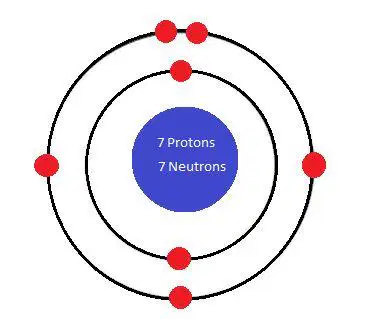
What is this element and what would the charge be if it became an ion?
a)
Nitrogen, +2
b)
Nitrogen, -3
c)
Nitrogen, +3
d)
Silicon, -3
30.
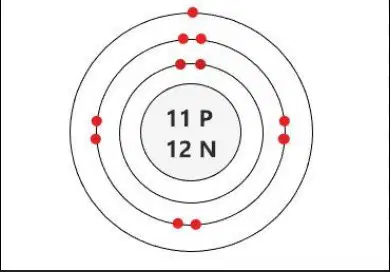
Based on the image, will the element become a cation or an anion and why?
a)
Cation - It will gain electrons
b)
Anion - it will gain electrons
c)
Cation - it will lose electrons
d)
Anions - it will lose electrons
31.
What are valence electrons?
a)
Electrons on the inner shell of an atom
b)
Electrons that are closest to the nucleus
c)
Electrons on the outer shell of an atom
d)
Electrons inside the nucleus of an atom
32.
What are cations?
a)
Elements that have a positive charge because they gain electrons
b)
Elements that have a negative charge because they gain electrons
c)
Elements that have a positive charge because they lose electrons
d)
Electrons that have a negative charge because they lose electrons
33.
What are anions?
a)
Elements that have a positive charge because they gain electrons
b)
Elements that have a negative charge because they gain electrons
c)
Elements that have a positive charge because they lose electrons
d)
Electrons that have a negative charge because they lose electrons
34.
What subatomic particles are found within the nucleus of an atom?
a)
Protons + Electrons
b)
Neutrons + Electrons
c)
Protons + Neutrons
d)
Protons
35.
Which period of elements would have the smallest atomic radius?
a)
Halogens
b)
Alkaline earth metals
c)
Alakali metals
d)
transition metals
36.
Which element has 7 valence electrons?
a)
S
b)
Br
c)
He
d)
Na
37.
Which element has the largest ionization energy?
a)
Cs
b)
Hf
c)
Sn
d)
S
38.
Based on the image, what element is represented by the bohr diagram shown?
a)
Sodium
b)
Magnesium
c)
Sulfur
d)
Scandium
39.
What element is in period 5, group 15
a)
Antimony
b)
Bismuth
c)
Tin
d)
Polonium
40.
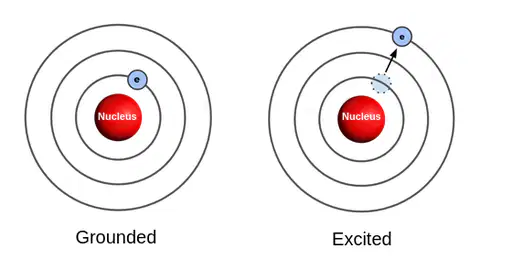
When an atom goes from a grounded state to an excited state and back to grounded, what does it release?
a)
Light
b)
sound
c)
Protons
d)
Neutrons
41.

Which of the following elements is most likely to form an anion?

a)

Aluminum (Al)

b)

Magnesium (Mg)

c)

Chlorine (Cl)

d)

Sodium (Na)

42.

What happens to the atomic radius as you move from left to right across a period?

a)

It stays the same

b)

It fluctuates randomly

c)

It decreases

d)

It increases

43.

Which group on the periodic table contains elements with a full outer shell of electrons?

a)

Transition metals

b)

Noble gases

c)

Halogens

d)

Alkali metals

44.

Choose the element with the highest electronegativity.

45.

(a)   has the highest electronegativity.

Choose from the below words
Bi
P
46.
The symbols W, X, Y, and Z represent four elements shown on the outline of a periodic table.
Which element has the highest electronegativity?

a)
W
b)
X
c)
Y
d)
Z
47.

Which element has the electron configuration of 1s 2^2 2s 2^2 2p 6^6 3s 2^2 3p 5^5 ?

a)

Chlorine

b)

Argon

c)

Sulfur

d)

Phosphorus

48.

Which electron configuration represents a neutral atom of oxygen?

a)

1s 2^2 2s 2^2 2p 4^4

b)

1s 2^2 2s 2^2 2p 6^6

c)

1s 2^2 2s 2^2 2p 3^3

d)

1s 2^2 2s 2^2 2p 5^5

49.

Which of the following are the alkaline earth metals?

50.

Which of the following are the alkali metals?