
 Worksheets
Chapter 7 analytical chemistry 2
Total questions: 66
Worksheet time: 17hrs 30mins
Which of the following is the correct list of the components of a typical spectroscopic instrument?
1. Source
2. Container
3. Wavelength selector
4. Radiation detector
5. Signal processor and readout
1. Source
2. Container
3. Amplifier
4. Transducer
5. Digital readout
1. Source
2. Container
3. Wavelength selector
4. Camera
5. Signal processor and readout
1. Radiation detector
2. Wavelength selector
3. Signal processor and readout
4. Source
5. Container
for absorption, fluorescence, and phosphorescence an external radiant energy source is required
true
false
for emission and chemiluminescence spectroscopy, an external radiant energy source is required
true
false
In photoluminescence spectroscopy, the source induces the sample to _____ characteristic radiation
emit
absorb
A source of radiation that emits a limited number of lines or bands of radiation, each of which spans a limited range of wavelengths, is known as a
continuum source
line source
laser source
the source
A source of radiation that emits a broad band of radiation that changes in intensity smoothly as a function of wavelength is known as a
continuum source
line source
laser source
the source
A source of radiation that produces a spatially narrow, extremely intense beam of radiation is known as a
continuum source
line source
laser source
the source
What is the term for exciting an active species of a laser by means of electric discharge, passage of electric current, or exposure to an intense radiant source?
Pumping
Spontaneous emission
Stimulated emission
Absorption
The normal emission process in which the species in the excited electronic state loses all or part of its energy by emission of radiation is known as
spontaneous emission
pumping
stimulated emission
absorption
When an excited laser species is hit by a photon of the same energy, it emits an identical photon and relaxes to a lower energy state. This is known as
stimulated emission
spontaneous emission
pumping
absorption
Stimulated emission causes
amplification
reduction
In a laser, what competes with stimulated emission?
absorption
emission
spontaneous emission
pumping
To have light amplification in a laser, the number of photons produced by stimulated emission must _______ the number of photons lost by absorption
be less than
exceed
be equal to
For lasers to work, we need more particles in higher energy states than lower energy states. Because of this, we need a
Population inversion
Ground state majority
Thermal equilibrium
Quantum leap
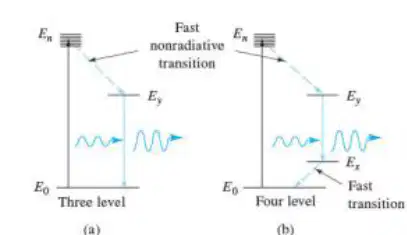
Is population inversion achieved more easily for four-level laser systems or three-level laser systems?
three-level systems
four-level systems
there is no difference
Draw your favorite animal or something

How is the effective bandwidth found?
The full width at half peak height
All the area under the curve
The maximum wavelength of the curve
In wavelength selectors, a narrower bandwidth indicates _______ performance
better
worse
Interference filters
rely on optical interference to provide narrow bands of radiation
have transmittances of nearly 100% over a portion of the visible spectrum, but then rapidly decrease to 0% over the remainder
commonly consist of colored glass or a dye suspended in gelatin
Allow a specific range of frequencies to pass through while attenuating frequencies both above and below this band.
Absorption filters
rely on optical interference to provide narrow bands of radiation
have transmittances of nearly 100% over a portion of the visible spectrum, but then rapidly decrease to 0% over the remainder
commonly consist of colored glass or a dye suspended in gelatin
Allow a specific range of frequencies to pass through while attenuating frequencies both above and below this band.
Cutoff filters
rely on optical interference to provide narrow bands of radiation
have transmittances of nearly 100% over a portion of the visible spectrum, but then rapidly decrease to 0% over the remainder
commonly consist of colored glass or a dye suspended in gelatin
Allow a specific range of frequencies to pass through while attenuating frequencies both above and below this band.
Which of the following is the correct list of optical elements in a monochromator?
1. Entrance slit
2. Collimating lens or mirror
3. Prism or grating
4. Focusing element
5. Exit slit
1. Source
2. Container
3. Wavelength selector
4. Radiation detector
5. Signal processor and readout
1. Light source,
2. Entrance slit
3. Grating
4. Exit slit
5. Detector
1. Entrance slit,
2. Collimating mirror
3. Prism
4. Diffraction grating
5. Exit slit
For a grating monochromator, angular dispersion of the wavelength results from______ which occurs at the reflective surface
Diffraction
Refraction
Absorption
Interference
For a prism monochromator, _____ at the two faces results in angular dispersion of the radiation
Diffraction
Refraction
Absorption
Interference
For prism monochromators, shorter wavelengths show _______ dispersion than longer wavelengths
greater
less
the same
no
A main disadvantage of prism monochromators is that they have a nonlinear wavelength scale
true
false
Which of the following best describes a grating monochromator?
It uses a prism to disperse light
It is a simple filter that blocks all wavelengths except the desired one
it uses lots of closely-spaced grooves to disperse UV, visible, and IR radiation
A device that uses a single mirror to reflect all incoming light onto an array of detectors
Echellette grating is
grooved such that it has relatively broad faces from which reflection occurs
transmission grating with fine, closely spaced grooves
A glass prism used for light dispersion
A flat optical surface without any grooves
For grating monochromators, to get constructive interference the path lengths must differ by------- (of the wavelength of the incident beam
zero
an integer multiple
an odd number
a random number
Which of the following methods is used to improve spectral purity in a monochromator?
Narrowing the entrance and exit slits
Increasing slit width
Coating interior surfaces with black paint
Using a more powerful light source
What does the ability of a monochromator to separate different wavelengths depend on?
dispersion
spectral purity
resolving power
light-gathering power
Which of the following refers to variation in wavelength as a function of y?
linear dispersion (D)
angular dispersion (dr/dλ)
resolving power (R)
spectral bandwidth Δλ
which is a more useful measure of dispersion?
linear dispersion (D)
reciprocal linear dispersion (D-1)
Of the following, which describes the limit of a monochromator's ability to separate adjacent images that have a slight difference in wavelength?
resolving power (R)
linear dispersion (D)
angular dispersion (dr/dλ)
light-gathering power
How can you increase the amount of light reaching the detector in a monochromator?
Use a lens or mirror with a smaller f-number
Narrow the entrance slit
Increase the focal length of the collimating lens
Use a higher diffraction order
What does the entrance slit of a monochromator serve as?
a radiation source
a device to focus light on the detector
a sensor that measures intensity
a mirror to reflect light inside the monochromator
What is an effective bandwidth?
The range of wavelengths that exit the monochromator at a given wavelength setting
The distance between the entrance and exit slits
The intensity of light passing through the exit slit
The total wavelength range of the light source
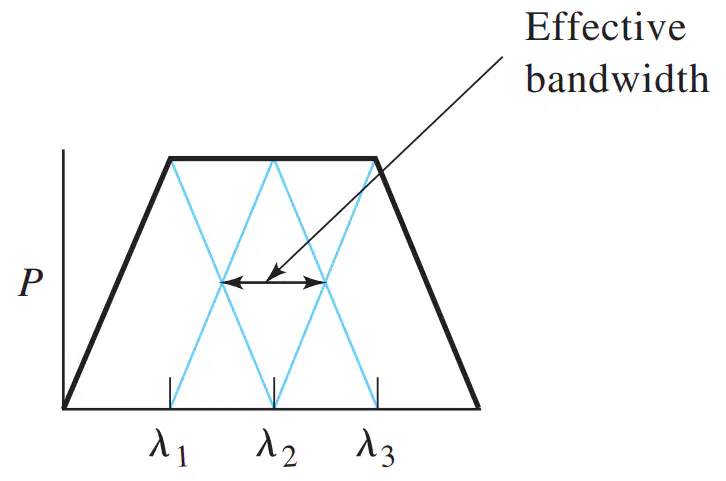
When the monochromator is set at λ2, ________ spectral resolution of the 3 wavelengths is achieved
no
partial
complete
half

When the effective bandwidth of an instrument is reduced to 3/4 of their original dimensions, _______ resolution of the three lines results
partial
complete
no
little
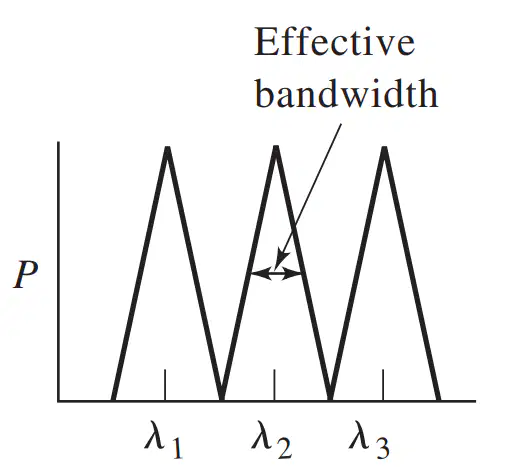
When the effective bandwidth is 1/2 the difference in wavelengths of the three beams, ________ resolution is achieved
complete
no
partial
narrow
Much greater detail is observed with the _______ slit setting and thus the ________ bandwidth
Narrowest, Narrowest
Broadest, Broadest
Narrowest, Broadest
Broadest, Narrowest
The available radiant power ________ when the slits are narrowed
decreases significantly
increases significantly
decreases slightly
increases slightly
does not change
It is important for cells/cuvettes to be _______ to the radiation in the spectral region of interest
transparent
opaque
absorbent
translucent
It is ideal for a transducer to have ______ sensitivity, ______ signal to noise ratio, and a _____ response over a considerable wavelength range
high, high, constant
high, low, constant
low, high, varied
high, low, varied
It is ideal for a transducer to have a _____ response time and ____ output signal in the absence of illumination
fast, no
slow, a high
fast, a high
slow, no
The two general types of radiation transducers
responds to heat
responds to photons
responds to pressure
responds to ionization
all photon transducers have an active surface that _______ radiation
absorbs
reflects
transmits
eats
photon transducers are _______ noise limited
shot
thermal
flicker
environmental
thermal transducers are _______ noise limited
shot
thermal
flicker
environmental
What type of photon transducer meets the following description: radiant energy generates a current at the interface of a semiconductor layer and a metal
photovoltaic cells
phototubes
photomultiplier tubes
photoconductivity transducers
What type of photon transducer meets the following description: radiation causes emission of e- from a photosensitive solid surface
photovoltaic cells
phototubes
photomultiplier tubes
photoconductivity transducers
What type of photon transducer meets the following description: contain a photoemissive surface as well as several additional surfaces that emit a cascade of e- when struck by e- from the photosensitive area
photoconductivity transducers
phototubes
photomultiplier tubes
photoconductivity transducers
silicon photodiodes
What type of photon transducer meets the following description: photons cause the formation of electron-hole pairs and a current across a reverse-biased pn junction
photovoltaic cells
charge-transfer transducers
photomultiplier tubes
photoconductivity transducers
silicon photodiodes
What type of photon transducer meets the following description: charges developed in a silicon crystal as a result of absorption of photons are collected and measured
photovoltaic cells
charge-transfer transducers
photomultiplier tubes
photoconductivity transducers
silicon photodiodes
Photomultiplier tubes are similar the phototubes, but ____________ sensitive
significantly more
significantly less
marginally more
marginally less
What type of optical instrument is used for the visual identification of atomic emission lines?
spectroscope
colorimeter
photometer
spectrometer
spectrophotometer
What type of optical instrument is an instrument for absorption measurements in which the human eyes serves as the detector using one or more color-comparison standards?
spectroscope
colorimeter
photometer
spectrometer
spectrophotometer
What type of optical instrument consists of a source, filter, and photoelectric transducer and is used for absorption measurements in the UV, visible, and IR regions?
spectroscope
colorimeter
photometer
spectrometer
spectrophotometer
What type of optical instrument provides information about the intensity of radiation as a function of wavelength or frequency and lets you scan a spectrum?
spectroscope
colorimeter
photometer
spectrometer
spectrophotometer
What type of optical instrument is a photometer but for fluorescence measurements?
spectroscope
colorimeter
fluorometer
spectrometer
spectrophotometer
What type of optical instrument is a spectrometer equipped with one or more exit slits and photoelectric transducers that permit the determination of the ratio of the radiant power of two beams as a function of wavelength as in absorption spectroscopy?
spectroscope
colorimeter
fluorometer
spectrometer
spectrophotometer
What type of optical instrument obtains spectral information without first dispersing or filtering the radiation to provide wavelengths of interest?
multiplex instrument
colorimeter
fluorometer
spectrometer
spectrophotometer
What type of transducer is typically used in the IR region?
thermal transducers
photon transducers
photovoltaic cells
photoconductivity transducers
Thermal transducers consist of a tiny blackened surface (blackbody) that absorbs IR radiation and _______ in temperature as a consequence
increases
decreases
stays the same
A signal processor is an electronic device that ________ the electrical signal from the transducer
amplifies
reduces
only digitalizes
filters
which of the following are advantages of photon counting over analog processing?
improved S/N
sensitivity to low radiation levels
improved precision for a given measurement time
lowered sensitivity to PMT voltage and temperature fluctuation
less complex and therefore less expensive

