
 Worksheets
REDOX Test Review
Total questions: 71
Worksheet time: 5hrs 39mins
Which particles are transferred during a redox reaction?
atoms
electrons
neutrons
positrons
Given the equation representing a reaction: 2Ca(s) + O2(g) → 2CaO(s), during this reaction, each element changes in
atomic number
oxidation number
number of protons per atom
number of neutrons per atom
Given the equation representing a reaction:
3CuCl2(aq) + 2Al(s) → 3Cu(s) + 2AlCl3(aq)
the oxidation number of copper changes from
+1 to 0
+2 to 0
+2 to +1
+6 to +3
What are the two oxidation states of nitrogen in NH4NO2?
+3 and +5
+3 and -5
-3 and +3
-3 and -3
Given the balanced equation representing a reaction:
Ni(s) + 2HCl(aq) → NiCl2(aq) + H2(g)
in this reaction, each Ni atom
loses 1 electron
loses 2 electrons
gains 1 electron
gains 2 electrons
Which process involves the transfer of electrons?
double replacement
neutralization
oxidation-reduction
sublimation
What occurs when Cr³⁺ ions are reduced to Cr²⁺ ions?
Electrons are lost and the oxidation number of chromium increases.
Electrons are lost and the oxidation number of chromium decreases.
Electrons are gained and the oxidation number of chromium increases.
Electrons are gained and the oxidation number of chromium decreases.
Which balanced equation represents a redox reaction?
Mg + Cl₂ → MgCl₂
CaO + H₂O → Ca(OH)₂
HNO₃ + NaOH → NaNO₃ + H₂O
NaCl + AgNO₃ → AgCl + NaNO₃
What is the oxidation number of manganese in KMnO₄?
+7
+2
+3
+4
What is the oxidation number of iodine in KIO₄?
+1
-1
+7
-7
Given the balanced equation representing a reaction:
2KClO₃(s) → 2KCl(s) + 3O₂(g)
the oxidation state of chlorine in this reaction changes from
-1 to +1
-1 to +5
+1 to -1
+5 to -1
What is the oxidation number of chromium in the chromate ion, CrO42-?
HINT: The oxidation numbers add up to the charge of the polyatomic ion, not zero!
+6
+2
+3
+8
Which change in oxidation number indicates oxidation?
-1 to +2
-1 to -2
+4 to +3
+3 to +2
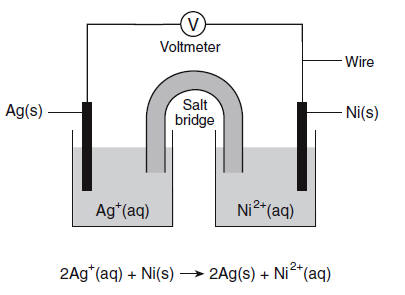

In an electrochemical cell, oxidation occurs at the
A) salt bridge
B) anode
C) switch
D) cathode
Given the equation representing a reaction: 3CuCl2(aq) + 2Al(s) → 3Cu(s) + 2AlCl3(aq). The oxidation number of copper changes from
A) +1 to 0
B) +2 to +1
C) +2 to 0
D) +6 to +3

The diagram and equation below represent an electrochemical cell.
A) chromatography
B) distillation
C) polymerization
D) electrolysis

A key is plated with nickel as shown in the diagram below.
A) voltaic cell; a chemical change produces electrical energy
B) electrolytic cell; a chemical change produces electrical energy
C) voltaic cell; electrical energy produces a chemical change
D) electrolytic cell; electrical energy produces a chemical change
Based on Table J, which ionic equation represents a spontaneous reaction that can occur in a voltaic cell?
A) Fe(s) + Mg²⁺(aq) → Fe²⁺(aq) + Mg(s)
B) Fe²⁺(aq) + Mg²⁺(aq) → Fe(s) + Mg(s)
C) Fe(s) + Mg(s) → Fe²⁺(aq) + Mg²⁺(aq)
D) Fe²⁺(aq) + Mg(s) → Fe(s) + Mg²⁺(aq)
Which process occurs at the anode in an electrolytic cell?
A) addition
B) oxidation
C) reduction
D) combustion
In a voltaic cell, oxidation occurs
A) in the salt bridge
B) in the external circuit
C) at the anode
D) at the cathode
Which statement describes the two types of reactions that occur in operating electrochemical cells?
Nonspontaneous reactions occur in voltaic cells, and spontaneous reactions occur in electrolytic cells.
Spontaneous reactions occur in electrolytic cells, and spontaneous reactions occur in voltaic cells.
Spontaneous reactions occur in voltaic cells, and nonspontaneous reactions occur in electrolytic cells.
Nonspontaneous reactions occur in electrolytic cells, and nonspontaneous reactions occur in voltaic cells.
Which reaction occurs at the anode in an electrochemical cell?
oxidation
substitution
neutralization
reduction
In which part of an electrochemical cell does reduction occur?
anode
wire
voltmeter
cathode
Which metal is most easily oxidized?
Co
Ag
Cu
Mg
Which half-reaction equation represents reduction?
Ag+ → Ag + e-
Cu → Cu2+ + 2e-
Cu2+ + 2e- → Cu
Ag + e- → Ag+
Which form of energy is converted to electrical energy in a voltaic cell?
chemical
nuclear
mechanical
thermal
Given the equation representing a reaction: Cd + NiO2 + 2H2O → Cd(OH)2 + Ni(OH)2. Which half-reaction equation represents the oxidation in the reaction?
A) Cd + 2e⁻ → Cd²⁺
B) Ni⁴⁺ + 2Ni²⁺ + 2e⁻
C) Ni⁴⁺ + 2e⁻ → Ni²⁺
D) Cd → Cd²⁺ + 2e⁻
In an electrochemical cell, oxidation occurs at the
A) salt bridge
B) anode
C) switch
D) cathode
In an electrochemical cell, oxidation occurs at the
A) salt bridge
B) anode
C) switch
D) cathode
Which energy conversion occurs in an operating electrolytic cell?
A) nuclear energy to electrical energy
B) electrical energy to nuclear energy
C) chemical energy to electrical energy
D) electrical energy to chemical energy
In which substance does hydrogen have an oxidation number of zero?
LiH
H2O
H2S
H2
Given the reaction:
F2(g) + 2 Br–(aq) → Br2() + 2 F–(aq)
Which species is reduced?
F2(g)
Br–(aq)
Br2 (l)
F–(aq)
Given the oxidation-reduction reaction:
H2 + 2 Fe+3 → 2 H+ + 2 Fe+2
Which species undergoes reduction?
H2
Fe3+
H+
Fe2+
Given the cell reaction:
Ca(s) + Mg2+(aq) → Ca2+(aq) + Mg(s)
Which substance was oxidized?
Ca(s)
Mg2+(aq)
Ca2+(aq)
Mg(s)
In the reaction
2 Fe3+ + S2– → 2 Fe2+ + S0,
the species oxidized is
Fe3+
S2–
Fe2+
S0
In a redox reaction, the species reduced
gains electrons and is the oxidizing agent
gains electrons and is the reducing agent
loses electrons and is the oxidizing agent
loses electrons and is the reducing agent
In the reaction
2 Mg + O2 → 2 MgO
the magnesium is the
oxidizing agent and is reduced
oxidizing agent and is oxidized
reducing agent and is reduced
reducing agent and is oxidized
Given the redox reaction:
Fe2+(aq) + Zn(s) → Zn2+(aq) + Fe(s)
Which species acts as a reducing agent?
Fe(s)
Fe2+(aq)
Zn(s)
Zn2+(aq)
Which half-reaction correctly represents oxidation?
Sn2+ + 2e– → Sn0
Sn4+ + 2e– → Sn2+
Sn2+ → Sn0 + 2e–
Sn2+ → Sn4+ + 2e–
Which balanced equation represents an oxidation-reduction reaction?
Ba(NO3)2 + Na2SO4 →BaSO4 + 2NaNO3
H3PO4 + 3KOH →K3PO4 + 3H2O
Fe(s) + S(s) →FeS(s)
NH3(g) + HCl(g) →NH4Cl(s)

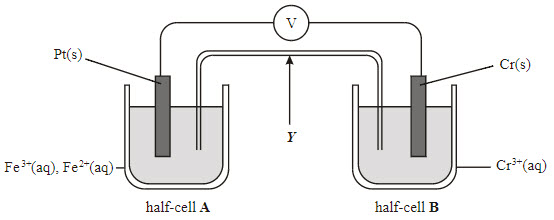
To maintain the excess buildup of charges in the electrolyte
To allow ions to move from one half cell to the other
Which statement best describes how a salt bridge maintains electrical neutrality in the half-cells of an electrochemical cell?
It prevents the migration of electrons.
It prevents the reaction from occurring spontaneously.
It permits the migration of ions.
It allows for the reaction from occurring spontaneously.

Base your answer to the question on the diagram of the voltaic cell.
Based on the given equation, the balanced half-reaction that occurs in half-cell 1 is
Pb(s) → Pb2+(aq) + 2e-
2Ag(s) → 2Ag+(aq) + 2e-
Pb2+(aq) + 2e- → Pb(s)
2Ag+(aq) + 2e- → Ag(s)

When the switch is closed, which group of letters correctly represents the direction of electron flow?
A) A → B → C → D
B) A → F → E → D
C) D → C → B → A
D) D → F → E → A

Which statement correctly describes the direction of flow for the ions in this cell when the switch is closed?
Ions move through the salt bridge from B to C, only.
Ions move through the salt bridge from C to B, only.
Ions move through the salt bridge in both directions.
Ions do not move through the salt bridge in either direction.

Which statement identifies the part of the cell that conducts electrons and describes the direction of electron flow as the cell operates?
Electrons flow through the salt bridge from the Ni(s) to the Zn(s).
Electrons flow through the salt bridge from the Zn(s) to the Ni(s).
Electrons flow through the wire from the Ni(s) to the Zn(s).
Electrons flow through the wire from the Zn(s) to the Ni(s).
Which statement is true about oxidation and reduction in an electrochemical cell?
Both occur at the anode.
Both occur at the cathode.
Oxidation occurs at the anode and reduction occurs at the cathode.
Oxidation occurs at the cathode and reduction occurs at the anode.
Which reaction occurs at the cathode in an electrochemical cell?
combustion
oxidation
neutralization
reduction

What type of electrochemical cell is shown?
oxidation cell
electrolytic cell
reduction cell
voltaic cell

Write the balanced half-reaction for the reduction that occurs in this electrolytic cell.
Cl2 + 2e⁻ → 2Cl⁻
Cl2 → 2Cl⁻ + 2e⁻
2Na⁺ + 2e⁻ → 2Na
2Na⁺ → 2Na + 2e⁻
An electrolytic cell is different from a voltaic cell because in an electrolytic cell
a redox reaction occurs
a spontaneous reaction occurs
an electric current is produced
an electric current causes a chemical reaction
In an electrolytic cell, to which electrode will a positive ion migrate and undergo reduction?
the anode, which is negatively charged
the anode, which is positively charged
the cathode, which is negatively charged
the cathode, which is positively charged
___ Al + ___ Fe+2 → ___ Al+3 + ___ Fe
2 CaO--> 2 Ca + O2
Which energy conversion shown below takes place in a voltaic cell?
Electrical to chemical
Mechanical to chemical
Mechanical to electrical
Chemical to electrical

According to reference Table J, which of the following reactions would occur spontaneously?
A
B
C
D

A power source is required for this cell to operate because the REDOX reaction is:
nonspontaneous and converts electrical energy to chemical energy
spontaneous and converts electrical energy to chemical energy
nonspontaneous and converts chemical energy to electrical energy
spontaneous and converts chemical energy to electrical energy

In the electrochemical cell shown, the Ni(s) is the:
anode and increases in mass as the cell operates
anode and decreases in mass as the cell operates
cathode and increases in mass as the cell operates
cathode and decreases in mass as the cell operates

