
Font size
 Worksheets
Chapter 1- Principles of Agentic Systems - Chapter Review
Total questions: 69
Worksheet time: 35mins
Match the following characteristics of intelligent agents with their implications for building agentic systems.
It allows for better selection of travel destinations
Improved user experience in travel planning
It helps in designing systems that can operate autonomously and interact effectively
Enhanced autonomy and interaction capabilities
It ensures the system uses the latest AI models
Utilization of cutting-edge technology
It reduces the need for user input in all cases
Minimized dependency on user input
What is the primary focus of agentic systems?
The optimization of decision-making within specific contexts
The development of physical hardware
The reduction of human labor in all industries
The elimination of all forms of accountability
Which of the following is NOT mentioned as a field where agentic systems have made significant advancements?
Robotics
AI
Systems engineering
Literature
What is a key benefit of agentic systems in robotics?
They can autonomously navigate disaster zones and make decisions to assist in rescue efforts.
They can write complex novels.
They can replace all human workers in factories.
They can only perform repetitive tasks.
How do agentic systems contribute to AI?
By leveraging advanced algorithms and machine learning to provide intelligent recommendations or automated decision-making
By building physical robots for manual labor
By eliminating the need for any human input in all processes
By focusing solely on data storage
In the context of systems engineering, what is a crucial role of agentic systems?
Efficient operation, resource allocation, and fault tolerance in complex, distributed, and adaptive systems
Writing software for entertainment purposes
Designing simple, single-component machines
Replacing all forms of human communication
Why do agentic systems challenge our conventional understanding of accountability and responsibility?
Because they make intricate decisions that are optimized within specific contexts
Because they always require human supervision
Because they are only used in entertainment
Because they do not interact with their environment
Which concept is central to the idea of agentic systems?
Self-governance, agency, and autonomy
Entertainment and leisure
Manual labor and repetition
Data storage and retrieval
Which of the following best defines self-governance in agentic systems?
The ability to follow external instructions without deviation
The ability to govern or control itself autonomously, without external direction or control
The ability to interact only with other systems
The ability to ignore internal rules and models
Which aspect of self-governance refers to the ability to organize and structure internal processes and behavior without external intervention?
Self-regulation
Self-adaptation
Self-organization
Self-determination
What is the primary focus of self-regulation in agentic systems?
Setting new objectives and priorities
Monitoring and adjusting actions and outputs based on feedback
Modifying behavior in response to external commands
Ignoring feedback from the environment
Which of the following is an example of self-adaptation in an agentic system?
Ignoring changes in the environment
Modifying strategies or decision-making processes in response to changes
Following a fixed set of rules regardless of context
Only optimizing performance through external input
Self-optimization in agentic systems primarily involves: (a)
Which aspect of self-governance allows a system to set its own objectives and courses of action based on internal decision-making?
Self-organization
Self-regulation
Self-determination
Self-adaptation
How is self-governance in agentic systems often enabled?
By ignoring technological advancements
By integrating technologies, frameworks, and methodologies such as machine learning and decision-making algorithms
By relying solely on human intervention
By avoiding the use of data and experiences
What does "decisional authority" refer to in agentic systems?
The power to act only when instructed by external forces
The ability to act and perform actions according to a chosen alternative or course of action
The inability to evaluate different options
The process of following predetermined rules without deviation
A system with agency is able to:
Only follow external instructions
Evaluate different options and select the most appropriate action based on internal decision-making processes
Ignore internal decision-making processes
Always act according to predetermined rules
Which of the following best describes "intentionality" in the context of agentic systems?
The ability to perform tasks without human intervention
The existence of intentions, goals, or objectives that guide actions and behavior
The use of external data to make decisions
The ability to sense environmental changes
What is the primary focus of "responsibility" in agentic systems?
The ability to adapt to new environments
The answerability or accountability for the outcomes and consequences of one’s actions
The use of advanced algorithms for decision-making
The independence from human control
Which of the following best defines "operational autonomy"?
The ability to make choices and take action to achieve objectives
The ability to perform a specific task or set of tasks without direct human intervention or control
The ability to sense and respond to environmental changes
The ability to interact with other entities
Match the following types of autonomy with their definitions.
Functional autonomy is about performing tasks without human intervention, while operational autonomy is about making choices to achieve objectives.
Operational autonomy is about making choices to achieve objectives.
Functional autonomy involves making choices and adapting behavior to achieve objectives, while operational autonomy is about executing tasks independently.
Functional autonomy is about executing tasks independently.
Functional autonomy is only relevant in non-AI systems, while operational autonomy is for AI systems.
Operational autonomy is for AI systems.
Functional autonomy requires constant human supervision, while operational autonomy does not.
Operational autonomy does not require constant human supervision.
Why is autonomy considered important in agentic systems?
It allows systems to be programmed only once
It enables systems to operate independently and adapt to changing conditions or stimuli
It ensures systems always require human intervention
It limits the system’s ability to interact with the environment
Which of the following best describes hierarchical autonomy in AI systems?
Systems with higher hierarchical autonomy have greater latitude in making decisions that impact their own operations or broader operations.
Systems with higher hierarchical autonomy have more constraints from higher-level entities.
Hierarchical autonomy refers to the ability of a system to perform physical tasks only.
Hierarchical autonomy means a system cannot make any decisions independently.
In the context of AI and robotics, what does autonomy primarily refer to?
The extent to which a system can perform tasks and make decisions without continuous human intervention.
The ability of a system to store large amounts of data.
The speed at which a system can process information.
The cost of developing an AI system.
Which of the following is an example of operational autonomy in a travel booking assistant?
The system books flights or hotels, manages reminders, and retrieves travel information with little or no human input.
The system requires human approval for every action it takes.
The system only stores user preferences without taking any action.
The system only provides weather updates.
Why might a chatbot in a travel booking example prompt the user for clarification?
To ensure accuracy while still operating autonomously within its programming boundaries.
To reduce the system's autonomy.
To avoid making any decisions.
To increase human intervention in every step.
How does the level of hierarchical autonomy affect a system's decision-making?
It determines the amount of decisional authority or decision-making power a system has within a larger framework.
It only affects the system's ability to store data.
It has no impact on the system's operations.
It is unrelated to the system's ability to interpret user commands.
Consider a scenario where an AI system must make decisions that could have significant ethical implications. What should be a primary concern according to the text?
Ensuring the system's decisions align with human values and ethical principles.
Maximizing the number of decisions made per second.
Minimizing the amount of data used by the system.
Ensuring the system never asks for user input.
Which of the following best describes the concept of "agency" in the context of the travel booking assistant algorithm?
The ability to act on behalf of a user
The ability to operate independently
The process of booking a flight
The use of artificial intelligence
Which of the following best describes the primary function of an intelligent agent?
To follow a set of random actions without any goals
To perceive its environment and take action to achieve certain goals or objectives
To only store information without interacting with its environment
To operate without any predefined rules or learning ability
What is the main difference between reactive and proactive intelligent agents?
Reactive agents ignore their environment, while proactive agents do not
Reactive agents only plan for the future, while proactive agents only react to the present
Reactive agents respond to changes in real time, while proactive agents anticipate future needs and plan accordingly
Reactive agents are always more effective than proactive agents
Which characteristic of intelligent agents enables them to work together and leverage collective intelligence?
Proactiveness
Social ability
Learning and adaptation
Reasoning and planning
How do intelligent agents improve their performance over time?
By ignoring new information
By learning from experience and adapting their behavior
By repeating the same actions regardless of outcome
By avoiding interaction with their environment
Knowledge representation and logical inference is an example of a technique used by intelligent agents for reasoning and planning.
(a)Suppose an intelligent agent is placed in a new environment and must achieve a goal it has never encountered before. Which characteristic would most help it succeed?
Reactivity
Social ability
Learning and adaptation
Proactiveness
A team of intelligent agents is tasked with solving a complex problem that requires negotiation and coordination. Which attribute is most critical for their success?
Proactiveness
Social ability
Reactivity
Reasoning and planning
An intelligent agent is able to analyze a situation, formulate a strategy, and make an informed decision. Which advanced capability does this demonstrate?
Reactivity
Social ability
Reasoning and planning
Learning and adaptation
Which of the following best describes the concept of autonomy and self-governance in intelligent agents?
The ability to follow strict human instructions at all times
The ability to make decisions and take actions independently without constant human intervention
The ability to operate only in static environments
The ability to require supervision for every action
What is the primary advantage of deliberative architectures in agentic systems?
They rely solely on random decision-making
They handle tasks involving complex reasoning, such as planning and problem-solving
They ignore knowledge representation
They only use trial-and-error methods
Which cycle do deliberative architectures typically follow to reach decisions?
Sense-react-repeat
Plan-execute-review
Sense-plan-act
Observe-decide-learn
In the context of deliberative architectures, what is the purpose of the knowledge base?
To store random data for the agent
To store symbolic representations of the environment, goals, constraints, and domain-specific knowledge
To execute physical actions in the environment
To provide entertainment for the agent
Which of the following is NOT a step in the sense-plan-act cycle of deliberative architectures?
Sensing
Knowledge updating
Random guessing
Planning and acting
How do deliberative architectures typically encode their knowledge base?
Using informal language and intuition
Using formal language or logic
Using only visual images
Using random number generators
Match the following actions with their appropriate responses in the sense-plan-act cycle.
Ignore the change
Take no action
Update its internal knowledge base to reflect the new information
Adjust knowledge based on new data
Immediately act without considering the change
Act without analysis
Wait for human intervention
Seek assistance from a human
Why are deliberative architectures particularly suited for tasks involving planning and problem-solving?
Because they act randomly
Because they use explicit representations of knowledge and reasoning mechanisms
Because they avoid using any knowledge base
Because they only react to immediate stimuli
Which of the following best describes the "Planning and reasoning" phase in a deliberative agentic system?
The agent receives input from the environment.
The agent updates its internal knowledge base with current data.
The agent employs reasoning techniques and algorithms to formulate plans and make decisions.
The agent executes actions in the environment.
Match the following disadvantages of deliberative architectures in agentic systems with their descriptions.
They cannot handle complex reasoning tasks.
They require significant resources to manage and process information.
They are unable to update their knowledge base.
They lack the ability to adapt to new information.
They have high computational costs associated with maintaining and reasoning over complex knowledge bases.
They struggle with intricate reasoning challenges.
They are not used in intelligent systems.
They are rarely implemented in practical applications.
Which of the following is NOT typically a technique used in the planning and reasoning phase of a deliberative architecture?
Constraint satisfaction
Logical inference
Search algorithms
Random guessing
Why are deliberative architectures often combined with reactive or behavior-based components in hybrid architectures?
To reduce the need for knowledge representation
To allow both complex reasoning and rapid response to environmental changes
To eliminate the need for planning
To avoid using computational resources
In the context of deliberative architectures, what is the main function of the "Plan execution" phase?
To update the internal knowledge base
To sense and receive input from the environment
To execute the corresponding actions in the environment based on the determined plan
To formulate new plans using reasoning techniques
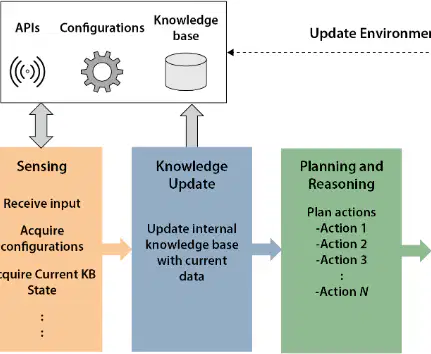
Which stage in the deliberative architecture is responsible for updating the internal knowledge base with current data?
Sensing
Knowledge Update
Planning and Reasoning
Plan Execution
Deliberative architectures are particularly important in which of the following domains?
Simple reflex-based systems
Intelligent tutoring systems
Systems with no need for decision-making
Systems that do not require planning
Which of the following best describes reactive architectures in agentic systems?
They rely on explicit models of the world and complex reasoning processes.
They provide immediate responses to stimuli from the environment without using explicit models.
They use only deliberative reasoning to generate outputs.
They require centralized control for all actions.
What is the primary function of the "Condition-Action store" in a reactive architecture?
To store explicit models of the world.
To execute complex reasoning processes.
To map perceptions onto actions using condition-action rules.
To generate random outputs.
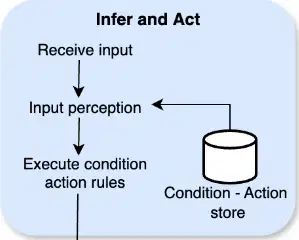
Which step comes immediately after "Receive input" in the reactive architecture diagram?
Output
Input perception
Execute condition action rules
Store input
Which property of reactive architectures allows them to be less prone to catastrophic failures due to noise or incomplete information?
Speed and responsiveness
Robustness and fault tolerance
Handling uncertainty
Parallel and distributed processing
How do reactive architectures handle uncertainty in dynamic environments?
By relying on complete models of the world
By ignoring environmental stimuli
By responding directly to stimuli and adjusting actions based on the current situation
By using only a single reactive module
Which of the following is a benefit of parallel and distributed processing in reactive architectures?
It makes the system slower and less scalable.
It requires all modules to operate sequentially.
It enables efficient handling of complex tasks and provides scalability and modularity.
It eliminates the need for condition-action rules.
Why are reactive architectures able to provide swift and timely responses?
They use time-consuming deliberative reasoning processes.
They directly couple perceptions to actions, bypassing complex reasoning.
They require explicit models of the world.
They process all inputs sequentially.
Which of the following best describes the "emergence of complex behavior" in reactive architectures?
The ability to plan long-term strategies
The interaction and coordination of multiple reactive components leading to intelligent-like behavior at the system level
The manipulation of symbolic representations
The adaptation of behavior based on past experiences
What is a primary limitation of reactive architectures regarding planning?
They are too slow to respond to stimuli
They lack the ability to plan ahead or reason about long-term consequences
They can only operate in static environments
They always require human intervention
Which of the following is NOT a limitation of reactive architectures?
Lack of long-term planning
Limited reasoning and abstraction
High adaptability to new experiences
Limited learning capabilities
In what type of applications are reactive architectures most widely used?
Applications requiring extensive symbolic reasoning
Applications where real-time responsiveness and robustness are essential
Applications that require long-term strategic planning
Applications that do not involve any uncertainty
What is the main function of the reactive layer in hybrid architectures?
To plan long-term strategies and reason about abstract concepts
To handle real-time interactions with the environment and provide rapid responses to stimuli
To store and retrieve large amounts of data
To manipulate symbolic representations for complex reasoning
Match the following contributions of the deliberative layer in hybrid architectures to agentic systems.
By providing rapid, low-level responses to environmental stimuli
Supports quick reactions to changes in the environment
By maintaining a comprehensive representation of the environment, goals, and constraints for high-level reasoning and planning
Enables strategic planning and understanding of the environment
By adapting its behavior based on immediate feedback only
Relies solely on short-term feedback for decision-making
By ignoring long-term consequences in favor of immediate actions
Prioritizes immediate actions over future implications
Why is the interaction between the reactive and deliberative layers important in hybrid architectures?
It allows the system to ignore environmental changes
It enables the system to respond effectively to dynamic contexts while planning and reasoning about actions
It prevents the system from adapting to new situations
It eliminates the need for real-time feedback
Which technique involves breaking down complex tasks into subtasks that can be handled by the appropriate layer in a hybrid architecture?
Task decomposition
Multiplan selection
Reflection and refinement
Memory-augmented planning
What is the primary advantage of hybrid architectures in agentic systems?
They balance responsiveness and reasoning, enabling robust, autonomous, and adaptable systems.
They only focus on real-time responsiveness.
They eliminate the need for planning and reasoning.
They rely solely on reactive components.
Which layer in a hybrid architecture is responsible for generating multiple potential plans or strategies?
Deliberative layer
Reactive layer
External modules
Memory-augmented layer

