
 Worksheets
Emergency Procedure Final Exam Study Guide
Total questions: 75
Worksheet time: 38mins
The good samaritan law is:
A law that protects people who help others in emergencies from legal liability.
A law that requires everyone to help in emergencies.
A law that punishes people for not helping in emergencies.
A law that only applies to medical professionals.
Abandonment is best described as:
Leaving someone or something behind without intending to return.
Taking care of someone or something responsibly.
Building a new relationship with someone.
Returning to a place after a long time.
The 4 primary goals of first aid are:
Preserve life, prevent further injury, promote recovery, relieve pain
Diagnose diseases, prescribe medication, perform surgery, provide therapy
Increase heart rate, induce vomiting, lower blood pressure, cause sweating
Administer vaccines, conduct physical exams, monitor diet, recommend exercise
Which of the following are the 3 exceptions that require you to provide care to a victim?
you started care and cannot abandon the victim, job responsibility, parent or guardian
You are a bystander, you witnessed the incident, or you called 911.
You are a minor, you are in a public place, or you are a healthcare professional.
You are off-duty, you are not trained, or you do not have equipment.
The 3 conditions that must be met to be found guilty of negligence are:
Duty of care, breach of duty, and resulting damages
Intent, motive, and opportunity
Strict liability, causation, and intent
Consent, knowledge, and recklessness
Which of the following lists the different forms of consent?
Express, Implied, Informed, and Explicit consent
Verbal, Written, Non-verbal, and Passive consent
Active, Passive, Silent, and Written consent
Direct, Indirect, Passive, and Assumed consent
The first step when responding to an emergency is:
Check for Scene Safety
Call for help immediately
Start CPR
Move the victim
The rules for talking to a dispatcher when calling 9-1-1 include:
Staying calm and answering all questions clearly
Hanging up immediately after dialing
Giving false information to the dispatcher
Speaking as quickly as possible without listening
Identify the 5 things to tell dispatch when calling 9-1-1.
Your location, nature of emergency, your phone number, what happened, number of people involved
Your favorite color, your location, your age, what you had for lunch, your phone number
The weather, your location, your favorite TV show, your phone number, your pet's name
Your location, your favorite movie, your phone number, your birthday, your emergency contact
The difference between hepatitis B and C lies in their modes of transmission and treatment options. Which of the following statements is correct?
Hepatitis B can be prevented with a vaccine, while hepatitis C cannot, and both have different antiviral treatments.
Both hepatitis B and C can be prevented with vaccines.
Hepatitis C is more commonly transmitted through contaminated food and water than hepatitis B.
Hepatitis B and C are treated with the same medications.
Personal protective equipment refers to items used to protect individuals from hazards. Which of the following are examples of personal protective equipment?
Gloves, gown and safety goggles
Books and pens
Chairs and tables
Shoes and socks
The human body is made up of how many bones?
206
205
210
201
The difference between ligaments and tendons is that:
Ligaments connect bones to bones, while tendons connect muscles to bones.
Ligaments connect muscles to bones, while tendons connect bones to bones.
Ligaments and tendons both connect muscles to muscles.
Ligaments and tendons both connect bones to muscles.
The number of vertebrae in the cervical, thoracic, and lumbar spine is:
Cervical 5, Thoracic 7, Lumbar 12
Cervical 7, Thoracic 12, Lumbar 5
Cervical 5, Thoracic 12, Lumbar 7
Cervical 12, Thoracic 5, Lumbar 7
The cavities of the human body and their contents are:
Cranial cavity (brain), thoracic cavity (heart and lungs), abdominal cavity (digestive organs), pelvic cavity (reproductive organs)
Cranial cavity (lungs), thoracic cavity (brain), abdominal cavity (heart), pelvic cavity (digestive organs)
Cranial cavity (heart), thoracic cavity (digestive organs), abdominal cavity (lungs), pelvic cavity (brain)
Cranial cavity (reproductive organs), thoracic cavity (stomach), abdominal cavity (brain), pelvic cavity (lungs)
The term 'anterior' refers to which of the following directions?
Toward the front of the body
Toward the back of the body
Away from the midline of the body
Toward the feet
The term 'Posterior' refers to which of the following directions?
Toward the back of the body
Toward the front of the body
Toward the head
Toward the midline of the body
Medial is best described as which of the following directional terms?
Toward the midline of the body
Away from the midline of the body
Toward the head
Away from the surface of the body
Lateral is best described as which of the following directional terms?
Away from the midline of the body
Toward the midline of the body
Above another part
Below another part
The term 'Superior' is used to describe a body part that is:
Above another part or closer to the head
Below another part or closer to the feet
Toward the front of the body
Toward the back of the body
The directional term 'Inferior' is best described as:
Away from the head or toward the lower part of a structure
Toward the front of the body
Toward the midline of the body
Away from the midline of the body
Proximal is best described as:
Closer to the point of attachment or origin
Farther from the point of attachment or origin
Toward the surface of the body
Away from the midline of the body
Distal is best described as:
Farther from the point of attachment or origin
Closer to the point of attachment or origin
Toward the midline of the body
On the surface of the body
An example of flexion is:
Bending the elbow
Straightening the knee
Turning the head
Raising the arm sideways
Select an example of the following movement: Extension.
Straightening the elbow
Bending the knee
Rotating the wrist
Flexing the hip
Select the correct example of ABDuction:
Raising your arm sideways away from the body
Bringing your arm towards the body
Bending your elbow
Rotating your wrist
An example of ADDuction movement is:
Bringing your arm towards your body
Raising your arm sideways away from your body
Turning your palm upwards
Bending your knee
What does the acronym AVPU mean?
Alert, Verbal, Pain, Unresponsive
Airway, Ventilation, Pulse, Urine
Assessment, Vital, Pulse, Unconscious
Awake, Visual, Pain, Unresponsive
What does the acronym CAB mean?
Circulation, Airway, Breathing
Compression, Airway, Breathing
Cardiac, Airway, Breathing
Care, Airway, Breathing
What does the acronym SAMPLE mean?
Signs/Symptoms, Allergies, Medications, Past medical history, Last oral intake, Events leading up to present illness/injury
Symptoms, Assessment, Medications, Past injuries, Last meal, Emergency contact
Signs, Allergies, Medical history, Physical exam, Last seen, Events observed
Symptoms, Allergies, Medications, Physical exam, Last intake, Emergency response
Putting someone into the recovery position involves which of the following steps?
Laying the person on their side with their head tilted back and mouth open
Sitting the person upright with their legs crossed
Laying the person flat on their back with arms at their sides
Standing the person up and supporting them against a wall
The primary assessment consists of:
checking airway, breathing, and circulation
measuring blood pressure and pulse only
performing a full body scan
taking a patient history
Checking Pulse Motor Sensation involves which of the following methods?
Assessing pulse, movement, and sensation in the affected limb
Measuring blood pressure only
Observing skin color only
Listening to heart sounds
CPR should be started when:
the person is unresponsive, no pulse and not breathing.
the person has a minor injury.
the person is coughing.
the person is awake and talking.
Rescue breaths should be begun:
when the person is not breathing normally
when the person is coughing
when the person is conscious and talking
when the person has a minor injury
The ratio of compressions to breaths for 1 rescuer adult CPR is:
30:2
15:2
20:2
10:1
The ratio of compressions to breaths for 2 rescuer adult CPR is:
15:2
30:2
5:1
20:2
The ratio of compressions to breaths for 1 rescuer child CPR is:
30:2
15:2
20:2
10:2
The ratio of compressions to breaths for 2 rescuer child CPR is:
30:2
15:2
20:2
10:2
The ratio of compressions to breaths for 1 rescuer infant CPR is:
30:2
15:2
20:2
10:2
The ratio of compressions to breaths for 2 rescuer infant CPR is:
30:2
15:2
20:2
10:2
Considerations for using the AED include:
Ensuring the area is safe before use
Using the AED only on children under 1 year old
Applying the AED pads over clothing
Waiting for medical professionals before using the AED
Treating a choking responsive infant involves which of the following steps?
Give 5 back slaps followed by 5 chest thrusts
Perform abdominal thrusts (Heimlich maneuver)
Give water to help swallow the object
Shake the infant gently to dislodge the object
Blood formation occurs in:
bone marrow
liver
heart
lungs
The purposes of a bandage include:
Protecting a wound and supporting an injured part
Causing infection to a wound
Restricting blood flow unnecessarily
Making a wound worse
The purposes of a dressing are:
To protect a wound and promote healing
To increase bleeding from a wound
To cause infection in a wound
To prevent the wound from closing
A tourniquet should be used in which situation?
When there is severe bleeding that cannot be controlled by other means
For minor cuts and scrapes
To treat a headache
For a sprained ankle
The difference in an injury to a vein, artery, and capillary can be identified by:
The type and flow of blood from the wound
The location of the injury on the body
The amount of pain experienced
The time of day the injury occurred
The different forms of shock include:
Hypovolemic, cardiogenic, distributive, and obstructive shock
Septic, metabolic, respiratory, and allergic shock
Cardiac, pulmonary, hepatic, and renal shock
Neurogenic, endocrine, muscular, and skeletal shock
Signs and symptoms of shock include:
Pale, cool, clammy skin
Increased energy and alertness
Improved digestion and appetite
Warm, flushed skin
DCAP BTLS is:
an acronym for Deformities, Contusions, Abrasions, Punctures/Penetrations, Burns, Tenderness, Lacerations, Swelling
a type of medical equipment used in trauma care
a medication used to treat burns
a protocol for cardiac arrest management
Which of the following is the proper treatment for an impaled object?
Remove the object immediately
Stabilize the object and seek medical help
Apply ice directly to the object
Bandage tightly over the object
Administering an epipen involves which of the following steps?
Remove the safety cap, press the tip firmly against the outer thigh, and hold for several seconds.
Inject into the arm muscle and massage the area for 10 minutes.
Place the epipen under the tongue and wait for it to dissolve.
Break the epipen in half and apply the liquid to the skin.
The acronym PRICE represents which of the following?
Protection, Rest, Ice, Compression, Elevation
Prevention, Rest, Ice, Compression, Exercise
Pressure, Recovery, Ice, Compression, Elevation
Protection, Recovery, Ice, Compression, Exercise

Refer to the diagram of the human heart. Using the word bank (Aorta, Right Ventricle, Left Ventricle, Right Atrium, Left Atrium, Superior Vena Cava, Pulmonary Artery), fill in the blank for the part labeled 1).
Superior Vena Cava
Aorta
Left Atrium
Pulmonary Artery

Refer to the diagram of the human heart. Using the word bank (Aorta, Right Ventricle, Left Ventricle, Right Atrium, Left Atrium, Superior Vena Cava, Pulmonary Artery), fill in the blank for the part labeled 2).
Right Atrium
Left Ventricle
Pulmonary Artery
Aorta
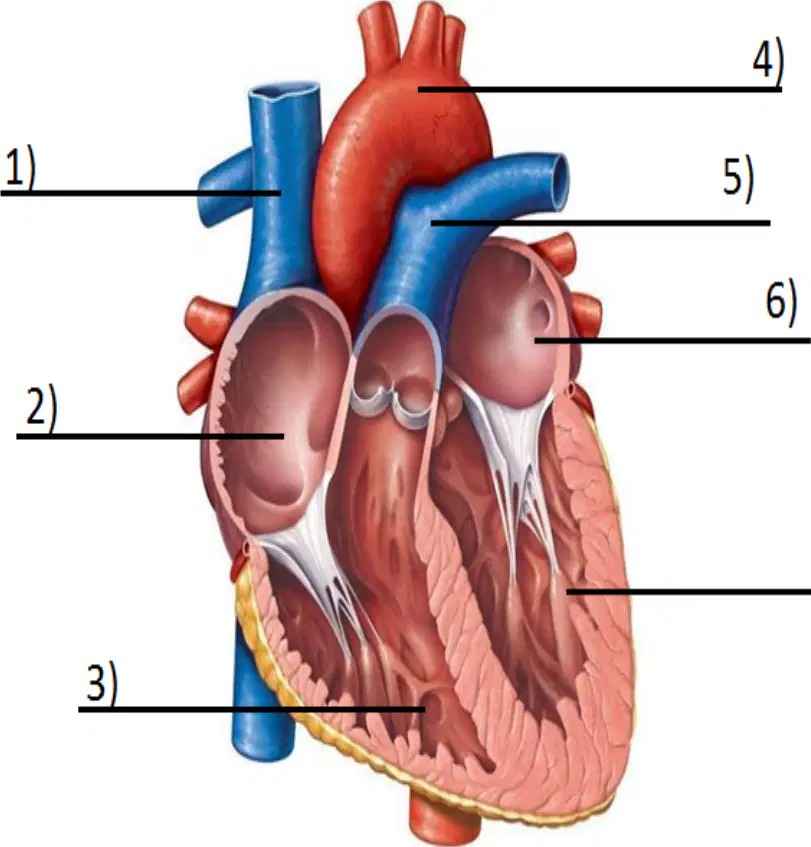
Refer to the diagram of the human heart. Using the word bank (Aorta, Right Ventricle, Left Ventricle, Right Atrium, Left Atrium, Superior Vena Cava, Pulmonary Artery), fill in the blank for the part labeled 3).
Right Ventricle
Aorta
Left Atrium
Pulmonary Artery
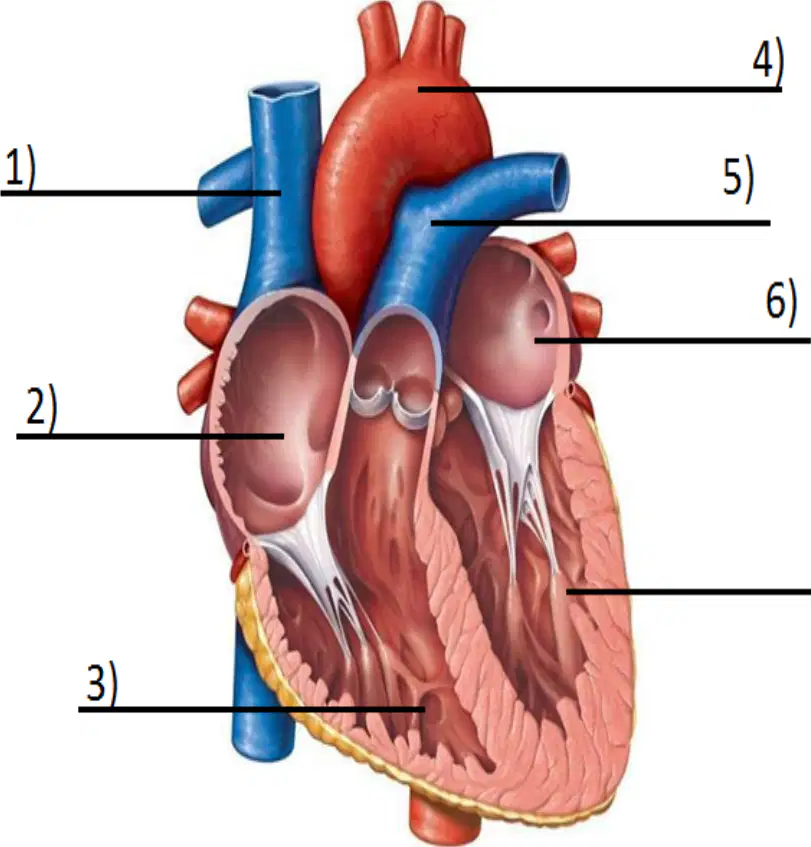
Refer to the diagram of the human heart. Fill in the blank for the part labeled 4).
Aorta
Pulmonary vein
Left atrium
Right ventricle

Refer to the diagram of the human heart. Fill in the blank for the part labeled 5).
Pulmonary Artery
Left Atrium
Right Ventricle
Aorta

Refer to the diagram of the human heart. Using the word bank (Aorta, Right Ventricle, Left Ventricle, Right Atrium, Left Atrium, Superior Vena Cava, Pulmonary Artery), fill in the blank for the part labeled 6).
Left Atrium
Right Ventricle
Aorta
Pulmonary Artery
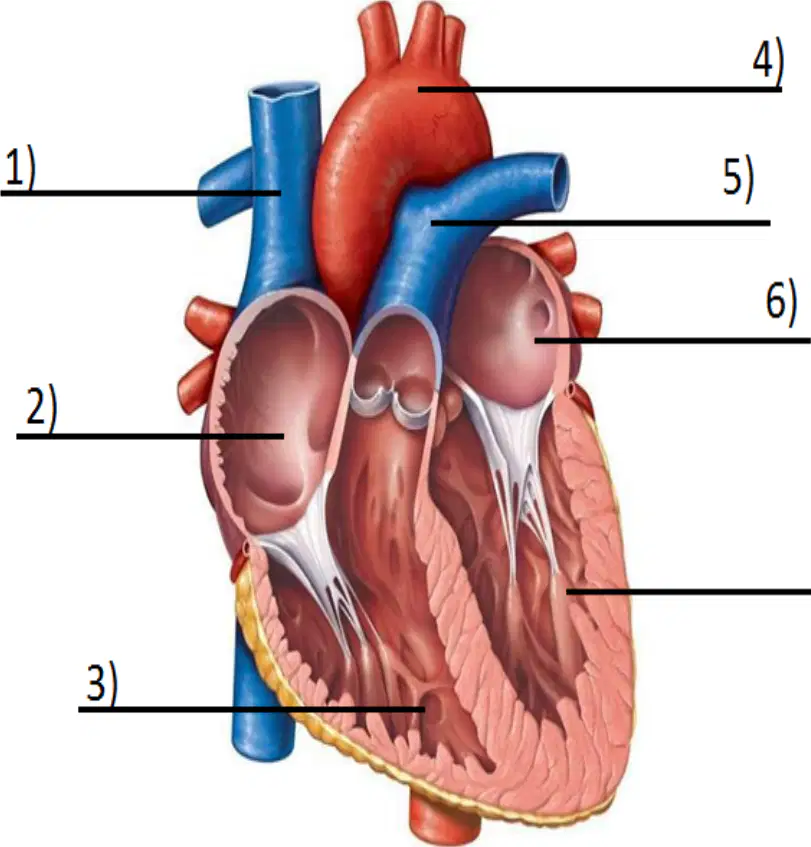
Refer to the diagram of the human heart. Using the word bank (Aorta, Right Ventricle, Right Atrium, Left Atrium, Superior Vena Cava, Pulmonary Artery), fill in the blank for the part labeled 7).
Left Ventricle
Aorta
Right Atrium
Pulmonary Artery
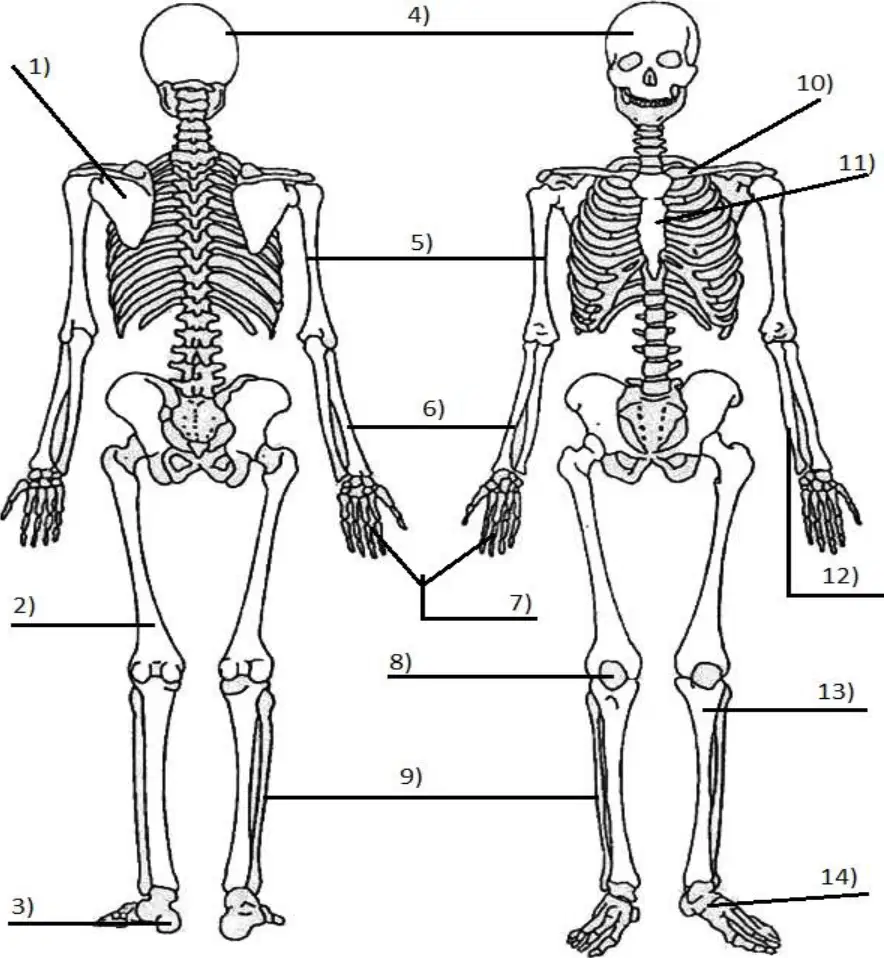
Refer to the diagram of the human skeleton. Fill in the blank for number 1 using the word bank provided.
Scapula
Femur
Ribcage
Pelvis
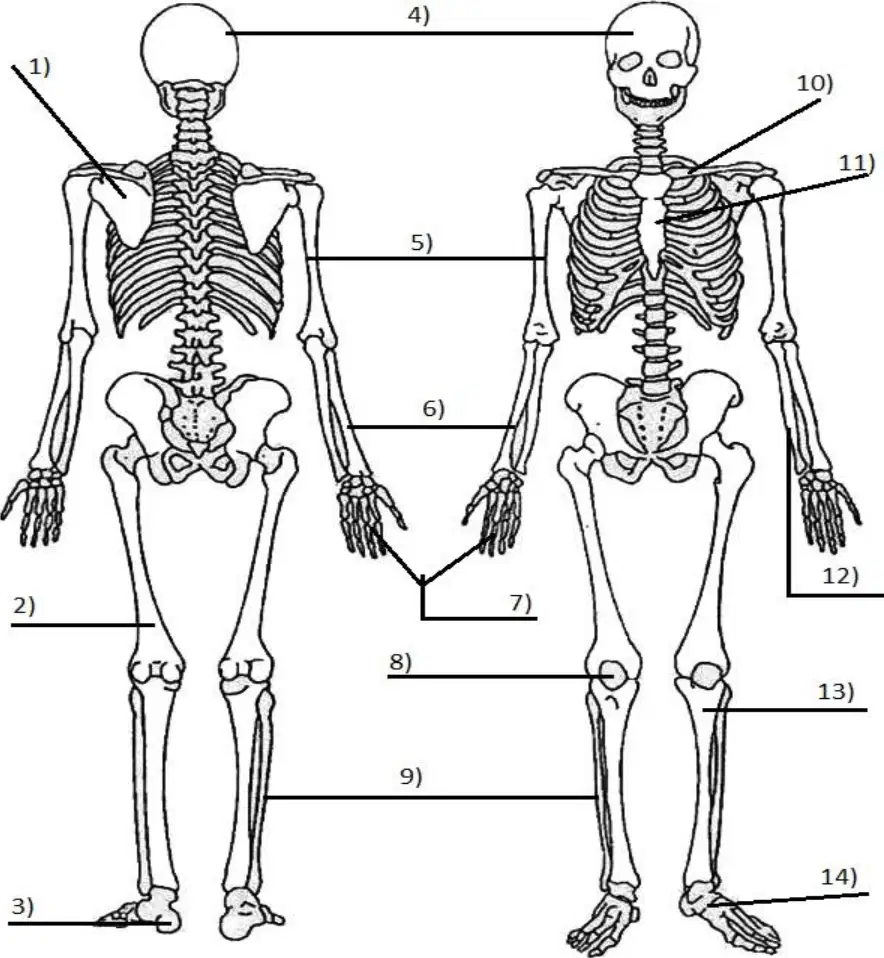
Refer to the diagram of the human skeleton. Fill in the blank for number 2 using the word bank provided.
Femur
Humerus
Tibia
Clavicle

Refer to the diagram of the human skeleton. Fill in the blank for number 3 using the word bank provided.
Calcaneus
Clavicle
Femur
Scapula

Refer to the diagram of the human skeleton. Fill in the blank for number 4 using the word bank provided.
skull
Femur
Scapula
Tibia

Refer to the diagram of the human skeleton. Fill in the blank for number 5 using the word bank provided.
Humerus
Femur
Scapula
Patella

Refer to the diagram of the human skeleton. Fill in the blank for number 6 using the word bank provided.
Humerus
Femur
Tibia
Radius

Refer to the diagram of the human skeleton. Fill in the blank for number 7 using the word bank provided.
Phalanges
Femur
Scapula
Tibia

Refer to the diagram of the human skeleton. Fill in the blank for number 8 using the word bank provided.
Fibula
Tibia
Patella
Humerus
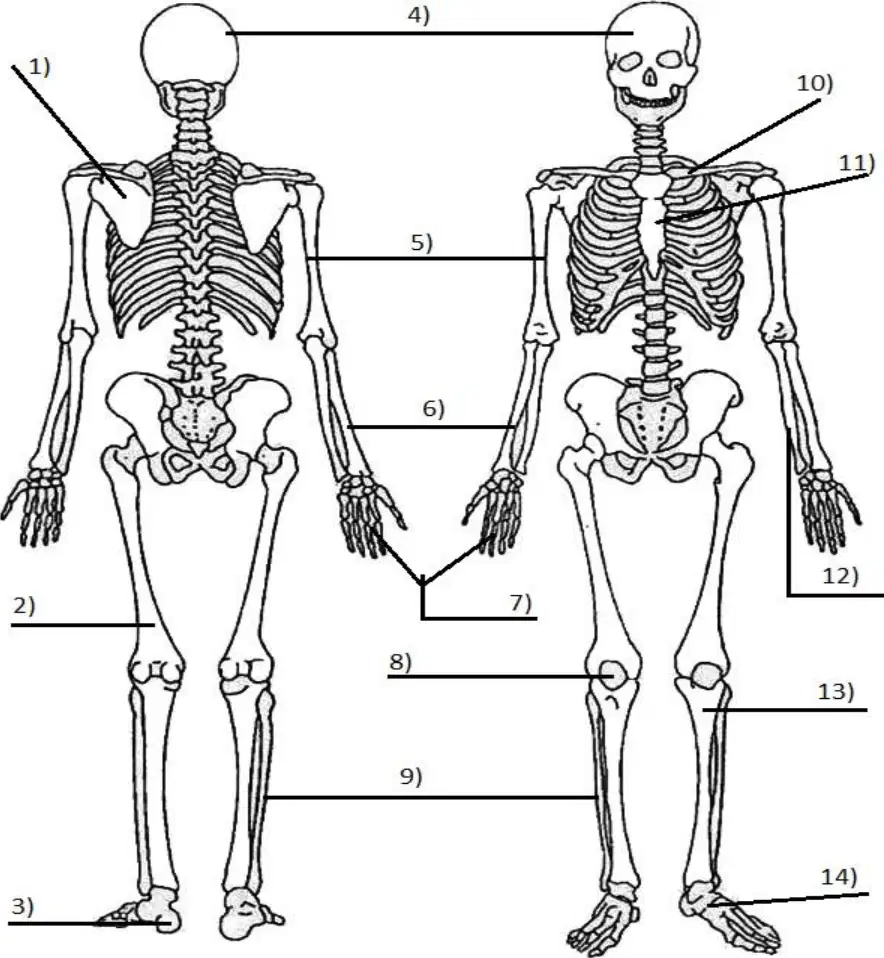
Refer to the diagram of the human skeleton. Fill in the blank for number 9 using the word bank provided.
Tibia
Femur
Humerus
Fibula

Refer to the diagram of the human skeleton. Fill in the blank for number 10 using the word bank provided.
Mandible
Femur
Clavicle
Scapula

Refer to the diagram of the human skeleton. Fill in the blank for number 11 using the word bank provided.
Sternum
Femur
Tibia
Clavicle
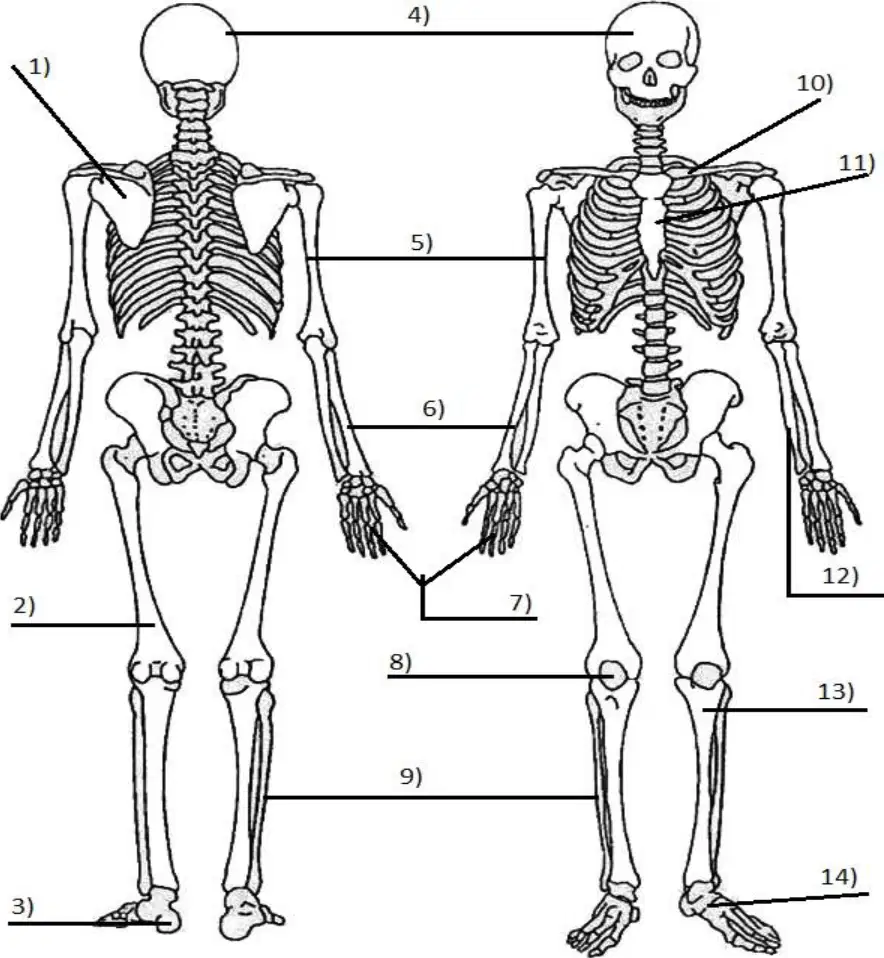
Refer to the diagram of the human skeleton. Fill in the blank for number 12 using the word bank provided.
Ulna
Femur
Tibia
Humerus

Refer to the diagram of the human skeleton. Fill in the blank for number 13 using the word bank provided.
Patella
Femur
Tibia
Fibula
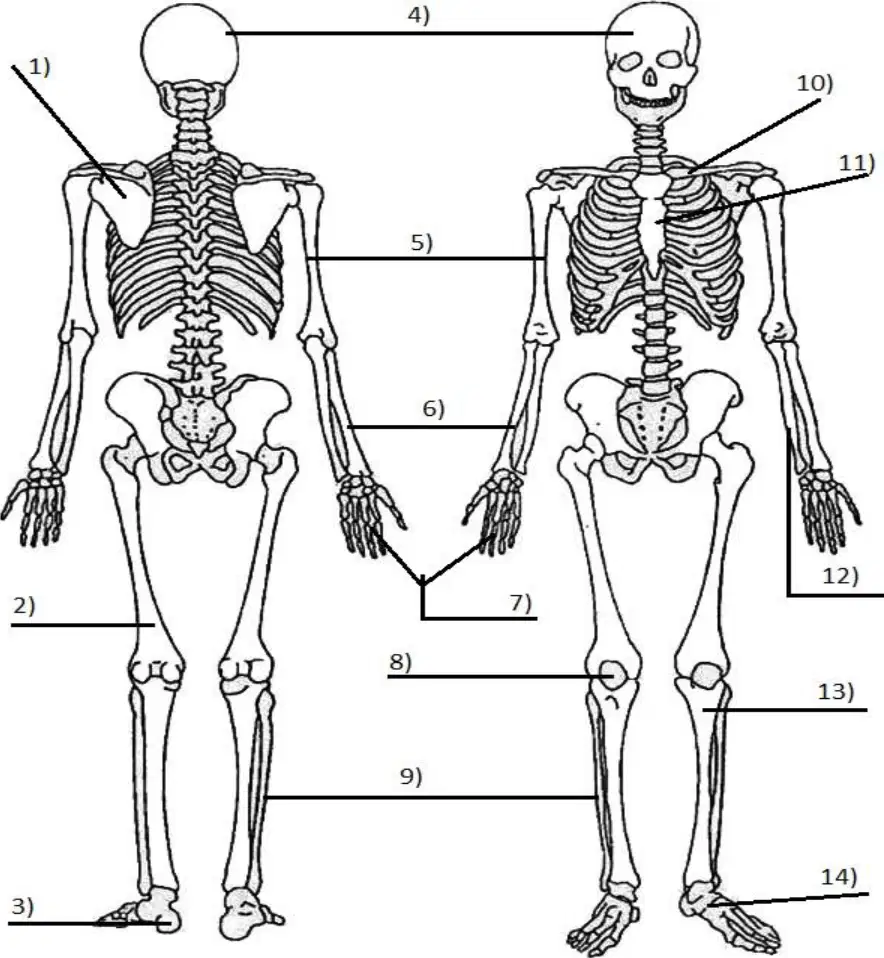
Refer to the diagram of the human skeleton. Fill in the blank for number 14 using the word bank provided.
Tarsals
Femur
Scapula
Patella

