
 Worksheets
U.S. Immigration and Biblical Perspectives Quiz
Total questions: 65
Worksheet time: 33mins
What does the Bible say about immigrants?
It encourages welcoming strangers.
It discourages any form of migration.
It has no mention of immigrants.
It promotes strict immigration laws.
What were the U.S. Immigration Acts of 1965 and 1990 primarily focused on?
Reducing immigration from Europe.
Increasing diversity in immigration.
Eliminating all immigration quotas.
Promoting only skilled labor immigration.
What is a DREAMer in the context of U.S. immigration?
A person who dreams of migrating to the U.S.
An undocumented immigrant brought to the U.S. as a child.
A legal immigrant with a work visa.
A tourist visiting the U.S. for a short period.
What does DACA stand for in U.S. immigration policy?
Deferred Action for Childhood Arrivals
Deferred Action for Citizenship Applications
Deferred Action for Criminal Aliens
Deferred Action for Corporate Applicants
According to Leviticus 19:33-34, how should the Israelites treat foreigners?
Ignore them
Treat them like native-born Israelites
Exploit them
Avoid them
What is the main message of Hebrews 13:2?
Show hospitality to strangers
Avoid strangers
Entertain only friends
Ignore hospitality
What lesson were the Israelites supposed to learn from their time in Egypt, according to the passage?
To seek revenge
To emulate God's heart for outsiders
To become more powerful
To isolate themselves
What does Hebrews 13:2 suggest might happen when showing compassion to a stranger?
You might be taken advantage of
You may be helping an angel
You will lose something valuable
You will be ignored
Why is the United States sometimes called the "land of immigrants"?
Because it has a large native population
Due to its history of welcoming immigrants
Because it is geographically diverse
Due to its economic policies
What did the laws before 1965 restrict regarding immigration?
Immigration of all people groups
Immigration of "nonwhite" people groups
Immigration of European people groups
Immigration of all Asian people groups
What did the Naturalization Act of 1790 limit?
Naturalized citizenship to all populations
Naturalized citizenship to Asian populations
Naturalized citizenship to white populations
Naturalized citizenship to African populations
Who are considered naturalized citizens in the United States?
People born in the United States
People who become citizens after birth
People who are citizens by descent
People who are citizens by marriage
What was the significance of the U.S. Immigration Act of 1965?
It was the largest incursion of immigrants in the United States.
It restricted immigration from Asian countries.
It supported European immigration exclusively.
It was the first immigration act in the U.S.
Which previous immigration law did the U.S. Immigration Act of 1965 repeal?
Immigration Act of 1924
Immigration Act of 1986
Immigration Act of 1907
Immigration Act of 1952
What was one of the effects of the U.S. Immigration Act of 1965 on Asian immigration?
More Asians began to immigrate to the United States.
Asian immigration was completely halted.
Asian immigration decreased significantly.
Asian immigration remained unchanged.
Who signed the U.S. Immigration Act of 1965?
Richard Nixon
John F. Kennedy
Lyndon B. Johnson
Gerald Ford
What is another name for the U.S. Immigration Act of 1965?
McCarran-Walter Act
Hart-Celler Act
Simpson-Mazzoli Act
Immigration Reform Act
During which historical period was the U.S. Immigration Act of 1965 enacted?
World War II
The Great Depression
The Cold War
The Vietnam War
How many visas per year did the U.S. Immigration Act of 1965 provide?
150,000
290,000
500,000
750,000
What was the impact of the family reunification clause in the U.S. Immigration Act of 1965?
Decreased immigration to 100,000 per year
Increased immigration to 500,000 per year
Limited immigration to 50,000 per year
Had no impact on immigration numbers
Who signed the U.S. Immigration Act of 1990?
Bill Clinton
Ronald Reagan
George H. W. Bush
Barack Obama
How many immigrants were allowed annually into the United States from 1992-1994 under the U.S. Immigration Act of 1990?
500,000
700,000
675,000
800,000
What was one of the new provisions for visas created by the U.S. Immigration Act of 1990?
Tourist-based
Family-based
Student-based
Investor-based
What requirement was removed for naturalization by the U.S. Immigration Act of 1990?
Citizenship test
English testing
Background check
Residency proof

What do you think happened to the United States school system because of the U.S. Immigration Acts of 1965 and 1990?
Increased diversity in schools
Decrease in student population
Elimination of public schools
Reduction in educational funding

What was the impact of the U.S. Immigration Acts of 1965 and 1990 on schools in the United States?
Reduced diversity in schools
Enhanced diversity in schools
Had no impact on schools
Decreased the number of schools
In 2020, how many students in the United States public schools were identified as Hispanic?
22.6 million
13.8 million
7.4 million
2.7 million
Which racial group had the smallest number of students in the U.S. public schools in 2020?
Asian
Black
Pacific Islander
American Indian/Alaska Native
What was the total number of students in U.S. public schools from pre-k to 12th grade in 2020?
49.4 million
22.6 million
13.8 million
7.4 million
How many students were identified as Asian in U.S. public schools in 2020?
2.7 million
2.2 million
0.5 million
180,000
Between 2009 and 2020, what was the percentage change in the population of White students?
Increased from 8% to 46%
Decreased from 8% to 46%
Increased from 46% to 8%
Decreased from 46% to 8%
What was the percentage of Hispanic students in 2020?
6%
28%
46%
15%
Which group of students remained the same in percentage from 2009 to 2020?
Black students
Asian students
Hispanic students
White students
What was the total percentage of students of two or more races in 2020?
1%
0.5%
5%
15%

What was the number of White students in 2009?
22.6 million
26.7 million
8.2 million
11.0 million

How many Black students were there in 2020?
7.4 million
8.2 million
13.8-14.1 million
26.7 million

What was the range of Hispanic students in 2020?
11.0 million
8.2 million
13.8-14.1 million
22.6 million
Which group of students saw a decrease in numbers from 2009 to 2020?
Hispanic students
White students
Black students
All groups
Based on the data from 1960, what percentage of immigrants to the United States came from Europe, Canada, or other parts of North America?
84%
6%
4%
3%
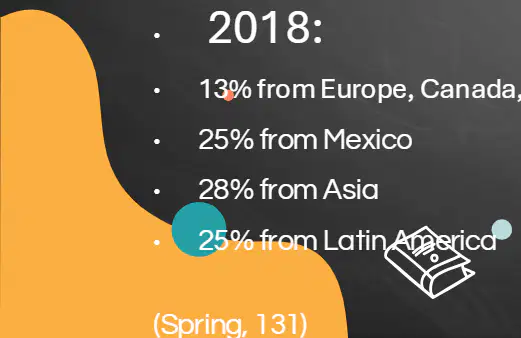
In 2018, what percentage of immigrants to the United States came from Asia?
13%
25%
28%
6%
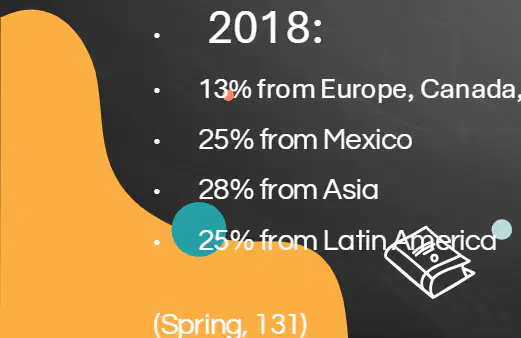
How did the percentage of immigrants from Mexico change from 1960 to 2018?
Increased from 6% to 25%
Decreased from 25% to 6%
Remained the same at 6%
Increased from 3% to 25%
Which country had the highest number of immigrants in 2018 according to the data?
India
Mexico
China
Philippines
In 2018, how many immigrants came from Mexico?
149,000
120,000
46,000
129,000
By 2065, what percentage of immigrants are estimated to come from Asia?
50%
25%
38%
45%
In 2065, what percentage of immigrants is estimated to come from Asia?
38%
31%
20%
9%
Which region is expected to contribute 31% of immigrants in 2065?
Asia
Mexico
Europe, Canada, or other North American areas
Areas that identify as black
What percentage of immigrants is projected to come from Europe, Canada, or other North American areas in 2065?
38%
31%
20%
9%
In 2065, what percentage of immigrants is estimated to come from areas that identify as black?
38%
31%
20%
9%
According to the quote, which country has more immigrants than any other in the world?
Canada
United States
Australia
United Kingdom
What is a DREAMer?
A child who is in the United States illegally and enrolled in American schools
A legal immigrant who has applied for citizenship
A tourist visiting the United States
A student studying abroad in Europe
In what year did the Texas Legislature pass laws affecting DREAMers' access to public education?
1975
1980
1970
1985
What was one consequence of the Texas Legislature's actions regarding educational resources for certain children?
Increased funding for all districts
DREAMers had to pay tuition for public education
Free education for all children
DREAMers received scholarships
Who was involved in charging DREAMers a yearly tuition in 1977?
Texas Governor
James Plyler
U.S. President
School Principal
According to Texas's arguments, why did the 14th Amendment's Equal Protection Clause not apply to illegal aliens?
They are not citizens.
They are not residents.
They are not taxpayers.
They are not voters.
What was one of the financial concerns Texas had regarding illegal immigrant children in schools?
They increase the cost of school supplies.
They take necessary funds away from children in the United States legally.
They require additional transportation costs.
They increase the need for more teachers.
How did Texas argue that providing free education to DREAMers would affect immigration?
It would discourage illegal immigration.
It would have no effect on immigration.
It would encourage illegal immigrants to come to the United States.
It would only affect legal immigration.
Who were the plaintiffs in the Plyler v. Doe case?
Four families of undocumented children
The Supreme Court
James Plyler
The Tyler School District
What was the outcome of the Plyler v. Doe case?
The case was dismissed
The case was taken to the Supreme Court
The case was settled out of court
The case was never heard

What did the United States Supreme Court rule in 1982 regarding school districts and immigration status?
School districts could ban students based on immigration status.
School districts could mistreat students due to suspected immigration status.
School districts could not prevent enrollment due to immigration status.
School districts could force families to reveal their immigration status.
Which of the following actions were school districts prohibited from doing according to the 1982 Supreme Court ruling?
Asking questions to determine the immigration status of students.
Encouraging students to enroll regardless of immigration status.
Providing special programs for immigrant students.
Offering financial aid to students based on need.
Under which amendment are illegal immigrant children classified as persons?
1st Amendment
14th Amendment
5th Amendment
10th Amendment
What role does education play according to the court's findings?
It is a minor aspect of cultural heritage.
It is pivotal in maintaining societal fabric and individual well-being.
It is primarily for economic growth.
It is mainly for political stability.
What does the state lack regarding the future of immigrant children?
Knowledge of their educational needs
Foreknowledge of deportation or citizenship
Control over their employment
Insight into their cultural background
Is there a federal law that supports the state's right to prevent immigrant children from being educated?
Yes, there is a specific law.
No, there is no such law.
It varies by state.
Only in certain circumstances.
What is the impact of not educating immigrant children on immigration, according to the findings?
It significantly reduces immigration.
It has no effect on immigration.
It stops immigration completely.
It increases immigration.

