
 Worksheets
Photosynthesis
Total questions: 93
Worksheet time: 2hrs 44mins
Which of the following are products of the light reactions of photosynthesis that are utilized in the Calvin Cycle?
CO2 and glucose
ATP and NADPH
ADP, P and NADP+
H2Oand O2
Where does the Calvin cycle take place?
Stroma
thylakoid
thylakoid space
matrix
When oxygen is released as a result of photosynthesis, it is a direct by-product of____
reducing NADP+
splitting water molecules
chemiosmosis
electron transfer in photosystem 1
Which of the following processes is most directly driven by light energy?
carbon fixation in stroma
reduction of NADP molecules
ATP Synthesis
removal of electrons from membrane-bound chlorophyll molecules
What is the primary function of the light reactions of photosynthesis?
To produce glucose
To produce NADPH and ATP
To use ATP
To produce RuBP

What supplies the electrons that are lost in PS I?
the electrons from PS II
water
glucose
oxygen
The light reactions occur in the ________ and the dark reactions take place in the ________.
Chloroplast / thylakoid membrane
stroma / thylakoid
mesophyl / stomata
thylakoid membrane / stroma
Where does the carbon come from that is used to form glucose?
The soil
CO2 in the air
From other carbohydrates
Calvin Cycle
What is the primary function of the Calvin cycle?
regenerate ATP for use in the light reactions of photosynthesis
produce carbon dioxide for use in the light reactions of photosynthesis
produce oxygen by oxidizing water
produce simple sugars from carbon dioxide
The H+ concentration gradient is formed to
make NADPH
split a water molecule
generate ATP
form water
Rubisco is important in which step of photosynthesis
energizing the electrons in chlorophyll
carbon fixation when CO2 is connected to RUBP during calvin cycle
regeneration phase as RUBP is made during calvin cycle
reduction of the carbon chain during the calvin cycle
If the proton (H+) pump in the thylakoid was not working which molecule could not be made during the light reaction?
NADPH
ATP
Water
Oxygen gas
ATP is made during the light reaction using all of the following EXCEPT
proton pump
hydrogen ion gradient
electron energy from photosystem II
NADPH donating electrons
An _____ can make its own food, while a _____ cannot make its own food.
Autotroph, Heterotroph
Heterotroph, Autotroph
Chlorophyll, Chloroplast
Endergonic reactions require:
an input of energy
a release of energy
do not change energy

Where is the most easily accessible energy stored in an ATP molecule?
between the 1st and 2nd phosphate groups
between the adenine and ribose groups
between the 2nd and 3rd phosphate groups
between the ribose and the 1st phosphate groups
The process of using electrons to pump H+ to create an electrochemical gradient that must flow through a protein is called:
Chemiosmosis
Fantasia
Induced Fit
Electrolysis
_________________ are the products of the light-dependent reactions.
chloroplast and light
water and sugars
ATP, NADPH and OXYGEN
The electrons travel though the ___________, a series of electron carrier proteins.
stroma
electron transport chain
chloroplasts
ATP Synthase is a membrane protein, through which excess __________ escape the thylakoid in a process that makes ATP.
water ions
NADPH ions
Hydrogen ions
The color of light least effective in driving photosynthesis is _________
blue
red
orange
green
T or F: The light reactions of Photosynthesis requires ATP.
True
False
Which of the following is NOT one of the stages of the Calvin Cycle?
Regeneration of RuBP
Carbon Fixation
Reduction
G3P Production
Which molecule is responsible for carbon fixation in the calvin cycle?
RuBP
Rubisco
NADPH
Reductase
During the light reactions, what is the purpose of passing electrons during the electron transport chain?
To create a proton gradient
To split water
To produce sugar
To produce oxygen gas
When a substace gains electrons, it has been ___.
Reduced
Oxidized
Electrified
Which of the following molecules REDUCES other molecules?
NADPH
ATP
RUBISCO
G3P
Which of the following is the sugar molecule DIRECTLY produced during the calvin cycle?
Glucose
ATP
G3P
RuBP
A molecule that has been phosphorylated
has a decreased chemical reactivity; it is less likely to provide energy for cellular work
has been oxidized as a result of a redox reaction involving the gain of an inorganic phosphate.
has an increased chemical potential energy; it is primed to do cellular work.
has less energy than before its phosphorylation and therefore less energy for cellular work.
A researcher claims that increased atmospheric carbon dioxide levels cause increased growth rates in plants.
Which of the following statements best supports the researcher’s claim?
Atmospheric carbon dioxide is produced by the burning of fossil fuels, which are formed from the remains of living organisms such as plants.
Atmospheric carbon dioxide is a byproduct of cellular respiration, which is a metabolic process that occurs in plants and other living organisms.
Atmospheric carbon dioxide typically enters plant leaves through stomata, which plants rely on for regulating gas exchange with the atmosphere.
Atmospheric carbon dioxide is the raw material for photosynthesis, which plants rely on for producing sugars and other organic compounds.
A substance that loses an electron has been...
reduced
oxidized
negatived
positived

Plants with the largest amount of which pigment will be best suited for growing conditions where light has a green hue.
Chlorophyll A
Chlorophyll B
Carotenoids
A combination of all 3
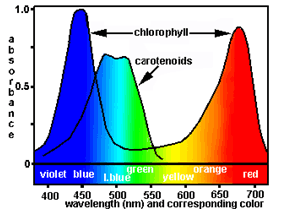
What is one function of the other pigments besides chlorophyll, in the chloroplast?
to block damaging wavelengths of light
to absorb different wavelengths than the chloroplasts
to provide different colors to the leaves
to transfer energy to a separate photosystem beside the one using chlorophyll a and b.
Where does the carbon come from that is used to form glucose?
The soil
CO2 in the air
From other carbohydrates
Calvin Cycle
How many 6-carbon sugar molecules are produced from every six molecules of carbon dioxide that enter the Calvin cycle?
1
3
6
12
If the proton (H+) pump in the thylakoid was not working which molecule could not be made during the light reaction?
NADPH
ATP
Water
Oxygen gas
ATP is made during the light reaction using all of the following EXCEPT
proton pump
hydrogen ion gradient
electron energy from photosystem II
NADPH donating electrons
Where does the oxygen produced in the light dependent reactions of photosynthesis come from?
chlorophyll
carbon dioxide
the atmosphere
water
Which of the following would have the least affect on photosynthetic rate?
increase the temp from 20°C to 30°C
increasing the CO2 from 400 ppm to 600ppm
increasing the light intesity from 40 Watts to 60 Watts
increasing the amount of O2 from 20% to 30% in the air
Plants obtain CO2 into the chloroplast by
active transport
diffusion
facilitated diffusion
endocytosis
The light reactions occur in the ________ and the calvin cycle takes place in the ________.
Chloroplast / thylakoid membrane
stroma / thylakoid
mesophyl / stomata
thylakoid membrane / stroma
What supplies the electrons that are lost in PS I?
the electrons from PS II
water
glucose
oxygen
Which of the following events occurs in the light reactions of photosynthesis?
NADP+ is produced
ATP is consumed to yield ADP
light is absorbed and funneled to chlorophyll a
carbon dioxide is fixed in organic molecules
The splitting of carbon dioxide to form oxygen gas and carbon compounds occurs during ______
photosynthesis
respiration
neither photosynthesis or respiration
both photosynthesis and respiration
What is the primary function of the Calvin cycle?
regenerate ATP for use in the light reactions of photosynthesis
produce carbon dioxide for use in the light reactions of photosynthesis
produce oxygen by oxidizing water
produce simple sugars from carbon dioxide
In a plant cell, where are ATP synthase complexes located?
thylakoid membranes only
inner mitochondrial membranes only
thylakoid membrane and inner mitochondrial membranes
thylakoid membrane and plasma membranes
T or F: The light reactions of Photosynthesis requires ATP.
True
False
T or F: Photosynthesis is anabolic and Cellular respiration is catabolic
True
False
Which of the following are products of the light reactions of photosynthesis that are utilized in the Calvin Cycle?
CO2 and glucose
ATP and NADPH
ADP, P and NADP+
H2Oand O2
Which of the following sequences correctly describes the flow of electrons in the light-dependent reactions?
Photosystem I → Photosystem II
Photosystem II → Photosystem I
Calvin Cycle → Photosystem I
Electron Transport Chain → Photosystem II
What is the primary role of Photosystem II in photosynthesis?
To capture carbon dioxide
To split water molecules
To produce glucose
To synthesize ATP
What are the main products of the light-dependent reactions that are used in the Calvin cycle?
Oxygen and glucose
ATP and NADPH
Carbon dioxide and water
Glucose and ATP
What is the function of the Electron Transport Chain (ETC) in photosynthesis?
To directly synthesize ATP
To create a proton gradient across the thylakoid membrane
To capture carbon dioxide
To produce glucose
Why is chlorophyll a crucial in the light-dependent reactions?
It absorbs water
It captures carbon dioxide
It absorbs light and transfers electrons
It produces glucose
What is the significance of the proton gradient created by the ETC?
It directly synthesizes glucose
It is used to produce ATP
It captures carbon dioxide
It absorbs sunlight
Which describes light dependent reactions?
Light is absorbed to synthesize ATP & NADPH
Light is absorbed to create a sodium gradient
Light is used to synthesize organic compounds
Light is used to heat the cell increasing reaction rate
Which describes light independent reactions?
Calvin cycle to break bonds to release carbon dioxide
Calvin cycle to synthesize organic compounds
Krebs cycle to break bonds to release carbon dioxide
Krebs cycle to synthesize organic compounds
The accumulation of free oxygen in Earth's atmosphere began _____
with the origin of life and respiratory metabolism
with the origin of photosynthetic bacteria that had photosystem I
with the origin of cyanobacteria that had both photosystem I and photosystem II
with the origin of land plants
A molecule that has been phosphorylated
has a decreased chemical reactivity; it is less likely to provide energy for cellular work
has been oxidized as a result of a redox reaction involving the gain of an inorganic phosphate.
has an increased chemical potential energy; it is primed to do cellular work.
has less energy than before its phosphorylation and therefore less energy for cellular work.
During photosynthesis, electrons travel downhill in which sequence?
food → NADH → electron transport chain → oxygen
glucose → pyruvate → ATP → oxygen
water → photosystem II → electron transport chain → NADPH
light → electron transport chain → chlorophyll --> ATP
Assume a thylakoid is somehow punctured so that the interior of the thylakoid is no longer separated from the stroma. This damage will have the most direct effect on which of the following processes?
the splitting of water
the flow of electrons from photosystem II to photosystem I
the synthesis of ATP
the reduction of NADP+
Which statement about photosynthesis is true?
The light reactions produce ATP and NADPH that are used in the Calvin cycle
The Calvin cycle produces NAD+ and ADP that are then used in the light reactions
The Calvin cycle produces G3P
All of these statements are true
During noncyclic photophosphorylation all of the following occur EXCEPT
ATP is made using electron energy that will leave on NADPH
results in oxygen gas being produced
water is split (photolysis)
electrons from photosystem 1 return back to photosystem 1
ATP is made during the light reaction using all of the following EXCEPT
proton pump
hydrogen ion gradient
electron energy from photosystem II
NADPH donating electrons
Plants obtain CO2 into the chloroplast by
active transport
diffusion
facilitated diffusion
endocytosis
If the proton (H+) pump in the thylakoid was not working which molecule could not be made during the light reaction?
NADPH
ATP
Water
Oxygen gas
Rubisco is important in which step of photosynthesis
energizing the electrons in chlorophyll
carbon fixation when CO2 is connected to RUBP during calvin cycle
regeneration phase as RUBP is made during calvin cycle
reduction of the carbon chain during the calvin cycle
The H+ concentration gradient is formed to
make NADPH
split a water molecule
generate ATP
form water
Where did photosynthesis originate?
Algae
Cyanobacteria
Plants
Protists
Earth included oxygen when it was first formed
True
False
Where was oxygen initially formed?
Atmosphere
Land
Meteorite
Ocean
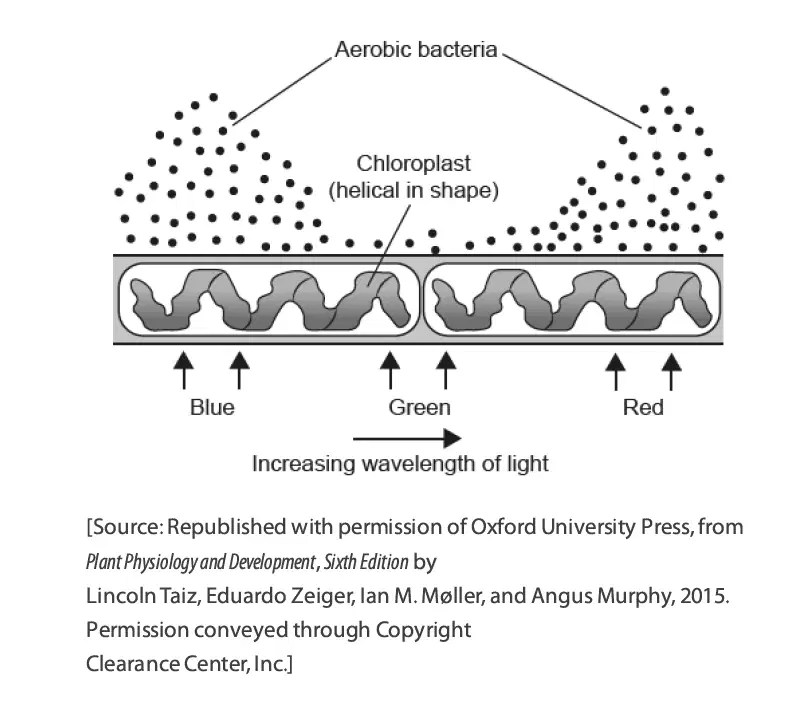
In 1882, Engelmann investigated photosynthesis by shining light of varying wavelength on a green alga. He observed where aerobic bacteria accumulated. What can be deduced from this experiment?
Only parts of the chloroplast contained chlorophyll.
The distribution of bacteria indicates the action spectrum of photosynthesis.
Most oxygen is released from the algae in green light.
Chloroplasts reflect blue and red light.
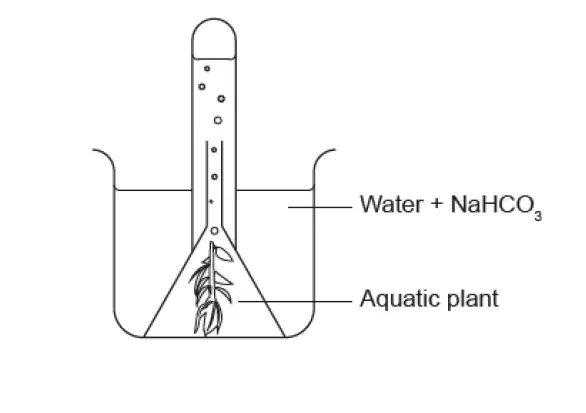
The apparatus shown was used to investigate the effect of varying carbon dioxide concentration on the rate of photosynthesis. Carbon dioxide concentrations were varied by adding different amounts of sodium hydrogen carbonate (NaHCO₃) to water. What is the dependent variable in this investigation?
Temperature
Light intensity
Amount of NaHCO₃ added
Volume of oxygen produced

What do the absorption spectra show about the pigments?
Phycoerythrin absorbs mostly red light.
Chlorophyll a reflects more green light than phycoerythrin.
Chlorophyll a photosynthesizes more at 550 nm than phycoerythrin.
Phycoerythrin does not absorb blue light.

Which pigment would be more favorable in green light?
Pigment A (Graph I)
Pigment B (Graph II)
What donates the electron in photosynthesis?
ATP
Water
Oxygen
NADH
Which step of photosynthesis synthesizes G3P?
Calvin Cycle
Light Reaction
Krebs Cycle
Glycolysis

B
Calvin Cycle
Light Dependent Reaction

What is this process?
Light dependent reaction
Calvin Cycle
Cellular respiration
The breakdown of glucose


What is the primary of the Calvin cycle during the second part of photosynthesis?
Production of carbohydrates and other organic compounds
Breakdown of sugar (carbohydrates)
Production of ATP
Production of NADP+

To produce one glucose molecule the Calvin cycle must turn
Once
Twice
Three times
Six times
The NADP+ is
oxidized during the light reaction
reduced during the Calvin cycle
oxidized during the Calvin cycle
reduced during the light reaction
Photosynthesis is a redox reaction. This means that water is ______ during the light reactions and carbon dioxide is ______ during the Calvin cycle.
consumed; reduced
consumed; reduced
oxidized; reduced
reduced; reduced

