
 Worksheets
HEALTH QUIZ on Ch 14 "Skeletal, Muscular, & Nervous Systems"
Total questions: 55
Worksheet time: 2hrs 50mins


Which system is responsible for creating red blood cells?
skeletal
muscular
respiratory
nervous
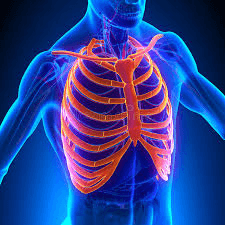
What bone is highlighted?
Ribs
Cranium
Clavicle
Femur

What is the name for the connector that attaches muscle to bone?
ligament
tendon
joint
bones

What is the name for the connector that attaches bone to bone?
ligament
tendon
joint
cartilage
What is a flexible connective tissue that is found in your nose and ears?
cartilage
joints
ligaments
cranium
What is the purpose of the rib cage?
Helps us to think
make blood for the body
Protects our brain
Protects our vital organs like heart and lungs
The skeletal system works with the ______________ to help your body move.
digestive system
circulatory system
respiratory system
muscular system
Which tissue cushions the end of bones?
tendons
ligaments
cartilage
joints
Examples of a hinge joint are the elbow and knee.
True
False
Name the condition in which the bones become weak and break easily.
Osteoarthritis
Rheumatoid arthritis
osteoporosis
arthritis
What is the process called when calcium continues to form in the bone structure, causing the bone to become hard?
ossification
osteoporosis
osteomalacia
osteoarthritis
This condition can be caused when a joint is damaged, causing the edges of the bones to rub together and become inflamed.
Arthritis
Fracture
Kyphosis
Lordosis
muscles that contract when needed without needing to think about it
fast twitch
slow twitch
voluntary
involuntary
muscles that you consciously make contract and move
fast twitch
slow twitch
voluntary
involuntary
Select all the apply for skeletal muscle
Voluntary
Involuntary
Attached to bones
Attached to internal organs
Produces heat and energy
Select all that apply for cardiac muscles
Voluntary
Involuntary
Found in heart
Found in internal organs
Contracts to circulate blood
Which of these is NOT a major task of the muscular system?
Movement for your body
Maintaining posture
Heat production for the body
Making red blood cells

Bulging of an organ or tissue through a weakened area in the muscle wall:
Hernia
Myalgia
Myositis
Muscular Dystrophy
Which muscles are involuntary (uncontrollable)?
Skeletal and Cardiac
Smooth and Skeletal
Cardiac and Smooth
Check all that apply. Skeletal muscle is responsible for:
movement of body
stabilizing joints
maintain posture
contracting organs to move substances
Muscular dystrophy is the inflammation of a tendon.
true
false
Which problem of the muscular system results when muscles are stretched or partially torn from overexertion?
muscle bruise
muscle sprain
hernia
muscular dystrophy
Inflammation of a tendon is called tendonitis.
true
false
Turning your head to look both ways before crossing the street is what kind of movement?
Voluntary
Involuntary
Swatting a fly off of your shoulder is what kind of movement?
Voluntary
Involuntary
Your stomach digesting food is an example of what kind of movement?
Voluntary
Involuntary
What is a nerve cell?
axon
neuron
dendrite
myelin
Which 2 are parts of the central nervous system?
brain
nose
spinal cord
left big toe
Cranial nerves and spinal nerves are part of the peripheral nervous system.
True
False
Voluntary muscle movement is coordinated by what part of the brain?
Temporal
Occipital
Frontal
Parietal
What part of the brain deals with appetite and temperature control?
Cerebellum
Cerebrum
Hypothalamus
Brain stem
What part of the nervous system is responsible for slowing down breathing and pulse?
Spinal Nerves
Sympathetic
Parasympathetic
Spinal Nerves
The branch like figures that receive impulses & conducts them to the cell body
Dendrite
Axon
Cell Body
Myelin Sheath
What is the peripheral nervous system
The spine and brain
Neurons and neuroglia
Cranial Nerves and Spinal Nerves
Bipolar and unipolar neurons
What do Neurons do?
transmit impulses in the nervous system
prevent seizures
control brain activity
What brain structure controls basic life functions like breathing & heartbeat?
cerebral cortex
neurons
brainstem
peripheral nervous system
Part of the autonomic nervous system responsible for "Rest & Digest" response
parasympathetic nervous system
sympathetic nervous system

