
 Worksheets
A&P Ch 6: Skeletal System
Total questions: 43
Worksheet time: 23mins
Fill in the blank: There are ______ bones in the adult skeleton, along with cartilage, ligaments, and joints.
206
201
210
180
The word skeleton comes from a Greek word meaning what?
dried-up body
living structure
strong framework
soft tissue
Summarize the definition of long bones?
Fairly equal in width and length and found mostly in wrists and ankles
Longer than they are wide and can be found in arms and legs
Flat and thin, found in the skull
Irregularly shaped and found in the spine
Short bones are mostly found in which parts of the body?
A) Arms and legs
B) Skull and ribs
C) Wrists and ankles
D) Spine and pelvis
Fill in the blank: Short bones are fairly equal in width and length and found mostly in ______ and ______.
wrists; ankles
arms; legs
fingers; toes
shoulders; hips
Flat bones are thinner and can be either flat or curved; platelike in nature and would include which of the following?
skull
ribs
sternum
all of these are classified as flat bones
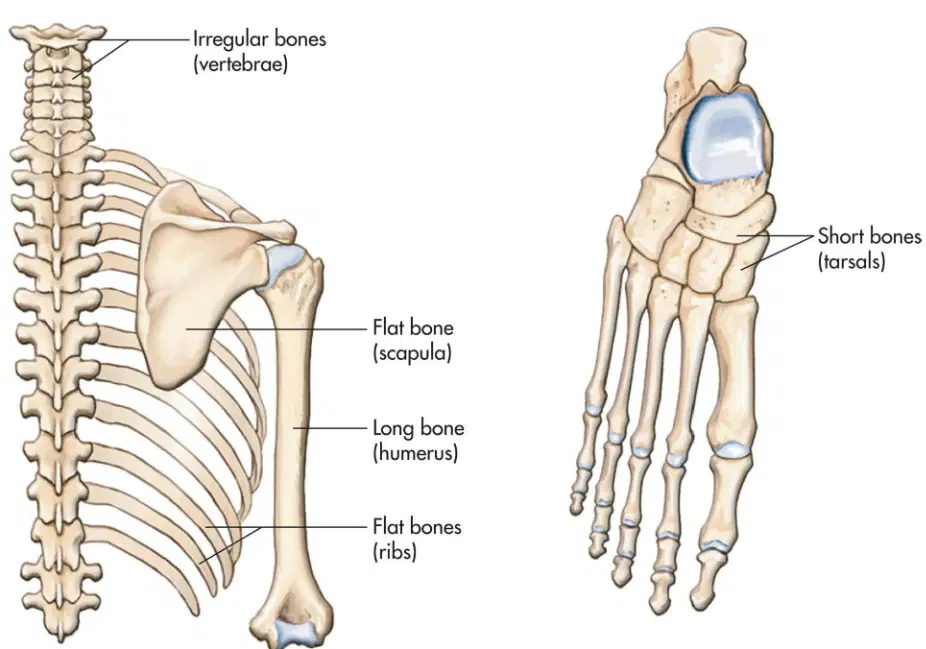
Summarize what type of bones the vertebrae would be classified as.
Long bones
Irregular bones
Flat bones
Short bones
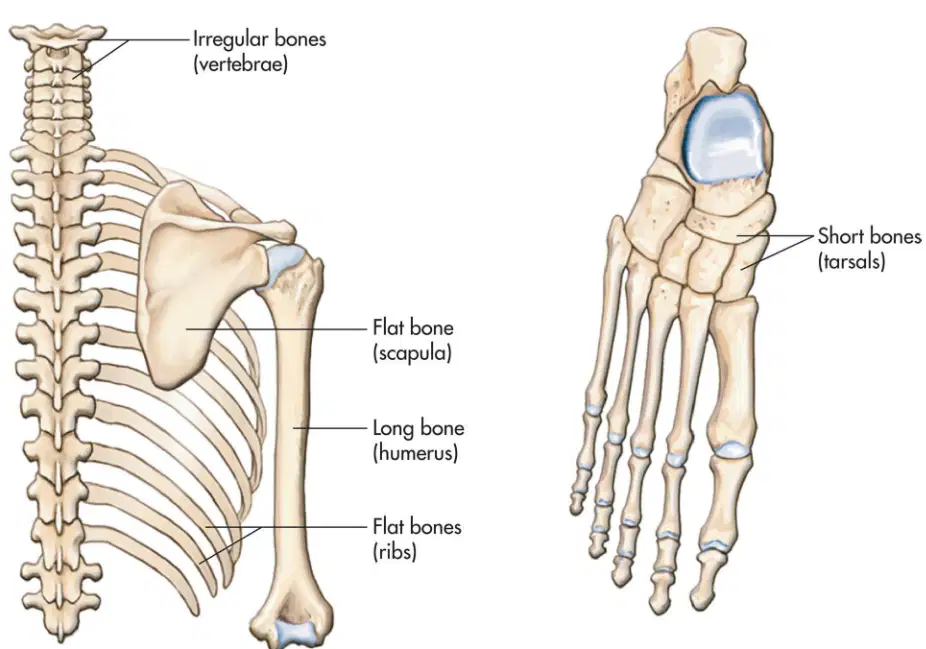
Refer to the diagram labeled 'Figure 6-1'. Which of the following is a long bone?
Scapula
Humerus
Ribs
Tarsals
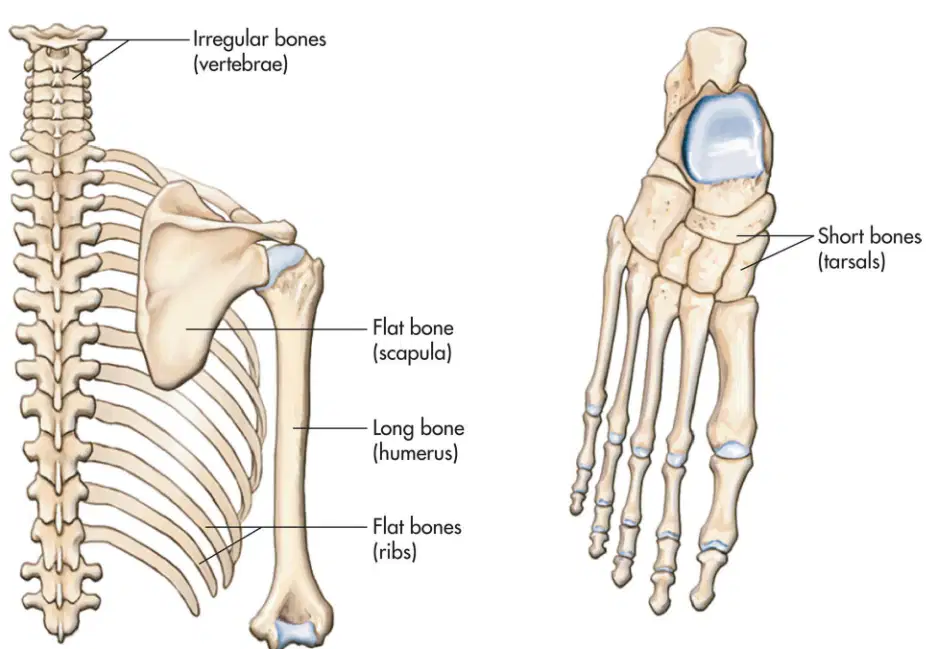
Refer to the diagram labeled 'Figure 6-1'. The ribs are classified as ________ bones.
flat
long
irregular
short
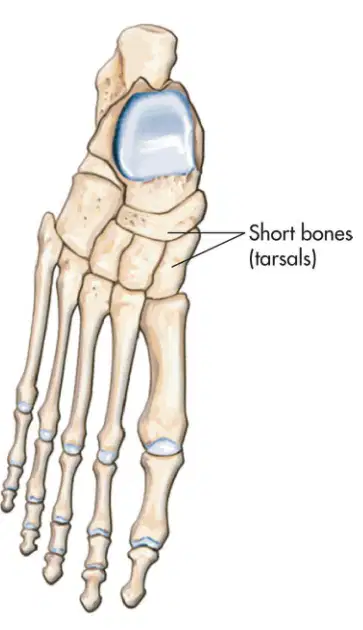
What type of bones are the tarsals?
Long bones
Irregular bones
Flat bones
Short bones
What is the tough and fibrous connective tissue covering bone called?
Periosteum
Endosteum
Ligament
Tendon
Which of the following is NOT a function of the periosteum?
Contains blood vessels to nurture bone cells
Acts as anchor points for ligaments and tendons
Produces red blood cells
Covers bone with tough and fibrous connective tissue
What is the epiphysis in bone anatomy?
Bone end
Bone shaft
Bone marrow
Bone membrane
What is the diaphysis in bone anatomy?
Region between or 'running through' two epiphyses; also called shaft
The rounded end of a long bone
The outer fibrous layer covering the bone
A cavity within the bone filled with marrow
What is the function of the hollow region in the diaphysis (medullary cavity or canal)?
Acts as storage area for bone marrow
Provides attachment for muscles
Facilitates joint movement
Produces synovial fluid
What does Red marrow create?
erythrocytes
platelets
white blood cells
red marrow creates all of these blood cells
Which type of bone marrow has high fat content and can convert to red marrow in an emergency?
Red marrow
Yellow marrow
White marrow
Blue marrow
What is the name of the region at the end of the long bone that is closest to the core of the body?
Proximal epiphysis
Diaphysis
Distal epiphysis
Metaphysis
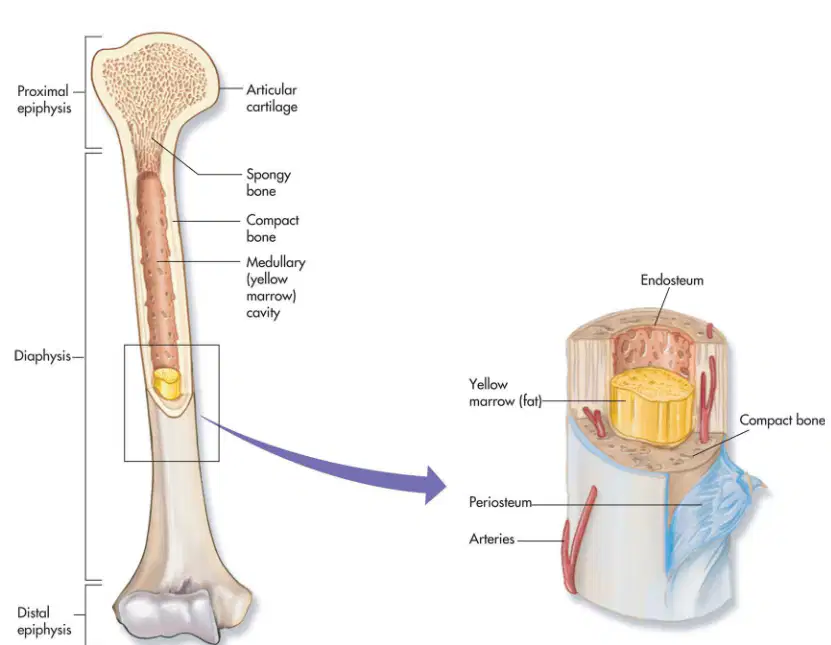
In Figure 6-2, which structure surrounds the medullary (yellow marrow) cavity?
Compact bone
Spongy bone
Periosteum
Articular cartilage
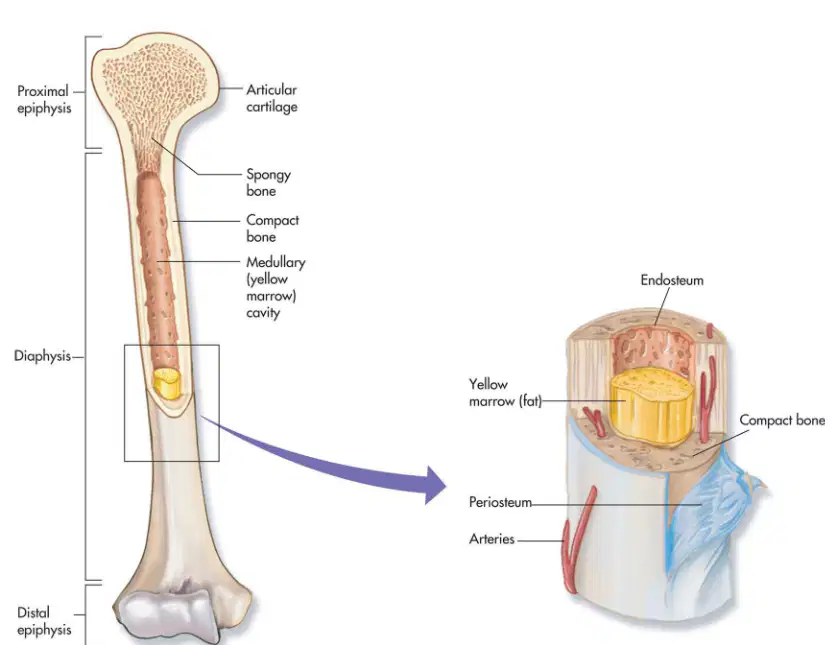
In Figure 6-2, what is the name of the cavity that contains yellow marrow (fat)?
Medullary cavity
Epiphyseal plate
Periosteum
Articular cartilage
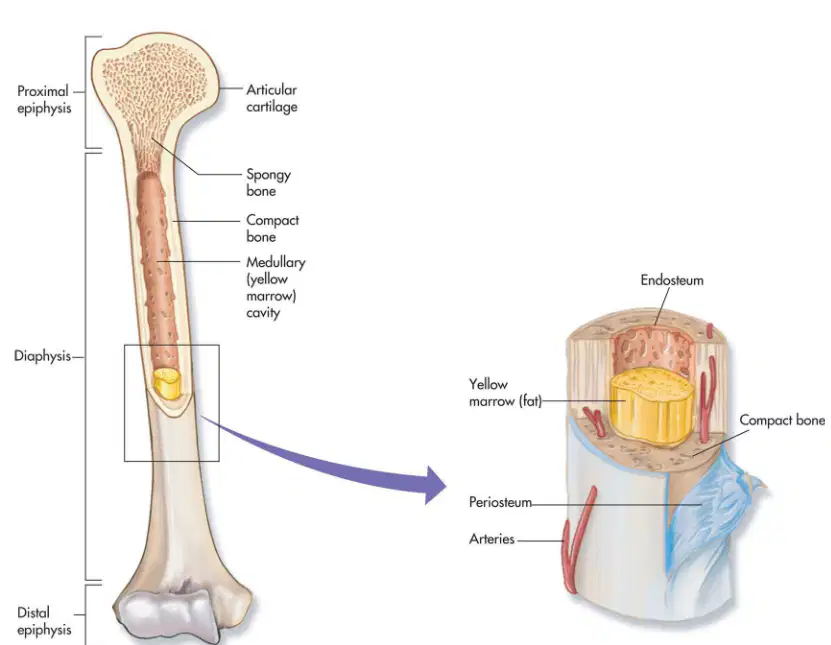
In Figure 6-2, what is the name of the membrane that lines the inner surface of the bone?
Endosteum
Periosteum
Epimysium
Perimysium
Which type of bone tissue forms the shafts of long bones and the outer layer of other bones?
Spongy bone
Compact bone
Cartilage
Marrow
Compact bone forms microscopic, cylindrical-shaped units called ________ or Haversian systems.
osteons
chondrocytes
trabeculae
lacunae
Each unit of bone tissue has mature bone cells called ________ forming concentric circles around blood vessels.
osteocytes
chondrocytes
erythrocytes
leukocytes
Fill in the blank: Osteons run ______ to each other; blood vessels laterally connect with them to ensure there is sufficient oxygen and nutrients for bone cells.
parallel
perpendicular
diagonal
random
Spongy (cancellous) bone is arranged in bars and plates called ________.
trabeculae
osteons
lamellae
canaliculi
What is the function of the irregular holes between trabeculae in spongy bone?
They make bone lighter in weight and provide space for red bone marrow, which produces red blood cells.
They store calcium for muscle contraction.
They allow nerves to pass through the bone.
They serve as attachment points for tendons and ligaments.
Label the bones with their correct shape by dragging onto the image.
Irregular bone
Long bone
Flat bone
Short bone
Identify these bones
Fibula
Mandible
Skull
Clavicle
Tibia
Femur
This membrane lines the spongy bone.
Epiphyses
Endosteum
Periosteum
Diaphysis
Which cordlike structure holds muscle to bone?
Nerve
Joint
Ligament
Tendon
The skeleton can still grow as long as there is cartilage left in the _____.
haversian system
epiphyseal plate
chondrocytes
diaphysis
A narrow ridge of bone is known as the what?
head
spine
crest
condyle
In the first few hours after the injury, a _______, or blood clot forms around the broken bone and inflammation occurs.
t
callus
reduction
hematoma
What is a general term used to describe an inflammatory process of a joint or joints?
arthritis
gout
bursitis
osteoarthritis
These joints permit the widest range of movement.
ball-and-socket
saddle
hinge
pivot
Bone-building cells are called?
hemopo
osteocytes
osteoblasts
osteoclasts
Osteoporosis is an example of which of the following?
degenerative disorder
infection
nerve disorder
congenital disorder
What is a groove or shallow depression on the surface of a bone?
sinus
meatus
fac
fossa
This movement occurs when you turn the sole of your foot inward.
Eversion
Flexion
Pronation
Inversion
What is another name for a compound fracture?
impacted fracture
open fracture
closed fracture
comminuted fracture
The joints of the hips and shoulders are examples of what kind of joints?
saddle
fibrous
pivot
ball-and-socket
The number of pairs of true ribs is?
14
5
7
12

