
 Worksheets
Protein Structure Quiz
Total questions: 50
Worksheet time: 25mins
Which of the following correctly lists the four levels of protein structure?
A. Primary, secondary, tertiary, quaternary
B. Alpha, beta, gamma, delta
C. Monomer, dimer, trimer, tetramer
D. Simple, complex, advanced, basic
What is the role of covalent and noncovalent forces in protein structure?
A. They contribute to different levels of structures and their structural maintenance.
B. They only affect the primary structure of proteins.
C. They are not involved in protein structure at all.
D. They only contribute to the quaternary structure.
Why is proper folding necessary for proteins?
A. It is necessary for the biological function of the protein.
B. It makes the protein more colorful.
C. It increases the protein’s size.
D. It allows the protein to dissolve in water.
How does specific structure contribute to protein function?
A. The specific structure determines the protein’s function.
B. The structure only affects the protein’s color.
C. The structure has no impact on protein function.
D. The structure only affects the protein’s mass.
Which of the following best describes the primary structure of a protein?
A string of different amino acids joined together by peptide bonds
A string of amino acids folded into alpha helices and beta sheets
Many interactions between secondary structures to form a three-dimensional structure
Interactions between two or more proteins of tertiary structure
What is formed when a string of amino acids folds into alpha helices and beta sheets?
Secondary structure
Primary structure
Tertiary structure
Quaternary structure
Which level of protein structure involves many interactions between secondary structures to form a three-dimensional protein structure?
Tertiary structure
Primary structure
Secondary structure
Quaternary structure
What does the quaternary structure of a protein refer to?
Interactions between two or more proteins of tertiary structure
A string of amino acids joined by peptide bonds
Folding of amino acids into alpha helices and beta sheets
Formation of a three-dimensional structure from secondary structures
A scientist is studying a protein that consists of several polypeptide chains interacting together. Which level of protein structure is the scientist most likely investigating?
Quaternary structure
Primary structure
Secondary structure
Tertiary structure
The secondary structure of a protein contributes to its overall shape and function by:
Forming regular sub-structures like alpha helices and beta sheets, which provide stability and a framework for further folding into tertiary and quaternary structures, ultimately influencing the protein's function.
Being just a random arrangement of amino acids and not affecting the protein's shape.
Being responsible for joining amino acids together by peptide bonds.
Being only present in quaternary proteins.
What is the tertiary structure of a polypeptide?
The sequence of amino acids in a polypeptide
The overall 3-D structure of a polypeptide
The arrangement of multiple polypeptide chains
The process of protein synthesis
Which of the following gives rise to the overall folding of a polypeptide?
Interactions involving side chains
The order of nucleotides in DNA
The presence of water molecules
The number of peptide bonds
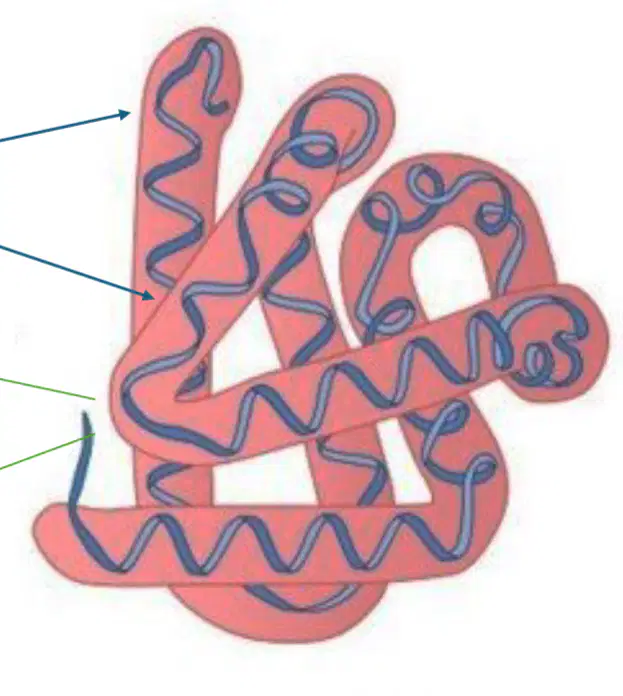
Which secondary structure is indicated in the diagram as part of the tertiary structure?
Beta sheet
Alpha helix
Random coil
Disulfide bridge
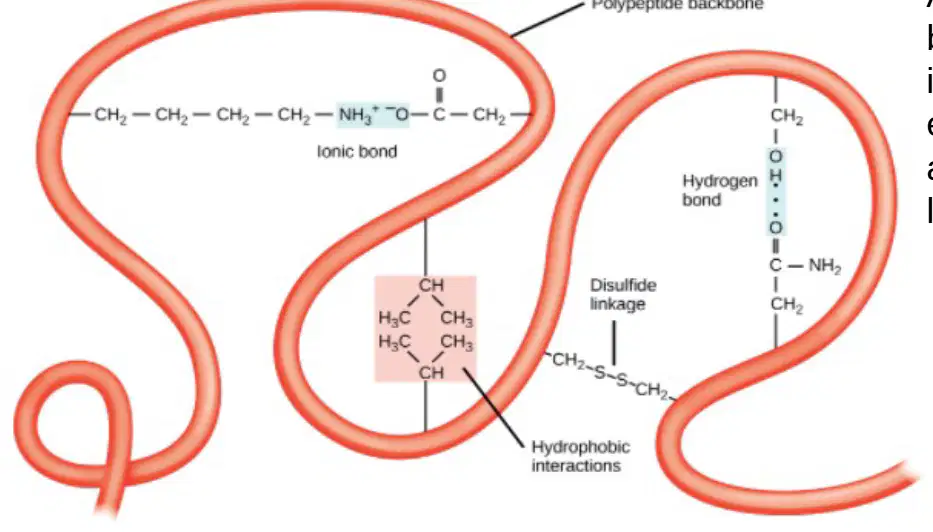
Which type of bond is formed between R groups with opposite charges in the tertiary structure of proteins?
Hydrogen bond
Disulfide bond
Ionic bond
Peptide bond
What is the main characteristic of hydrophobic interactions in protein tertiary structure?
Amino acids with polar R groups cluster together on the inside of the protein
Amino acids with nonpolar, hydrophobic R groups cluster together on the inside of the protein
Hydrophilic amino acids cluster together on the inside of the protein
Hydrophobic R groups interact with water molecules on the outside
A hydrogen bond in a protein’s tertiary structure occurs between a hydrogen atom and which of the following?
A less electronegative atom
A carbon atom
A more electronegative atom such as oxygen or nitrogen
A sulfur atom
Which type of bond involves covalent linkages between the sulfur-containing side chains of cysteines?
Ionic bond
Disulfide bond
Hydrogen bond
Peptide bond
Hydrophobic interactions contribute to the stability of a protein’s tertiary structure by:
Forming covalent bonds between side chains
Clustering nonpolar R groups inside the protein, away from water
Forming ionic bonds with water molecules
Creating hydrogen bonds with the protein backbone
Which type of interaction involves a partially electrostatic attraction between a hydrogen atom and more electronegative atoms such as nitrogen (N) and oxygen (O)?
Intramolecular hydrogen bond
Disulfide bond
Ionic interaction
Hydrophobic interaction
Which amino acid residue is involved in the formation of disulfide bonds in proteins?
Cysteine
Lysine
Glutamate
Arginine
Which of the following pairs of amino acids are involved in ionic interactions due to their opposing charges?
Lysine and Glutamate
Cysteine and Arginine
Lysine and Cysteine
Glutamate and Aspartate
Amino acids with non-polar side chains are most likely to participate in which type of interaction?
Hydrophobic interactions
Disulfide bonds
Ionic interactions
Intramolecular hydrogen bonds
Which statement best describes Van der Waals interactions in the context of protein tertiary structure?
They are weak attractions that become significant collectively between two complimentary surfaces.
They are strong covalent bonds between sulfur atoms.
They are electrostatic attractions between ions of opposite charges.
They are hydrogen bonds between water molecules.
The stabilization of a protein's native conformation is achieved by which combination of side chain interactions?
By providing a variety of non-covalent and covalent forces, such as hydrogen bonds, disulfide bonds, ionic interactions, hydrophobic interactions, and Van der Waals forces, the protein achieves a stable three-dimensional structure that is energetically favorable and functional.
By only using hydrogen bonds to hold the structure together.
By relying solely on hydrophobic interactions to exclude water.
By forming only disulfide bonds between all amino acids.
Which tool is suggested to predict the structure for the mature beta defensin 1?
alphaFold
BLAST
PyMOL
Chimera
Why is it important to visualize the full range of forces in the structure of beta defensin 1?
To understand the stability and interactions within the protein structure
To determine the protein’s color
To find the gene sequence
To measure the protein’s mass
What are prosthetic groups in proteins?
Non-protein components bound tightly to proteins required for protein functions
Protein components that are loosely attached to enzymes
Sugars attached to the protein backbone
Lipids that interact with protein surfaces
Which of the following is an example of a prosthetic group in proteins?
The heme group in hemoglobin and myoglobin
The phosphate group in ATP
The sugar group in glycoproteins
The fatty acid tail in lipoproteins
What type of bonds does the Fe²⁺ ion in the center of heme form with histidine and oxygen gas?
Ionic bonds
Hydrogen bonds
Coordinate bonds
Disulfide bonds
Which statement best describes coordinate bonds?
They are a type of ionic bond formed between metals and nonmetals.
They are special covalent bonds where both electrons in the bond come from the same atom.
They are hydrogen bonds formed between water molecules.
They are peptide bonds linking amino acids.
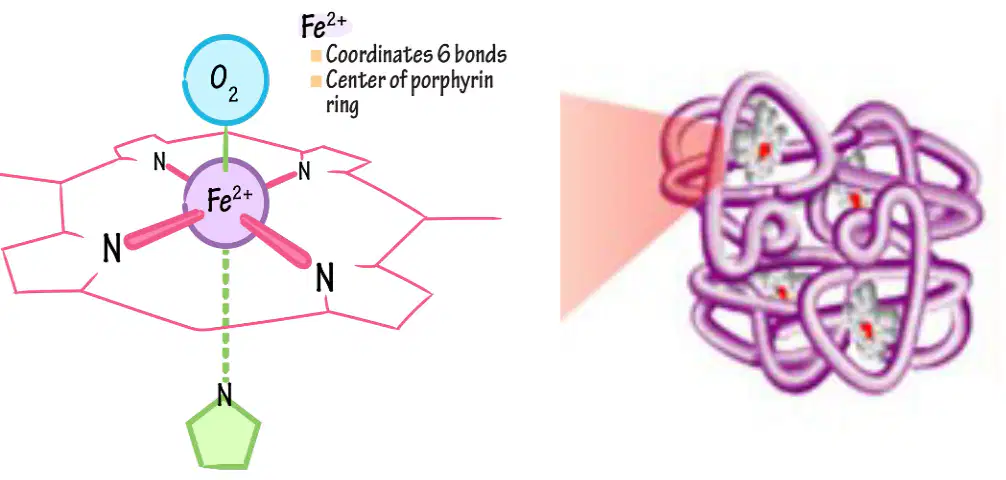
What is the role of Fe²⁺ in the heme group as shown in the diagram?
It binds to oxygen and histidine via coordinate bonds
It provides structural support to the protein
It acts as an enzyme catalyst
It stores energy for the cell
What is the main purpose of using alphaFold in the context of the hemoglobin beta subunit with heme group?
To predict the structure of the hemoglobin subunit beta with heme group
To sequence the DNA of hemoglobin
To measure the oxygen-carrying capacity of hemoglobin
To visualize the color of hemoglobin
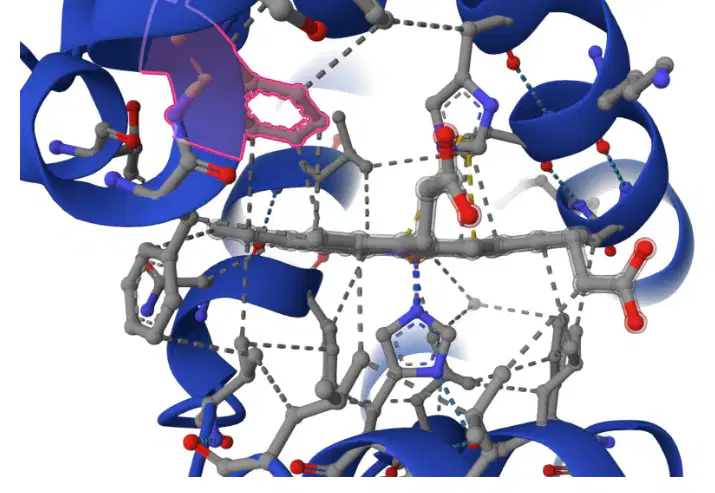
What type of interactions stabilize heme inside beta hemoglobin?
Hydrophobic interactions and coordinate bonds
Only covalent bonds
Only hydrogen bonds
Only van der Waals forces
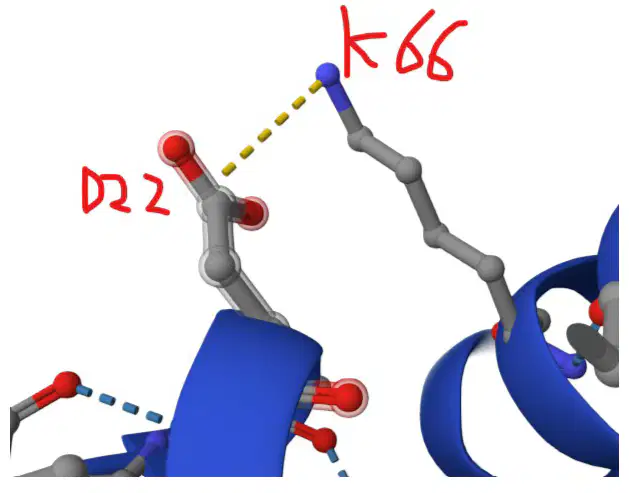
Which of the following best describes the ionic interactions in biological molecules?
Electrostatic attraction between two groups of opposite charge
Sharing of electrons between atoms
Hydrophobic exclusion from water
Formation of peptide bonds
Strong interactions contribute to the stability of heme in beta hemoglobin by:
They allow heme to freely move within the protein.
They create a dense network of hydrophobic interactions and coordinate bonds that lock heme in place.
They break down the heme group for energy.
They prevent any interaction with other molecules.
Disrupting the electrostatic attraction between two oppositely charged groups in a protein is likely to have which effect?
The protein may lose stability or proper folding, affecting its function.
The protein will become more stable.
The protein will not be affected at all.
The protein will gain new functions unrelated to its original role.
Which of the following best describes a protein with quaternary structure?
A protein made up of multiple polypeptide chains
A protein with only one polypeptide chain
A protein that is always a single helix
A protein that does not contain any subunits
What is the difference between a homodimer and a heterodimer in protein quaternary structure?
A homodimer has identical subunits, while a heterodimer has different subunits
A homodimer has different subunits, while a heterodimer has identical subunits
A homodimer is always a single chain, while a heterodimer is always a triple helix
A homodimer is found only in antibodies, while a heterodimer is found only in hemoglobin
Which protein has a tetrameric quaternary structure?
Hemoglobin
Collagen
Antibody IgG
Myosin
Antibody IgG is composed of which of the following?
Two heavy chains and two light chains
Four identical chains
Three polypeptide chains
A single polypeptide chain
Why are proteins with quaternary structure often referred to as multimeric proteins?
Because they are made up of more than one polypeptide chain
Because they have only one type of amino acid
Because they do not have any subunits
Because they are always enzymes
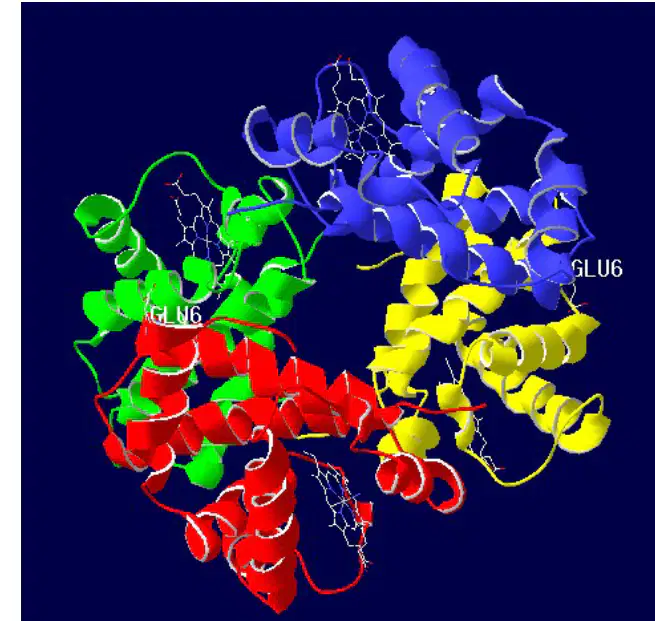
What is the structural composition of hemoglobin as shown in the material?
Monomeric
Dimeric
Tetrameric (α₂β₂)
Hexameric
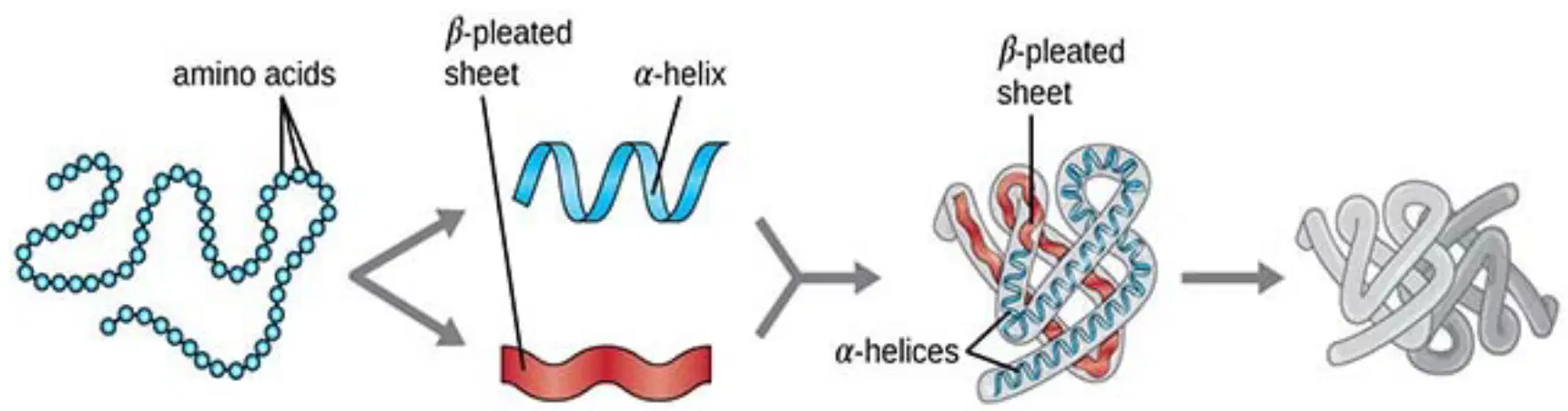
Which level of protein structure involves the three-dimensional folding pattern of a protein due to side chain interactions?
Primary protein structure
Secondary protein structure
Tertiary protein structure
Quaternary protein structure
A protein consisting of more than one amino acid chain is described as having which level of structure?
Primary protein structure
Secondary protein structure
Tertiary protein structure
Quaternary protein structure
Given a protein with both α-helices and β-pleated sheets, which levels of protein structure are present?
Only primary
Primary and secondary
Only tertiary
Only quaternary
What does PTM stand for in the context of proteins?
Post-translational modification
Protein tertiary motif
Primary translation mechanism
Peptide transferase molecule
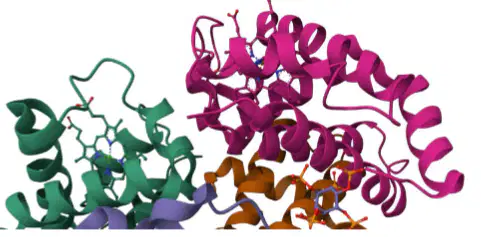
What is the main secondary structural feature of hemoglobin?
Alpha helices
Beta sheets
Random coils
Disulfide bridges
How many alpha helices are present in the beta subunit of hemoglobin?
8
7
6
9
The absence of beta sheets in hemoglobin's secondary structure is significant because:
Beta sheets would make the protein too rigid, affecting oxygen binding.
Beta sheets are required for enzymatic activity, which hemoglobin does not perform.
The presence of beta sheets would increase the solubility of hemoglobin.
Beta sheets would allow hemoglobin to bind to DNA.
Each subunit of hemoglobin contains how many heme groups?
One heme group
Two heme groups
Four heme groups
No heme group
![Reviewer [NAT G12] Personality Development](https://cf.quizizz.com/image/image-loader.svg)
