
 Worksheets
Chapter 6 Summary: Chemical Reaction Rates and Mechanisms
Total questions: 99
Worksheet time: 50mins
Quel est le terme utilisé pour désigner la vitesse à laquelle une réaction chimique se produit ?
Vitesse de réaction
Énergie d'activation
Constante d'équilibre
Catalyseur
Quel est le terme utilisé pour désigner la vitesse d'une réaction à un instant précis ?
Vitesse moyenne de réaction
Vitesse instantanée de réaction
Vitesse globale de réaction
Vitesse d'équilibre
Quel est le terme pour la variation de concentration d'une réaction sur une période de temps ?
Constante d'équilibre
Vitesse instantanée de réaction
Énergie d'activation
Vitesse moyenne de réaction
Selon le résumé, le taux de réaction est déterminé par : Choisissez la bonne réponse.
L'énergie d'activation
L'énergie totale gagnée ou perdue pendant la réaction
La quantité de réactifs utilisés
La quantité de produits formés
Le taux de réaction est toujours exprimé comme une valeur positive.
Vrai
Faux
Le taux instantané d'une réaction chimique est le taux à un instant donné.
Faux
Vrai
Pour qu'une réaction ait lieu, les réactifs doivent entrer en collision avec la bonne orientation et une énergie cinétique suffisante pour surmonter la barrière d'énergie d'activation. Comment s'appelle cette théorie ?
Théorie de l'équilibre
Théorie de l'état de transition
Théorie des collisions
Théorie des orbitales moléculaires
Lequel des éléments suivants N'EST PAS un facteur influençant la vitesse de réaction selon le résumé ?
A) Nature des réactifs
B) Température
C) Couleur des réactifs
D) Concentration des réactifs
Quel est le terme pour l'énergie minimale requise pour qu'une réaction ait lieu ?
Énergie d'activation (Eₐ)
Énergie potentielle
Énergie cinétique
Enthalpie
Les enzymes sont des catalyseurs biologiques qui accélèrent les réactions sans être consommés.
Vrai
Faux
Comment s'appelle l'étape la plus lente dans un mécanisme de réaction ?
Étape catalytique
Énergie d'activation
État de transition
Étape élémentaire
La relation entre la vitesse de réaction et la concentration des réactifs est indiquée par l'exposant dans l'expression de la loi de vitesse. Comment s'appelle cet exposant ?
Ordre de la réaction
Énergie d'activation
Molecularité
Constante de vitesse
Le taux d'une réaction peut être directement proportionnel à la concentration d'un réactif ou au carré de la concentration.
Vrai
Faux
Laquelle des propriétés suivantes est celle d'un catalyseur ?
Il est consommé lors de la réaction
Il augmente la vitesse de la réaction
Il diminue l'énergie d'activation
Les réponses B et C
Laquelle de ces expressions pourrait être une unité de vitesse de réaction ?
mol²/L²
L·min
mol/L
mol/L·s
s⁻¹
Laquelle des caractéristiques suivantes d'une réaction chimique est le meilleur indicateur pour déterminer si la réaction se déroulera rapidement à température ambiante ?
Le mécanisme de la réaction
L'énergie d'activation
L'équation équilibrée
L'équation de vitesse
La valeur de ΔH
Concernant la réaction représentée par A + B → C, laquelle des affirmations suivantes concernant la formation du produit C est correcte ?
Le taux de formation de C est la moitié du taux auquel les réactifs A et B sont consommés.
Le taux de formation de C correspond à deux fois le taux auquel les réactifs A et B sont consommés.
Le taux de formation de C est identique au taux auquel les réactifs A et B sont consommés.
Le taux de formation de C est indépendant du taux auquel les réactifs A et B sont modifiés.
Le taux de formation de C est égal à la somme des taux auxquels les réactifs A et B sont consommés.
Quelle propriété ne peut pas être utilisée pour mesurer la vitesse de réaction décrite dans l'équation suivante ? CaC₂(s) + 2H₂O(ℓ) → Ca(OH)₂(aq) + C₂H₂(g)
Un changement dans la concentration des réactifs
Un changement de pH
Un changement dans la masse de CaC₂(s)
Un changement dans le volume de C₂H₂(g)
Un changement dans la concentration de Ca²⁺(aq)
Une diminution de la température ralentit principalement la vitesse de réaction parce que :
Les particules ont moins d'énergie potentielle à basse température.
Les particules des réactifs se rapprochent les unes des autres à basse température.
L'énergie d'activation augmente à basse température.
L'énergie d'activation de la réaction est réduite à basse température.
Moins de particules ont une énergie égale ou supérieure à l'énergie d'activation.
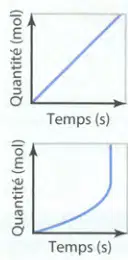
Quel graphique illustre correctement la variation de la quantité de produit lorsque la réaction suivante atteint sa complétion ? S₈(s) + 8O₂(g) → 8SO₂(g)
[Graphique a]
[Graphique b]
[Graphique c]
[Graphique d]
[Graphique e]
Une réaction est exothermique et se déroule dans le sens direct. Quelle affirmation est correcte concernant l'énergie d'activation de la réaction inverse ?
Eₐ(inv) = Eₐ(dir) + ΔH_f
Eₐ(inv) = Eₐ(dir) - ΔH_f
Eₐ(inv) = Eₐ(dir) + 2ΔH_f
Eₐ(inv) = Eₐ(dir) - 2ΔH_f
Eₐ(inv) = Eₐ(dir) + ΔH_r
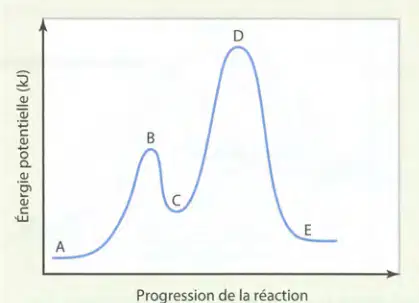
Examinez le diagramme d'énergie potentielle ci-dessous. Indiquez la ou les lettre(s) qui représentent la position d'un intermédiaire dans la réaction.
E
B et D
B, C et D
C
A
Laquelle des affirmations suivantes concernant un complexe activé est correcte ?
Il se décompose toujours pour former des molécules de produit.
Il ne se forme pas lors d'une réaction endothermique.
Il a une énergie potentielle plus faible que les réactifs ou les produits.
C'est une substance stable.
Il se forme lorsque la réaction est à l'état de transition.
Laquelle de ces lois est la plus pertinente pour la théorie des collisions ?
Théorie cinétique moléculaire
Premier principe de la thermodynamique
Loi de Boyle
Théorie atomique
Loi des proportions définies
Concernant la réaction de substitution suivante :
Zn(s) + CuSO₄(aq) → Cu(s) + ZnSO₄(aq)
Choisissez le facteur parmi la liste ci-dessous qui aurait le plus grand effet sur la vitesse de la réaction.
Augmenter la quantité de Zn(s)
Augmenter la quantité de Cu(s)
Agiter la réaction
Augmenter la concentration de CuSO₄(aq)
Augmenter la pression dans le système
Un catalyseur augmentera la vitesse d'une réaction en :
En réduisant la valeur de ΔH des réactions directe et inverse.
En augmentant le nombre de collisions entre les particules.
En fournissant un mécanisme de réaction alternatif avec une énergie d'activation plus faible.
En éliminant l'étape limitante dans le mécanisme de réaction.
En agissant comme un intermédiaire dans le mécanisme de réaction.
Deux tubes à essai, A et B, contiennent des masses égales de zinc avec la même surface active. Des quantités concentrées et égales d’acide sulfurique sont ajoutées aux deux tubes à essai. Un catalyseur est ajouté uniquement au tube à essai A. Pourquoi les échantillons de zinc doivent-ils avoir des surfaces actives identiques ?
Le tube à essai B sert de comparaison.
La surface active est un autre facteur qui peut influencer la vitesse de réaction.
Le tube à essai A sert de comparaison.
Les réponses (a) et (b) sont correctes.
Les réponses (b) et (c) sont correctes.
Énoncez une définition quantitative de la vitesse de réaction.
Le changement de concentration d'un réactif ou d'un produit par unité de temps.
La quantité totale de réactif consommée pendant une réaction.
La température à laquelle une réaction a lieu.
Le volume de gaz produit lors d'une réaction.
Quelle serait la meilleure unité pour mesurer la vitesse des réactions suivantes ?
mol/L/s
kg/m^3
L/mol
s/mol
Comment la pression totale dans un système affecte-t-elle la vitesse de réaction ?
Augmenter la pression totale arrête toujours la réaction.
Augmenter la pression totale diminue toujours la vitesse de réaction.
La pression totale n'a aucun effet sur la vitesse de réaction.
Augmenter la pression totale augmente généralement la vitesse de réaction pour les réactions impliquant des gaz.
Certaines réactions sont difficiles à initier parce que :
Elles nécessitent une énergie d'activation élevée et peuvent avoir besoin de conditions spécifiques pour démarrer.
Elles produisent toujours des sous-produits toxiques et sont dangereuses.
Elles ne se produisent qu'à des températures extrêmement basses.
Elles n'impliquent aucun changement d'énergie.
20. Les catalyseurs peuvent altérer considérablement la vitesse de nombreuses réactions chimiques.
a) De quelle façon un catalyseur accélère-t-il la vitesse d’une réaction?
b) Un catalyseur influerait-il sur la vitesse de la réaction suivante : Pb2+(aq) + CO32-(aq) → PbCO3(s)?
Choisissez la bonne réponse.
a) Un catalyseur change la nature des produits formés, accélérant la réaction et modifiant la précipitation de PbCO3. Un catalyseur abaisse l'énergie d'activation,
b) Un catalyseur augmente la concentration des réactifs, accélérant la réaction et la précipitation de PbCO3.
c) Un catalyseur change la nature des produits formés, accélérant la réaction et modifiant la précipitation de PbCO3. Un catalyseur abaisse l'énergie d'activation, accélérant ainsi la réaction. Il n'aurait pas d'effet sur la précipitation de PbCO3, car elle est déjà rapide.
d) Un catalyseur ralentit la réaction en augmentant l'énergie d'activation, ce qui diminue la vitesse de précipitation de PbCO3.
Une augmentation de la pression partielle d’un réactif gazeux a pour effet :
d’augmenter la vitesse de réaction en diminuant la concentration des réactifs.
de diminuer la vitesse de réaction en réduisant l’énergie des molécules.
de ne pas influencer la vitesse de réaction.
d’augmenter la vitesse de réaction en diminuant la concentration des réactifs.d’augmenter la vitesse de réaction en augmentant la fréquence des collisions entre les molécules.
Selon la théorie des collisions, pourquoi le fait de remuer la solution accélère-t-il la dissolution d’un solide dans l’eau?
Parce que cela augmente le nombre de collisions entre les particules du solide et de l’eau.
Parce que cela diminue la température de la solution.
Parce que cela réduit la quantité de solide présente.
Parce que cela change la nature chimique du solide.
Laquelle des affirmations suivantes décrit correctement la différence entre l’énergie d’activation et le complexe activé dans une réaction chimique?
L’énergie d’activation est l’énergie minimale nécessaire pour démarrer la réaction, tandis que le complexe activé est l’état intermédiaire à haute énergie formé pendant la réaction.
L’énergie d’activation est l’état intermédiaire à haute énergie formé pendant la réaction, tandis que le complexe activé est l’énergie minimale nécessaire pour démarrer la réaction.
L’énergie d’activation et le complexe activé sont identiques dans une réaction chimique.
L’énergie d’activation est l’énergie libérée à la fin de la réaction, tandis que le complexe activé est l’état initial des réactifs.
Pour déterminer la relation entre la vitesse de réaction et la concentration, il faut :
Mesurer la vitesse initiale de la réaction à différentes concentrations.
Utiliser la même concentration pour toutes les mesures.
Changer la température au lieu de la concentration.
Mesurer la vitesse finale de la réaction uniquement.
L'importance d'un fait pour chaque étape d'un mécanisme de réaction réside dans :
La détermination de la vitesse et du déroulement de la réaction.
La couleur du produit final.
La quantité de solvant utilisée.
La température ambiante.
Quels facteurs peuvent influencer la capacité d’une substance à catalyser une réaction et comment agissent-ils sur le processus catalytique?
La température, le pH et la concentration du catalyseur modifient la vitesse de la réaction.
La couleur de la substance augmente l’efficacité catalytique.
La taille du récipient détermine la capacité catalytique.
La présence de lumière rend tous les catalyseurs plus efficaces.
27. Relativement à une réaction à la température ambiante, le tracé d’un graphique de la vitesse de réaction par rapport à la concentration du réactif produit une droite. Cela indique que la réaction est :
d'ordre zéro
d'ordre un
d'ordre deux
d'ordre trois
28. Voici l’équation de vitesse d’une réaction :
Si la concentration de chaque réactif est réduite de 50 %, quel effet global cela aura-t-il sur la vitesse de la réaction ?
Quelle annotation est attribuée au NO3 dans ce mécanisme de réaction ?
La vitesse est réduite à 1/8 de la valeur initiale ; NO3 est un intermédiaire
La vitesse est réduite à 1/4 de la valeur initiale ; NO3 est un catalyseur
La vitesse est réduite à 1/2 de la valeur initiale ; NO3 est un produit
La vitesse reste inchangée ; NO3 est un réactif
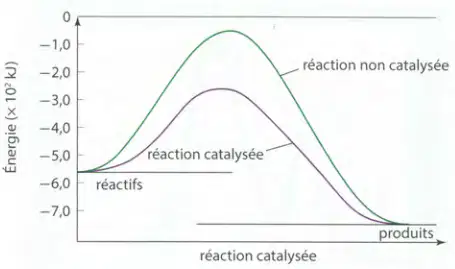
La valeur de Eₐ(dir) dans la réaction non catalysée est :
élevée
faible
nulle
négative
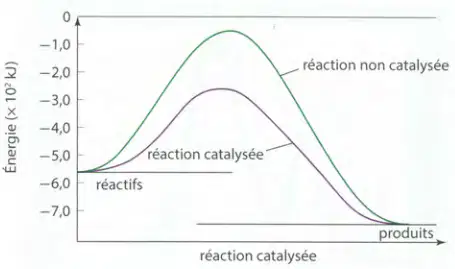
Quelle est la valeur de Eₐ(dir) dans la réaction catalysée?
Eₐ(dir) est plus faible dans la réaction catalysée.
Eₐ(dir) est plus élevée dans la réaction catalysée.
Eₐ(dir) ne change pas dans la réaction catalysée.
Eₐ(dir) disparaît complètement dans la réaction catalysée.
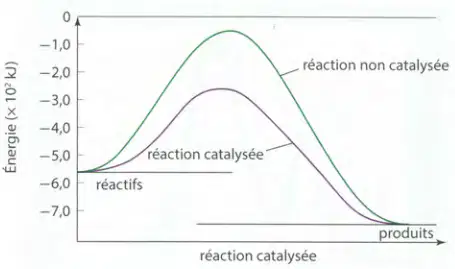
31. Parmi les deux réactions, laquelle est plus rapide et pourquoi ?
La réaction A est plus rapide car elle a une énergie d'activation plus faible.
La réaction B est plus rapide car elle a une énergie d'activation plus faible.
La réaction A est plus rapide car elle produit plus de chaleur.
La réaction B est plus rapide car elle produit plus de chaleur.
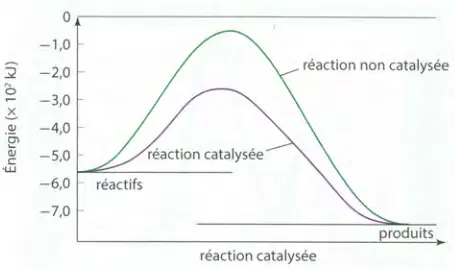
32. Quelle est la valeur de Eₐ(inv) dans la réaction non catalysée ?
Eₐ(inv) est de 80 kJ/mol
Eₐ(inv) est de 50 kJ/mol
Eₐ(inv) est de 120 kJ/mol
Eₐ(inv) est de 30 kJ/mol
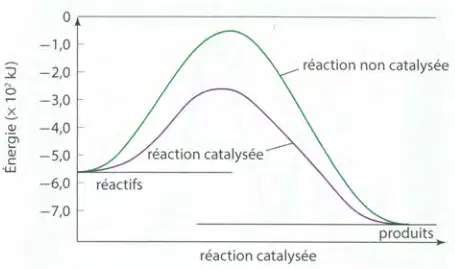
Quelle est la valeur de Eₐ(inv) dans la réaction catalysée ?
Eₐ(inv) est plus faible dans la réaction catalysée.
Eₐ(inv) est plus élevée dans la réaction catalysée.
Eₐ(inv) reste inchangée dans la réaction catalysée.
Eₐ(inv) disparaît dans la réaction catalysée.
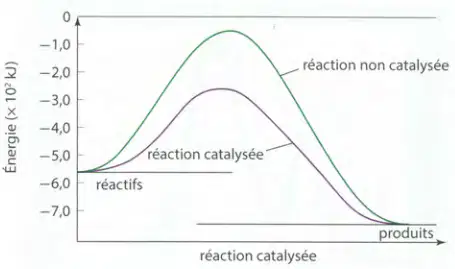
Quelle est la valeur de ΔH dans la réaction directe ?
ΔH = -100 kJ
ΔH = 0 kJ
ΔH = +100 kJ
ΔH = +50 kJ
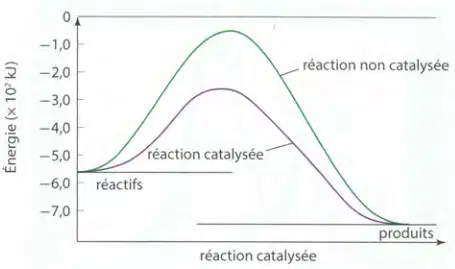
What is the value of ΔH in the reverse reaction?
ΔH becomes positive
ΔH remains unchanged
ΔH becomes negative
ΔH doubles
Dans la réaction de décomposition 2AB → A2 + B2, la concentration de A2 après 4,4 min = 0,52 mol/L et, après 5,6 min, sa concentration passe à 0,68 mol/L. Quel est le taux de changement moyen de la concentration de AB au cours de cette période?
0,133 mol/L/min.
0,080 mol/L/min.
0,045 mol/L/min.
0,200 mol/L/min.
Le taux de changement de la masse de cuivre est :
0,25 g/s
2,5 g/s
0,025 g/s
1,5 g/s
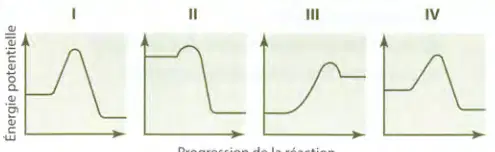
Désigne où les diagrammes d’énergie potentielle qui représentent chacune des réactions suivantes. La réaction qui:
I
a)
II
b)
III
c)
II
d)
Examinez la réaction : 4HBr(g) + O2(g) → 2Br2(g) + 2H2O(g). Comment le taux de décomposition de HBr (en mol/L/s) se compare-t-il au taux de formation de Br2 (en mol/L/s) ?
Le taux de décomposition de HBr est deux fois supérieur au taux de formation de Br2.
Le taux de décomposition de HBr est égal au taux de formation de Br2.
Le taux de décomposition de HBr est la moitié du taux de formation de Br2.
Le taux de décomposition de HBr est quatre fois supérieur au taux de formation de Br2.
Calculate the rate at which CO2(g) is produced in moles per second.
9.6 × 10^-5 mol/s (rounded).
1.2 × 10^{-4} mol/s
7.8 × 10^{-6} mol/s
2.5 × 10^{-3} mol/s
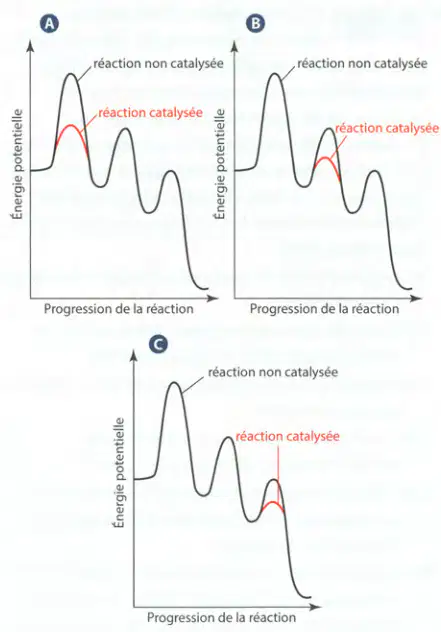
Which potential energy diagram most accurately shows the catalytic process if a catalyst was used in the reaction?
The diagram with a lower activation energy pathway compared to the uncatalyzed reaction.
The diagram with a higher activation energy pathway compared to the uncatalyzed reaction.
The diagram with no change in activation energy compared to the uncatalyzed reaction.
The diagram with a higher final energy of products than reactants.
What is the activation energy of the reverse reaction, Ea(inv)?
70 kJ.
40 kJ.
100 kJ.
150 kJ.
If the reaction were exothermic with an enthalpy of -25 kJ and the direct reaction always had an activation energy of +45 kJ, would the activation energy of the reverse reaction be the same as in (a)? Demonstrate your reasoning with a calculation.
No, the activation energy of the reverse reaction would be 20 kJ higher than the direct reaction.
Yes, the activation energy of the reverse reaction would be the same as the direct reaction.
No, the activation energy of the reverse reaction would be 70 kJ.
No, the activation energy of the reverse reaction would be 25 kJ lower than the direct reaction.
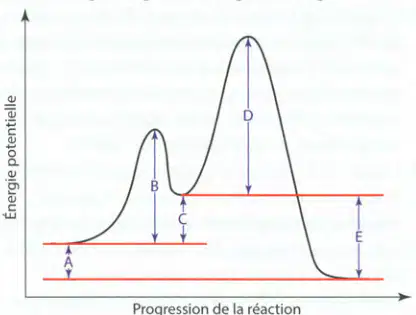
How many steps does this reaction have?
Three steps (as indicated by three peaks in the diagram).
One step (as indicated by a single peak in the diagram).
Two steps (as indicated by two peaks in the diagram).
Four steps (as indicated by four peaks in the diagram).
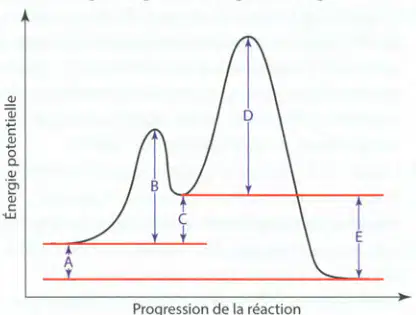
Which quantity represents the overall activation energy?
Quantity E represents the overall activation energy.
Quantity A represents the overall activation energy.
Quantity B represents the overall activation energy.
Quantity C represents the overall activation energy.
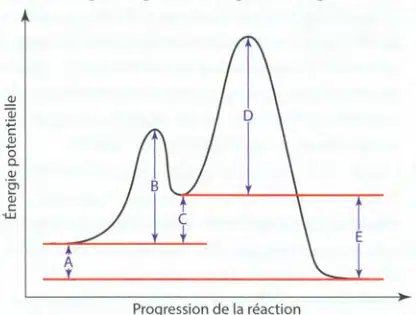
Is the overall reaction exothermic or endothermic?
Exothermic (final energy is lower than initial energy).
Endothermic (final energy is higher than initial energy).
Neither exothermic nor endothermic.
Cannot be determined from the information given.
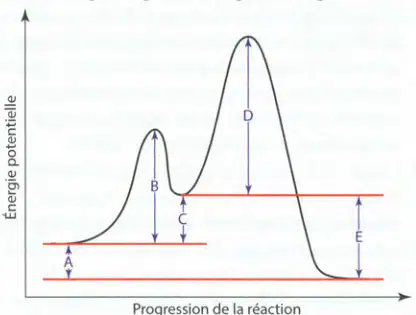
What does quantity B represent?
Quantity B represents the activation energy of the first step.
Quantity B represents the enthalpy change of the reaction.
Quantity B represents the rate constant of the reaction.
Quantity B represents the equilibrium constant of the reaction.
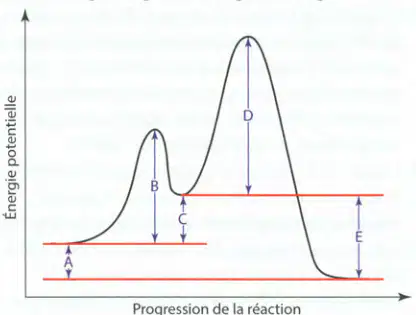
What does quantity F represent?
Quantity F represents the enthalpy change (ΔH) of the reaction.
Quantity F represents the activation energy of the reaction.
Quantity F represents the rate constant of the reaction.
Quantity F represents the equilibrium constant of the reaction.
What is the order of the overall reaction for each reaction?
Reaction A: first order; Reaction B: second order.
Reaction A: second order; Reaction B: first order.
Reaction A: zero order; Reaction B: first order.
Reaction A: first order; Reaction B: zero order.
What is the effect on each reaction when the molar concentration of R is doubled?
Reaction A: rate doubles; Reaction B: rate doubles (if S is constant).
Reaction A: rate halves; Reaction B: rate remains unchanged.
Reaction A: rate remains unchanged; Reaction B: rate doubles.
Reaction A: rate doubles; Reaction B: rate halves.
Describe the role of each element in the mechanism below: P2 → PQ → PQ2 → Q2 Step 1: P2 + Q → 2PQ Step 2: 2PQ → PQ2 Step 3: PQ2 → P2 + Q Which element acts as a catalyst in the above mechanism?
Q
P2
PQ2
PQ
46. Two gases, X2(g) and Y2(g), react in a closed vessel. The rate equation is: rate = k[X2]. If the volume of the vessel is reduced by half, what effect does this have on the reaction rate?
The reaction rate doubles.
The reaction rate is halved.
The reaction rate remains unchanged.
The reaction rate decreases by a factor of four.
47. Which of the following is the rate-limiting step in the mechanism for the reaction C6H5Br + C6H6 → HBr + C6H5C6H5? A) C6H5Br + AlBr3 → AlBr4- + C6H5+ B) C6H5+ + C6H6 → C6H6C6H5+ C) C6H6C6H5+ + AlBr4- → AlBr3 + HBr + C6H5C6H5 D) AlBr3 + HBr + C6H5C6H5
C6H5Br + AlBr3 → AlBr4- + C6H5+
C6H5+ + C6H6 → C6H6C6H5+
C6H6C6H5+ + AlBr4- → AlBr3 + HBr + C6H5C6H5
AlBr3 + HBr + C6H5C6H5
To ensure a valid comparison of reaction rates between metals using the loss of mass method with dilute HCl, how should you present your report?
Record the initial and final mass of each metal and compare the rate of mass loss under identical conditions.
Use different concentrations of HCl for each metal to observe varied reactions.
Only measure the volume of H2 produced for each metal.
Report only the final mass of each metal without considering initial mass.
Use a graphic organizer to present the list of units used to measure the rate of chemical reactions and the gaseous products in a reaction.
Moles per second, liters, and atm
Kilograms, meters, and seconds
Joules, watts, and volts
Candela, lumen, and lux
The statement about activation energy is: 'The activation energy depends on the frequency of collisions between particles.' Is this correct?
Yes, because activation energy is determined by how often particles collide.
No, activation energy is independent of the frequency of collisions between particles.
Yes, activation energy increases with more frequent collisions.
No, activation energy only depends on temperature.
Explain how such a large difference between the two instantaneous rates could occur.
A large difference between the two instantaneous rates could occur due to a significant change in concentration of reactants or products.
A large difference between the two instantaneous rates could occur because the temperature remains constant.
A large difference between the two instantaneous rates could occur due to identical reaction conditions.
A large difference between the two instantaneous rates could occur because the reaction is at equilibrium.
If a catalyst changes the reaction rate in the same way as temperature, how would you explain the difference?
A catalyst lowers the activation energy, while temperature increases the kinetic energy of molecules.
Both catalyst and temperature increase the activation energy.
A catalyst increases the temperature of the reaction mixture.
Temperature and catalyst both provide energy to break bonds.
What is the reason? Explain your answer using a diagram.
The diagram helps to visually represent the reason.
The diagram is used to decorate the answer.
The diagram is not necessary for explanation.
The diagram makes the answer longer.
54. Two reactions between two reactants occur at the same temperature. Both have an activation energy of +60 kJ, but one is endothermic and the other exothermic. Explain why both reactions do not necessarily have the same rate.
Because the overall energy change (endothermic vs exothermic) affects the rate, not just the activation energy.
Because both reactions have the same activation energy, their rates must be identical.
Because temperature does not influence reaction rates.
Because the reactants are different, so the rates must differ.
Which of the following is a factor to consider when choosing a catalyst for a reaction?
The cost and availability of the catalyst
The color of the catalyst
The shape of the reaction vessel
The amount of light in the room
56. To demonstrate the effect of surface area on reaction rate, blow flour onto a metal screen and then into a flame. The flour on the screen does not ignite, but the flour blown into the flame ignites instantly. Which statement best explains the difference in combustion rates according to collision theory?
The increased surface area of flour in the flame allows more collisions, increasing the reaction rate.
The flour on the screen has a higher activation energy, preventing ignition.
The flour blown into the flame has less oxygen available, slowing the reaction.
The flour on the screen is cooler, so it ignites faster.
57. Which of the following is a way to increase the reaction rate of combustion?
Increase the temperature
Decrease the concentration of reactants
Remove the catalyst
Lower the pressure
58. The use of a catalyst in chemical reactions can help achieve profitability under milder conditions. In what way does a catalyst change the rate of a reaction?
It increases the rate by lowering the activation energy.
It decreases the rate by increasing the activation energy.
It stops the reaction completely.
It has no effect on the rate of reaction.
Summarize what you have learned in this chapter using a graphic organizer. Which sections should you review to help you with this task?
Summary, Key Points, and What You Have Learned from chapter 6
Introduction and Glossary from chapter 6
References and Index from chapter 6
Author's Biography and Preface from chapter 6
An appropriate unit to measure the rate of decomposition of FeS2(s) is:
mol s⁻¹
kg m⁻³
J s⁻¹
m s⁻¹
What is an appropriate unit to measure the rate of formation of SO2(g)?
mol/s
kg/m
L/s
atm
How can the rate of decomposition of FeS2(s) and the rate of formation of SO2(g) be measured, and what is the difference between the two rates?
By measuring the change in mass of FeS2(s) and the change in volume of SO2(g); the difference is that one measures a reactant and the other a product.
By measuring the color change of FeS2(s) and the temperature of SO2(g); the difference is that both measure physical properties.
By measuring the pH of the solution for FeS2(s) and the pressure of SO2(g); the difference is that both measure chemical properties.
By measuring the boiling point of FeS2(s) and the melting point of SO2(g); the difference is that both measure phase changes.
In the Hall-Héroult process, cryolite, Na3AlF6, decomposes as illustrated in the equation: Na3AlF6(l) → 3Na(l) + Al(l) + 3F2(g). If the average rate of formation of F2(g) is 0.85 mol/s, what is the average rate of decomposition of Na3AlF6, in grams per second?
0.283 mol/s (or corresponding grams per second based on molar mass of Na3AlF6)
2.55 mol/s (or corresponding grams per second based on molar mass of Na3AlF6)
0.85 mol/s (or corresponding grams per second based on molar mass of Na3AlF6)
0.15 mol/s (or corresponding grams per second based on molar mass of Na3AlF6)
The energy variations and reaction rates can be quantified. An ammonia plant uses the following synthesis reaction: N2(g) + H2(g) → 2NH3(g) ΔH = -91.8 kJ (a) Using the concentration data in the table below, graphically determine the average rate of formation of NH3(g) during the first 130 s of the reaction. Données relatives à la production de l’ammoniac Temps (s) | Concentration (mol/L) 0 | 0.000 20 | 0.050 60 | 0.100 90 | 0.125 130 | 0.125 160 | 0.160 200 | 0.160
Average rate = (0.125 mol/L - 0.000 mol/L) / 130 s = 0.00096 mol/L/s
Average rate = (0.100 mol/L - 0.000 mol/L) / 130 s = 0.00077 mol/L/s
Average rate = (0.125 mol/L - 0.050 mol/L) / 130 s = 0.00058 mol/L/s
Average rate = (0.160 mol/L - 0.000 mol/L) / 130 s = 0.00123 mol/L/s
For NH3(g) to be produced at this rate in the process, will the reactants N2(g) and H2(g) be consumed at the same rate? Justify your answer.
No, because the stoichiometry of the reaction requires different rates of consumption for N2 and H2.
Yes, because all reactants are consumed at the same rate in every reaction.
No, because N2 is consumed faster than H2.
Yes, because NH3 production rate determines equal consumption rates for N2 and H2.
In an industrial process, dinitrogen pentoxide, N2O5(g), is used at a rate of 5.00 × 10² kg per hour. The equation for the process is: 2N2O5(g) → 4NO2(g) + O2(g) What is the rate, in moles per minute, at which NO2(g) is produced?
Rate = (5.00 × 10² kg/hr) × (1 hr/60 min) × (1 mol N2O5/108 g) × (4 mol NO2/2 mol N2O5)
Rate = (5.00 × 10² kg/hr) × (1 hr/60 min) × (1 mol N2O5/54 g) × (2 mol NO2/2 mol N2O5)
Rate = (5.00 × 10² kg/hr) × (1 hr/60 min) × (1 mol N2O5/108 g) × (2 mol NO2/2 mol N2O5)
Rate = (5.00 × 10² kg/hr) × (1 hr/60 min) × (1 mol N2O5/108 g) × (1 mol NO2/2 mol N2O5)
In the Haber-Bosch process, only 15% of nitrogen and hydrogen are converted to ammonia per pass through the reactor. What is a possible hypothesis for why the conversion percentage is so low in the presence of a catalyst, and how could conversion be improved?
The reaction is reversible and reaches equilibrium, so not all reactants are converted; conversion can be improved by removing ammonia as it forms.
The catalyst is ineffective, and conversion can be improved by increasing the temperature indefinitely.
Nitrogen and hydrogen are not reactive, and conversion can be improved by using a different catalyst.
The reactor is too small, and conversion can be improved by increasing the reactor size.
65. Increasing the reaction temperature improves the efficiency of product formation. Why does the reaction rate between two gases increase when the temperature is raised, as shown by the change from 1.43 × 10⁻³ mol/L/s at 18.0°C to 2.50 × 10⁻³ mol/L/s at 28.0°C?
Because higher temperature increases the number of molecules with enough energy to overcome the activation energy barrier.
Because higher temperature decreases the activation energy of the reaction.
Because higher temperature increases the enthalpy change of the reaction.
Because higher temperature reduces the number of collisions between reactant molecules.
65. It is suggested to increase the reaction temperature to improve the efficiency of product formation. The reaction rate between two gases, which occurs in a single step, is 1.43 × 10⁻³ mol/L/s at T₁ = 18.0°C. The activation energy of this reaction is 20 kJ and the enthalpy change is –30 kJ. At T₂ = 28.0°C, the reaction rate is almost 2.50 × 10⁻³ mol/L/s. (b) Which of the following best describes the changes in the potential energy diagram when the temperature is increased?
The activation energy remains the same, but the enthalpy change stays negative and unchanged.
The activation energy increases, and the enthalpy change becomes less negative.
The activation energy decreases, and the enthalpy change becomes positive.
Both activation energy and enthalpy change increase.
What other factors, besides temperature, could affect the reaction rate?
Concentration of reactants
Color of reactants
Shape of container
Type of thermometer used
It has been determined that a reaction between two substances D and E is of first order with respect to D. Which of the following statements best explains which mechanism is most likely to be adopted, and whether you can affirm with certainty which mechanism is most appropriate?
The mechanism where D is involved in the rate-determining step is most likely, but certainty cannot be affirmed without further evidence.
The mechanism where E is involved in the rate-determining step is most likely, and certainty can be affirmed.
Both mechanisms are equally likely, and certainty can be affirmed based on the order.
Neither mechanism is likely, and certainty cannot be affirmed.
In an industrial exothermic process, a new compound, less reactive, is substituted for a reactant. The process start-up is more difficult with the new reactant. What could be a hypothesis to explain this difficulty, and what other agent could help start the reaction?
The new reactant has a higher activation energy, so a catalyst could help start the reaction.
The new reactant is more volatile, so cooling agents could help start the reaction.
The new reactant is more reactive, so inhibitors could help start the reaction.
The new reactant is less stable, so increasing pressure could help start the reaction.
Transition metals are often used as catalysts in industrial reactions because they have which of the following properties related to their atomic structure?
They have variable oxidation states and can form complexes easily.
They have a full outer electron shell.
They are non-reactive and do not form compounds.
They have low melting points and are soft metals.
In reaction rate theory, the number of collisions between reactants is not a factor. Give an example.
Unimolecular reactions
Bimolecular reactions
Termolecular reactions
Catalyzed reactions
Examine the reaction below: Mg(s) + 2CH3COOH(aq) → Mg(CH3COO)2(aq) + H2(g) We can calculate the reaction rate for a time interval by determining the variation of:
the pH of the solution.
the concentration of Mg(s).
the color.
the temperature.
the volume of the solution.
The concentration of reactant A(g) is 0.39 mol/L at the start of the reaction. After 3.2 minutes, it drops to 0.023 mol/L. What is the rate of change of A(g) during this period?
5.0 × 10⁻² mol L⁻¹ s⁻¹
1.1 × 10⁻² mol L⁻¹ s⁻¹
3.9 × 10⁻¹ mol L⁻¹ s⁻¹
3.9 × 10⁻² mol L⁻¹ s⁻¹
1.9 × 10⁻³ mol L⁻¹ s⁻¹
During a reaction in aqueous solution, increasing the concentration of reactants increases the reaction rate because:
the potential energy of the chemical bond is reduced.
there are more collisions between reactants.
there are more intermolecular attractions between reactants and losses of water.
the energy of the reactants increases.
a greater percentage of aqueous ions have an energy greater than the activation energy.
Examine the potential energy diagram from question 23. Which letter represents the activation energy of the direct reaction in the second step?
B
H
I
J
The rate equation for a reaction is as follows: rate = k[B]ⁿ[C]ᵐ. According to this rate equation, which statement is correct?
The order of the global reaction is zero.
The global reaction is of the second order.
The reaction rate is of the first order with respect to B and C.
The global reaction is of the first order.
The rate-limiting step must involve B.
In the case of a reaction whose value ΔHᵣ = +58 kJ, the activation energy of the direct reaction, Eₐ(direct), is +89 kJ. Find the value of Eₐ(reverse):
+114 kJ
+73 kJ
+37 kJ
-89 kJ
+31 kJ
According to the reaction mechanism below, which substance or substances whose concentration would have the greatest effect on the overall reaction rate? Step 1: A → B + C (fast) Step 2: C + D → F (slow) Step 3: F + B → G (fast)
A
A + B
D
C + D
F

