
 Worksheets
LT4 Chapter 7&8
Total questions: 115
Worksheet time: 1hrs 26mins
Which example provides evidence of a chemical change?
Wood releases ash and smoke when burned.
Rock particles separate when soil is being sifted.
Boiling water bubbles when being heated.
Sugar is not visible when dissolved in water.
When vinegar and baking soda are combined, bubbles and foam are produced.
What evidence demonstrates that a chemical change has occurred?
A color change occurs.
A gas is formed.
A solid is dissolved.
A precipitate is formed.
In a _______ change, a substance changes into a different substance
physical
chemical
Which of these is NOT a sign a chemical change has occurred?
color change
temperature change
bubble formation
cutting material
The Law of Conservation of Mass states
that matter exists in all states and reacts the same
that matter can only be changed into new substances by introducing a catalyst
that matter exists in the same state throughout any chemical change
that matter cannot be created or destroyed
SELECT ALL THAT APPLY: Why is it important that chemical equations are always balanced?
Matter cannot be created
Matter cannot be destroyed
Matter can only be rearranged
Matter doe
SELECT 2: Which of the following 2 are chemical reactions?
sugar dissolving in water
water turning into steam
burning wood
mixing baking soda and vinegar
tearing paper
In a chemical equation, the reactants are found on the _____ of the arrow
right
left
An ending substance that is made during a chemical reaction
reactant
product
A starting substance that is part of a chemical reaction
Reactant
Product
A process in which atoms rearrange to form new substances
chemical reaction
chemical formula
science
Select the pair of words that correctly displays the general FORMAT for writing chemical equations
products --> reactants
products --> products
reactants--> products
reactants --> reactants
The total mass of the reactants is 18.4g. What would the total mass of the products be? (NOTE: Refer to the Law of Conservation of Mass)
18.4g
9.2g
4.6g
36.8g
Reactant 1 is 4 grams, reactant 2 is 2 grams. How many total grams is the product?
4 grams
2 grams
6 grams
10 grams
What are the 5 signs of a chemical reaction?
Gas released, smoke or fire, fizzing and new atoms created.
Gas released, color change, smoke or fire, new substances form, and temperature change.
Gas released, new lights, and bubbles.
Bubbling or fizzing, color change, smoke or fire, new substances form, and old atoms destroyed.
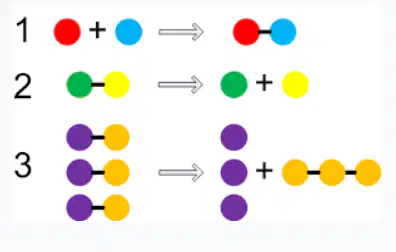
What does this model show?
physical change
phase change
chemical change
ooohh colors!
According to the Law of Conservation of Mass, the total mass of the reactants...
is always same as the total mass of the reactants.
is sometimes more or sometimes less than the products.
is a new substance formed from the chemical reaction.
is equal to the total mass of the products.
Copper oxide and carbon dioxide are made when copper carbonate is heated strongly. Which is a product?
Heat
Copper carbonate
Copper oxide
Oxygen
What is another name for combustion?
Reduction
Burning
James
Displacement
Combustion reactions always release energy. What word can be used to describe them?
Endothermic
Exothermic
Reversible
Fluorescent
Which of these is found in the fire triangle and is therefore essential for combustion?
Oxygen
Water
Carbon dioxide
Hydrogen

This image shows a
chemical reaction
physical change
musical change
all of these answers are correct

This change is a
chemical reaction
physical change
musical change
all answers are correct

The reactants in the image above are:
CH4 and 2 O2
2 H2O and CO2
All of these are reactants
All of these are products
The products in the image above are:
CH4 and 2 O2
2 H2O and CO2
All of these are reactants
All of these are products
When energy is absorbed and taken in during a chemical reaction it is called
exothermic
endothermic
eccentric
ectomorphic
When energy like heat and light are given off in a chemical reaction it is called
exothermic
endothermic
eccentric
ectomorphic
When the matter in a chemical reaction gets warmer it is called
exothermic
endothermic
eccentric
endomorphic
When the matter in a chemical reaction gets colder it is called
exothermic
endothermic
eccentric
endomorphic

The products are:
molecular oxygen and 2 carbon
2 carbon monoxide
all of these are products
all of these are reactants
The reactants are:
molecular oxygen and 2 carbon
2 carbon monoxide
all of these are products
all of these are reactants
A combination of symbols that represents the elements in a compound.
subscripts
Chemical formula
products
reactants
A substance that enters into a chemical reaction.
Reactants
Compounds
PH
Water
A one letter or two letter set of characters used to identify an element.
symbols
products
elements
coefficient
The periodic table shows that Carbon has 6 protons. This means that Carbon also has
6 electrons
Atomic mass of 6
12 Electrons
No properties
How are elements sorted?
by their atomic number
by the atomic weight
alphabetically
by the groups
What are the charges of a PROTON, NEUTRON, and ELECTRON.
Negative, Neutral, Positive
Neutral, No charge, Positive
Positive, Neutral, Negative
Positive, Negative, Neutral
Which of the following is an element?
Water
Baking soda
Carbon Dioxide
Neon
Which of the following is a compound?
Gold
Siver
Iron
Water
Two or more elements that are chemically combined.
Elements
Compounds
Mixtures
Solutions
What are elements?
Pure substances that can NOT be broken down into something else.
Substances that can be broken down into other substances.
Elements can be heterogeneous or homogeneous.
Elements can be solutions.
If an element has 113 protons, what is it's atomic number?
12
113
13
1.3
This ID's the element. It also gives you the number of protons inside the element.
Atomic mass
Atomic number
Mass number
Isotope number
A subatomic particle with a neutral charge.
Proton
Neutron
Electron
Ion
Where do you find the amount of electrons in an element?
Atomic Weight
Chemical Name
Chemical Symbol
Atomic Number
What is the atomic weight made up of?
number of protons and neutrons
Number of protons and electrons
Number of electrons and neutrons
Number of elements and metals
Which of the following determines the identity of an atom?
Protons
Neutrons
Electrons
Negative

What is the atomic number of this element?
6
12.011
14
12

How many electrons does this element have?
1
106.11
26
53


Cu(NO3)2 is ...

How could we make this reaction happen more quickly?
Crush the chalk to increase the surface area
Decrease the concentration of the acid
Put the test tube in an ice bath
The sugar cubes are called the
solute
solvent
The water is called the
solvent
solute
In which cup will the salt dissolve more slowly?
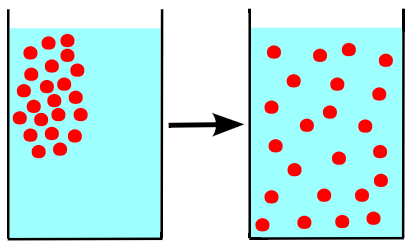
water can't dissolve ...............
sugar
oil
salt
coffe
What things can be dissolved?
salt
sand
black pepper powder
The sugar cubes are called the
solute
solvent
The water is called the
solvent
solute
The process of evenly mixing one substance into another forming a solution is ................... process
concentration
heating
dissolving
condensation
.................. is often called the universal solvent
Oil
Water
Acetone
air
when a solvent can no longer hold any more solute
saturation
dilute
dissolve
Some substances ........................... when you mix them with water.
squash
dissolve
heat
Substances that dissolve in water are called ...................
soluble
insoluble
solution
Substances that do not dissolve in water are called ...................
soluble
insoluble
solution
The mix of solute and solvent
soluble
insoluble
solution
The liquid that the solid dissolve into.
soluble
solute
solvent
The flour is …………………………., it means it cannot dissolve.
insoluble
solution
soluble

Look at the diagram. B is?
Solute
Solvent
Solution
Look at the diagram. A is?
Solute
Solvent
Solution

Look at the following picture.
A powder is about to be poured into the liquid. Which of the following should be done to make this powder dissolve faster?
freeze the mixture
store the mixture in a dark place
add more powder to the liquid
stir the powder in the liquid
Zahra wants to make a solution, she has a spoonful of baking soda powder, which of the following ingredients must Zahra mix to make a solution?
more salt
water
sand
rocks
Stirring the solution increases the rate of dissolution (rate of dissolving).
True
False
The smaller the particle size the faster the rate of dissolution (rate of dissolving).
True
False
How does cold water affect the speed of dissolving?
Cold water slows down dissolving.
Cold water speeds up dissolving.
Cold water has no effect on dissolving.
Cold water has no effect on dissolving.
Jackson is making dinner and is trying to dissolve salt into a pot of water. The salt is dissolving slowly. What should Jackson do to speed up the rate of dissolving?
He should put larger salt particles in the water.
He should heat the water to a higher temperature.
He should completely stop stirring the pot of water.
He should slow down the speed he is stirring the pot.
to spread out evenly in a liquid
Evaporation
Dissolve
Magnetic
Solute

How many neutrons are in the element shown?
4
9
5
13
Use your periodic table to find which element has 5 protons.
Lithium
Calcium
Boron
Neon
Which element has an atomic mass of 19?
Hydrogen
Argon
Fluorine
Potassium
How do you find the number of neutrons in an atom?
Atomic Number
Atomic Mass
Atomic Mass - Atomic Number
Atomic Number + Atomic Mass

How many electrons does the element in the picture have?
19
39
20
58

What is the atomic mass of the element shown?
14
28
42
How many elements are there on the Periodic table?
101
99
118
125
Symbol of Silicon is ...
Si
S
Sl
Sn
Pb is symbol for ...
Lead
Potassium
Phosphorus
Platina
Below are symbol of gold, silver, and sodium ...
Au, Ag, and Na
Ge, S, and S
Au, S, and Na
Ga, Ag, and Na

Number 12.001 refers to ...
number of mass
number of atom
number of proton
number of electron
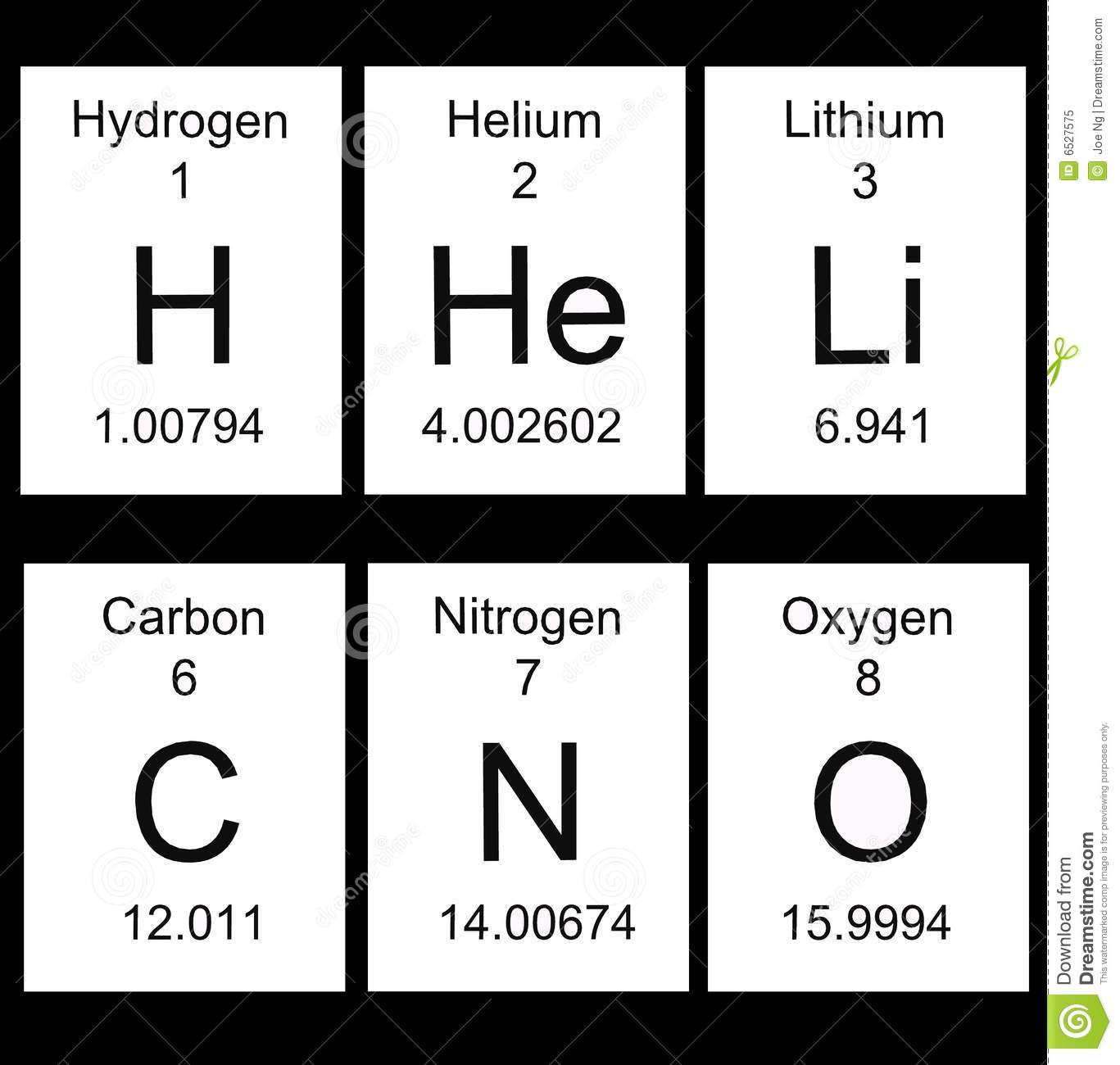
the basic structural unit of matter
atom
matter
element
nucleus

In an element box, the number at top is the
atomic number
atomic name
atomic mass
atomic symbol

The chemical symbol in this element box is
26
Fe
Iron
55.845

