
 Worksheets
Rome
Total questions: 82
Worksheet time: 41mins
Name
Class
Date
1.
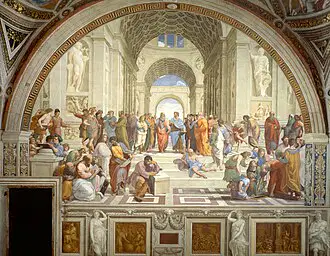
The topic and theme of School of Athens shows the Renaissance admiration of
a)
medieval culture
b)
Roman-Greek Culture
c)
Islamic influence
d)
the Northern Renaissance
2.
A focus on the human experience, the abilities of humans and celebrating what humans can do in art is an example of
a)
classicism
b)
idividualism
c)
humanism
d)
perspective
3.
In Renaissance Art perspective refers to
a)
adding depth and dimension to the art with a focal point
b)
telling multiple stories in the art using characters
c)
creating an illusion where the art looks different from angles
d)
showing the geographic location where the art was created
4.
The Renaissance was a cultural Golden Age, rebirth or reawakening of thought in Europe as _______ began to decline
a)
the Enlightenment
b)
Feudalism
c)
the Roman era
d)
trade
5.
Which family supported the arts in Florence?
a)
Medici
b)
Cervantes
c)
Machiavelli
d)
Moore
6.

What does this map likely show
a)
The Catholic Church's economic influence in various regions
b)
the expansion of Renaissance ideas to the north
c)
the expansion of Renaissance ideas from Florence
d)
the importance of Venice in trade after the Crusades
7.
Who largely funded the Northern Renaissance?
a)
The Roman Catholic Church
b)
Wealthy Italian Bankers
c)
Northern nobles and kings
d)
The commoners
8.
Patronage is
a)
the investment and spending on culture and the arts
b)
giving 10% of one's earnings to the church
c)
the act of creating art for charity
d)
the act of buying and selling goods with other countries
9.
All of the following are true of the city of Venice except
a)
Venice is located at the end of the Adriatic Sea east of Italy making it important for trade
b)
Venice is a port city that was a major trade city during and after the Crusades.
c)
Merchants in Venice generated wealth that would help lead to money for investments and patronage
d)
Venice was the home of wealthy banking families such as the Medicis
10.
_______ is the Italian city credited for starting the Renaissance
a)
Florence
b)
Naples
c)
Rome
d)
Venice
11.
Which direction did the Renaissance grow through Europe?
a)
north
b)
south
c)
east
d)
west
12.
Which of the following cities was an important economic hub in Northern Europe that drew artists in with its opportunities?
a)
Florence
b)
Bruges
c)
Milan
d)
Constantinople
13.
All of the following are true of the Medici except
a)
the Medici ruled over all of Italy during the Renaissance
b)
the Medici gained power from their wealth in Florence
c)
the Medici had a member of their family become pope
d)
the Medici used their wealth and power ot expand the arts
14.
The city of Venice was ruled by
a)
the Great Council and the Doge
b)
the Medici Family
c)
the Roman Catholic Church
d)
Wealthy nobles from Flanders
15.
The _______ was a significant influencer of daily life as well as politics throughout Europe.
a)
Roman Catholic Church
b)
Italian Merchants
c)
Florentine Bankers
d)
Vikings
16.
All of the following were true of the Italian city-states during the Renaissance except
a)
the Italian Peninsula was under the rule of Muslim invaders
b)
the Italian city-states were largely independent
c)
many Italian city-states were led by powerful wealthy families
d)
the Roman Catholic Church was centered in Rome
17.
Michelangelo is known for all of the following except
a)
writing the play "Merchant of Venice"
b)
sculpting "David"
c)
painting the Sistine Chapel
d)
being a famous artist from Florence, Italy
18.
Which book argued that rulers should do whatever they need to gain and maintain power?
a)
Shakespeare's "The Merchant of Venice"
b)
DaVinci's "The Last Supper"
c)
Cervantes' "Don Quixote"
d)
Machiavelli's "The Prince"
19.
_______ wrote many plays and sonnets
a)
Shakespeare
b)
DaVinci
c)
Raphael
d)
Van Eyke
20.
Who painted the Last Supper and Mona Lisa?
a)
DaVinci
b)
Michelangelo
c)
Raphael
d)
Donatello
21.

This piece of artwork most likely refers to
a)
the Bubonic Plague
b)
the Crusades
c)
the 100 Years War
d)
Viking Ivasions
22.
In Spain and Eastern Europe, Medieval European Christianity mostly clashed with _______
a)
Hinduism
b)
Islam
c)
Buddhism
d)
Norse (Viking) Religion
23.
Which foreign culture was a major influence on English court between William the Conqueror's conquest and the 100 Years War?
a)
Roman-Greco
b)
Spanish- Iberian
c)
Normand-French
d)
Norse-Viking
24.
When given land by the English and French, Vikings had to promise to
a)
not practice religion
b)
convert to Judaism
c)
worship norse-gods
d)
convert to Christianity
25.
Which group was known for attacking and raiding villages to gain wealth?
a)
the Vikings
b)
the Brits
c)
the Normands
d)
the Umayyads
26.
What economic effect did the Crusades most have on Europe?
a)
European monarchs gained gold and wealth from pillaging
b)
Italian merchants began to develop wealth through trade
c)
Viking warriors became highly paid professional mercenaries
d)
Medieval towns became bankrupt and lost charters
27.
Which of the following is true of the Bubonic Plagues effects on the Medieval European working class?
a)
the working class were largely unaffected because they plague did not reach the manors.
b)
the working class gained wealth and reclaimed large plots of land from medieval lords.
c)
working conditions improved due to an increased demand for workers and food surplus.
d)
working conditions remained the same and Feudalism continued until the Reconquista.
28.
Peasants Revolt was a rebellion by English peasants against
a)
the failure of the crusades in Jerusalem
b)
taxes after the Bubonic Plague
c)
the loss of English land grants in France
d)
the success of the Norman Conquest
29.
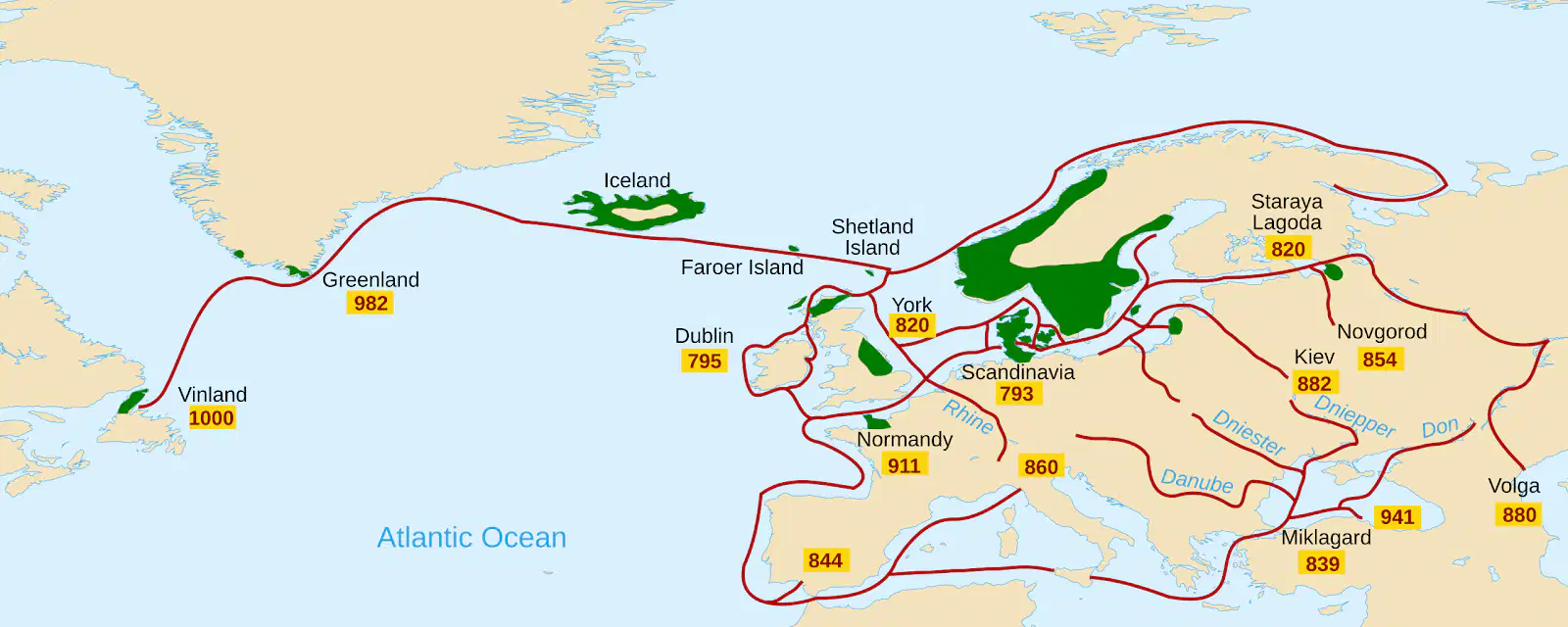
This map likely shows the voyages of
a)
the VIkings
b)
the Umayadds
c)
the French
d)
the Brits
30.
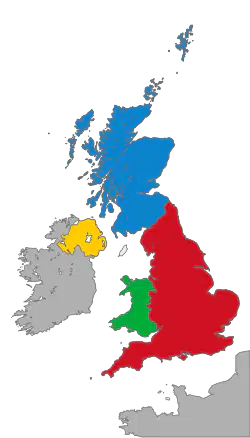
The blue, red and green make up the Island of
a)
Norway
b)
Britain
c)
Normandy
d)
Ireland
31.
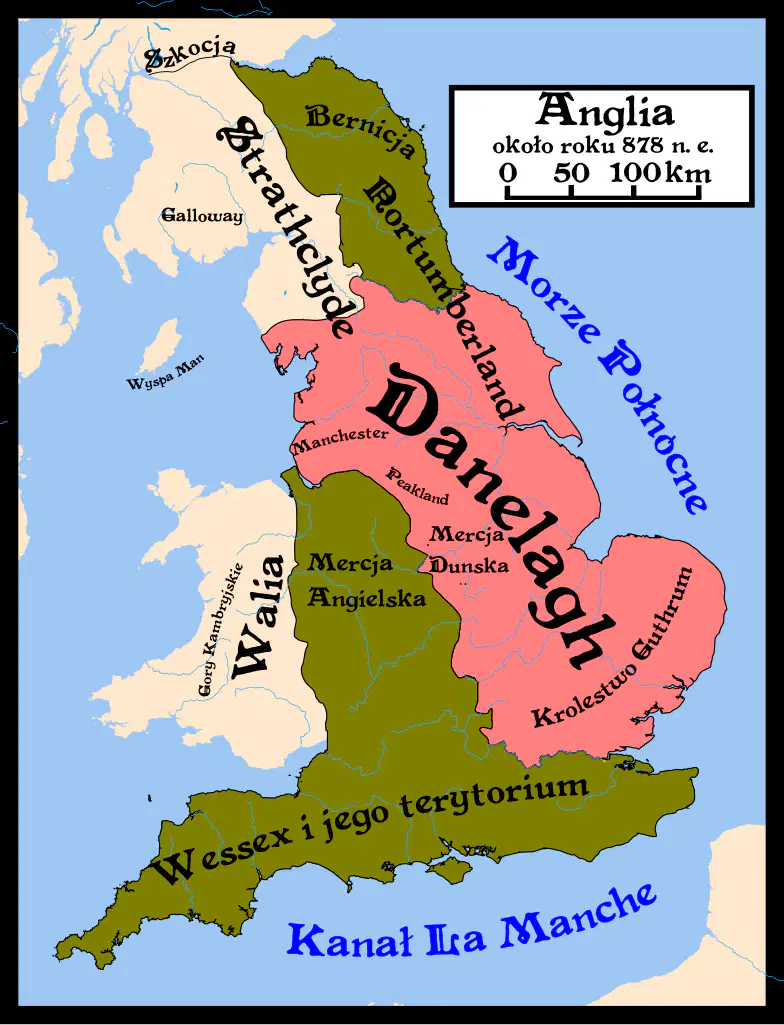
Which land was given to the Vikings to settle from the English?
a)
Walia
b)
Wessex
c)
Danelagh
d)
Mercia
32.
"If you will attack the city tomorrow, the Lord will deliver it into your hands. God is all powerful. If he wills, he will storm the walls even with one ladder. The Lord aids those who labor for the truth!" – An anonymous hermit to the crusaders in 1099.
This Crusader is likely talking about the city of
a)
Constantinople
b)
Rome
c)
Paris
d)
Jerusalem
33.
When Edward the Confessor and Charles IV died without heirs, this led to a _______.
a)
power vaccuum
b)
social contract
c)
holy crusade
d)
balance of power
34.
What group did the French and English make an alliance with for protection in exchange for land; to avoid conflicts with them?
a)
the Turks
b)
the Irish
c)
the Vikings
d)
the Byzantines
35.
"Here is a law which is above the King and which even he must not break"
This quote comes from
a)
the Magna Carta
b)
the Doomsday Book
c)
Canterbury Tales
d)
Beowolf
36.
What effect did the 100 Years War have on English and French governments?
a)
the lords gained more power controlling the peasants in war
b)
the monarchs gained more power by using professional armies
c)
England conquered France and France became a vassal of England
d)
the peasants were bale to rise up and bring down the monarchies
37.
The Norman Conquest of 1066 was won by _______.
a)
William the Conqueror
b)
Harold Godwinson
c)
Harold III
d)
Alfred the Great
38.

This image of Joan of Arc fighting against England for France comes from the _______.
a)
Norman Conquest of 1066
b)
100 Years War
c)
Crusades
d)
Reconquista
39.
All of the following are true of the Bubonic Plague except
a)
It reached Europe from Asia through trade towns
b)
It killed more than 1/3 of the European population
c)
Plague doctors attempted to treat those affected
d)
It was caused by mosquitos and flying gnats
40.
All of the following are true of the Crusades except
a)
It was triggered by the Seljuk Turk take over of Jerusalem
b)
It was a series of Holy Wars between Muslims and Christians
c)
It lead to European Empires gaining lands in Southwest Asia
d)
It ended with the new Ottoman Empire conquering Constantinople
41.
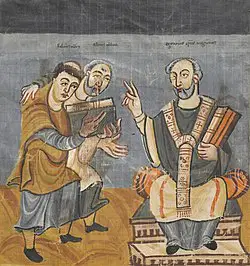
This artwork during Charlemagne's reign is an example of the
a)
Carolingian Renaissance
b)
Greek Classicism
c)
Italian Renaissance
d)
Gothic Movement
42.
All of the following are true of castles except
a)
the would be the living homes of the lord/lady or king
b)
they were built by the vikings from the north
c)
they would be daily government centers for the people
d)
they displayed wealth and power of the owner
43.
Which best displays the code that Knights lived by?
a)
Leisure: to relax and enjoy life
b)
Success: to work hard and achieve great things
c)
Wealth: to get rich or die trying
d)
Chivalry: to be brave and serve others
44.
_______ was the most popular influential religion in Western Europe during the Medieval Period.
a)
Islam
b)
Judaism
c)
Christianity
d)
Hinduism
45.
Charlemagne
a)
standardized the coinage based on Roman styled coins
b)
promoted far sea trade with China, Africa and America
c)
began developing paper money throughout the empire
d)
gave land taken from the Roman government to peasants
46.
A group of craftsmen or merchants that regulated quality and prices of goods and services is known as
a)
a tithe
b)
a guild
c)
an apprentice
d)
a manor
47.
All of the following are true of towns except
a)
towns fostered more buying and selling to make money
b)
towns held markets where people would travel to buy and sell
c)
towns were often clean, quiet and empty
d)
towns became specialized in goods and services
48.
All of the following could be considered noble social classes except
a)
kings
b)
lords
c)
knights
d)
serfs
49.
A plot of land given to a noble in exchange for their loyalty was known as a
a)
fief
b)
guild
c)
tithe
d)
glebe
50.
All of the following are true of a Three Field System except
a)
one field at a time laid fallow for soil to rest
b)
one field was permanently given to the Church
c)
the fields were rotated based on the season
d)
crops were planted based on the seasons
51.

The modern day nation in blue is
a)
Britain
b)
Spain
c)
France
d)
Italy
52.
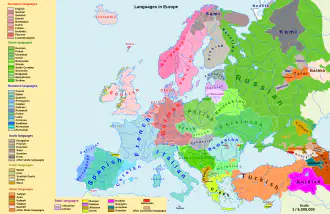
What geographic landscape often has helped divide European languages such as Spanish and French and Italian and French?
a)
oceans
b)
glaciers
c)
deserts
d)
mountains
53.
A lord given land from a king becomes a(n) _____ to the king
a)
vassal
b)
guild
c)
apprentice
d)
bishop
54.
Who would often be left to manage the peasants to ensure their work is done?
a)
the bailiff
b)
the serf
c)
the knight
d)
the friar
55.
Which of the following best describes Feudalism?
a)
a system where one person holds absolute power and rules the entire empire singlehandedly
b)
a society where leadership is rotated among the masses and all are treated equally with rights.
c)
a society based on democratic ideas voting and freedom to the common person based on equality.
d)
an agreement where a overlord gives land and protection in exchange for loyalty and service
56.
"We are informed by the texts of the gospels that in this Church and in its power are two swords; namely, the spiritual and the temporal... Both, therefore, are in the power of the Church, that is to say, the spiritual and the material sword, but the former is to be administered for the Church but the latter by the Church... If, therefore, the earthly power errs, it shall be judged by the spiritual power"
This quote best describes the relationship between
a)
the knight and the king
b)
the serfs and the bailiff
c)
the bailiff and the lord
d)
the pope and the king
57.
Charles Martel's Frankish army stopped the Umayyad Invasion of Western Europe at the Battle
a)
Tours
b)
Normandy
c)
Paris
d)
Britain
58.
Which Frankish leader christianized and united the Franks?
a)
Charles Martel
b)
Clovis
c)
Charlemagne
d)
Henry
59.
All of the following are true of Charlemagne except
a)
He was crowned the first Holy Roman Emperor
b)
He used feudalism to rule his empire
c)
He was a Viking conqueror who invaded Europe
d)
He expanded the Frankish borders to united much of Central Europe
60.
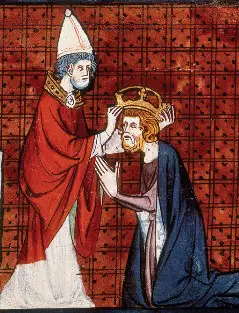
This image depicts _______ crowning Charlemagne
a)
Abd al-Rahman al-Ghafiqi
b)
Charles Martel
c)
Irene of Athens
d)
Pope Leo
61.
Last, First
4 lines
62.
Period
a)
1
b)
2
c)
3
d)
4
e)
5
63.
Roman aqueducts were engineering marvels
a)
that brought fresh water to Rome
b)
where gladiators fought for entertainment
c)
where Romans worshiped their gods
d)
roads that connected cities in Rome
64.
"When in Rome, do as the Romans do" -Saint Ambrose
This quote most reflects the definition of _______ in the Roman Empire.
a)
democracy
b)
assimilation
c)
citizenship
d)
expansion
65.
_______ was a religious group that was persecuted at first by Rome, but eventually became legalized and then the official religion of Rome
a)
Zoroastrianism
b)
Hinduism
c)
Judaism
d)
Christianity
66.

This image is an example of _______ art.
a)
surrealist
b)
abstract
c)
mosaic
d)
fresco
67.
As the empire grew larger the cost of the army
a)
also became greater because of a larger boundary to cover
b)
remained the same because no one would attack Rome
c)
became cheaper because barbarians joined the Roman army
d)
became cheaper because Rome experienced more peace.
68.
"Bread and Circuses" refers to free food, water and entertainment that Roman Emperors offered to distract the _______ to prevent them from rebelling.
a)
patricians
b)
unemployed
c)
Senate
d)
barbarians
69.
When Rome added copper to coins during a metal shortage, prices of goods and services went up. This is called _______
a)
deficit
b)
interest
c)
inflation
d)
deflation
70.
How did Rome raise funds from its citizens to pay for the Empire?
a)
selling bonds
b)
collecting tithes
c)
demanding tribute
d)
collecting taxes
71.
The non-Latin speaking Germanic peoples were known as ______
a)
barbarians
b)
immigrants
c)
pilgrims
d)
Christians
72.

This map best shows
a)
the land of the Germanic peoples
b)
trade routes leading to Rome
c)
the expansion of the Roman Empire
d)
languages of the Roman Empire
73.
Which sea did the Roman Empire territories surround?
a)
Black Sea
b)
Red Sea
c)
Mediterranean Sea
d)
Caspian Sea
74.
The capital of Rome was
a)
Venice
b)
Milan
c)
Florence
d)
Rome
75.
Becoming a Roman citizen meant
a)
gaining all the privileges and protections Rome offered
b)
serving in the Senate or Plebeian Council
c)
becoming a slave to a Patrician for ten years
d)
being forgiven for all crimes previously committed
76.
All of the following are examples of bad Roman Emperors except
a)
Augustus started the "Pax Romana"
b)
Commodus speant time pretending to be a gladiator
c)
Nero was said to play the fiddle as Rome burned
d)
Diocletian persecuted and killed Christians
77.
Diocletian and some other emperors attempted to reform Rome. This means they tried to
a)
overthrow the Roman government
b)
expand the borders of Rome
c)
convert Romans to Christianity
d)
improve society and law for the better
78.
Which of the following is true of the Senate in Rome?
a)
they represented the plebians
b)
they served leading the military
c)
they protected the emperors
d)
they influenced law and order
79.
The leader of the Visigoths who sacked Rome in 410 was _______
a)
Alaric
b)
Tiberius
c)
Theodosius
d)
Julius Caesar
80.
_______ was known as the "Scourge of Rome" because he attacked and weakened the Roman Empire in the east.
a)
Totila the Ostrogoth
b)
Attila the Hun
c)
Brennus the Gallic
d)
Marcus Aurelius
81.
"Our purpose is to grant both to the Christians and to all others full authority to follow whatever worship each person has desired, whereby whatsoever Divinity dwells in heaven may be benevolent and propitious to us, and to all who are placed under our authority"
This quote is most likely attributed to
a)
Alaric
b)
Attila
c)
Constantine
d)
Diocletian
82.
All of the following are true of Diocletian's "Great Schism" of the Roman Empire except
a)
Diocletian took control of the Eastern Empire
b)
the Western Empire collapsed shortly afterwards
c)
the Eastern Empire would become the Byzantine Empire
d)
the Western Empire would conquer the Eastern Empire
100 %

