
 Worksheets
Vetscience3
Total questions: 100
Worksheet time: 50mins
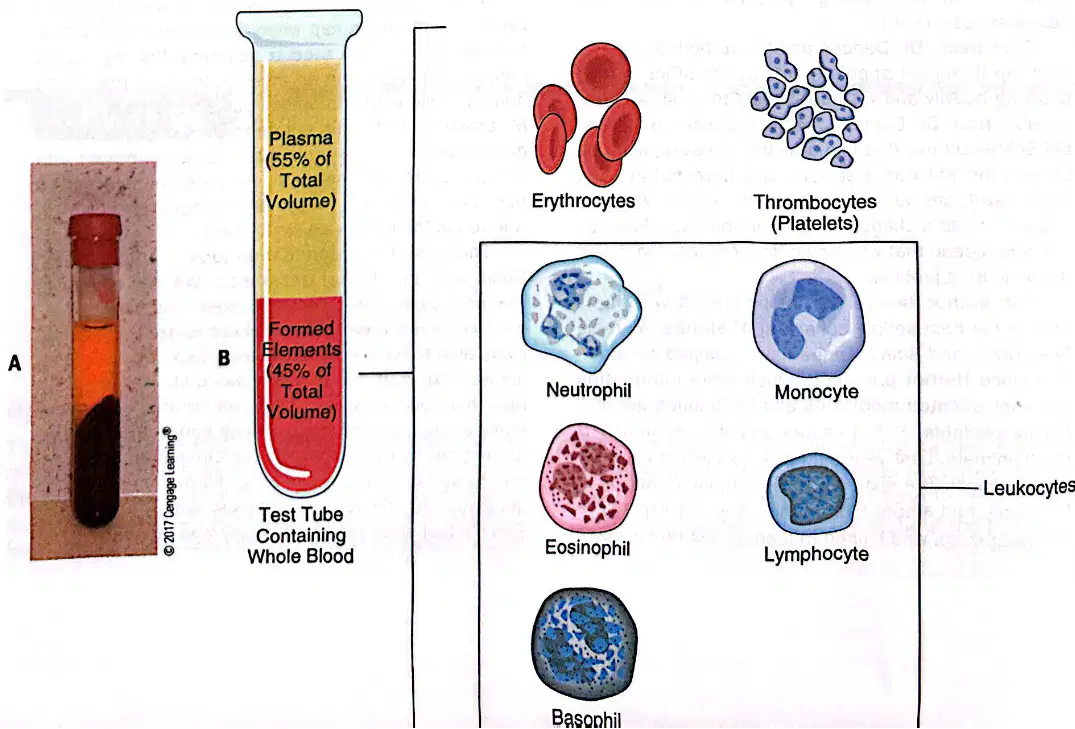
What are the two main portions blood separates into when placed in a centrifuge?
Plasma and formed elements
Water and protein
Electrolytes and hormones
Oxygen and carbon dioxide
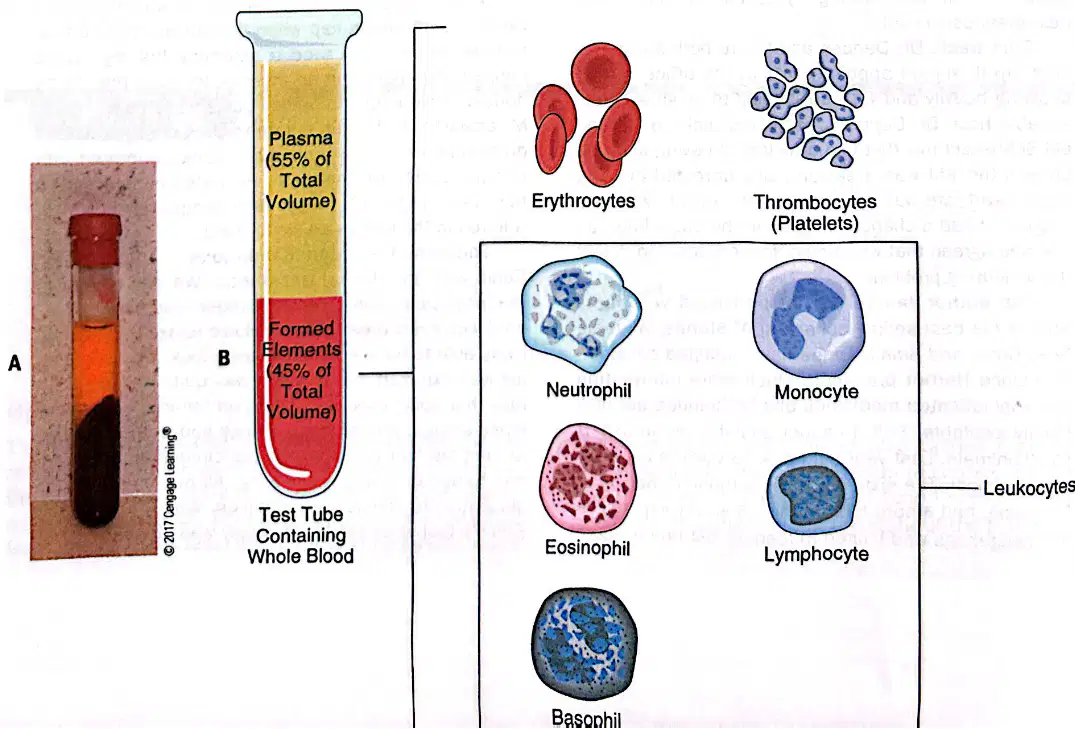
What percentage of the total blood volume is made up by plasma?
10-20%
30-45%
55%
91-94%
Fill in the blank: Plasma consists mainly of _________.
water
protein
fat
glucose
Which of the following is NOT an electrolyte found in plasma?
Sodium
Calcium
Magnesium
Glucose

Match the following blood cell types with their names:
Erythrocytes
Red blood cells
Thrombocytes (Platelets)
Platelets
Neutrophil
Type of leukocyte
Monocyte
Type of leukocyte
Eosinophil
Type of leukocyte
Which protein in plasma is responsible for maintaining water in the bloodstream?
Globulin
Albumin
Fibrinogen
Hemoglobin
Fill in the blank: The protein in plasma that aids in clotting blood is called _________.
fibrinogen
albumin
globulin
hemoglobin
Globulins in plasma are antibodies produced to fight disease.
True
False
What are the three formed elements of blood?
Red blood cells, white blood cells, and platelets.
Plasma, serum, and lymph.
Hemoglobin, fibrinogen, and albumin.
Erythrocytes, leukocytes, and antibodies.
What is the function of red blood cells (RBCs)?
Red blood cells carry oxygen.
Red blood cells produce hormones.
Red blood cells fight infections.
Red blood cells digest food.
Which of the following cells do not have a nucleus when mature?
Red blood cells
White blood cells
Platelets
All of the above
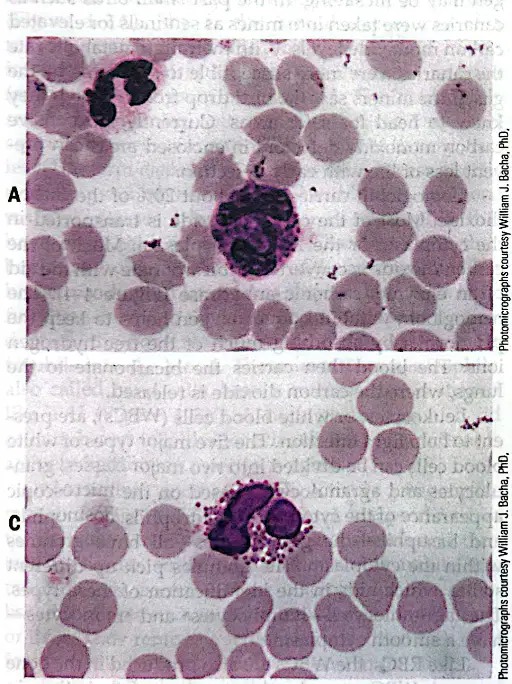
Identify the large, darkly stained cell with granules in image A.
Basophil
Neutrophil
Lymphocyte
Monocyte
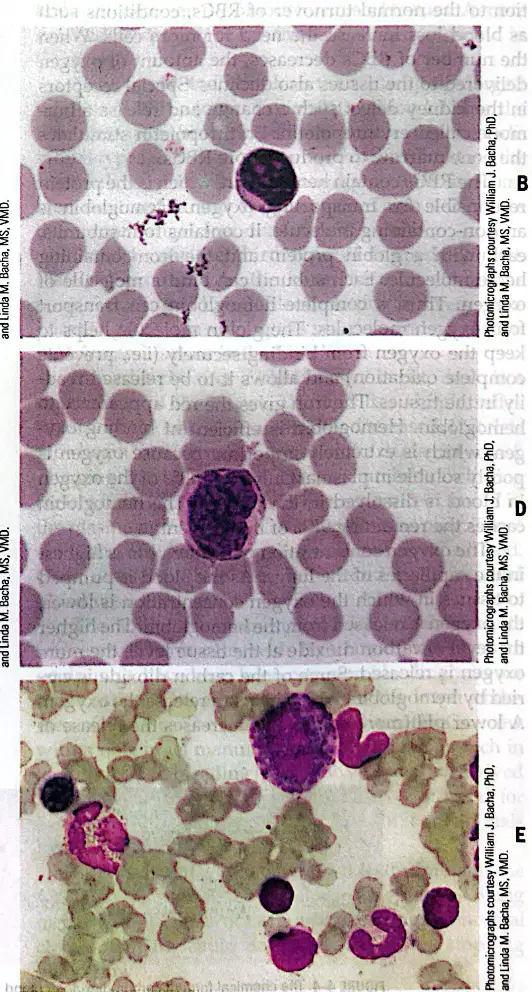
In image B, what type of cell is shown with a small nucleus?
Eosinophil
Small lymphocyte
Monocyte
Basophil

Which cell type is shown in image C, characterized by granules and a nucleus similar in shape to a basophil?
Eosinophil
Neutrophil
Lymphocyte
Monocyte
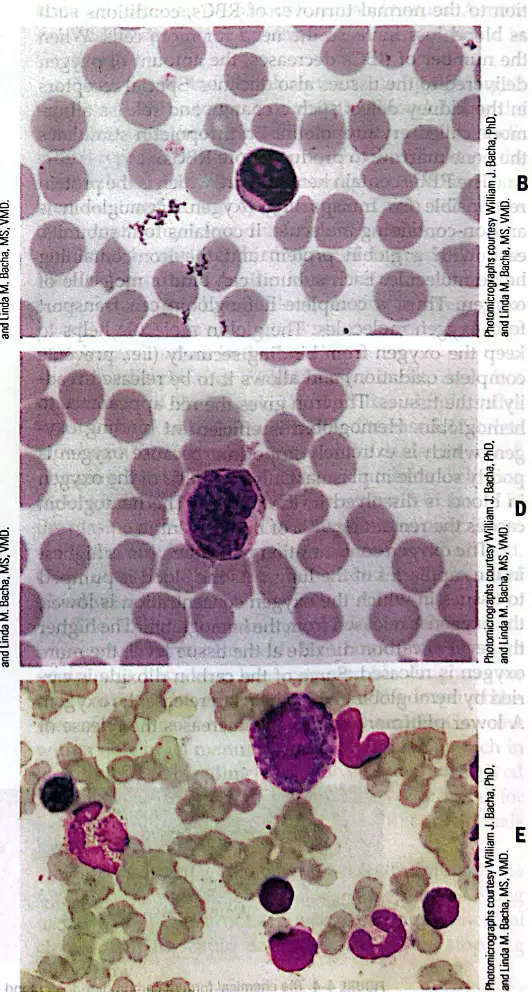
In image D, which cell type is shown in the bone marrow smear from a dog?
Neutrophil
Monocyte
Basophil
Eosinophil
What is the life span of red blood cells in dogs?
100-110 days
50-60 days
200-210 days
10-20 days
What is the life span of red blood cells in humans?
120 days
60 days
200 days
45 days
Table 4-1: Which animal has the longest life span of red blood cells among those listed?
Cats
Horses
Sheep
Cattle
Humans
What is the protein responsible for transporting oxygen in red blood cells?
Hemoglobin
Myosin
Keratin
Collagen
What percentage of oxygen in blood is carried by hemoglobin?
97%
50%
80%
25%
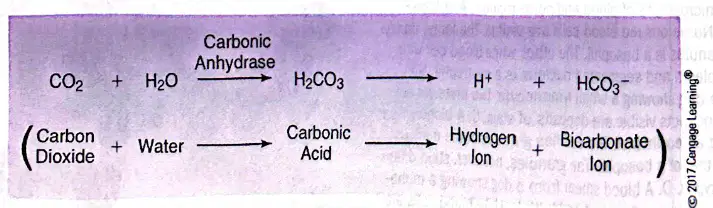
What enzyme catalyzes the reaction between carbon dioxide and water to form carbonic acid in blood?
Carbonic anhydrase
Amylase
Lipase
Pepsin
Which type of blood cell is responsible for fighting infection?
White blood cells (WBCs)
Red blood cells (RBCs)
Platelets
Plasma cells
What is the normal range of WBCs in the blood of a normal dog per microliter?
6,000 to 17,000 per microliter
2,000 to 5,000 per microliter
18,000 to 25,000 per microliter
500 to 1,500 per microliter
Which type of WBC is predominant in dogs, cats, and horses?
Neutrophil
Eosinophil
Basophil
Lymphocyte
What is the main function of neutrophils?
To phagocytize (ingest in a form of endocytosis) and destroy microorganisms and cellular debris.
To produce antibodies against pathogens.
To transport oxygen throughout the body.
To regulate blood pressure.
Neutrophils generally perform their function in the tissues, not in the blood.
True
False
Which WBC actively phagocytizes microbes and moves into the bloodstream and then into the tissues?
Monocytes
Eosinophils
Basophils
Lymphocytes
Which WBC plays a role in fighting parasites and also in allergic reactions?
Eosinophils
Neutrophils
Basophils
Lymphocytes
Which WBC contains granules with histamine and is involved in allergic reactions?
Basophils
Neutrophils
Eosinophils
Monocytes
Which type of cell is essential in immune function and produces antibodies that help fight disease?
Lymphocytes
Erythrocytes
Neurons
Osteocytes
Platelets are produced in the bone marrow and aid in what process?
Normal clotting of blood
Digestion of food
Transmission of nerve impulses
Production of hormones
Only the damaged blood vessel wall stimulates the formation of a clot.
True
False

Refer to the diagram of the internal structure of the heart. Fill in the blank: The upper right chamber of the heart is called the _________?
Right Atrium
Left Atrium
Right Ventricle
Left Ventricle

Refer to the diagram of the internal structure of the heart. Fill in the blank: The valve between the right atrium and right ventricle is called the _________
Atrioventricular Valve
Semilunar Valve
Pulmonary Valve
Bicuspid Valve

Refer to the diagram of the internal structure of the heart. Fill in the blank: The blood vessel that carries blood from the right ventricle to the lungs is the _________.
Right Pulmonary Artery
Left Pulmonary Vein
Aorta
Superior Vena Cava

Refer to the diagram of the internal structure of the heart. Fill in the blank: The wall that separates the left and right sides of the heart is called the _________?
Septum
Atrium
Valve
Ventricle

Refer to the diagram of the internal structure of the heart. Fill in the blank: The main artery that carries oxygen-rich blood from the heart to the body is the _________?
Aorta
Pulmonary artery
Vena cava
Coronary artery

Refer to the diagram of the flow of blood through the body. Fill in the blank: The vessel that returns oxygen-poor blood from the body to the heart is the _________
Cranial Vena Cava
Aorta
Pulmonary Vein
Carotid Artery

Refer to the diagram of the flow of blood through the body. Fill in the blank: The vessel that carries oxygen-rich blood from the lungs to the heart is the _________
Pulmonary Vein
Pulmonary Artery
Aorta
Vena Cava

Refer to the diagram of the flow of blood through the body. Fill in the blank: The circulation that carries blood between the heart and lungs is called _________.
Pulmonary Circulation
Systemic Circulation
Coronary Circulation
Renal Circulation

Refer to the diagram of the flow of blood through the body. Fill in the blank: The circulation that carries blood between the heart and the rest of the body is called _________.
Systemic Circulation
Pulmonary Circulation
Coronary Circulation
Renal Circulation
Match the following parts of the heart with their functions:
Pumps oxygen-rich blood to the body
Pumps oxygen-rich blood to the body
Receives oxygen-poor blood from the body
Receives oxygen-poor blood from the body
Separates left and right sides of the heart
Separates left and right sides of the heart
Main artery carrying blood from heart to body
Main artery carrying blood from heart to body
Which directional term is used to describe the position towards the head of the dog?
A) Caudal
B) Cranial
C) Dorsal
D) Ventral
Match the following directional terms with their correct position on the dog:
Toward the tail
Toward the head
Toward the head
Toward the tail
Toward the back
Toward the back
Toward the belly
Toward the belly
What is the name of the valve shown in the image, and what structure secures the edge of the valve?
Atrioventricular valve; chordae tendineae
Semilunar valve; papillary muscles
Mitral valve; Purkinje fibers
Tricuspid valve; sinoatrial node
In adult animals, which arteries are the only ones that carry oxygen-poor blood?
Pulmonary arteries
Carotid arteries
Coronary arteries
Renal arteries
The pulmonary valve keeps blood that has entered the pulmonary artery from flowing back into the heart.
True
False
Which vessels possess a much thinner wall that is related to the amount of blood flowing within the vessel?
A) Arteries
B) Veins
C) Capillaries
D) Arterioles
Fill in the blank: The wall of the capillary has a simple squamous endothelium lining with a small amount of surrounding ______ tissue.
connective
muscular
nervous
epithelial
What is the term that describes excess fluid in the extracellular space?
Edema
Anemia
Ischemia
Necrosis
What is the rate at which the heart beats controlled by?
The nervous system.
The digestive system.
The respiratory system.
The skeletal system.
What are the cells that begin the heartbeat called?
Neurons
Pacemaker cells
Muscle fibers
Red blood cells
The pacemaker system is important in maintaining the heart's ________ rhythm.
regular
irregular
slow
fast
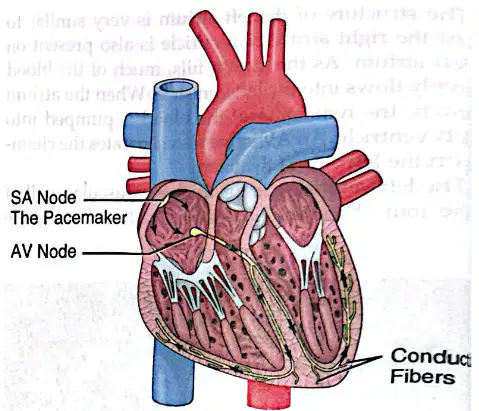
Which node initiates the signal in the heart?
AV Node
SA Node
Purkinje fibers
Bundle branches
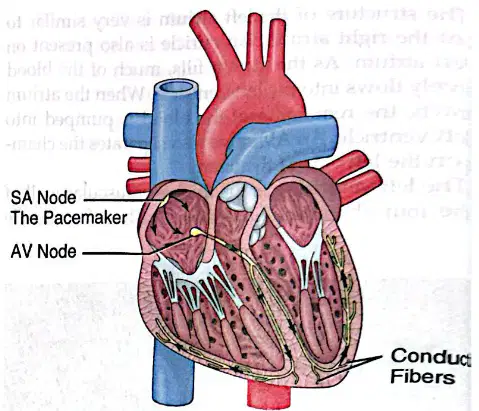
What is the function of the atrioventricular (AV) node in the heart conduction system?
It initiates the heartbeat
It delays the signal to allow the atria to contract and empty prior to the contraction of the ventricles
It pumps blood into the arteries
It absorbs nutrients from the blood
What is the cardiac cycle? Fill in the blank: The cardiac cycle includes one complete contraction and the relaxation that follows. During relaxation the atria fill with blood in preparation for the next contraction. The rate of this cycle varies between species. The rate for an individual animal can vary with breed and fitness level. The contraction phase of the cycle is called ______. Diastole is the relaxation phase.
systole
atrium
ventricle
mitral
What is the typical blood pressure value in humans? Fill in the blank: In human medicine a typical number, such as ______ mm Hg, represents the systolic over the diastolic pressure.
120/80
140/90
100/70
130/85
Which of the following best describes the function of the electrocardiogram (ECG)?
Measures blood pressure
Identifies problems associated with the contraction of the heart
Delivers electrical stimulation to the heart
Measures oxygen levels in the blood
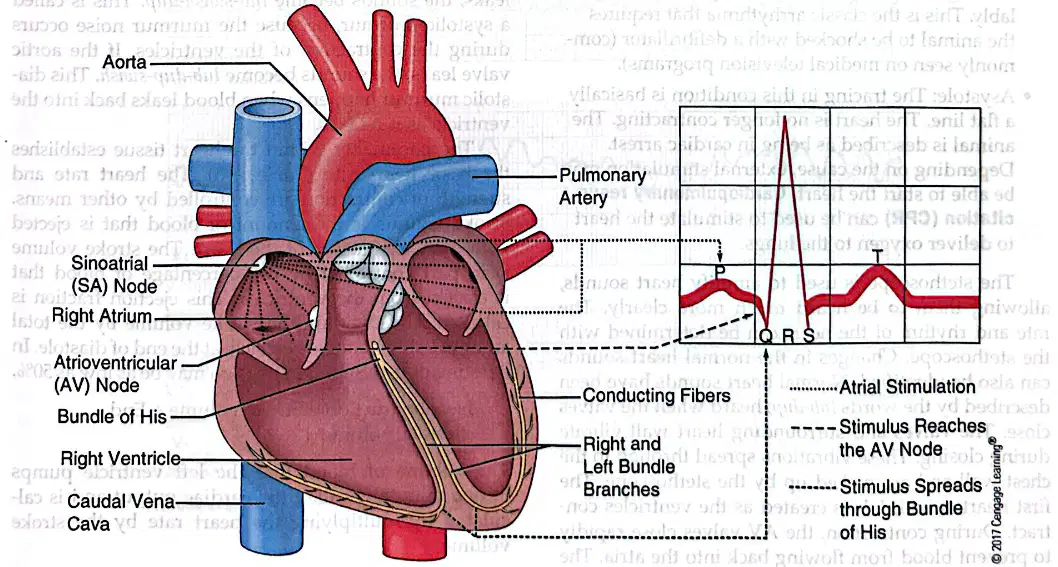
Match the following heart conduction system components to their locations in the diagram: (Refer to the diagram for matching.)
Aorta
top left red vessel
Pulmonary Artery
top right blue vessel
Sinoatrial (SA) Node
upper right of right atrium
Right Atrium
upper right chamber
Atrioventricular (AV) Node
lower right of right atrium
The SA node is the primary pacemaker in setting the heart rate.
True
False
Fill in the blank: The PR interval is the time delay that occurs between the beginning of atrial depolarization and the beginning of ______ depolarization.
ventricular
atrial
nodal
bundle
What does the term 'arrhythmia' describe? Fill in the blank: An arrhythmia describes any change in the ______, rhythm, or conduction within the heart.
rate
pressure
volume
temperature
Which phase of the cardiac cycle is associated with higher blood pressure?
Systole
Diastole
Fill in the blank: Sinus tachycardia indicates a heart rate that is ______ than normal, with a normal rhythm that originates in the SA node.
faster
slower
irregular
lower
Fill in the blank: Sinus bradycardia denotes a heart rate that is ______ than normal, with a normal rhythm that originates in the SA node.
slower
faster
stronger
irregular
Fill in the blank: Sinus arrhythmia is a condition where the heart rate ______ with inspiration and ______ with expiration.
increases; decreases
decreases; increases
remains constant; fluctuates
fluctuates; remains constant
Fill in the blank: In atrial fibrillation, the SA node no longer acts as the pacemaker and the atria are ______ and fire very frequently.
irritated
relaxed
enlarged
blocked
Fill in the blank: Ventricular fibrillation is a condition where the ventricles fire ______ and no longer contract normally, but quiver uncontrollably.
extremely rapidly
very slowly
in synchrony
occasionally
Fill in the blank: Asystole is a condition where the heart is no longer ______ and is described as being in cardiac arrest.
contracting
beating regularly
pumping blood efficiently
responding to stimuli
What is the formula for cardiac output?
Stroke volume + Heart rate
Stroke volume x Heart rate
Heart rate / Stroke volume
Stroke volume - Heart rate
What sound is created as the ventricles contract and the AV valves close?
lub
dup
murmur
swoosh

What is the first step when blood pressure declines?
Kidney releases aldosterone
Renin released by kidney into bloodstream
Kidney detects pressure drop
Vasoconstriction (vessels contract)

What is the effect of vasoconstriction?
Blood pressure increases
Blood pressure declines
Kidney releases aldosterone
Blood volume decreases
Fill in the blank: When veins are cut, the dark red blood flows in a steady stream. This is because veins have ______ pressure compared to arteries.
lower
higher
equal
variable
Which of the following mechanisms helps blood flow upward against gravity in veins?
Arterial valves
Muscle contractions in the legs
Blood pressure increases
Renin release by kidney
The body quickly responds to higher pressure by constricting vessels and pushing more blood to the brain.
True
False
Fill in the blank: Soldiers forced to stand at attention may experience blood pooling in the veins of the legs, which can lead to ______ if the heart cannot supply enough blood to the brain.
fainting
sneezing
coughing
yawning
The clinical significance of the academic material learned in this chapter is:
It helps in understanding disease mechanisms and improving patient care.
It is only useful for passing exams.
It has no relevance to real-world medical practice.
It is mainly theoretical and not applicable clinically.
What condition is shown in the cow's heart, and what is the main feature present between the heart and pericardium?
The condition shown is pericarditis due to hardware disease, and the main feature is a large amount of inflammation present between the heart and pericardium.
The condition shown is endocarditis due to bacterial infection, and the main feature is thickening of the heart valves.
The condition shown is myocardial infarction, and the main feature is necrosis of the heart muscle.
The condition shown is congestive heart failure, and the main feature is fluid accumulation within the heart chambers.
What is the purpose of the rectangular gray magnet in the reticulum of cattle?
The magnet is used to trap ingested metal and prevent it from puncturing the stomach, thereby preventing hardware disease.
The magnet helps in the digestion of fibrous material.
The magnet is used to stimulate milk production.
The magnet is used to regulate body temperature.
What is the term used to describe low calcium levels in the blood?
Hypocalcemia
Hypercalcemia
Hypokalemia
Hyponatremia
What is the term used to describe high sodium levels in the blood?
Hypernatremia
Hyponatremia
Hypokalemia
Hypercalcemia
Which of the following terms describes low glucose levels in the blood?
A) Hyperglycemia
B) Hypoglycemia
C) Hypokalemia
D) Hypercalcemia
Match the following blood test items with their corresponding low and high conditions:
Hypokalemia
Potassium
Hyperkalemia
Potassium
Hypochloremia
Chloride
Hyperchloremia
Chloride
The prefix 'hypo-' is used for blood values that are:
Above normal
Below normal
Within normal range
Not related to blood values
The suffix '-penia' is used when the white blood cell count is less than normal.
True
False
Anemia is the term used to describe a low RBC count. With anemia, the blood supplies less oxygen to the tissues.
True
False
What is the normal range of Albumin (g/dl) in Adult Dogs according to Table 4-4 Normal Ranges for Blood Chemistry?
2.8-3.9
1.5-2.5
4.0-5.5
3.0-4.5
What is the normal range of Calcium (mg/dl) in Adult Cats according to Table 4-4 Normal Ranges for Blood Chemistry?
8.7-11.9
6.0-8.0
12.0-14.0
10.0-15.0
What is the normal range of Carbon dioxide (mEq/L) in Adult Cattle according to Table 4-4 Normal Ranges for Blood Chemistry?
24-33
15-22
34-40
10-18
What is the normal range of Chloride (mEq/L) in Sheep according to Table 4-4 Normal Ranges for Blood Chemistry?
95-110
80-95
110-125
70-85
What is the normal range of Globulins (g/dl) in Goats according to Table 4-4 Normal Ranges for Blood Chemistry?
2.7-4.1
1.0-2.0
4.5-6.0
0.5-1.5
What is the normal range of Glucose (mg/dl) in Swine according to Table 4-4 Normal Ranges for Blood Chemistry?
65-95
40-60
100-130
80-120
What is the normal range of Phosphorus (mg/dl) in Horses according to Table 4-4 Normal Ranges for Blood Chemistry?
3.1-5.6
2.0-3.0
5.7-7.2
1.5-2.5
What is the normal range of Potassium (mEq/L) in Adult Cats according to Table 4-4 Normal Ranges for Blood Chemistry?
4.3-6.1
3.0-4.0
6.5-8.0
2.0-3.5
What is the normal range of Total serum protein (g/dl) in Sheep according to Table 4-4 Normal Ranges for Blood Chemistry?
6.0-7.5
5.0-6.0
7.5-8.5
4.0-5.5
What is the normal range of Sodium (mEq/L) in Swine according to Table 4-4 Normal Ranges for Blood Chemistry?
135-150
120-135
150-165
100-120
The three types of shock described in animals and their causes are:
Hypovolemic shock (caused by blood or fluid loss), cardiogenic shock (caused by heart failure), and distributive shock (caused by abnormal blood flow or vessel dilation).
Hypovolemic shock (caused by infection), cardiogenic shock (caused by dehydration), and distributive shock (caused by trauma).
Hypovolemic shock (caused by allergic reaction), cardiogenic shock (caused by poisoning), and distributive shock (caused by excessive exercise).
Hypovolemic shock (caused by heart attack), cardiogenic shock (caused by blood loss), and distributive shock (caused by fever).
In animals in shock, what is the typical appearance of the gums when pressed and released?
The gums turn white when pressed and should return to normal pink color within a second if healthy. In shock, the refill time is much slower.
The gums remain bright red and do not change color when pressed.
The gums turn blue when pressed and quickly return to pink.
The gums stay yellow and do not change when pressed.
Which of the following is NOT a symptom of shock in animals?
A) Weak and depressed heart rate
B) Increased respiratory rate
C) Increased urine production
D) Body temperature below normal

