
NEW
Font size
 Worksheets
Unit 7: Digestive System Test
Total questions: 60
Worksheet time: 30mins
Indicate whether the statement is true or false. 1. The uvula prevents food from entering the trachea during swallowing.
True
False
Indicate whether the statement is true or false. Hemorrhoids are painful dilated or varicose veins of the rectum and/or anus.
True
False
Indicate whether the statement is true or false. 3. Vaccines are available to help prevent both hepatitis A and hepatitis B.
True
False
Indicate whether the statement is true or false. The rectum is a storage area for indigestibles.
True
False
Indicate whether the statement is true or false. After food is partially digested by the acid and enzymes in the stomach, it is called a bolus.
True
False
Indicate whether the statement is true or false. 6. In the stomach, food is converted into a semifluid material called chyme.
True
False
Indicate whether the statement is true or false. 7. Type A, or infectious, hepatitis is transmitted by blood and body fluids.
True
False
Indicate whether the statement is true or false. 8. The liver is the largest gland in the body.
True
False
Indicate whether the statement is true or false. Most of digestion and absorption takes place in the stomach.
True
False
Indicate whether the statement is true or false. Taste receptors on the tongue allow a person to taste sweet, salty, sour, and bitter sensations.
True
False
Which of the following is not a function of the large intestine?
Absorption of remaining water
Production of intestinal juice containing enzymes
Transportation of waste products
Absorption of remaining nutrients
Which of the following is not a pair of salivary glands?
parotid
sublingual
submandibular
submaxillary
Salivary glands produce salivary amylase, which ____.
begins the chemical breakdown of carbohydrates
starts the chemical digestion of fats
converts sugar to energy
begins the chemical breakdown of proteins
What is the function(s) of the gallbladder?
produce amylase
concentrate and store bile
produce bile
all of the above
A sprain occurs when a tear occurs to a ____.
joint
tendon
ligament
muscle
Which of the following is considered a voluntary muscle?
cardiac muscle
skeletal muscle
visceral muscle
smooth muscle
When muscles contract, they become longer and thinner.
True
False
45. Which of the following muscles is not an injection site?
Deltoid muscle
Gluteus maximus muscle
Trapezius muscle
quadriceps femoris muscle
The bright red color of blood indicates ____.
anemia
fibrinogen carrying oxygen
venous blood
hemoglobin carrying oxygen
The blood vessels that carry blood away from the heart are the ____.
veins
arteries
capillaries
venoules
The chamber of the heart that receives deoxygenated blood as it returns from body cells is the ____.
left atrium
right ventricle
left ventricle
right atrium
The largest artery in the body is the ____.
coronary
aorta
femoral
carotid
The ____ artery carries blood to the lungs.
a. aortic
b. coronary
c. pulmonary
d. brachial
The correct term for a nosebleed is ____.
sinusitis
rhinitis
pleurisy
epistaxis
What structures are located on the ends of terminal bronchioles and resemble a bunch of grapes?
alveoli
cilia
bronchi
bronchus
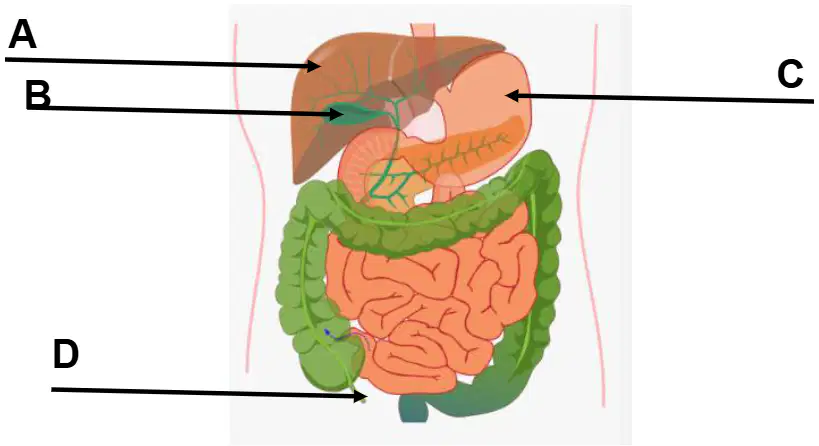
What organ/structure is represented by letter A?
Stomach
Liver
Pancreas
Small Intestine
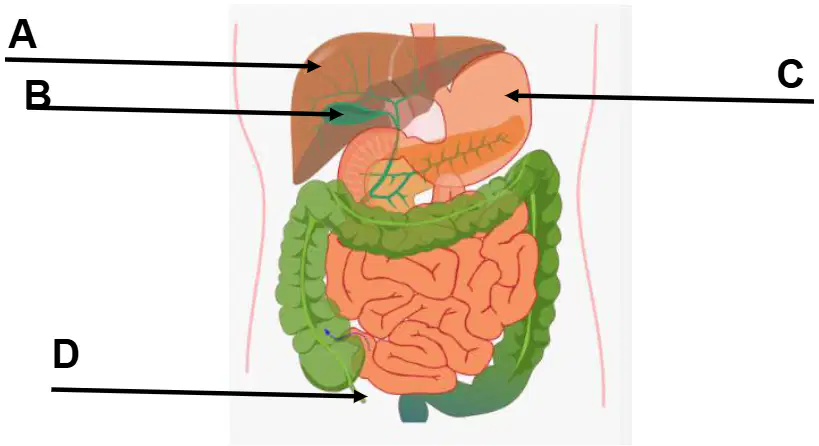
What organ/structure is represented by letter B?
Appendix
Liver
Gallbladder
Pancreas
What organ/structure is represented by letter C?
Appendix
Stomach
Large Intestine
Small Intestine
What organ/structure is represented by letter D?
Appendix
Liver
Pancreas
Gallbladder
The organ behind the stomach that produces enzymes and the hormone insulin is the ____.
liver
pancreas
gallbladder
spleen
A chronic destruction of liver cells accompanied by the formation of fibrous connective and scar tissue is ____.
diverticulitis
cholecystitis
hepatitis
cirrhosis
The stomach turns the bolus into a semi-fluid material called _____.
pepsin
amylase
rennin
chyme
Salivary glands produce salivary amylase, which ____.
begins the chemical breakdown of carbohydrates
starts the chemical digestion of fats
converts sugar to energy
begins the chemical breakdown of proteins
The walls of the small intestine are lined with fingerlike projections called ____.
lacteals
capillaries
villi
rugae
The section of the small intestine that connects to the lower portion on the stomach is the _______.
ileum
duodenum
cecum
jejunum
The folds in the mucous membrane lining of the stomach are called ____.
rugae
villi
cilia
sphincters
The first section of the large intestine is the ____.
ascending colon
descending colon
cecum
sigmoid
Hydrochloric acid in the gastric juice is responsible for ____.
killing bacteria
facilitating the absorption of iron
activating the enzyme pepsin
all of the above
What is the wavelike, involuntary movement of muscles that causes the food to move in a forward direction through the digestive tract?
skeletal muscle
villi
peristalsis
rugae
Where does a hiatal hernia originate?
small intestine
stomach
duodenum
large intestine
The bony structure that forms the roof of the mouth is the ____.
soft palate
hard palate
maxilla
mandible
The presence of gallstones in the gallbladder is ____.
cholecystitis
cholecystectomy
cholelithiasis
cholecalculus
The body cavity located in the chest is the ____.
dorsal cavity
spinal cavity
thoracic cavity
abdominal cavity
How many quadrants is the abdomen separated into?
3
4
2
9
Which of the following statements is correct?
The shoulder is proximal
The wrist is proximal
The ankle is proximal
The hip is distal
Body parts close to the midsagittal plane are called ____.
medial
lateral
inferior
superior
The constant state of fluid balance is ____.
homeostasis
hydration
dehydration
dehydration
Baldness or the permanent loss of hair from the scalp is ____.
erythema
alopecia
cyanosis
albino
What is the proper name for sweat glands?
Subcutaneous fascia
Sebaceous glands
Wheals glands
Sudoriferous glands
The measurement of the balance between heat produced and heat lost is ____.
vital signs
homeostasis
temperature
wellness
The most accurate method for taking a temperature is ___.
aurally
axillary
orally
rectally
The shaft of long bones is the ____.
medullary cavity
diaphysis
epiphysis
endosteum
Areas where two or more bones join together are ____.
joints
ligaments
tendons
foramina
A sprain occurs when a tear occurs to a ____.
joint
tendon
ligament
muscle
A freely movable joint such as the should or hip is a _____ type of joint.
diathrosis
synarthrosis
amiphiathrosis
parabiosis
Spaces or "soft spots", in the cranium that allow for the enlargement of the skull as brain growth occurs are ___
fontanels
sutures
foramina
sinuses
The tissue that produces power and movement in the body is ____.
muscle
connective
epithelial
adipose
If the lower leg is straightened away from the upper leg, the movement is called ____.
abduction
adduction
flexion
extension
External respiration is the exchange of carbon dioxide and oxygen between the ____ and ____.
blood stream and tissue cells
lungs and blood stream
tissue cells and bronchi
bronchi and bloodstream
The right lung contains _____ lobes.
2
3
4
5

