
Font size
 Worksheets
Intelligent Design and Scientific Theory
Total questions: 91
Worksheet time: 46mins
Intelligent design is a scientific theory that explains the diversity of life.
True
False
What is a biological population?
Groups of individuals of different species
Groups of individuals of the same species
Groups of individuals living in the same area
Groups of individuals with different diets
Biological populations are often isolated by _______.
geography
climate
food sources
predators
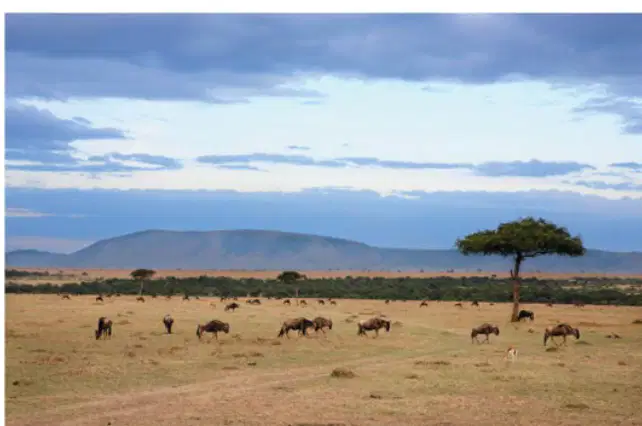
Look at the image of animals in the landscape. Does this image represent a biological population?
True
False
What is biological evolution?
Change in the characteristics of a biological population that occurs over the course of generations
Change in the weather patterns over time
Change in the physical environment
Change in the diet of a population
Biological evolution is inherited via _______.
genes
cells
proteins
hormones
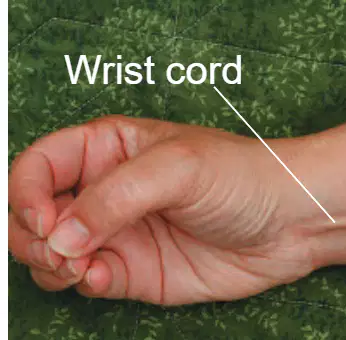
What does the diagram labeled 'Wrist cord' illustrate?
It illustrates a physical trait that can be inherited via genes, as an example of biological evolution.
It shows a method for tying knots in climbing equipment.
It demonstrates the structure of a plant stem.
It depicts the process of photosynthesis in leaves.
What are nonevolutionary changes?
Changes due to long-term genetic factors
Changes due to short-term environmental changes
Changes that are always genetic
Changes that occur over millions of years
Nonevolutionary changes are _______.
Due to short-term environmental changes
Inherited through generations
Result of genetic mutations
Permanent adaptations
Are nonevolutionary changes genetic?
True
False
The average dress size in women has changed from size 8 to size 14 over the past 50 years due to _______.
Genetic mutations
Higher average calorie intake
Evolutionary changes
Environmental pollution
Fill in the blank: Natural selection is the ______ by which populations adapt to their changing environment.
process
result
organism
methodology
What is the result of different levels of survival and reproduction of individuals in a population?
Extinction
Evolutionary change
No change
Decreased population
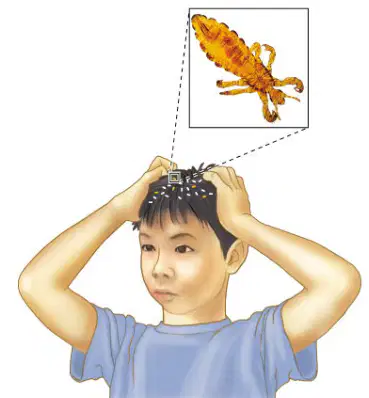
What is the result of natural selection as described in the slide?
Extinction of all lice
Evolution of pesticide resistance in lice
Increase in susceptible lice
No change in lice population
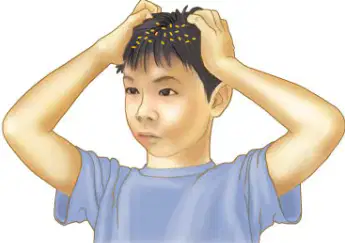
Fill in the blank: After permethrin treatment, most lice are dead, but a few that are _______ to the pesticide survive.
resistant
sensitive
exposed
allergic
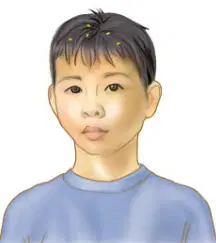
Explain how natural selection leads to the evolution of pesticide resistance in lice, as shown in the diagram.
Natural selection favors lice with resistance genes, allowing them to survive and reproduce, increasing resistance in the population.
Natural selection causes all lice to die when exposed to pesticides, eliminating resistance.
Natural selection randomly creates resistance in all lice regardless of pesticide use.
Natural selection decreases the number of resistant lice over time, making pesticides more effective.
What is microevolution?
A) Changes that occur within a biological population
B) Changes that occur between different species
C) Changes that occur in the environment
D) Changes that occur in the climate
Which of the following is a characteristic of microevolution?
Difficult to observe
Easily observed
Highly controversial
Rarely occurs
Microevolution is considered _________
Noncontroversial
Controversial
Impossible
Irrelevant
Which of the following is an example of microevolution?
Pesticide resistance in crop-eating insects
Climate change
Formation of new continents
Extinction of dinosaurs
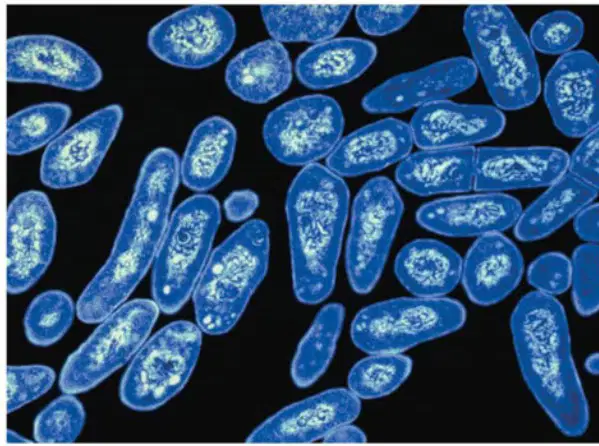
Antibiotic resistance in infectious bacteria is an example of _________.
Microevolution
Macroevolution
Genetic drift
Speciation
What is macroevolution?
The accumulation of microevolutionary changes that results in the origin of a new species
The rapid change of a species in a short period
The extinction of species
The study of fossils
Macroevolution occurs slowly over long periods of time.
True
False
Macroevolution is controversial among non-biologists.
True
False
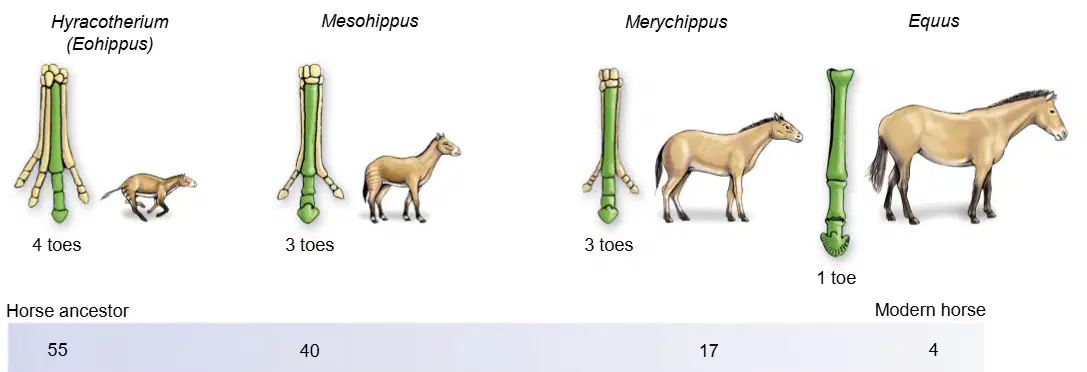
Fill in the blank: The horse ancestor Hyracotherium (Eohippus) had ____ toes.
4
2
5
3
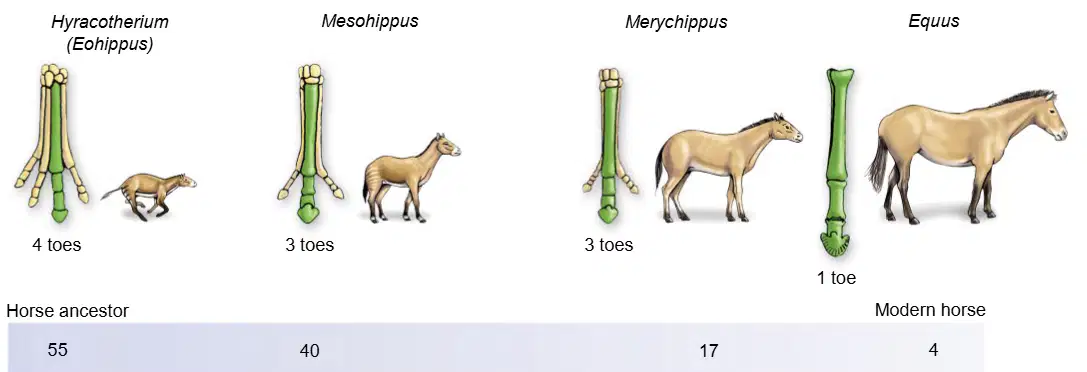
Which modern horse ancestor had 1 toe?
Hyracotherium (Eohippus)
Mesohippus
Merychippus
Equus
Evolution is just a theory
True
False
Fill in the blank: In everyday conversation, a theory is a ______ explanation with little systematic support; a hunch.
tentative
scientific
proven
elaborate
What is a scientific theory?
A guess with little evidence
A substantial statement providing the current best explanation of how the universe works
An untested idea
A random thought
Which of the following are characteristics of a scientific theory?
Supported by many lines of evidence
Withstands repeated experimental tests
Both A and B
None of the above
Examples of scientific theories:
Theory of gravity – ________ (Fill in the blank with what the theory of gravity explains)
explains planetary motion
explains photosynthesis
explains cell division
explains chemical reactions
Examples of scientific theories: Germ theory – ________ (Fill in the blank with what germ theory explains)
explains the relationship between microorganisms and human disease
explains the movement of planets in the solar system
explains the process of photosynthesis in plants
explains the structure of atoms
Examples of scientific theories: Atomic theory – ________ (Fill in the blank with what atomic theory explains)
explains the structures of atoms
explains the movement of planets
explains the process of photosynthesis
explains the laws of motion
Fill in the blank: The theory of evolution states that all species present on Earth today are descendants of a single common ancestor, and all species represent the product of millions of years of accumulated ______ evolutionary changes.
micro
macro
rapid
sudden
Fill in the blank: The theory of evolution states that all species present on Earth today are descendants of a single common ancestor, and all species represent the product of millions of years of accumulated ________ changes.
microevolutionary
catastrophic
photosynthetic
geological
According to the theory of evolution, modern animals, plants, fungi, bacteria, and other living things are related.
True
False
Fill in the blank: Living things, through various processes, have been diverging from a common ________ since life originated.
ancestor
habitat
cell
organism
What does the theory of common descent state?
A) All life shares a common ancestor
B) All life is unrelated
C) Evolution does not occur
D) Organisms do not change over time
Fill in the blank: The theory of common descent suggests that all life shares a ________ ancestor.
common
unique
modern
ancient
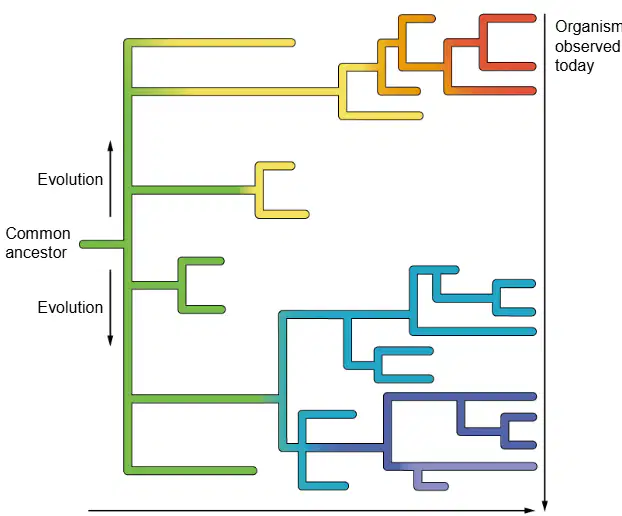
According to the diagram, what does the branching pattern represent?
A) Evolutionary relationships and common ancestry
B) Food chains
C) Migration patterns
D) Weather changes
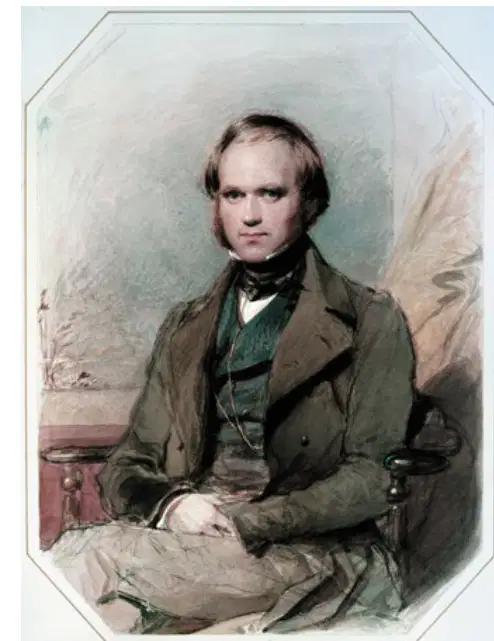
Who is credited with bringing evolution to mainstream, modern science?
A) Isaac Newton
B) Charles Darwin
C) Albert Einstein
D) Gregor Mendel
Fill in the blank: The term 'Darwinism' is sometimes applied to the theory of evolution by opponents to ________ descent.
common
parallel
vertical
horizontal
Many scientists proposed ideas about evolutionary change before Charles Darwin did.
True
False
Who was the Greek philosopher who suggested that humans evolved from fish that had moved onto land?
Aristotle
Anaximander
Socrates
Plato
According to Anaximander, humans evolved from ______ that had moved onto land.
fish
birds
reptiles
insects
Which scientist proposed that giraffe offspring would inherit longer necks because their parents stretched their necks to reach for higher leaves?
Darwin
Lyell
Lamarck
Wallace
Which scientist proposed that giraffe offspring would inherit longer necks because their parents stretched their necks to reach for higher leaves?
A. Darwin
B. Lyell
C. Lamarck
D. Wallace
Who was the first modern evolutionist according to early views of evolution?
Jean Baptiste Lamarck
Charles Darwin
Gregor Mendel
Alfred Russel Wallace
In what year did Jean Baptiste Lamarck publish his ideas about evolution?
1809
1822
1758
1844
According to Jean Baptiste Lamarck, what did organisms have an innate drive for?
Survival
Perfection
Reproduction
Adaptation
Jean Baptiste Lamarck believed that traits acquired over a lifetime could be passed on to offspring.
True
False
Give an example mentioned by Lamarck to illustrate his idea of acquired traits being passed on to offspring.
Stretching legs of wading birds
Changing color of fur due to sunlight
Learning to sing a new song
Developing a scar from injury
According to the slide '11.2 Charles Darwin and the Theory of Evolution', why were Lamarck's ideas considered unconvincing?
They were accepted by all scientists
'Inheritance of acquired characteristics' was not accepted by other scientists
Blacksmiths' children inherited muscles
Lamarck's ideas were never published
Fill in the blank: According to the slide '11.2 Charles Darwin and the Theory of Evolution', blacksmiths' children did not inherit _______.
muscles
skills
tools
wealth
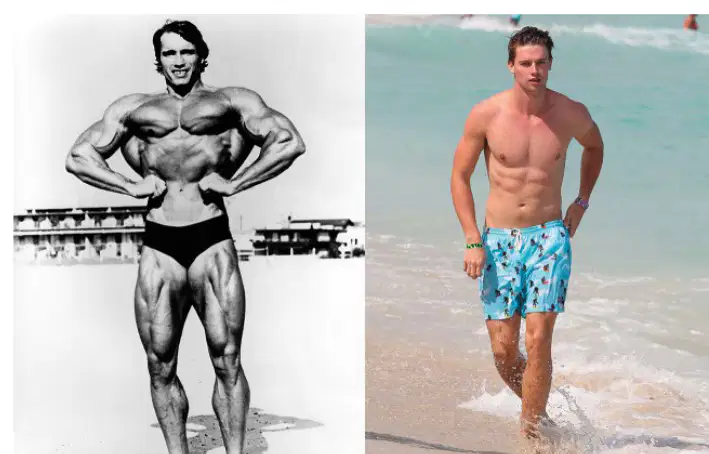
The images of two men with different physiques in the slide '11.2 Charles Darwin and the Theory of Evolution' illustrate which concept by showing that blacksmiths' children did not inherit muscles?
Inheritance of acquired characteristics is not supported
Muscle development is always genetic
Children always inherit physical traits from parents
Evolution only affects physical strength
In 1831, what was Charles Darwin's role on the HMS Beagle?
Captain
Ship's naturalist
Navigator
Cook
How old was Charles Darwin when he joined the voyage of the HMS Beagle?
18
22
30
25
The voyage of the HMS Beagle lasted for five years and included travel to South America and other tropical locales.
True
False
During the voyage of the HMS Beagle, Darwin collected diverse ______ and plants.
animals
minerals
books
fossils
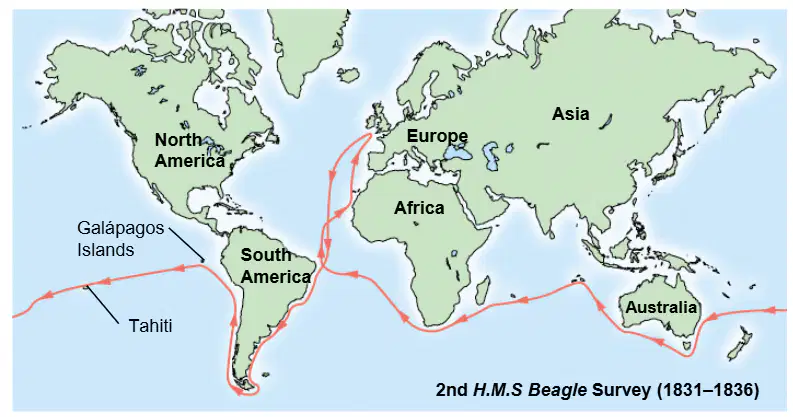
Refer to the map of the HMS Beagle's route. Which continent did the ship visit after leaving Europe?
North America
South America
Africa
Asia
According to Charles Lyell's 'Principles of Geology', what was hypothesized about current geologic processes?
They are different from past processes
They are the same as past processes
They do not affect geological features
They are faster than past processes
Fill in the blank: Large geological features result from the accumulated effects of _________
these processes
chemical reactions
human activities
weather forecasts
According to 'Principles of Geology', Earth must be older than ______ years.
10,000
1,000
100,000
1,000,000
The ideas in 'Principles of Geology' influenced Darwin’s reflections.
True
False
According to the section 'The voyage of HMS Beagle', Darwin was strongly influenced by the ________ of Brazil.
Rainforests
Deserts
Mountains
Rivers
According to the section 'The voyage of HMS Beagle', Darwin was strongly influenced by which of the following?
Fossil collection
Ocean currents
Mountain climbing
Desert exploration
According to the section 'The voyage of HMS Beagle', Darwin was strongly influenced by birds and reptiles of the ________ Islands.
Galapagos
Canary
Hawaiian
Falkland
Which type of tortoises did Darwin observe in the Galapagos Islands according to the section 'The voyage of HMS Beagle'?
Giant tortoises with domed or flat shells
Small tortoises with spiked shells
Sea tortoises
Painted tortoises
According to the section 'The voyage of HMS Beagle', Darwin noted the divergence between island organisms and ________ species.
mainland
marine
tropical
polar
Which type of cacti did Darwin observe as an example of divergence between island and mainland species according to the section 'The voyage of HMS Beagle'?
Prickly pear cacti with ground-hugging or tree-like forms
Saguaro cacti
Barrel cacti
Christmas cacti
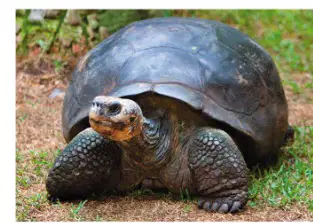
The voyage of HMS Beagle: Which type of tortoise is found on Santa Cruz Island, an island with abundant ground-level vegetation?
Dome-shelled tortoise
Flat-shelled tortoise
Sea turtle
Painted turtle
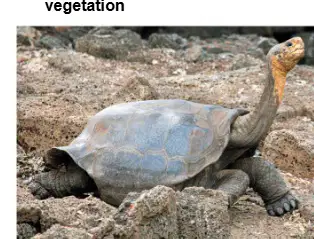
Which type of tortoise is found on Española Island, an island with tall vegetation?
Dome-shelled tortoise
Flat-shelled tortoise
Sea turtle
Painted turtle
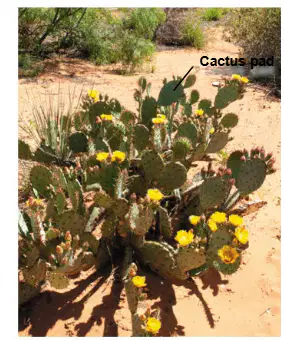
The prickly pear cactus in mainland South America is characterized by which feature?
Tall trunk
Cactus pad
Red flowers
No thorns
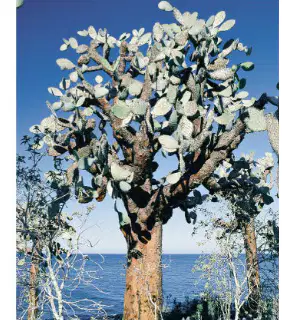
The prickly pear cactus in Galápagos is characterized by which feature?
Tall trunk
Cactus pad
Red flowers
No thorns
In what year did Charles Darwin return to England?
1836
1859
1809
1845
What was the status of Darwin's journal of his travels after he returned to England?
It was unpublished
It was a bestseller
It was lost
It was ignored
After returning to England, Darwin continued reflection on his _________
journal entries
scientific experiments
family history
travel companions
How many more years did Darwin spend collecting evidence after returning to England?
20 years
5 years
10 years
15 years
What did Darwin do after spending 20 more years collecting evidence?
Abandoned his theory
Further developed his theory
Published a novel
Traveled to America
In 1858, who received Alfred Russel Wallace’s manuscript detailing a mechanism for evolutionary change similar to natural selection?
Charles Darwin
Gregor Mendel
Louis Pasteur
Jean-Baptiste Lamarck
What was presented at a scientific meeting in London in 1858?
Excerpts by Wallace and Darwin
The Origin of Species
Mendel's laws of inheritance
The double helix structure of DNA
Fill in the blank: In 1859, Darwin published ________ by Means of Natural Selection, or the Preservation of Favoured Races in the Struggle for Life.
On the Origin of Species
The Descent of Man
Principles of Geology
The Voyage of the Beagle
Alternative ideas on origins and relationships: Is special creation by supernatural causes observable or measurable?
Observable
Measurable
Not observable or measurable
Both observable and measurable
Alternative ideas on origins and relationships: What does the static model hypothesis propose about organisms?
Organisms are constantly changing
Organisms are unchanging
Organisms are extinct
Organisms are evolving rapidly
According to the transformation hypothesis, ______ have occurred after species were created.
small changes
large extinctions
no changes
rapid evolution
According to the separate types hypothesis, plants and animals arose ______.
separately
together
from a common ancestor
by chance
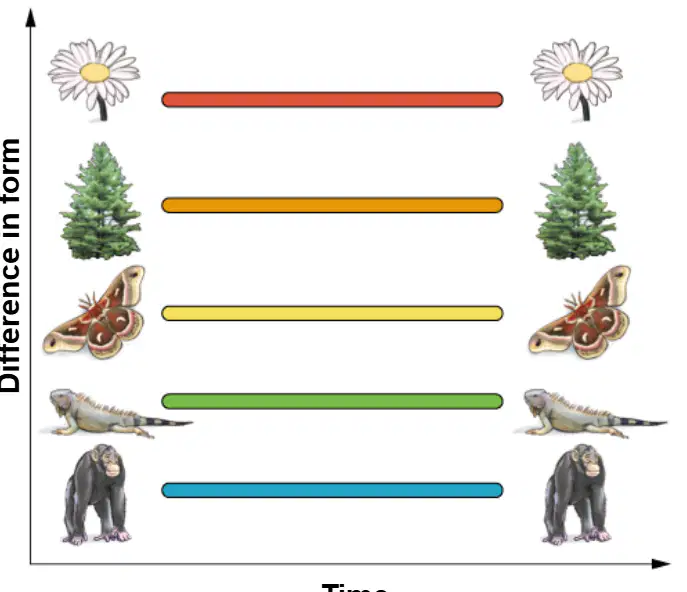
What hypothetical model for the origin of modern organisms is shown in this figure?
common descent
separate types
static model
transformation
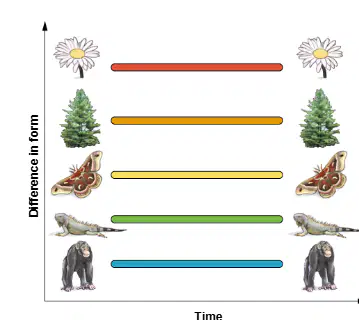
Which hypothesis states that species arise separately and do not change over time?
Static model
Transformation
Separate types
Common descent
Match the following hypotheses to their descriptions:
Species arise separately and do not change over time.
Static model
Species arise separately and change over time in order to adapt to the changing environment.
Transformation
Species change over time, and new species can arise, but not from a common ancestor. Each group of species derives from a separate ancestor that arose independently.
Separate types
Species do change over time, and new species can arise. All species derive from a common ancestor.
Common descent
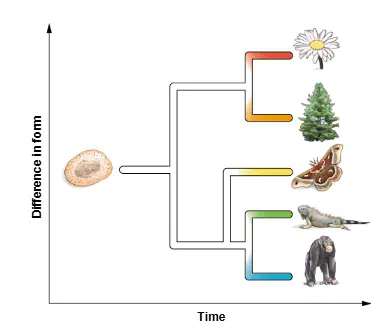
Fill in the blank: The ______ hypothesis states that all species derive from a common ancestor and can change over time.
common descent
independent origin
fixity of species
catastrophism
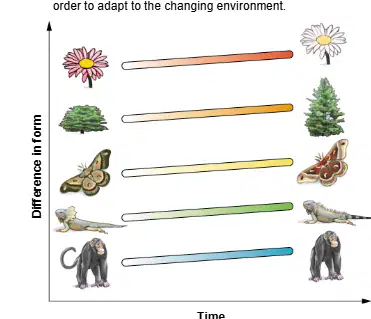
The transformation hypothesis states that species arise separately and change over time in order to adapt to the changing environment.
True
False

