
 Worksheets
Analyzing Motion Graphs (PHYS.5A)
Total questions: 55
Worksheet time: 36mins
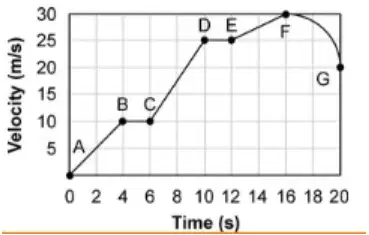
A car travels northward on a straight highway. The velocity–time graph shows labeled points A through G. During interval AB, velocity increases linearly from 0 m/s at 0 s to 25 m/s at 10 s. What is the car’s acceleration during AB?
0.40 m/s^2
2.5 m/s^2
10 m/s^2
40 m/s^2
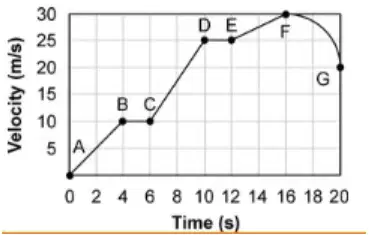
Using the same velocity–time graph with points A–G, which labeled interval shows zero acceleration?
CD, where velocity increases
DE, where velocity is constant at 25 m/s
FG, where velocity decreases
AB, where velocity increases from 0 to 25 m/s
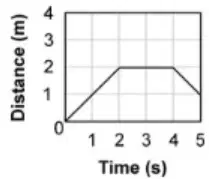
The distance–time graph of an object moving in a straight line shows it rising from 0 m at 0 s to 2 m at 2 s, staying at 2 m from 2 s to 4 s, then returning to 0 m by 5 s. What is the object’s average speed during the first 4 seconds?
0.5 m/s
1.0 m/s
2.0 m/s
4.0 m/s
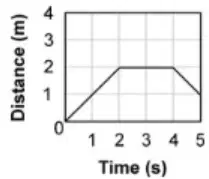
For the same distance–time graph, which statement best describes the motion from 2 s to 4 s?
The object moves forward at constant speed.
The object remains at the same position (zero speed).
The object accelerates uniformly.
The object reverses direction at increasing speed.
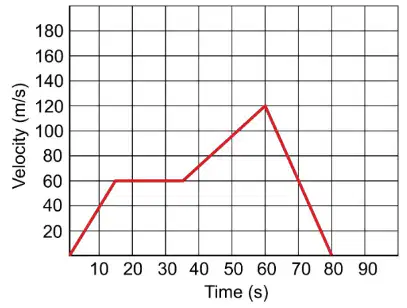
A velocity–time graph shows an object’s velocity rising from 50 m/s at 35 s to 120 m/s at 60 s, then dropping to near 0 by 80–90 s. During which time interval is the velocity constant?
0 to 15 s
15 s to 35 s
35 s to 60 s
60 s to 80 s
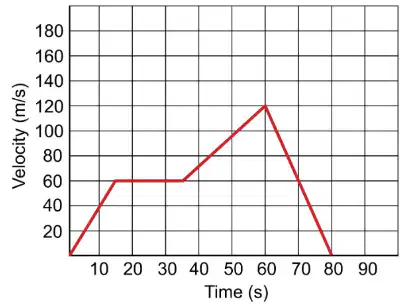
Using the same velocity–time graph, estimate the average acceleration during 35 s to 60 s if velocity increases linearly from 60 m/s to 120 m/s.
1.2 m/s^2
2.4 m/s^2
3.0 m/s^2
4.8 m/s^2
Which statement best distinguishes a scalar quantity from a vector quantity?
A scalar has magnitude and direction; a vector has only magnitude.
A scalar has only magnitude; a vector has magnitude and direction.
Scalars and vectors both require direction but not magnitude.
Scalars and vectors both require magnitude and direction in the same way.
An object moves 3.0 m east and then 4.0 m north. What is the magnitude of its resultant displacement? Use the Pythagorean theorem for perpendicular vectors.
5.0 m
7.0 m
1.0 m
4.5 m
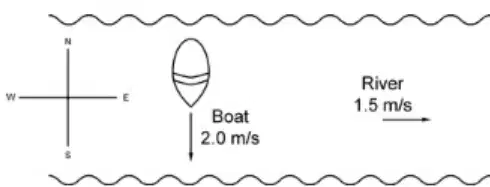
A river current flows due east at 1.5 m/s while a boat’s motor drives the boat due south at 2.0 m/s. What is the boat’s resultant speed? Assume perpendicular vectors and ignore friction.
2.0 m/s
2.5 m/s
3.5 m/s
6.25 m/s
Which description correctly identifies velocity as a vector rather than a scalar?
It specifies only how fast an object is moving.
It states speed and the direction of motion.
It gives the total path length traveled.
It lists the object’s mass and temperature.
A drone flies 6.0 m west and then 8.0 m south. Which expression correctly computes the magnitude of the resultant displacement R?
R = 6.0 + 8.0
R=6.02+8.02
R = 8.0 − 6.0
R = (6.0 × 8.0) / 2
An object’s motion is represented by two perpendicular velocity components: 4.0 m/s north and 3.0 m/s west. What is the object’s resultant speed?
7.0 m/s
5.0 m/s
1.0 m/s
4.0 m/s
Which situation requires vector addition rather than simple arithmetic addition?
Adding two masses of sand placed on a scale.
Combining two temperatures in the same beaker.
Finding the net displacement from perpendicular movements north and east.
Calculating total time spent studying across two days.
A ball is dropped from rest and experiences a constant acceleration due to gravity of 9.8m/s2 downward. Which kinematic equation correctly relates its displacement y to time t under these conditions (initial velocity v0=0 )?
y=v0t+21at2
y = v t + a
y=v02+2ay
y = v0 + a t
A car travels 35 km north and then 20 km east. To the nearest tenth, what is the magnitude of its resultant displacement? Use the right-triangle relationship for perpendicular legs.
5.9 km
55 km
15.0 km
40.3 km
A pirate walks 39 m east and 80 m north. What is the magnitude of his resultant displacement?
89 m
119 m
238 m
1,521 m
A river is 35.0 m wide, and the current pushes the boat 50.0 m downstream while you cross. What is the magnitude of the boat’s resultant displacement from start to finish?
35.0 m
61.0 m
85.0 m
1,225 m
Which statement best explains why the diagonal path across the river is the boat’s displacement rather than the sum of the distances across and downstream?
Displacement is the total path length traveled.
Displacement is the vector sum, giving the straight-line change in position.
Displacement equals the larger of the two component distances.
Displacement only depends on time, not direction.
Starting from one shore, you row across a river 35.0 m wide while the current carries you 45.0 m downstream. What is the magnitude of your resultant displacement?
325 m
45.4 m
35.6 m
57.0 m
For vertical free-fall motion with upward taken as positive, which sign convention and equation pairing is correct when an object is thrown upward with initial speed v0 and the only acceleration is gravity?
a = +g; y = v0 t + 21gt2
a = −g; v = v0 − g t
a = +g; v = v0 + g t
a = −g; v02+2gy
Recall: Which statement best defines inertia according to Newton’s First Law?
The tendency of an object to change its motion when a force is applied
The tendency of an object to resist changes in its state of motion
The property of matter that causes objects to accelerate spontaneously
The force that pulls objects toward Earth
Skill/Concept: A 4.0 kg box on a horizontal surface has a 18 N applied force to the right and a 6.0 N kinetic friction force to the left. What is the box’s acceleration? Use Newton’s Second Law.
3.0 m/s^2 to the right
4.5 m/s^2 to the right
2.0 m/s^2 to the left
12 m/s^2 to the right
Skill/Concept with diagram: The diagram shows a block on a rough horizontal surface with forces labeled: 25 N to the right (applied), 10 N to the left (friction), and vertical normal and weight cancel. What is the net force on the block?
15 N to the right
35 N to the right
10 N to the left
0 N
Strategic Thinking: Two students push a 50 kg cart. One applies 80 N to the right; the other applies 30 N to the left. Friction is 20 N to the left. Determine the cart’s acceleration and justify the direction using Newton’s Second Law.
a = 0.6 m/s^2 to the right; because net force is 30 N right
a = 0.6 m/s^2 to the left; because net force is 30 N left
a = 2.0 m/s^2 to the right; because net force is 100 N right
a = 1.0 m/s^2 to the left; because net force is 50 N left
Strategic Thinking: A sled is initially at rest on level ice. If the net external force on the sled becomes zero while it is moving, what will happen to its motion according to Newton’s First Law?
It immediately stops due to inertia.
It continues at constant velocity in a straight line.
It speeds up because no forces oppose it.
It slows down due to inertia alone.
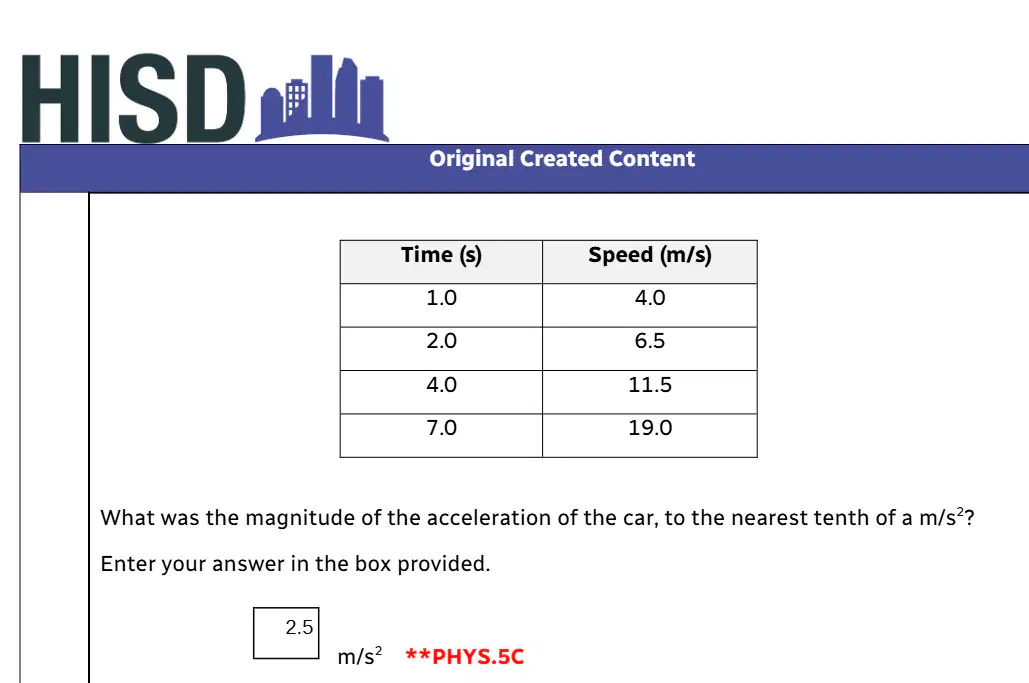
A car’s speed is recorded at four times: at 1.0 s it is 4.0 m/s, at 2.0 s it is 6.5 m/s, at 4.0 s it is 11.5 m/s, and at 7.0 s it is 19.0 m/s. Assuming constant acceleration, which value best represents the car’s acceleration?
1.9 m/s^2
2.5 m/s^2
3.0 m/s^2
3.5 m/s^2

A driver travels at 22.0 m/s and brakes to a stop with a constant acceleration of −9.60 m/s2. Using kinematics, what is the length of the skid marks?
12.4 m
25.2 m
71.3 m
211 m
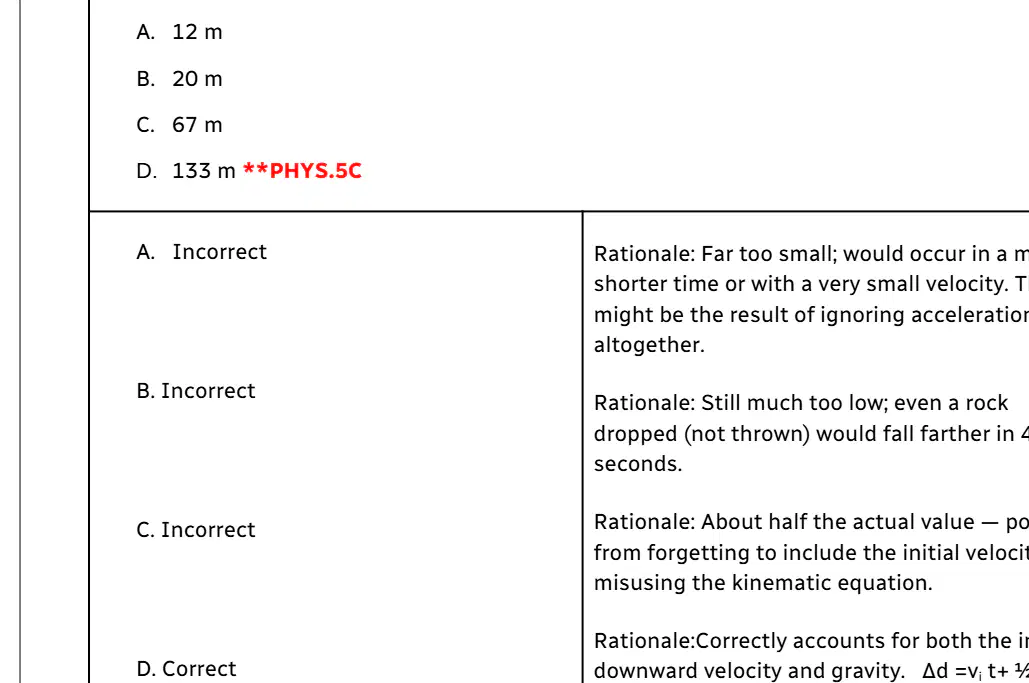
A rock is thrown straight down from a cliff with an initial speed of 7.50 m/s. It hits the ground in 4.50 s. Neglect air resistance and take g = 9.8m/s2 downward. How high is the cliff?
12 m
20 m
67 m
133 m
Which statement best describes inertia according to Newton’s First Law?
Inertia is an object’s tendency to maintain its mass.
Inertia is an object’s tendency to stay at rest only.
Inertia is an object’s tendency to stay in motion only.
Inertia is an object’s tendency to stay at rest or, if moving, to keep moving.
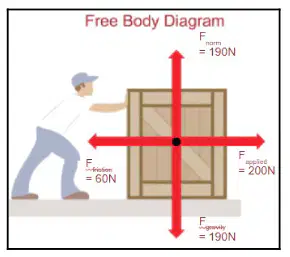
Refer to the free-body diagram of a person pushing a box. Forces shown: to the right 200 N, to the left 60 N, upward 150 N, downward weight such that vertical forces balance. What is the net horizontal force on the box, including sign convention where rightward is positive?
−140 N
+140 N
−260 N
+260 N




Magnitude 139.0N
Magnitude 195N
Magnitude 139.0N
Magnitude 139.0N

What is the resultant of the two vectors shown above?
+5
-5
+15
-15

Starting from the origin, a person walks 8 km east during first day, and 5 km west the next day. What is the net displacement of the person from the initial point in two days?
6 km east
3 km east
10 km west
5 km west
11 km west


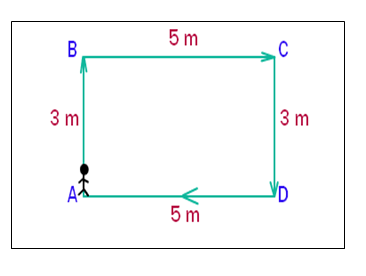
Suzie goes from Home to shopping to lunch to the movies to the gas station. What was her DISPLACEMENT?
5 miles
13 miles
4 miles
8 miles

The sum of two or more vectors (450 N in this picture)
Zero vector
Parallel vectors
Equivalent vectors
Resultant

What is the resultant for the following example?
(Part of the work is done, but not all)
24.6 km at 27 degrees north of east
24.6 km at 63 degrees north of east
33 km at 27 degrees north of east
33 km at 63 degrees north of east

A skier moves from point A to point B, then moves backwards to point C, before travelling forwards again to point D. What is her displacement? (ignore the time listed)
40m
100m
140m
420m

Suzie goes from Home to shopping to lunch to the movies to the gas station. What was her DISTANCE traveled?
24 miles
28 miles
16 miles
29 miles
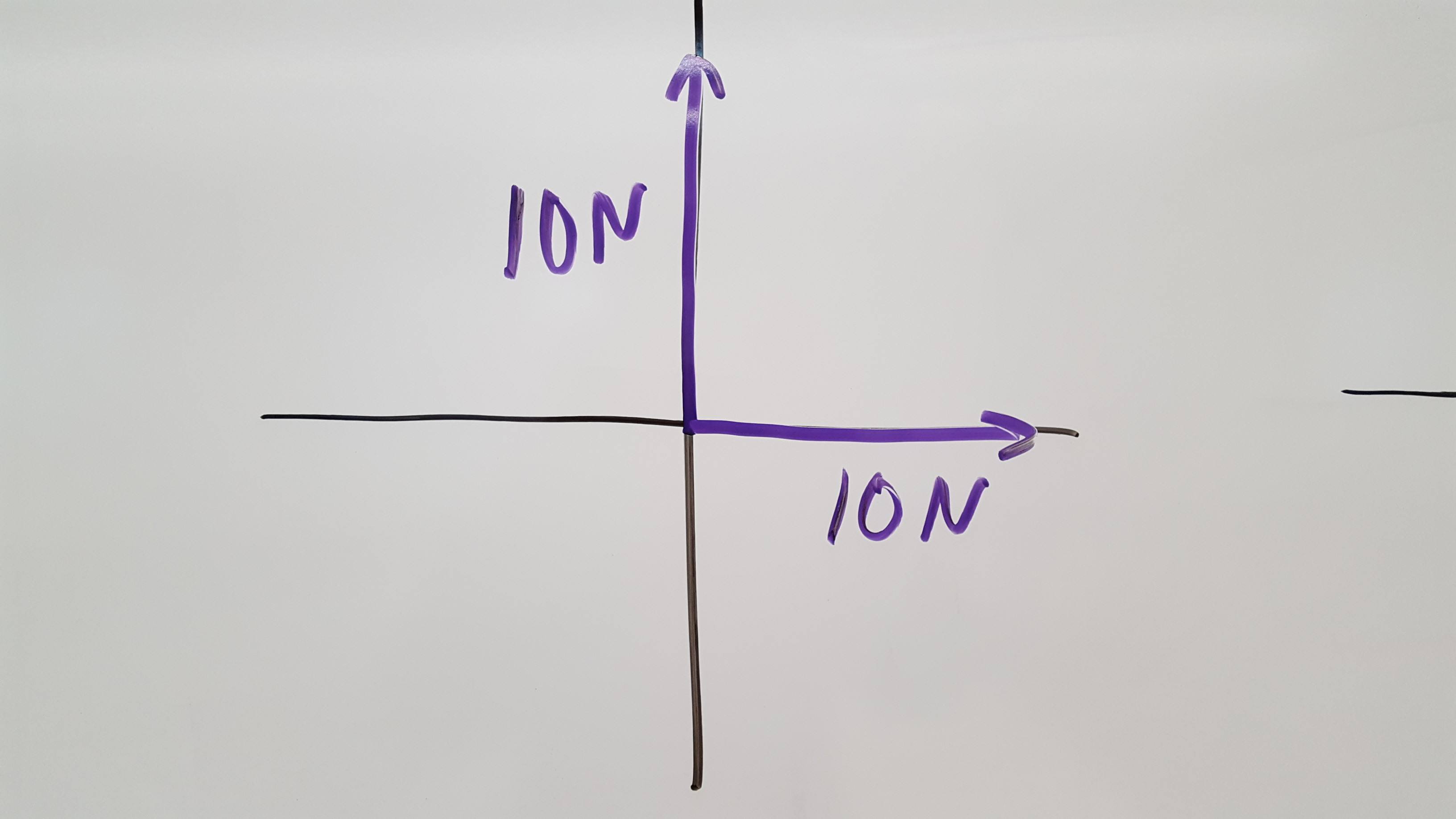
What is the resultant vector's force?
10
20
-10
14.14


What is the displacement of the car in Image A?
6 km
6 km, right
4 km
2 km left

Two people walk across a parking lot. Their paths are shown in the image. Who traveled a shorter distance?
Person A
Person B
They both had the same displacement.
The displacement and distance are the same.

Which vector best represents the resultant of forces F1 and F2 acting concurrently on point P, as shown in the diagram?


Vector A is directed northward and vector B is directed eastward. Which of the following vector addition diagrams best represent the addition of vectors A and B and the subsequent resultant?
A
B
C
D
E

Two perpendicular forces act on an object as shown in the diagram. What is the magnitude of the resultant force on the object?
17 N
13 N
7.0 N
5.0 N

How was the graph created?
Keeping the car steady, moving it away from the sensor at a constant speed, holding it still for a little while, then moving it back toward the sensor
Keeping the car steady, moving it away from the sensor slowly after first and then faster, holding it still for a little while, then moving it back toward the sensor
Keeping the car steady, moving it away from the sensor quickly at first then slowly, holding it still for a little while, then moving it back toward the sensor
Computers hooked up to a science machine

Adding which two vectors would give a resultant of zero magnitude?
A + B
A + E
B + E
C + F
A + D

