
Font size
 Worksheets
CHEM104_Thermochemistry_Quizizz
Total questions: 76
Worksheet time: 38mins
Thermochemistry is the study of:
The heat changes that occur during chemical reactions.
The rate at which chemical reactions occur.
The structure of atoms and molecules.
The color changes in chemical reactions.
Energy is defined as:
The capacity to do work or produce heat.
The ability to create matter from nothing.
The process of breaking down molecules.
The movement of objects without force.
Work (w) is:
The energy used to move an object against a force.
The amount of heat transferred between objects.
The speed at which an object moves.
The force applied to an object.
Heat (q) is:
The energy transferred between objects due to a temperature difference.
The force that moves objects from one place to another.
The amount of matter in an object.
The speed at which an object moves.
Which is a form of kinetic energy?
Motion of particles (e.g., thermal energy).
Stored energy in batteries (chemical energy).
Energy stored in a stretched rubber band (elastic potential energy).
Energy due to an object's position (gravitational potential energy).
In thermodynamics, the part we focus on is called the:
System.
Surroundings.
Boundary.
Environment.
The surroundings refer to:
Everything outside the system.
Everything inside the system.
Only the air around the system.
Only the boundaries of the system.
The law of conservation of energy states:
Energy cannot be created or destroyed, only transformed.
Energy can be created from nothing.
Energy is always lost during transformation.
Energy can only be destroyed, not transformed.
The equation for the first law of thermodynamics is:
ΔU = q + w
ΔU = q - w
ΔU = w - q
ΔU = q × w
When heat is released by a system:
q is negative (exothermic process).
q is positive (endothermic process).
q remains unchanged.
q is always zero.
When work is done on the system, w is:
Positive.
Negative.
Zero.
Undefined.
ΔU depends only on:
Initial and final states (state function).
Path taken between states.
Amount of heat supplied.
Work done by the system.
Which of the following are not state functions?
Work (w) and heat (q).
Internal energy (U) and enthalpy (H).
Pressure (P) and volume (V).
Temperature (T) and entropy (S).
A process where energy flows into the system is:
Endothermic.
Exothermic.
Isothermal.
Adiabatic.
The specific heat capacity (Cs) is:
The amount of heat required to raise the temperature of 1 gram of a substance by 1°C.
The amount of heat required to melt 1 gram of a substance.
The amount of heat required to raise the temperature of 1 mole of a substance by 1°C.
The amount of heat required to vaporize 1 gram of a substance.
Formula for heat transfer:
q = m × Cs × ΔT
q = m × v × ΔT
q = m × a × ΔT
q = m × Cp × ΔT
If a metal absorbs 500 J and its temperature rises by 10°C with mass 50 g, Cs is:
Cs = 1 J/g°C
Cs = 0.1 J/g°C
Cs = 10 J/g°C
Cs = 5 J/g°C
is a measure of thermal energy and heat is the transfer of thermal energy
Temperature
Heat
Work
Heat flows naturally:
From hot to cold objects.
From cold to hot objects.
Equally in both directions.
Only in the presence of light.
Thermal equilibrium occurs when:
No net heat flow occurs between objects.
Objects are at different temperatures.
Heat flows continuously between objects.
Objects are in motion relative to each other.
Work done by expanding gas is:
Negative (w < 0).
Positive (w > 0).
Zero (w = 0).
Cannot be determined.
If ΔV is positive:
The system expands.
The system contracts.
The temperature decreases.
The pressure increases.
SI unit of work and energy:
Joule (J).
Watt (W).
Newton (N).
Calorie (cal).
A piston compresses gas; ΔV < 0 and w is:
Positive.
Negative.
Zero.
Cannot be determined.
Formula for bomb calorimeter

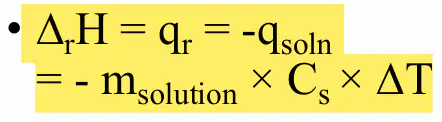


Formula for coffee cup calorimeter
Bomb calorimeter measures:
ΔU (change in internal energy).
= qv
ΔH (change in enthalpy).
Specific heat capacity.
Latent heat.
Coffee-cup calorimeter measures:
ΔH (change in enthalpy).
qp
ΔS (change in entropy).
ΔG (change in free energy).
ΔE (change in internal energy).
If qcal = +2.5 kJ in a bomb calorimeter, qrxn =
-2.5 kJ
+2.5 kJ
0 kJ
2.5 J
In calorimetry, qsystem =
-qsurroundings
qsurroundings
qsystem + qsurroundings
qsystem - qsurroundings
If temperature of solution rises, reaction is:
Exothermic.
Endothermic.
Neutral.
Reversible.
Enthalpy is:
The heat content of a system at constant pressure.
The amount of work done by a system.
The temperature of a system at equilibrium.
The pressure exerted by a system.
ΔH = qp because:
At constant pressure, heat flow equals enthalpy change.
At constant volume, heat flow equals enthalpy change.
Enthalpy is always equal to internal energy.
Heat flow is independent of pressure.
If ΔH < 0:
The reaction is exothermic.
The reaction is endothermic.
The reaction absorbs heat.
The reaction does not involve heat change.
Breaking bonds is always:
Endothermic.
Exothermic.
Neutral.
Spontaneous.
Forming bonds is always:
Exothermic.
Endothermic.
Neutral.
Unpredictable.
Freezing water is:
Exothermic.
Endothermic.
Neutral.
Radioactive.
ΔH = –2044 kJ/mol for C3H8 combustion. For 2 mol burned, total ΔH =
–4088 kJ
–1022 kJ
–2044 kJ
4088 kJ
Doubling a chemical equation will:
Double ΔH.
Halve ΔH.
Have no effect on ΔH.
Triple ΔH.
Reversing a chemical equation will:
Change the sign of ΔH.
Increase the rate of reaction.
Change the physical state of reactants.
Decrease the activation energy.
If ΔHreaction = –500 kJ, heat is:
Released (exothermic).
Absorbed (endothermic).
Neither released nor absorbed.
Stored in the reactants.
Hess’s law states that:
The total enthalpy change is the sum of enthalpy changes for individual steps.
The entropy of a system always increases over time.
Energy cannot be created or destroyed, only transformed.
The rate of a reaction depends on the concentration of reactants.
Standard enthalpy of formation for any element =
0 kJ/mol
100 kJ/mol
-50 kJ/mol
1 kJ/mol
Formula for ΔH°reaction is:
ΔH°reaction = ΣΔH°f(products) – ΣΔH°f(reactants)
ΔH°reaction = ΣΔH°f(reactants) – ΣΔH°f(products)
ΔH°reaction = ΣΔH°f(products) + ΣΔH°f(reactants)
ΔH°reaction = ΣΔH°f(reactants) × ΣΔH°f(products)
Energy can exist as potential or kinetic energy.
True
False
q and w are path-dependent.
True
False
Temperature and internal energy are state functions.
True
False
Heat and work are state functions
True
False
In exothermic reactions, surroundings gain energy.
True
False
In bomb calorimetry, ΔV = 0.
True
False
In coffee-cup calorimetry, ΔP = 0.
True
False
The unit for specific heat is J g⁻¹°C⁻¹.
True
False
A 48.1 g copper sample (Cs=0.385 J/g°C) heats from 20.9°C→41.1°C. Find q.
374J
185.2 J
420.0 J
250.7 J
Balloon expands from 0.111L → 1.24L at 1.05 bar. Find work (J).
–118.5 J
–10.5 J
–50.0 J
–200.0 J
Calculate q when 25 g water cools from 80°C – 25°C (Cs=4.184 J/g°C).
-5.75*10^3
-2615 J
-3430 J
-4500 J
If Δn(gas)=+1 at 298K, find work (J). (R=8.314)
-2478 J
298 J
8.314 J
24.8 J
The ΔH for 2A–B is +40 kJ. What is ΔH for 4A–2B?
+80 kJ
+20 kJ
+40 kJ
+160 kJ
What is the formation of new substances called?
Chemical change
Evaporation
Condensation
Melting
What is force acting through a distance called?
work
Momentum
Pressure
Energy
What is energy stored in bonds called?
Chemical potential energy
Kinetic energy
Thermal energy
Electrical energy
What is the environment in thermochemistry?
Everything outside the system that can exchange energy with it
The system itself where reactions occur
Only the reactants involved in a chemical reaction
A closed container with no energy exchange
Can energy be created?
Energy cannot be created
Energy can be created from nothing
Energy is always increasing
Energy is destroyed during reactions
What is the formula for heat transfer in terms of mass, specific heat, and temperature change?
q = mCΔT
q = mC/T
q = mC + T
q = mC - T
When is q positive in thermochemistry?
q is positive when heat is absorbed by the system
q is positive when heat is released by the system
q is positive when the temperature of the surroundings increases
q is positive when the system loses energy
What does 'Positive' refer to in thermochemistry?
Positive refers to heat absorbed or work done on the system
Positive refers to heat released or work done by the system
Positive refers to a decrease in temperature of the system
Positive refers to the system losing energy
What does 'Path taken' refer to in thermochemistry?
Path taken refers to the process or steps taken during a reaction
Path taken refers to the amount of heat released in a reaction
Path taken refers to the final products formed in a reaction
Path taken refers to the temperature at which a reaction occurs
What type of reaction releases heat?
Exothermic
Endothermic
Neutralization
Decomposition
What is the heat needed to raise 1 mol by 1°C called?
1.0 J/g°C
Specific heat capacity
Latent heat
Enthalpy
What is the formula for heat capacity?
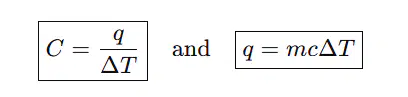
q = mCΔT
q = mcT
q = mT
What is the value of q when there is no heat exchange?
q = 0
q = 1
q = -1
q = 100
What is the formula for work done on the system?
w = +PΔV
w = -PΔV
w = mgh
w = Fd
When is work done on the system?
Work is done on the system when w is positive
Work is done on the system when w is negative
Work is done on the system when w is zero
Work is done on the system when w is undefined
What is a calorie in thermochemistry?
Cal
J
W
Mole
What does 'Positive' mean in the context of enthalpy change?
Positive means heat is absorbed (endothermic)
Positive means heat is released (exothermic)
Positive means temperature decreases
Positive means the reaction is spontaneous
What does '+qsurroundings' mean in thermochemistry?
+qsurroundings means heat gained by the surroundings
+qsurroundings means heat lost by the surroundings
+qsurroundings means heat gained by the system
+qsurroundings means heat lost by the system
What type of reaction absorbs heat?
Endothermic
Exothermic
Combustion
Neutralization

