
Font size
 Worksheets
Unit 4 Periodic Table (11/14/25)
Total questions: 47
Worksheet time: 56mins
Examine the portion of the periodic table that contains Argon in Group 18. Which element would have similar properties to it, and why?
Ne; elements in the same family of the periodic table share the same characteristics.
Fl; elements in the same period of the periodic table share the same characteristics.
Fr; elements on opposite corners of the periodic table share the same characteristics.
Li; elements on opposite sides of the periodic table share the same characteristics.
Carbon is an element. Which of the following best describes the smallest particle of Carbon that retains all the properties of Carbon?
a molecule
an atom
a proton
an electron
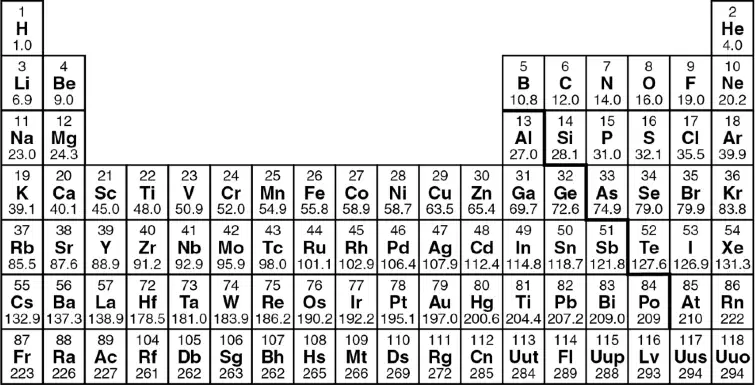
Which group contains the noble gases?
1 (1A)
2 (2A)
17 (7A)
18 (8A)
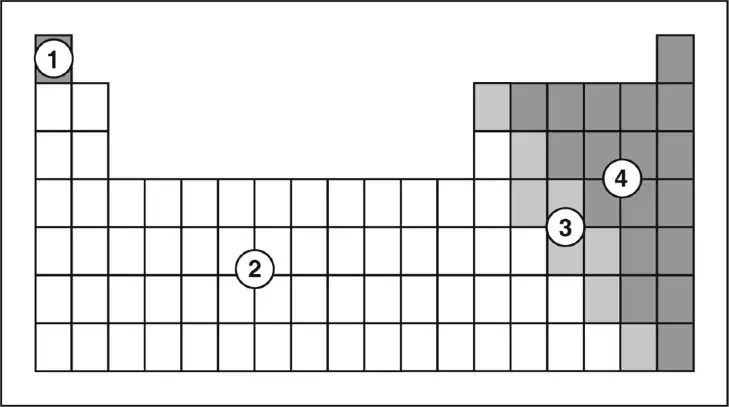
The outline of a partial periodic table is shown. Zinc is a metal. In which section of the partial periodic table is zinc located?
Section 1
Section 2
Section 3
Section 4
Find the listed elements on the periodic table. Which element has the highest atomic number?
Ar
Ca
Mn
P
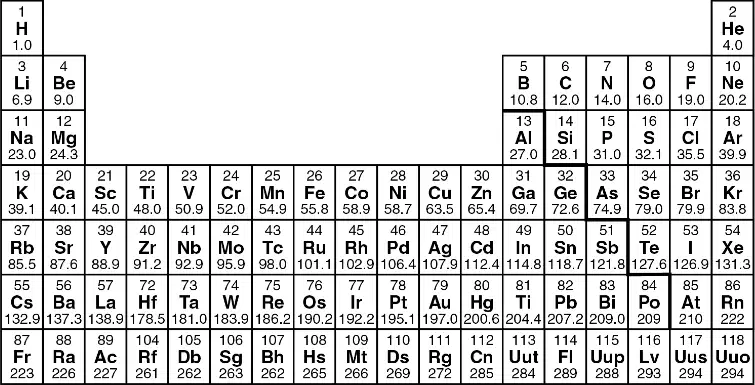
A partial periodic table is shown. Using the partial periodic table, which statement is correct?
Oxygen (O) has more protons than chlorine (Cl).
Iron (Fe) has more protons than silver (Ag).
Sodium (Na) has more protons than carbon (C).
Hydrogen (H) has more protons than helium (He).
Where are nonmetals found on the periodic table?
Nonmetals are found throughout the periodic table.
Nonmetals are found on the left of the periodic table.
Nonmetals are found in the middle of the periodic table.
Nonmetals are found on the right of the periodic table.

A student examines a periodic table with two elements (X and Y) labeled. How can X and Y be classified?
Both X and Y are metals.
Both X and Y are metalloids.
X is a nonmetal, and Y is a metal.
X is a metal, and Y is a nonmetal.
What can be concluded from the following statements about a property of metals? • A cast-iron skillet on a stove is used to fry bacon. • A metal spoon left in a pot of soup heating on a stove is too hot to touch. • An aluminum playground slide gets hot on a summer day.
Metals conduct heat.
Metals conduct electricity.
Metals are good insulators.
Metals combine with nonmetals.
Element X is a good conductor of electricity. Which of the following most likely describes other elements that are good electrical conductors?
all elements in the same row of the periodic table as X
all elements in the same column of the periodic table as X
all elements that can be combined with X to form ionic compounds
all elements that can be combined with X to form covalent compounds
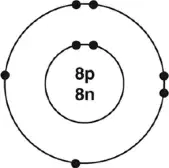
A model of an oxygen atom is shown. What is the net charge for this oxygen atom?
+8
-8
0
+16
What happens when an atom gains an electron?
The atom loses a proton.
The atom attracts additional electrons.
The atom increases in atomic mass.
The atom becomes negatively charged.
When an atom has a neutral charge, which particles within the atom have equal numbers?
electrons and neutrons
protons and electrons
neutrons and protons
ions and neutrons
The mass of an element is the sum of the atomic number and the number of
electrons.
ions.
neutrons.
protons.
Which statement correctly describes the difference between a compound and a mixture at the molecular level?
Components of a mixture are chemically bonded, while elements in a compound are only physically combined.
Compounds are pure substances with a fixed ratio of elements, whereas mixtures have a variable composition and are not chemically bonded.
Mixtures have new chemical properties different from their components, while the properties of a compound are similar to its components.
Compounds can be separated by physical methods, but mixtures can only be separated by chemical reactions.

Non metals
elements that have no metallic properties
metals
elements with metallic properties
Chlorine
example of a halogen
Xenon
example of a noble gas
metalloids
element that has both physical and chemical properties of a metal and non metal
Label each part of the periodic table correctly.
Metals
Nonmetals
Metalloids

What will this atom do to become stable?
Gain 1 electron
Gain 2 electrons
Nothing, it is already stable
Lose 7 electrons
Lose 8 electrons

What will this atom do to become stable?
Lose 7 electrons
Gain 1 electrons
Nothing, it is already stable
Chlorine
C
Ch
Cl
Co
Sodium
S
So
Sm
Na
Calcium
Ca
C
K
Cl
Fluorine
Fl
F
Fn
Fe


Which contains only elements?
A
B
C
D

Which contains only elements (no compounds)? (Choose all)
A
B
C
If the solar system were used as a model of an atom, what would the Sun most likely represent?
an ion
a nucleus
a neutron
an electron
This word means “unable to be divided" or "uncuttable"
atom.
proton.
neutron.
electron.
Which scientist was the first to devise the rules of chemical reactions that are explained by modern atomic theory?
John Dalton
Isaac Newton
Galileo Galilei
Albert Einstein
Which law states that the volume of a gas increases with increasing temperature, if pressure is constant?
Boyle’s law
Charles’s law
Pressure law
Kinetic molecular theory
A helium-filled balloon is released into the atmosphere. As the balloon rises, which would most likely increase and cause the balloon to burst?
the mass of the helium
the density of the helium
the volume of the helium
the temperature of the helium
Ninety-nine percent of the mass of an atom is located in
the outermost energy level.
the first energy level.
the electron clouds.
the nucleus.
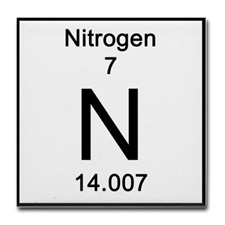

What does the atomic number represent?
how many atoms are in a group.
how much an atom weighs.
the number of protons in the nucleus of the atom.
If an atom has nine protons and ten electrons, then the atom is
positively charged.
negatively charged.
radioactive.
neutral.
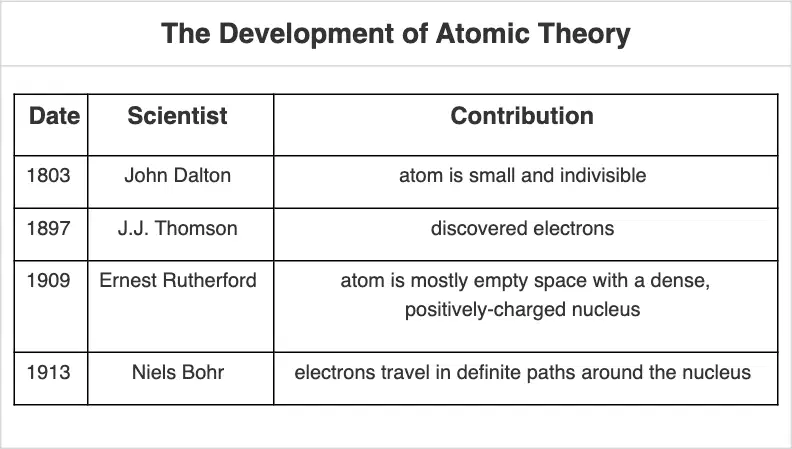
The table shows the contributions made to atomic theory by four scientists. What does the table indicate regarding the theory of the atom?
One scientist made more significant contributions than others.
Hundreds of years passed between discoveries.
People did not think about the atom after 1913.
Atomic theory changed over time as new discoveries were made.

How many valence electrons does this atom have?


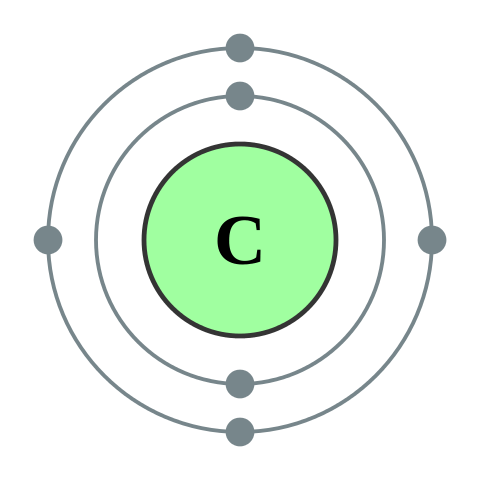
How many valence electrons does carbon have?
4
5
6
7

