
Font size
 Worksheets
Recap Marketing and Functions
Total questions: 86
Worksheet time: 43mins
Choose the most accurate definition to mean a market?
Any place where goods are sold for money only
Any person, group, or organization with an existing or potential exchange relationship
Only the group of current paying customers of a firm
A digital platform that lists products from multiple sellers
Identify which items are listed as parts of the marketing function by McDonald, Wilson & Chaffey (2024). Select all that apply.
Defining markets
Quantifying the needs of customer groups (segments)
Determining value propositions and revenue models to meet needs
Issuing quarterly financial statements to investors
Monitoring the value delivered to customers and the organization
Which option best describes the role of communication within the marketing function, as outlined by McDonald, Wilson & Chaffey (2024)?
Informing only external customers about promotional discounts
Communicating value propositions to internal stakeholders responsible for delivery and securing their buy-in
Outsourcing all customer service inquiries to reduce costs
Sending weekly sales reports to regulators
Match each step of the marketing function to its purpose, based on McDonald, Wilson & Chaffey (2024).
Defining markets
Deciding the scope and boundaries of the customer groups to serve
Quantifying customer needs
Measuring what segments require and to what extent
Determining value propositions and revenue models
Designing offerings and ways to generate revenue that meet segment needs
Monitoring value delivered
Assessing whether customers and the organization are receiving expected value
According to the instructional text, which outcome directly reflects the efficiency of marketing spending and is used to evaluate campaign effectiveness?
Maximize revenue
Maximize profits
Return on Investment
Minimize cost
Select all benefits that the instructional text explicitly lists as reasons marketing planning is essential.
Maximize revenue
Maximize profits
Increase headcount
Return on Investment
Minimize cost
Match each marketing planning objective to the most accurate brief description.
Maximize revenue
Increase total sales inflows from customers
Maximize profits
Increase the gap between sales inflows and total expenses
Return on Investment
Assess gains relative to the resources spent on marketing
Minimize cost
Reduce expenditures required to execute marketing activities
A firm improves targeting and allocates budget based on a clear plan. Which listed essential reason best captures the financial ratio used to assess whether those allocations paid off?
Maximize revenue
Maximize profits
Return on Investment
Minimize cost
Which pair of goals from the instructional text together most directly strengthens a company’s cash position by increasing inflows while controlling outflows?
Maximize revenue and Minimize cost
Maximize profits and Return on Investment
Return on Investment and Maximize revenue
Minimize cost and Return on Investment
Which element belongs to the Product component of the 4Ps marketing mix?
Credit terms
Brand name
Transportation
Sales promotion
In the 4Ps, which activities are primarily associated with Place?
Advertising and publicity
List price and discounts
Channels and logistics
Design and features
Select all items that fall under the Price element of the 4Ps.
Payment period
Allowance
Public relations
List price
Which statement best describes Promotion within the 4Ps?
It deals with product variety and packaging choices.
It includes advertising, personal selling, sales promotion, and public relations.
It determines locations and assortments for distribution.
It covers discounts, allowance, and credit terms.
Match each 4Ps element to an example activity.
Product
Design and features
Price
Discounts and credit terms
Place
Channels and logistics
Promotion
Public relations and advertising
According to the material, who created the 4Ps and when?
E. Jerome McCarthy in 1960
Philip Kotler in 1970
Booms and Bitner in 1982
Peter Drucker in 1954
Which list correctly shows all four components of the original marketing mix?
Product, Price, Place, Promotion
Product, People, Process, Physical evidence
Price, Place, People, Positioning
Product, Packaging, Publicity, Profit

In the 7Ps model by Booms and Bitner (1982), which three Ps were added to the original 4Ps?
Packaging, Positioning, Profit
People, Process, Physical evidence
Performance, Productivity, Pricing
Publicity, Partners, Purpose
Which objective aligns with how the 7Ps model should be used?
Ignore current market conditions and focus on past success.
Set clear objectives based on the current situation the company is facing.
Emphasize price over all other elements.
Target as many markets as possible without positioning.
Select the points that are highlighted as guidance for applying the 7Ps framework.
Build strategies to meet objectives
Focus on target markets
Eliminate promotion activities
Consider the company’s positioning
Match each P from the 7Ps to a brief description focus.
People
Staff and customer interactions that deliver service
Process
Steps and flows that deliver the offering
Physical evidence
Tangible cues that signal quality in services
Which statement best differentiates the 7Ps from the 4Ps?
The 7Ps remove Promotion and add Packaging and Profit.
The 7Ps retain the original 4Ps and add People, Process, and Physical evidence to address services and experiences.
The 7Ps focus only on pricing tactics and remove distribution concerns.
The 7Ps replace Product with Positioning to emphasize branding only.
Which statement best captures the scope of Product in the marketing mix as presented: it includes the physical good or service and also the overall experience users and customers have with it?
Product is limited to the tangible item offered for sale.
Product refers only to branding and packaging decisions.
Product includes the physical good or service and the customer experience surrounding it.
Product focuses solely on post-sale support services.
According to the material, which customer considerations should guide Product decisions? Choose all that apply.
What problem the product solves
Which production technology is cheapest
What attracts people to the product or service
Which internal department owns the product roadmap
Customers may be attracted to several product attributes. Which option lists examples aligned with the text?
Packaging, features, ease-of-use, name, quality, design, support
Factory location, tax rate, board composition, patent count
Executive salaries, vendor contracts, warehouse layout
Loan terms, shareholder dividends, currency hedges
What does the text emphasize about the buying experience in relation to the Product element?
Only the physical item determines purchase decisions.
The purchase is influenced by the entire buying experience beyond the physical product.
The buying experience matters only for luxury goods.
Experience affects promotion but not product strategy.
Which actions are recommended to center Product, Price, and Promotion decisions around the customer?
Create buyer personas and conduct customer research to learn about current or potential customers
Prioritize internal stakeholder preferences over customer data
Avoid segmentation to keep messaging broad and simple
Delay research until after launch to prevent bias
A firm underprices its product. According to the text, what perception might consumers form?
They may question its effectiveness or think it is too good to be true.
They will perceive it as premium and trustworthy.
They will assume the brand is a market leader.
They will ignore effectiveness and focus on color.
What challenge might a non-luxury brand face if it prices too high, as per the material?
It will always grow market share.
Consumers may see it as overpriced and unnecessary, making sales difficult.
It will automatically be perceived as a luxury brand like Coach or Chanel.
It will trigger legal action from competitors.
Match each pricing approach with its example described in the text.
Economy pricing
Generic grocery brands priced lower than name brands
Psychological pricing
Prices with odd decimals like 53.99 or 3.97
Competitive pricing
Pricing set with regard to rivals in the market
Which list correctly includes pricing strategy models specifically mentioned in the material?
Bundle, subscription, competitive, economy, discount, psychological
Skimming, penetration, freemium, dynamic, auction
Cost-plus, value-based, surge, pay-what-you-want
Barter, leasing, franchising, tendering
Select the factors the text says should influence the pricing strategy you choose. Choose all that apply.
Value of your product
Production and distribution costs
Consumer demand and the competitive landscape
Personal preference of the CEO
Which statement reflects the role of consumers in pricing according to the material?
Price is independent of consumers once costs are covered.
Price is heavily influenced by your consumers and what they will pay.
Consumer influence applies only in luxury segments.
Consumers affect promotion but not price.
The text provides a concrete pricing misfit example. Which is it?
Charging $900+ for a handbag when the target market is middle-income
Offering a free trial for a software subscription
Setting an even 54.00insteadof 53.99
Discounting seasonal inventory at year-end
According to the material, what does Promotion primarily focus on within the marketing mix?
How to manufacture the product efficiently
How you will communicate your product to people via tactics that spread the word
How to set the optimal price point using cost data
How to select retail shelf placements only
Which clarification about Promotion is emphasized?
Promotion is synonymous with marketing and replaces sales.
Promotion doesn’t encompass the entire marketing function; it also addresses the sales process and areas such as public relations and advertising.
Promotion deals only with advertising, not public relations or sales.
Promotion is unnecessary when demand is high.
What immediate outcomes is Promotion intended to generate, as stated in the text?
Awareness, interest, desire, or action
Inventory reduction and cost savings
Patent filings and investor relations
Product redesigns and line extensions
Before pushing for a transaction, what should Promotion ensure according to the material? Choose all that apply.
People know what your products and services are
People understand what they offer customers
People know why they are worth buying
People have already purchased once
Promotion messaging should clearly explain how a product solves a specific need for the target audience. Which element is most important to include according to the material?
Technical specifications of the product only
A clear reason why the audience needs the product and how it benefits them
A detailed company history
A comparison of global market share trends
When crafting promotional messages, which type of content differentiator is specifically suggested as an example?
Manufacturing location
Lower price, higher quality, faster service, or more flexibility
Celebrity endorsements
International patents
Selecting promotion channels should be based primarily on which factor?
The channel with the lowest advertising rates
Where and when your audience most actively consumes content
The channels most used by competitors
Internal staff preferences
Which of the following is listed as a promotion channel option? Select all that apply.
Word-of-mouth
Podcasts
Television ads
Wholesale distribution
Which question is recommended to ask when identifying promotional channels for your audience?
How many employees does the company have?
What types of content does the audience consume daily?
What is the company’s annual revenue?
Which distributors offer bulk discounts?
Place refers to which aspect of the marketing mix, as defined in the material?
Pricing strategy across regions
Distribution: how customers find and purchase the product
Product design features
Employee training programs
Which are identified as two common distribution channels under Place?
Direct sales and wholesalers
Social media ads and email newsletters
Retail merchandising and packaging
Call centers and online chat
For a local retail business, what is the likely primary sales approach described?
Selling exclusively through a wholesaler
Licensing the brand to resellers
Direct sales at the location, possibly with an online store
Franchising to international partners
What is a key trade-off when selling through a wholesaler or reseller compared to direct sales?
Higher profit margins and stronger customer connection
Wider distribution network but reduced direct customer connection
Faster product development and lower costs
Improved customer service but limited geographic reach
According to the material, why might intermediary sales be unsuitable for some businesses?
They require a year-round consistent supply of products
They are illegal for seasonal goods
They prevent online sales
They always reduce quality control

Which statement best describes the role of People in the 7Ps as presented?
People are responsible only for back-office operations
People primarily design advertising creatives
People interact with customers across multiple touchpoints and become the organisation’s face
People handle financial audits exclusively

Which customer interaction channels are mentioned for People? Select all that apply.
In person
Online chat
Social media
Wholesale purchasing

What capabilities must a company’s people optimise, according to the material?
Advanced coding skills and patent filing
Knowledge of products and services, access to relevant information, and everyday approach and attitude
Warehouse logistics only
Foreign language proficiency for all employees
Match each distribution method under Place with its characteristic advantage or consideration.
Direct sales
Primary contact shaping customer experience
Wholesaler/reseller
Wider distribution network and larger customer-base
Seasonal direct sales
More suitable when supply is limited-time or seasonal
Which consideration is highlighted when choosing the timing of promotional messages?
Times when your audience is most actively consuming content
Times when competitors are least active
Times that align with fiscal year-end
Times that match supplier delivery schedules
Process in the marketing mix focuses on the steps behind the scenes that shape the customer journey. Which statement best captures why businesses invest in process design?
To create a smooth, efficient, and customer-friendly journey by organizing behind-the-scenes steps
To increase product features without changing operations
To replace customer service staff with automation for cost cutting only
To focus on advertising instead of operations
A customer journey often includes stages such as making an online enquiry, requesting information, and making a purchase. What is the primary benefit of mapping these steps?
It identifies what processes must be in place to ensure a positive customer experience
It determines the exact price customers are willing to pay
It eliminates the need for physical locations
It guarantees customers will buy without any marketing
Select all elements that directly relate to physical evidence in services marketing.
Staff uniform
Online reviews
Production line scheduling
Testimonials
Physical evidence offers tangible cues of service quality. In which situation is it particularly useful?
When the customer is new to the organization and seeks reassurance, or must pay before service delivery
When the customer has long-standing loyalty and never reads reviews
When the company sells only low-priced goods that require no information
When services are delivered entirely by robots with no human oversight
Match each example to the type of physical evidence it represents.
Staff uniform
Visual identity worn by employees
How the menu is designed
Information layout guiding choices
Website
Digital channel presenting the firm
Company reports
Formal documents signaling transparency
Which statement best distinguishes process from physical evidence within the 7Ps?
Process is the organized sequence of steps that deliver the experience; physical evidence is the tangible cues that signal quality
Process is the price paid; physical evidence is the promotion message
Process is the building location; physical evidence is the people delivering service
Process is the product features; physical evidence is the discount offered
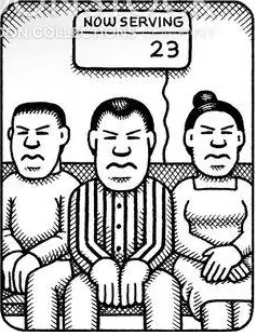
Referring to the cartoon showing a queue system with number tickets and 'Now Serving 23', which process issue is being illustrated?
Poorly coordinated customer flow leading to confusion and long waits
Dynamic pricing error changing the ticket number
Staff uniforms not matching brand colors
Website forms displaying testimonials incorrectly
Which of the following would most likely improve process efficiency across the customer journey?
Clarifying steps from enquiry to purchase and aligning internal operations
Adding more product features without training staff
Designing a colorful menu without changing workflows
Publishing annual reports instead of revising service steps
Select all items that are listed as examples of physical evidence.
Website
Testimonials
Company reports
Dynamic pricing algorithm
Why do companies consider processes 'behind the scenes' when planning customer experience?
Because these organized steps enable smooth interactions even if customers do not see the work
Because hidden processes allow companies to avoid regulatory scrutiny
Because unseen steps reduce the need for physical evidence
Because behind-the-scenes work eliminates the need for customer service
Refer to the 7Cs Marketing Mix diagram. Which set includes only components shown in the diagram?
Consumer, Cost, Convenience
Customer service, Price, Promotion
Credibility, Channel, Communication
Connection, Product, Place
According to the 7Cs Marketing Mix diagram, which components directly emphasize relationships and trust with the audience? Select all that apply.
Credibility
Connection
Cost
Convenience
Match each 7C element with the most fitting one-line focus based on the diagram’s labels.
Consumer
End-user needs and preferences
Cost
Total expenditure to the buyer
Convenience
Ease of access and purchase
Communication
Two-way messaging and outreach
Customer service
Support before and after sale
In the 7Cs Marketing Mix visual, which component most directly addresses post-purchase interactions with buyers?
Customer service
Cost
Communication
Consumer
According to the 7Cs perspective introduced by Robert F. Lauterborn in 1990, what should the first “C” primarily direct marketers to focus on?
Maximizing product features regardless of demand
Solving a problem or filling a void for the ideal customer
Lowering production costs through economies of scale
Expanding distribution to as many channels as possible
Which statement best reflects the role of understanding the customer in the 7Cs Marketing Mix?
It mainly helps determine factory locations for efficient logistics.
It enables businesses to create useful products and tailor outreach effectively.
It is primarily used to benchmark against competitors’ pricing strategies.
It ensures that advertising budgets are kept within industry standards.
Robert F. Lauterborn argued that the classic 4Ps were inadequate. In which publication and year was this claim made?
Harvard Business Review, 1985
Advertising Age, 1990
Journal of Marketing, 1995
Fortune, 1988
In the customer element of the 7Cs, which action best demonstrates the intended shift in focus?
Adding luxury features to outperform competitors’ specs
Designing offerings that address consumers’ wants and needs
Setting prices strictly based on production overheads
Launching nationwide promotions before testing demand
Which of the following questions aligns most closely with the 7Cs ‘Customer’ element?
How quickly can we scale our supplier base?
Which void or problem does our ideal buyer experience?
What tax incentives are available for exports?
Which celebrity partnership offers the highest reach?
Within the 7Cs framework, how is ‘Cost’ defined from the customer’s perspective?
The sticker price set by the seller
The price plus sales tax only
The total cost of buying, accessing, and using the product
The cost of materials and labor incurred by the firm
Which factor would NOT typically belong in the 7Cs notion of total customer cost?
Time required to set up or use the product
Benefit actually provided by the product
Time required for the customer to access the product
Depreciation method used in the company’s accounting
Select all considerations that fit the 7Cs ‘Cost’ element as described:
Customer travel or wait time to obtain the product
Actual usefulness and benefits delivered
Time needed for installation or setup
Firm’s advertising media buying rates
Which statement best links Convenience with Cost in the 7Cs Marketing Mix?
Convenience is unrelated to cost because it focuses only on design aesthetics.
Convenience improves when overall customer cost is reduced and access is easy.
Convenience depends solely on brick-and-mortar store ambience.
Convenience replaces the need for any market research.
After studying customer habits, what decision does the 7Cs ‘Convenience’ element help you make?
Whether to pursue cost-plus pricing across the portfolio
Whether customers prefer to shop in stores or online and how far they will go to purchase
Which celebrity endorsements drive the best social buzz
How to set warranty length for premium products
Which action best increases convenience according to the 7Cs discussion?
Requiring in-person pickup at a single location
Making the product cost-effective and easy to obtain
Delaying fulfillment to batch orders weekly
Limiting payment methods to reduce fees
In the 7Cs, why is Communication described as crucial to marketing success?
It guarantees viral growth without strategy.
It focuses on developing relationships and conversations with customers.
It replaces the need for product development.
It allows a firm to reduce service channels.
According to the material, which use of social media aligns with effective Communication in the 7Cs?
Posting constant product promotions without interaction
Automating replies so no human engagement is needed
Engaging in conversations and building relationships with followers
Avoiding customer comments to protect brand image
Which outcome is most likely when it is easy for customers to communicate with a business?
Customers will be less price sensitive in all categories.
Customers are more likely to keep coming back.
Customer service costs will always decrease.
Customers will rely exclusively on social media.
Match each 7Cs element discussed with its core emphasis.
Customer
Understand wants and needs; solve customer problems
Cost
Total customer burden to buy, access, and use
Convenience
Ease of obtaining the product based on habits and channels
Communication
Relationship-building through interaction and dialogue
In the 7Cs Marketing Mix, what best defines credibility for a business?
Offering the lowest prices regardless of quality
The trust of consumers, who need to be confident in the business before they buy
Launching products faster than competitors to signal innovation speed
Maximizing advertising frequency across all channels
Which statement best captures the meaning of connection in the 7Cs Marketing Mix?
Coordinating discounts across sales teams to boost quarterly revenue
Communicating one’s corporate identity coherently and in an interconnected way across all communication channels
Outsourcing brand storytelling to third-party influencers without brand guidelines
Restricting messaging to a single high-performing social platform to avoid noise
Multi-select: According to the 7Cs Marketing Mix, which outcomes are directly supported by strong connection activities? Select all that apply.
Consumer satisfaction
Loyalty
Retention
Lower production costs
Customer service in the 7Cs is described as a set of services provided when?
Only after the purchase, focusing on returns and refunds
Only during the purchase, focusing on checkout efficiency
Before, during, and after the purchase of a product or service
Only before the purchase, focusing on lead generation
Match each customer service element to the primary benefit it supports, based on the 7Cs description.
Clarification and information
Increased customer satisfaction through clear guidance
Complaints handling
Recovery of issues to maintain satisfaction and loyalty
Warranty on products
Assurance that supports loyalty and repeat purchase

