
 Worksheets
Q1 G4 Revision
Total questions: 103
Worksheet time: 2hrs 31mins
Plants need photosynthesis to make ___.
oxygen
carbon dioxide
food
new plants
The process of photosynthesis takes place in the:
Leaves of the Plant.
Stem of the plant.
Roots of the plant.
All of the above.

The openings that are found in the leaves of plants are called:
Stomata
Chlorophyll
Xylem
Chloroplast
The leaves of plant take in carbon dioxide from the air.
true
false

The basic needs of plants
air, water, sunlight, nutrients, and space
roots, stems, leaves, water, and sunlight
air, roots, stems, sunlight, and space
roots, nutrients, water, stems, and sunlight

A gas that plants need to make their own food
water
oxygen
carbon dioxide
nutrients

Part of the plant that take in water and dissolved nutrients from the soil
stem
roots
leaves
flowers

Part of the plant that supports the plant and is also the plant's transport system
stem
leaves
flowers
cones

Part of the plant that is the site of gas exchange and food production
flowers
leaves
stem
roots

Most flowers have two parts (choose two answers)
male (stamen)
flowers
female (pistil)
seeds

a physical trait or behavior that helps an organism survive in its environment
adaptation
stomata
stimulus
response

Plant's response to water, gravity, light, and touch
stimulus
response
tropism
transpiration

A structure is --
a nonliving thing.
a part of an organism.
when an organism grows and changes.
none of these

What is a function?
a model of a water environment
a nonliving thing
what a structure does
a living thing

A _____ is an organism that uses energy from sunlight to make its own food.
animal
chef
structure
plant

What is the plant structure that makes seeds for new plants to grow?
stem
leaves
roots
flower

The function of the roots is to --
absorb water and nutrients for the plant.
carry food to other parts of the plant.
make seeds for new plants to grow.
make food for the plant.

What is the function of the stem?
to make seeds for the plant
to absorb water and nutrients from the soil
to make food for the plant
to carry water, nutrients and food to other parts

What plant structure is number 1?
roots
stem
leaf
flower
seed
What plant structure is number 2?
roots
stem
leaf
flower
seed
What is the job of the roots?
to make seeds for the plant
to make food for the plant and take in air
to help the flower reproduce
to support the plant and help deliver food, minerals, and water to other parts of the plant
to anchor the plant in place, soak in water, and store food for the plant
What is the job of the stem?
to make seeds for the plant
to make food for the plant and take in air
to help the flower reproduce
to support the plant and help deliver food, minerals, and water to other parts of the plant
to anchor the plant in place, soak in water, and store food for the plant
What three things does a plant need to take in to be able to go through photosynthesis?
sunlight, water, and carbon dioxide
sunlight, water, and oxygen
oxygen, carbon, and hydrogen
water, oxygen, and glucose
What does internal mean?
Outside something
Veins and Arteries
Inside something
Lasts forever
What does external mean?
Inside something
Mutant Superheroes
Outside something
Aliens
What does function mean?
Something's job
A type of cheese
A new social media app
The organised parts of something
What is the function of leaves?
Leaves are tasty so can be used for salad
When you don't want to be somewhere anymore
Leaves take in sunlight and CO2 gas and use it to make food for the plant.
Leaves grow deep underground to absorb water and minerals

"photo" in the word photosynthesis means...
Picture
Light
Selfie
Making

"Synthesis" in the word Photosynthesis means...
Robot
Making
Light
Food
What things does a plant need for photosynthesis?
Sunlight
Friendly words
Water
Carbon Dioxide (CO2)
What is created from photosynthesis?
Oxygen
Seeds
Light
Sugar
Where do plants get the energy for photosynthesis to take place?
nutrients in the soil
the sun
chlorophyll
bee pollination
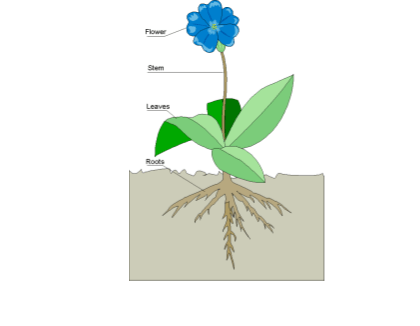

What part of the plant is this?
stem
seeds
leaves
roots

What part of the plant is this?
roots
seeds
flower
stem

What is the function of the roots?
anchors the plant in the ground and absorbs water and minerals
makes seeds
supports the plant and carries water and nutrients up and down to all parts of the plant
Why do animals need oxygen?
a. To provide energy to plants
b. To perform photosynthesis
c. To help them get energy from food
d. To collect water
What is the purpose of a shelter for animals?
a. To play
b. To provide protection and a place to raise young
c. To store food
d. To escape from preys
What do fish use to exchange gases with the water?
a. Gills
b. Lungs
c. Fins
d. Tail
Why do animals need space?
a. to hunt for food
b. to escape from predators
c. to build homes
d. All the previous answers
Which of the following is an example of an external structure?
a. Brain
b. Kidney
c. Stomach
d. A shark's teeth
Which of the following is an internal structure of an animal?
a. A shark's teeth
b. A bird's wings
c. A bird's beak
d. Stomach
The Brain is part of which system?
circulatory system
central nervous system
peripheral nervous system
digestive system
What is included in the nervous system?
Only the sense organs
Only the spinal cord and sense organs
Only the brain, spinal cord, nerves, and sense organs
Only the stomach, skin, and brain
What do animals use to gather information from outside the body?
brain
sensory organs
spinal cord
reflex
All animals can see, smell, taste, touch, and feel just like humans do.
True
False
an action or movement of the body that happens automatically as a reaction to something
reflex
central nervous system
spinal cord
peripheral nerve
a nerve that is not part of the central nervous system and receives sensory information
brain
reflex
nervous system
peripheral nerve
the part of the nervous system that is made up of the brain and spinal cord
brain
central nervous system
peripheral nerve
reflex
what interprets information from the nervous system and controls muscle movement
spinal cord
peripheral nerve
reflex
brain
moves information to and from the brain and peripheral nerves
reflex
spinal cord
central nervous system
brain
Which other internal structure’s function is
most similar to the lungs?
gills
heart
skin
brain
Is the heart an internal or external structure?
Internal
External
Is the structure that receives information about an animal’s environment
heart
brain
skull
ribs
Which of the following is an internal structure in animals?
Fur
Lungs
Scales
Claws
Which are internal structures of an animal? Select 2 options.
Brain
Beak
Heart
Teeth
The brown coat of a deer helps it blend in with its wooded environment. This adaptation is called:
Camouflage
Mimicry
Tropism
Adaptation
Why do bears have sharp claws?
To help them smell better.
To help them see better.
To help them breathe.
To help them catch their food.
Check all that are internal structures of an elephant
Stomach
Skin
Teeth
Liver
Esophagus
What structures are found inside an organisms body?
external structures
internal structures
What structures are found outside an organisms body?
external structures
internal structures
Which of the following is regarded as an internal structure in animals?
the ear
the stomach
the beak
the fur
A physical feature or trait that helps an animal survive, grow, behave, or reproduce is called?
exoskeleton
stimulus
inherit
adaptation
A bird's wings is a
Structure
Function
Animals use their eyes ___________.
to blink
to see

What part of the eye is sending information from your eye to your brain?
optic nerve
pupil
lens
iris
Which type of animals will have eyes on the front of their heads?
Predator
Prey
Plants
Why do prey have eyes on the side of their heads?
To see their food
To see danger from everywhere
To be able to watch TV better
What do animals do with their eyes?
They look for toy
They look for clothes
They look for food
What is it called when an object completely blocks light from passing through?
(a)
Animals that have eyes on the sides of their heads are usually (a) .
What do compound eyes do?
See changes in light.
See far away.
See danger from all directions.
See more clearly.
Which two parts of the eye allow light to pass through it?
cornea
eyelid
pupil
optic nerve
completely blocking light from passing through
reflection
translucent
image
opaque
refraction
letting only some light pass through
reflection
translucent
opaque
image
refraction
Which type of animals will have eyes on the front of their heads?
Predator
Prey
Plants
_____________ tell animals what they need to know about the environment.
internal organs
response
senses
behaviors
What do bats use to sense the world around them at night?
echolocation
camouflage
touch
migration
Last week we used our senses to observe objects. We tasted items, smelled items, and listened to items. What system transferred our observations to our brain?
respiratory system
nervous system
circulatory system
digestive system
Which sense organ allows animals to receive vibrations and detect sound?
skin
nose
ears
mouth
Which sensory organ allows an animal to detect odors that are produced by other animals?
tongue
eyes
ears
nose
Mrs. Berry was describing her curtains to Mrs. Jackson. She said they were thin, silky, and soft. Which sense is Mrs. Berry using to describe her curtains?
hearing
touching
tasting
seeing
Which sense detects flavors to help animals determine if the food is poisonous or not?
hearing
sight
smell
taste
Which sense organ detects scents?
tongue
ear
nose
eye
A prairie dog whistles loudly when it senses danger. When it whistles, all of the prairie dogs nearby run and hide in their burrows. Which sense helps the other prairie dogs receive this warning?
hearing
seeing
tasting
smelling

What is unique about the eyes of giant squids?
They are the smallest of any animal
They are the same size as a human's eyes
They are the largest of any animal
They have no eyes

How do elephants communicate with each other from miles away?
By making low, rumbling noises
By making high-pitched noises
By flapping their ears
By stomping their feet

Where do butterflies have taste buds?
On their wings
On their antennae
On their feet
On their eyes
A (a) is something that an animal can sense that can cause a response.
What is the sensory organ for taste?
tongue
ears
eyes
skin
nose
What is tropism?
A plant's response to a stimulus
A plant reproducing
An animal's response to a stimulus
A prokaryote's response to a stimulus
Which of these are types of tropism? Select all that apply:
Hydrotropism
Synthetropism
Electrotropism
Gravitropism
What is gravitropism/geotropism?
The movement of a plant in response to gravity
The movement of a plant in response to earthquakes
The movement of bacteria in response to changes in temperature
The movement of plants towards water
What is hydrotropism?
The movement of plants towards water
The movement of plants away from water
The rate of growth of a plant in response to temperature changes in water
A plant's response to gravity and touch
What is phototropism?
The movement of plants towards light
The movement of plants away from light
The movement of plants in response to infrared light
The movement of plants towards water

