
 Worksheets
Heat Transfer: Conduction
Total questions: 28
Worksheet time: 14mins
Which of the following is NOT a method by which heat can be transferred?
Conduction
Convection
Radiation
Evaporation
What is the process called when heat travels through or along a material from one molecule to the next?
Conduction
Convection
Radiation
Insulation
Which of the following is an example of heat transfer by conduction in construction?
Heating copper tube to solder
Warm air rising in a room
Sunlight warming a wall
Water boiling in a kettle
Select all materials that are good thermal conductors.
Copper
Aluminium
Wood
Polystyrene
Select all materials that are poor thermal conductors.
Still air
Polystyrene
Iron
Glass
Materials that are good thermal conductors are also usually good electrical conductors. Is this statement true or false?
True
False
Why can bad thermal conductors be useful in construction?
They can be used as insulators to prevent heat loss
They increase the speed of heat transfer
They are always strong materials
They are good electrical conductors
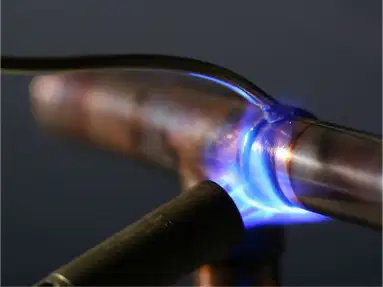
Refer to the diagram showing heating a copper tube and a heating coil in a domestic hot water cylinder. Which material is being used for its good thermal conductivity in both examples?
Copper
Plastic
Wood
Brick

Refer to the diagram showing a list of materials from good to bad thermal conductors. Which material is shown as the best thermal conductor?
Copper
Glass
Brick
Still air
Which principle of heat transfer can only take place in a fluid or gas?
Convection
Radiation with air movement
Conduction in solids
Evaporation
What happens to molecules during convection when they are heated and then cooled?
They heat and rise, then cool and fall.
They cool and rise, then heat and fall.
They remain stationary regardless of temperature changes.
They move randomly without any pattern.
Which method is the main way a Domestic Hot Water Cylinder (DHWC) heats water?
Convection
Radiation
Conduction
Evaporation
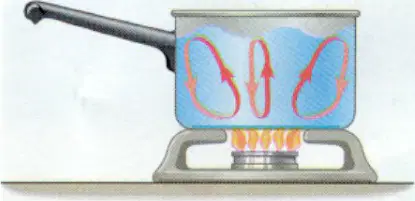
Refer to the diagram showing a pot of water being heated. Which process is illustrated by the movement of water inside the pot?
Convection currents
Radiation transfer
Conduction through the pot
Evaporation of water
Which principle of heat transfer involves infrared light and transfers heat from one body to another without heating the space in between?
Radiation
Convection
Conduction
Evaporation
Select all examples that demonstrate heat transfer by radiation.
Heat from the sun warming a beach chair
Heat from a fire warming your hands
Heat from an infrared heater
Warm air rising to the ceiling
Why does radiation not heat the space between the source and the object?
Because radiation transfers energy via infrared light directly between bodies
Because the air absorbs all the heat before it reaches the object
Because only solids can transfer heat by radiation
Because radiation requires a medium to travel through
Which unit is used to measure heat scientifically?
Kelvin (K)
Fahrenheit (F)
Joule (J)
Watt (W)
Why do hot water cylinder pipes need to be insulated?
To keep the heat in and maintain the temperature of the hot water for efficiency.
To prevent the pipes from rusting over time due to moisture.
To make the pipes easier to clean and maintain.
To reduce the noise produced by water flow.
What is the main reason cold water mains pipes need to be insulated?
To stop condensation forming on the pipe.
To prevent heat loss from the water.
To increase water pressure in the system.
To reduce the risk of pipe freezing.
Which colour is more common for cars in hot countries and why?
White, because it reflects the sun’s heat.
Black, because it absorbs the sun’s heat.
Red, because it is less likely to fade.
Blue, because it is more visible in sunlight.
In solar panels, what type of surface is needed to absorb heat from the sun?
Shiny surfaces
Matte surfaces
Textured surfaces
Transparent surfaces
Which statement is correct about heat absorption and reflection?
Dark colours absorb heat, while light colours reflect heat.
Light colours absorb heat, while dark colours reflect heat.
Both dark and light colours absorb heat equally.
Only metallic colours reflect heat.
What is the effect of insulating pipework on efficiency and running costs?
Insulation increases efficiency and reduces running costs.
Insulation decreases efficiency and increases running costs.
Insulation has no effect on efficiency or running costs.
Insulation only affects the appearance of the pipework.
According to Building Regulations part L, what needs to be controlled in heating systems?
Heat transfer
Water pressure
Pipe diameter
Electrical wiring
Which device should be used to ensure heating is only on when needed?
Programmer
Boiler stat
Cylinder stat
Room stat
What is the recommended maximum temperature setting for a cylinder stat in a secondary circuit?
Not above 60°C
Not above 80°C
Not above 100°C
Not above 40°C
Which device is used to control the temperature in individual rooms?
TRV (thermostatic radiator valve)
Boiler stat
Cylinder stat
Programmer
How can heating zones be managed in a building?
By setting separate zones for upstairs and downstairs.
By using only one thermostat for the whole building.
By installing additional water pipes.
By painting the walls with light colours.

