
Font size
S
M
L
XL
 Worksheets
Integumentary Test
Total questions: 40
Worksheet time: 20mins
Name
Class
Date
1.
What is the gland that surrounds the hair follicle hydrating the hair shaft?
a)
sebaceous gland
b)
eccrine sweat gland
c)
root hair plexus
d)
Merkle's Disks
2.
The skin the the largest organ by weight?
a)
Yes
b)
No
3.
Eccrine sweat glands
a)
respond primarily to emotional stress
b)
respond primarily to elevated body temperature
c)
usually are associated with hair follicles
d)
are most common in the armpits and groin
4.
Reddened skin reflects
a)
inheriting extra melanin
b)
dilated blood vessels with more blood entering the dermis
c)
eating too many carrots
d)
constricted blood vessels with more blood entering the epidermis
5.
What type of gland is associated with an odor?
a)
Eccrine
b)
Apocrine
c)
Sebaceous
d)
Mammary
6.
_______________ glands are found in the axillary and genital regions.
a)
Apocrine
b)
Sebaceous
c)
Eccrine
d)
Mammary
7.
Which of the following is a normal response to excessive loss of body heat in a cold environment?
a)
Blood flows towards the skin.
b)
Dermal blood vessels constrict.
c)
Sweat glands become active.
d)
Dermal blood vessels dilate.
8.
Epidermis is ___________, whereas dermis is ________________.
a)
composed of stratified squamous epithelial tissue; composed of connective tissue, smooth muscle, and nerve cell processes
b)
the outermost layer of the skin; composed of stratified squamous epithelial tissue
c)
largely composed of dense connective tissue; composed of stratified squamous epithelial tissue
d)
the innermost layer of the skin; under the epidermis
9.
Which layer of cells undergoes cell division?
a)
Stratum corneum
b)
Stratum basale
c)
Stratum granulosum
d)
Stratum spinosum
10.
The "tanning" effect (darkening of the skin) that occurs when a person is exposed to the sun is due to:
a)
oil
b)
keratin
c)
sweat
d)
melanin
11.
The skin is a _________.
a)
organ system
b)
organelle
c)
organ
d)
tissue
12.
The major blood vessels that supply the skin with nutrients are in the
a)
basement membrane
b)
adipose tissue
c)
epidermis.
d)
dermis.
13.
The skin functions to
a)
regulate body temperature.
b)
prevent water loss from deeper tissues.
c)
excrete waste substances.
d)
All of the choices are correct.
14.
A needle would pierce the epidermal layers of the sole of the foot in which order:
a)
s. corneum 🡪 s. lucidum 🡪 s. granulosum 🡪 s. spinosum 🡪 s. basale
b)
s. corneum 🡪 s. granulosum 🡪 s. lucidum 🡪 s. spinosum 🡪 s. basale
c)
s. basale 🡪 s. spinosum 🡪 s. granulosum 🡪 s. corneum
d)
s. corneum 🡪 s. granulosum 🡪 s. spinosum 🡪 s. basale
15.
Skin cells play an important role in the production of
a)
vitamin A
b)
vitamin C
c)
vitamin E
d)
vitamin D
16.
Goosebumps are caused by
a)
arrector pili muscles
b)
nerve fibers
c)
blood vessel constriction
d)
dermal papilla
17.
The cutaneous membrane is
a)
a membrane that lines body cavities that are closed to the exterior part of the body.
b)
also known as our skin.
c)
a moist membrane that lines body cavities open to the exterior of the body.
18.
In areas of the skin where the epidermis is thin, the ________ may be absent.
a)
stratum granulosum
b)
stratum corneum
c)
stratum basale
d)
stratum lucidum
19.
What is the function of the subcutaneous layer (hypodermis) of the skin?
a)
provides insulation and warmth
b)
protection and waterproofing
c)
causes sweating
d)
holds the body together and houses nerves, blood vessels, and hair roots
20.
You step out of the shower and vigorously rub your skin with a towel. If you were able to analyze the towel, you would find skin cells. They are most likely
a)
from the dermis.
b)
fibroblasts.
c)
subcutaneous layer cells.
d)
keratinized epidermal cells.
21.
Sebaceous glands secrete
a)
fat globules that mix with cellular debris, forming sebum.
b)
sweat in the armpits.
c)
hormones.
d)
mucus.
22.
The uppermost layer of skin is:
a)
called the subcutaneous layer
b)
composed of dense connective tissue
c)
called the dermis
d)
keratinized
23.
What is the largest organ of the body?
a)
femur bone
b)
skin
c)
brain
d)
liver
24.
What is the region where adipose tissue is found?
a)
follicle
b)
subcutaneous layer/hypodermis
c)
dermis
d)
epidermis
25.
Fever is
a)
a special case of hyperthermia in which body temperature rises in response to an elevated set point, typically in response to infection.
b)
a result of inflammation.
c)
due to exposure to heat.
d)
a special case of hypothermia in which body temperature falls to protect the core from infection
26.
A burn affecting only the epidermis is a
a)
second-degree burn.
b)
first-degree burn.
c)
third-degree burn.
d)
deep partial-thickness burn.
27.

What layer is #6?
a)
epidermis
b)
dermis
c)
hypodermis
28.

#8 refers to what two structures?
a)
lymphatic vessels
b)
veins only
c)
veins and arteries (blood vessels)
d)
lymphatic vessels and arteries
29.

#5 refers to what structure?
a)
arrector pili muscle
b)
sebaceous gland
c)
Meissner's corpuscle
d)
pore
30.

#9 refers to what structure?
a)
arrector pili muscle
b)
apocrine sweat gland
c)
Pacinian corpuscle
d)
Meissner's corpuscle
31.

#4 refers to what structure?
a)
hair shaft
b)
eccrine sweat gland
c)
hair folicule
d)
root hair plexus
32.
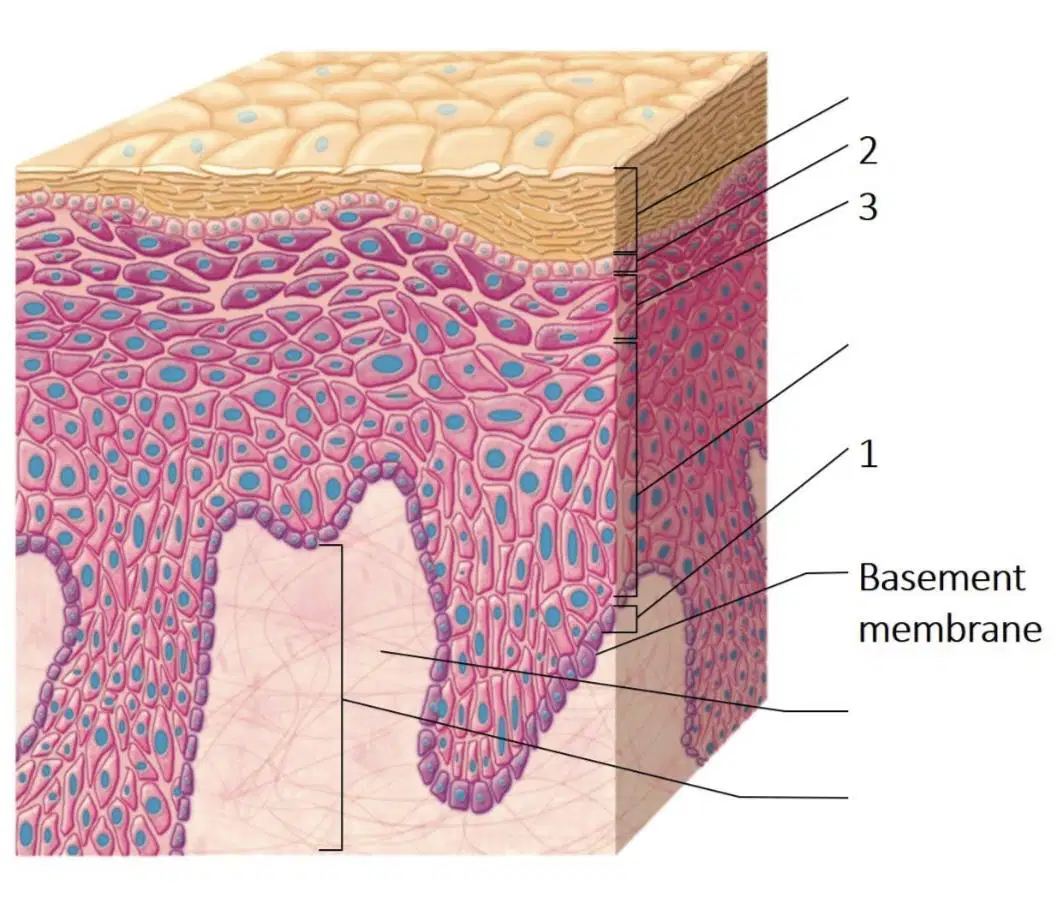
When looking at the layers of the epidermis what layer is #3
a)
stratum granulosum
b)
stratum lucidium
c)
stratum basale
d)
stratum corneum
e)
stratum spinosum
33.

When looking at the layers of the epidermis what layer is #2 assuming that this model is taken from the sole of the foot.
a)
stratum corneum
b)
stratum granulosum
c)
stratum basale
d)
stratum lucidium
e)
stratum spinosum
34.
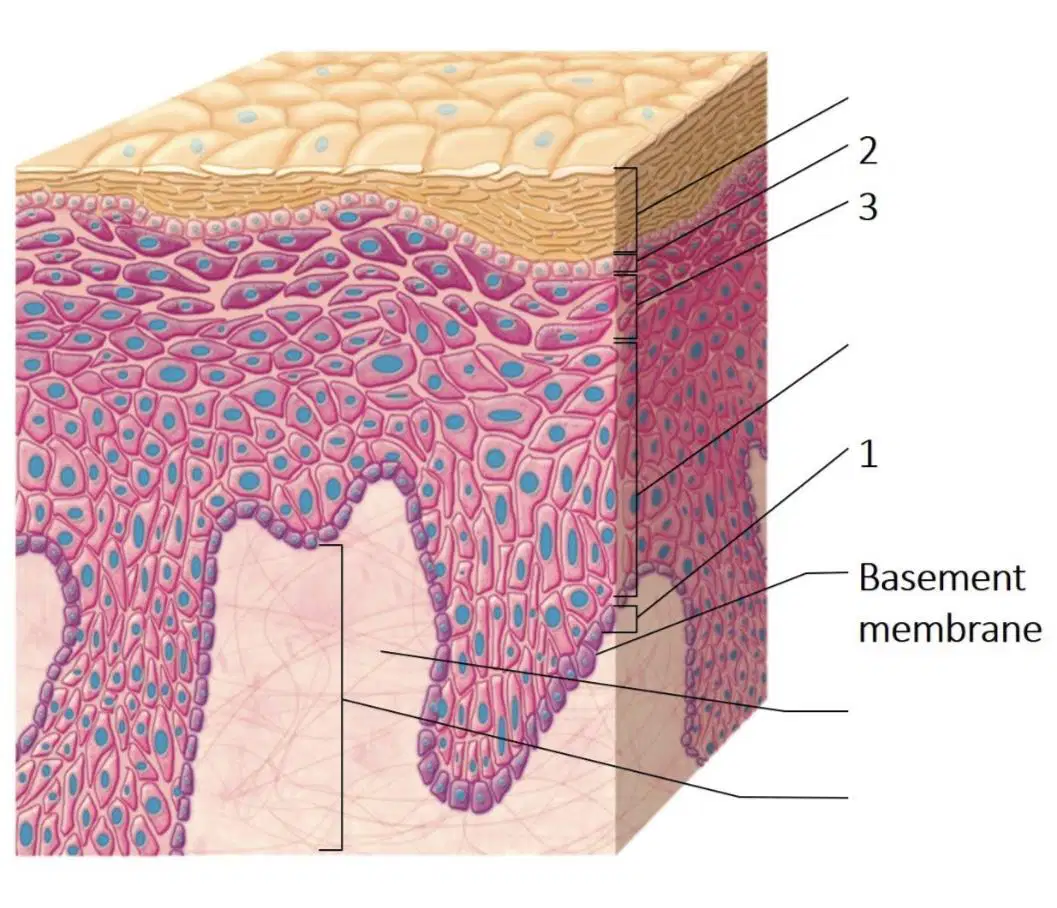
When looking at the layers of the epidermis what layer is #1?
a)
stratum corneum
b)
stratum basale
c)
stratum granulosum
d)
stratum spinosum
e)
stratum lucidium
35.
Regulation of body temperature is vital for humans. Two part question.
A) Discuss why the body must regulate temperature. [2 points] other than just homeostasis...
B) How does the body maintain the balance between hot and cold? [4 points]
4 lines
36.
The skin, which at first seems like a simple and basic structure, has a VITAL role in the entire body. List at least three problems that would arise if the skin was not there or did not function properly due to an illness or disease. [6 points]
4 lines
37.
Which layer of the skin contains most sensory receptors?
a)
Stratum corneum
b)
Subcutaneous layer
c)
Dermis
d)
Epidermis
38.
What pigment is primarily responsible for the yellowish color of the skin?
a)
Melanin
b)
Carotene
c)
Hemoglobin
d)
Keratin
39.
Which type of sweat gland is most numerous on the palms and soles?
a)
Mammary gland
b)
Sebaceous gland
c)
Apocrine gland
d)
Eccrine gland
40.
Rule of nines...burn victim came in with their forearm and upper thigh burned. Using the rule of nines how much of the body's surface was covered in burns?
a)
9
b)
7.75
c)
4.5
d)
11.5
Reset

