
 Worksheets
History Unit 5: 5.1 & 5.2
Total questions: 134
Worksheet time: 1hrs 7mins
Which statement best describes a core ideal of the Enlightenment introduced in the 17th and 18th centuries?
Emphasizing tradition and community values over individualism
Prioritizing reason and individualism over tradition
Rejecting scientific inquiry in favor of religious dogma
Promoting absolute monarchy as the most stable government
According to the section, what effect did Enlightenment ideals such as freedom and self-determination have on societies?
They solidified the authority of monarchs and church leaders
They discouraged political change and revolution
They challenged traditional authorities and planted seeds of revolution
They eliminated religious practices across Europe
Which development is associated with the optimism of Enlightenment thought growing out of the Scientific Revolution and humanism?
Belief that natural laws governed social and political spheres
A return to strict religious governance and censorship
Rejection of human accomplishments as unworthy
Acceptance that progress was impossible through reason
During the "Age of Isms," which pair represents opposing currents of thought that emerged in Europe?
Nationalism and mercantilism
Socialism and liberalism versus conservatism
Deism and empiricism versus capitalism
Absolutism and republicanism versus deism
Which concept helped drive revolutions seeking independence and constitutional representation during the Enlightenment era?
Mercantilism, favoring heavy state control over trade
Nationalism, emphasizing shared language and culture
Feudalism, reinforcing hereditary social order
The divine right of kings, legitimizing monarchs' rule
What is the best definition of empiricism as emphasized by Francis Bacon?
Knowledge based on inherited traditions and religious doctrine
Knowledge gained from sensed experience and observation, including experiments
Knowledge derived only from mathematical axioms without observation
Knowledge revealed solely through divine inspiration
Which statement aligns with Thomas Hobbes’s view of the social contract?
People’s natural state is peaceful, so no government is needed
Life in the natural state is bleak, so people accept a strong central government for law and order
Citizens should always resist any limitations imposed by government
Government should be chosen only by religious authorities
John Locke’s interpretation of the social contract included which principle?
Citizens must obey government without question
Government grants rights that can be revoked at will
Citizens have the right, even the responsibility, to revolt against unjust government
Natural rights apply only to property, not life or liberty
Which idea is associated with John Locke’s An Essay Concerning Human Understanding (1690)?
Humans are born inherently sinful and must be controlled
A child’s mind is a blank slate (tabula rasa) shaped by environment and education
Personality is fixed by ancestry and cannot change
Knowledge comes only from religious instruction
Baron Montesquieu’s The Spirit of Laws (1748) most directly influenced which feature of the American system?
The blending of executive and legislative powers
The use of checks and balances and separation of powers among branches
The elimination of a judicial branch
The establishment of a hereditary aristocracy
Which contribution is most closely associated with Voltaire?
Defense of absolute monarchy and censorship
Critique of civil liberties and constitutional government
Advocacy for civil liberties, religious liberty, and judicial reform
Promotion of mercantilism and heavy trade regulation
Jean-Jacques Rousseau expanded the social contract by introducing which concept in The Social Contract (1762)?
Divine right of kings
General Will of the population and the obligation of a sovereign to carry it out
The necessity of a permanent aristocracy
Complete separation of society from government
Which economic principle did Adam Smith generally advocate in The Wealth of Nations (1776)?
Strict mercantilism with extensive government control
Laissez-faire policies minimizing government intervention in economic decisions
Government ownership of all means of production
Elimination of taxes and all forms of regulation
In Adam Smith’s view, what guides individuals to make choices beneficial for society when they act in their own interests?
The visible hand of the monarchy
The invisible hand of the market
The divine hand of the church
The iron hand of law enforcement
Which statement best summarizes Deism as adopted by some Enlightenment thinkers?
God continuously intervenes in everyday events to enforce moral laws
A divinity set natural laws in motion like a watchmaker and does not interfere day-to-day
All truth is found only in scripture and tradition
Nature is chaotic and cannot be understood through laws
Which statement best describes conservatism as presented in this section?
A belief that society can be perfected through rational planning and communal living
A reliance on practical experience over ideological theories, favoring traditional institutions
An emphasis on laissez-faire economics and constitutional government
A commitment to ending serfdom and expanding suffrage through parliamentary means
According to the text, what did utopian socialists generally advocate?
Private ownership of the means of production by entrepreneurs
Public works projects controlled by the military
Setting up ideal communities to channel human potential in positive directions
Absolute monarchy to ensure social order
Which thinker believed scientists and engineers collaborating with businesses could produce useful goods and clean, efficient workplaces, and supported projects like the Suez Canal?
Henri de Saint-Simon
Charles Fourier
Robert Owen
John Locke
Which utopian socialist emphasized harmonious living in communities and identified hundreds of human passions to make work more enjoyable, contrasting with Karl Marx’s focus on class struggle?
Henri de Saint-Simon
Charles Fourier
Robert Owen
Francis Bacon
Robert Owen’s intentional communities were characterized by which feature?
Military governance and strict labor quotas
Communal ownership of property and rules for work, education, and leisure
Private ownership and competition-driven markets
A focus on elite education for the wealthy only
The Fabian Society in late 19th-century England is best described as:
Revolutionary socialists who sought immediate overthrow of the government
Gradual socialists advocating reform through parliamentary means
Classical liberals prioritizing laissez-faire economics
Conservative religious reformers focused on private charity
Classical liberalism in this period included support for which of the following?
Natural rights and constitutional government
State ownership of factories and mines
Religious absolutism and increased church spending
Elimination of all parliamentary representation
In Britain, classical liberals backed Reform Bills in 1832, 1867, and 1884 primarily to:
Broaden male suffrage and reflect changing population patterns in Parliament
Increase military spending and expand colonial rule
Abolish the monarchy and establish a republic
Promote communal ownership of land and industry
Which French writer published a “Declaration of the Rights of Woman and of the (Female) Citizen” in 1791 to highlight that women’s rights had been overlooked?
Mary Wollstonecraft
Olympe de Gouges
Lucretia Mott
Elizabeth Cady Stanton
Mary Wollstonecraft’s A Vindication of the Rights of Women argued primarily that:
Women should have limited education to focus on domestic roles
Females should receive the same education as males to participate in society independently
Only property-owning women should vote
Religious authority should determine women’s rights
The Seneca Falls Convention (1848) issued the Declaration of Sentiments asserting which key principle?
Women should defer political participation to men
All men and women are created equal, with demands for suffrage and property rights
Slavery should continue to support economic growth
Religious law should govern civil rights
Abolitionism in the 18th and 19th centuries focused on which goal?
Ending the Atlantic slave trade and freeing all enslaved people
Expanding colonial trade routes
Reforming parliamentary representation
Introducing serfdom to industrial economies
Which sequence correctly identifies early national bans on the Atlantic slave trade as stated in the text?
United States (1808), Great Britain (1807), Denmark (1803)
Denmark (1803), Great Britain (1807), United States (1808)
Great Britain (1807), United States (1808), Denmark (1803)
France (1791), Brazil (1888), United States (1808)
According to the section, what typically happened in most countries when the slave trade ended?
Slavery increased due to labor shortages
Slavery began to decline and was abolished within about 30 years
Serfdom emerged as a replacement for slavery
Immediate universal emancipation occurred
Which statement about the end of serfdom is supported by the text?
Serfdom expanded in Europe with industrialization
Queen Elizabeth I abolished serfdom in 1574; French feudal rights ended in 1789
Alexander II restored serfdom in Russia in the 1860s
Serfdom ended first in the Americas and later in Europe
Which statement best defines Zionism as described in the vocabulary bank and passage excerpt?
A movement to maintain Jewish communities within European nations
The desire of Jews to reestablish an independent homeland in the Middle East
An effort to spread deism and empiricism across Europe
A campaign to abolish serfdom throughout Russia
Who is identified as a leading figure in the Zionist movement during the late 19th century?
Baron Montesquieu
Adam Smith
Theodor Herzl
Robert Owen
What event revealed the extent of anti-Semitism in France during the 1890s?
French Revolution
Dreyfus Affair
Industrial Revolution
Fabian Society Debates
In the provided key terms, which thinker is most associated with the concept of the social contract?
Voltaire
Jean-Jacques Rousseau
John Locke
Henri de Saint-Simon
Which economic thinker wrote The Wealth of Nations, listed under Economy: Reforms?
Charles Fourier
Adam Smith
Robert Owen
Fabian Society
Which term refers to a policy of minimal government interference in the economy?
Socialism
Nationalism
Laissez-faire
Empiricism
Which pair correctly matches a term with its theme column in the key terms list?
Philosophes — Economy: Reforms
Zionism — Culture: Isms
Utopian socialists — Government: Reforms
Tabula rasa — Economy: Reforms
Which concept is associated with gaining knowledge through observation and experience?
Empiricism
Deism
Conservatism
Classical liberalism
According to the passage, which empires or groups controlled the land sought by Zionists, adding complexity to their goal?
British Empire and Irish nationalists
Ottoman Empire and Palestinian Arabs
Austro-Hungarian Empire and German states
French Empire and Algerian Berbers
Which Enlightenment figure is listed under Government: Reforms and is known for ideas about separation of powers?
Baron Montesquieu
Voltaire
Robert Owen
Henri de Saint-Simon
Match each term from the Culture: Isms column with its most associated concept.
Nationalism
Pride and advocacy for one's nation
Feminism
Equality for women
Conservatism
Support for traditional values
Abolitionism
Movement to end slavery
Which movement aimed to end slavery, as indicated in the Culture: Isms list?
Classical liberalism
Abolitionism
Conservatism
Deism
Which set of terms belong under Economy: Reforms in the key terms list?
Liberalism, empiricism, nationalism
Social contract, tabula rasa, philosophes
Capitalism, socialism, utopian socialists
Enlightenment, deism, conservatism
Which philosopher is directly linked with the idea of ‘tabula rasa’ in the Government: Reforms column?
John Locke
Voltaire
Jean-Jacques Rousseau
Baron Montesquieu
Which term identifies the group advocating gradual and democratic socialist reforms in Britain?
Fabian Society
Physiocrats
Philosophes
Nationalists
What broader cultural theme includes Enlightenment, liberalism, conservatism, and nationalism in the key terms box?
Economy: Reforms
Government: Reforms
Culture: Isms
Industrialization
Which option best explains why many European Jews turned to Zionism, according to the passage?
They sought to expand trade routes in the Balkans
Repeated anti-Semitism and pogroms made living securely in Europe seem unrealistic
They wished to align with utopian socialist communities
They aimed to support the Dreyfus family’s political ambitions
Which economic theory is paired with Adam Smith and supports free markets?
Socialism
Capitalism
Mercantilism
Feudalism
Which individual is connected to early socialist ideas and appears in the Economy: Reforms list?
Baron Montesquieu
Charles Fourier
Voltaire
Jean-Jacques Rousseau
What milestone marked the significant growth of the Zionist movement, as stated in the passage?
The French Revolution of 1789
The founding of the modern country of Israel in 1948
The abolition of serfdom in Russia in 1861
Publication of The Wealth of Nations in 1776
Read the excerpt: “Who made man the exclusive judge, if women partake with him the gift of reason?… you deny them civil and political rights… you will not assert that a duty can be binding which is not founded on reason.” Based on this passage, what is Wollstonecraft’s main goal?
Secure inheritance rights for surviving wives
Secure female equality with males in civil and political life
Promote marriage based solely on romantic love
Urge Britain to back the bourgeoisie in the French Revolution
According to the ideas in Wollstonecraft’s excerpt, which thinker would be LEAST likely to support her goals for women’s rights?
A conservative advocating traditional gender hierarchies
A utopian socialist promoting social equality
A classical liberal emphasizing individual rights
A Marxist critiquing class oppression
Which feature of Wollstonecraft’s passage most closely reflects Enlightenment ideals?
Reference to equality in marriage as sacred
Mention of equitable laws forming citizens
Appeal to reason as the foundation of duty and rights
Rejection of tyrants as personally cruel
Match each philosophical debate from the late 18th century to the excerpt or idea it best reflects.
Debate over divine right monarchy vs. hereditary aristocracy
Debate about whether kings rule by God’s will or by inherited status among nobles.
Debate over popular sovereignty and the design of representative government
Debate about who should create laws and how governments should represent the people, as seen in Abigail Adams’ questions about forming a government.
Debate over mercantilism vs. free trade capitalism
Debate about whether colonies should follow strict trade rules or allow open markets.
Debate over the morality of scientific experimentation
Debate about the ethical implications of new scientific discoveries and experiments.
In the same Abigail Adams passage, which idea aligns most with Thomas Hobbes?
Humans are naturally cooperative and easily trust one another
Man is a dangerous creature and power is ever grasping, requiring strong authority
Liberty is best protected by minimal government interference
Ancient customs should always guide modern policy
Which statement from the Abigail Adams excerpt best reflects John Locke’s political philosophy?
“Will it be left to our Assemblies to choose one?” indicating government by consent
“Man is a dangerous creature” emphasizing the need for absolute rule
“Prejudices of people in favor of ancient customs” endorsing tradition over reform
“Whatever is to take place” implying inevitable monarchy
Identify one way the Renaissance impacted Enlightenment ideas. Choose the best answer based on common themes discussed in this section.
Strengthened belief in feudal obligations and vassalage
Revived classical learning and humanism, encouraging reason and inquiry
Expanded church control over universities and censorship
Promoted reliance on alchemy over empirical science
According to the section’s emphasis on Enlightenment debates, which similarity best describes Enlightenment thinkers in Britain and America during 1750–1900?
Both primarily defended absolute monarchy to ensure stability
Both valued reason and individual rights when arguing for political reforms
Both rejected written constitutions as incompatible with liberty
Both insisted that social equality must precede any political change
Think as a historian: The section contrasts deductive (“top-down”) and inductive (“bottom-up”) reasoning. Which example correctly shows deductive reasoning?
Observing several rainy Julys and concluding future Julys will be rainy
Starting from the principle that all citizens have natural rights and concluding that censorship violates those rights
Counting votes in a town meeting to find the winner
Noting that one law is unjust and inferring that all laws are unjust
Which statement best describes deductive reasoning as used in historical argument analysis?
Drawing a general conclusion from many specific examples
Starting from a general principle and applying it to a specific case
Comparing two similar cases to infer similarity in another aspect
Using emotional appeals to persuade without evidence
In his 1791 report on public education, Talleyrand argues that women should be educated primarily where and for what reason?
In public schools to prepare them for political leadership
At home because the paternal home is better for women’s education
In universities to equalize opportunities with men
Through apprenticeships so they can manage commerce
Which option best captures Mary Wollstonecraft’s central claim responding to Talleyrand?
Women’s education should be limited to domestic skills to preserve social order.
If women remain uneducated, they will hinder progress; educating women advances morality, patriotism, and knowledge.
Women should avoid public investigation because it distracts from their duties as companions.
Education has little impact on the moral and civil interests of mankind.
Which statement best reflects conservative thinkers like Edmund Burke and Joseph de Maistre regarding revolutions during the age of Enlightenment ideas?
Revolutions were necessary to advance democracy and constitutional government.
Revolutions were bloody, disruptive, and unlikely to yield positive results.
Revolutions should be encouraged to spread natural law and progress.
Revolutions were mainly economic and rarely affected political systems.
According to the section, which ideals helped inspire the American Revolution?
European Enlightenment philosophy and physiocrats' free market ideas
Medieval feudal traditions and mercantilist protectionism
Religious revival movements and royal absolutism
Industrialization and labor union demands
Which phrase, derived from John Locke and used by Thomas Jefferson in the Declaration of Independence, summarizes key natural rights?
Liberty, equality, and fraternity
Life, liberty, and the pursuit of happiness
Order, stability, and prosperity
Security, property, and representation
Which factor contributed to a growing spirit of independence among American colonists prior to 1776?
Closer communication with Parliament in London
Colonial legislatures increasingly making decisions usually made by Parliament
The king granting more titles to colonial nobles
French hostility toward the colonies forcing unity with Britain
Match each description to the correct statement about the New Zealand Wars.
They were conflicts among Maori iwi only, with no European involvement.
Describes wars fought solely between indigenous groups, without European participation.
They were wars between Maori tribes and the British that intensified after the 1840 annexation.
Describes conflicts that escalated between Maori and British following New Zealand's annexation.
They were civil wars within Britain over colonial policy.
Describes internal British disputes regarding overseas territories.
They were sparked by the abolition of feudalism in New Zealand in 1789.
Describes wars resulting from the end of feudalism in New Zealand in the late 18th century.
Match the outcomes of the New Zealand Wars by 1872 with their descriptions.
Maori established an independent republic.
Maori created a separate nation after the wars.
British control over Maori affairs was defeated.
British authority over Maori was overturned.
The British had won the wars.
British forces emerged victorious in the New Zealand Wars.
A coalition of Maori and French forces expelled the British.
Foreign allies helped Maori remove British rule.
In the French Revolution, which slogan captured revolutionary ideals popularized by the philosophes?
Vive la monarchie
Liberté, égalité, et fraternité
Pain et travail pour tous
Progrès, raison, et loi naturelle
Which financial and political conditions helped trigger the French Revolution in 1789?
Budget surplus and equal voting among estates
Long-term overspending, war costs, and inequality in voting within the Estates-General
Industrial downturn and universal male suffrage
Colonial independence movements and the abolition of guilds
What event on July 14, 1789, symbolized popular anger against monarchy and aristocracy in France?
Storming of the Bastille
Signing of the Treaty of Paris
Execution of Louis XVI
Establishment of the Directory
Which document adopted early in the French Revolution declared basic human rights?
Magna Carta
Bill of Rights (1689)
Declaration of the Rights of Man
Napoleonic Code
Which group and period are correctly matched in the French Revolution?
Jacobins — Reign of Terror marked by executions of opponents
Girondins — Declaration of Independence of 1776
Physiocrats — storming of the Bastille
National Assembly — rule of Napoleon as emperor
In the Haitian Revolution, who emerged as the capable general leading enslaved Africans and Maroons to establish an independent government?
Jean-Jacques Dessalines
Toussaint L’Ouverture
Marquis de Lafayette
Simón Bolívar
Which reform did Toussaint L’Ouverture implement after 1801 in Haiti?
Reinforced plantation slavery to boost exports
Granted equality and citizenship to all residents in a new constitution
Established a constitutional monarchy under French protection
Invited British rule to stabilize the economy
What made Haiti’s independence in 1804 historically significant in the Americas?
It was the first black-led country in the Western Hemisphere and the only permanent independence resulting from a slave uprising.
It was the first republic to abolish taxes and tariffs.
It was the earliest case of industrialization-led independence.
It was the first nation to reestablish feudal landholdings.
How did Enlightenment ideas influence both the Haitian and French revolutions, and what key difference distinguished the Haitian case?
Both emphasized hereditary rights; Haiti differed by protecting noble privileges.
Both insisted on natural rights and citizen freedom; Haiti’s rebellion was led by people who initially had no rights at all.
Both rejected social estates; Haiti differed by strengthening class divisions.
Both focused on economic deregulation; Haiti differed by preserving plantation elites.
In Latin America, the group that was born in the Americas of European ancestry and led many independence movements was called (a) .
In the colonial social hierarchy described, which group consisted of colonists born in Spain or Portugal and felt superior to everyone?
Mestizos
Peninsulares
Creoles
Indigenous peoples
Which economic policy did many creole estate owners oppose because it required colonies to buy manufactured goods only from Spain and sell products only to Spain?
Free trade capitalism
Mercantilism
Protectionism by local juntas
Laissez-faire industrialism
Simón Bolívar promoted independence for areas that later became which set of countries?
Mexico, Guatemala, and Honduras
Venezuela, Colombia, Ecuador, and Peru
Argentina, Chile, and Uruguay
Brazil, Paraguay, and Bolivia
According to Bolívar’s Jamaica Letter (1815), which principle best captures his Enlightenment-inspired goals?
Strict monarchy guided by divine right
Generous souls should recover rights endowed by the Creator and Nature
Economic isolation and mercantilist policies
Perpetuation of slavery to avoid social unrest
One consequence that followed the wars of independence in Latin America, leading to strong local leaders with regional power bases who often disregarded representative government, was the rise of (a) .
Which statement about the results of the Creole Revolutions is accurate?
They universally granted voting rights to all adults regardless of literacy.
They legally ended slavery and some social distinctions, but governments were often conservative.
Women gained full political rights and access to contracts.
Indigenous peoples immediately dominated national politics.
Manuela Sáenz is best known for which role during the Latin American independence movements?
Drafting Peru’s first constitution
Serving as a colonel and saving Bolívar’s life, earning the title “Liberator of the Liberator”
Leading Haiti’s slave uprising
Founding Gran Colombia’s parliament
Which figure in Puerto Rico became famous for eloquent critiques of Spanish rule and inspired revolutionaries with the song “La Boriqueña”?
José Martí
Lola Rodríguez de Tió
Antonio Maceo
Emilio Aguinaldo
What pattern characterized Lola Rodríguez de Tió’s life after the 1868 uprising in Puerto Rico?
Continuous government appointments in San Juan
Exile to Venezuela, brief return, then further exile to New York, later campaigning in Cuba
Permanent settlement in Madrid with Spanish support
Retirement from political activity and focus on private business
Which statement explains why many well-to-do Filipinos (often creoles and mestizos) traveled to Europe during the 19th century?
They sought military training unavailable in Manila.
Educational opportunities in the Philippines were limited and controlled by religious authorities.
Spain banned all universities in Asia.
They were required by law to study in Madrid.
Which group did many creoles fear and therefore refused to support during independence movements, partly due to events in Haiti and the French Revolution?
Peninsulares and royal officials
Mestizos, indigenous people, and mulattos
European liberals and merchants
North American colonists
Which best describes nationalism as presented in the section: a unifying force that encouraged people who shared language, history, and customs to join into one political state?
A desire to keep small, independent city-states separate
A movement to expand colonial empires overseas
A unifying force encouraging people with shared culture to form one political state
A policy focused entirely on economic trade agreements
In the mid-19th century Italian unification, which leader practiced realpolitik and maneuvered European powers to advance Italian unity?
Giuseppe Mazzini
Count Camillo di Cavour
Victor Emmanuel II
Giuseppe Garibaldi
Realpolitik, as used by Cavour and later Bismarck, is best characterized as which approach?
Idealistic reliance on natural rights regardless of outcomes
Practical politics that use manipulation and power to achieve goals
Religious-based governance aimed at papal authority
Economic liberalism promoting free-market reforms only
Which event did Cavour engineer in 1858–1859 to weaken Austrian influence over the Italian Peninsula?
An alliance with Russia against Prussia
A war that drew Napoleon III of France into conflict with Austria
A naval blockade of the Papal States
A popular referendum that unified all city-states at once
(a) ’s philosophy of Risorgimento influenced Cavour’s unification efforts.
Which military force, led by Giuseppe Garibaldi, supported Italian unification in the south?
The Black Shirts
The Red Shirts
The Green Berets
The White Guards
Which statement about German nationalism after 1815 is most accurate according to the text?
It declined rapidly due to the Congress of Vienna
It strengthened in opposition to French occupation of German states under Napoleon
It focused on colonial expansion in Africa
It was entirely driven by religious revivalism
Otto von Bismarck’s path to German unification prominently featured three wars. Which sequence identifies the first two opponents he targeted before provoking France?
Austria then Denmark
Denmark then Austria
France then Austria
Russia then France
Which territory became part of the new German Empire in 1871 as a result of the Franco-Prussian War?
Lombardy
Alsace-Lorraine
Sicily
Bavaria
According to the section, what was one global consequence by 1871 of Italian and German unifications?
A permanent balance of power ensured peace in Europe
Two new powers emerged amid competing alliances, and extreme nationalism later contributed to World War I
The immediate dissolution of the Ottoman Empire
Universal suffrage across Europe
Which factor contributed to significant late-19th-century emigration from Italy, particularly to the United States and Argentina?
Religious persecution in the Papal States
Industrial overemployment in the north
Poverty, especially in the south, with the 1853 constitution encouraging immigration into Italy
Frequent earthquakes forcing relocation
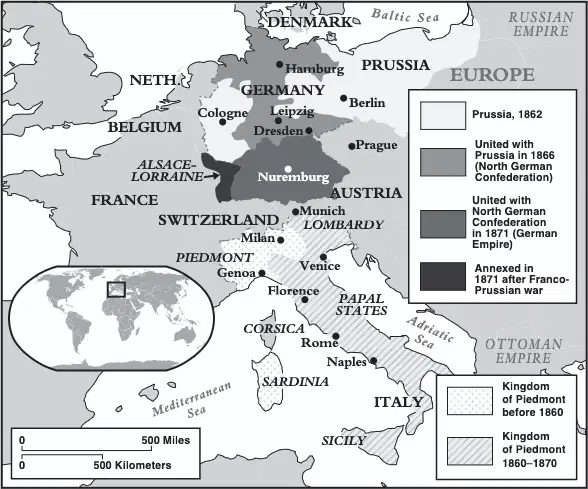
Refer to the map titled "Wars of Unification in Europe." Which area is shaded to show land annexed in 1871 after the Franco-Prussian War?
Northern Denmark
Alsace-Lorraine on the border with France
Lombardy in northern Italy
Corsica in the Mediterranean
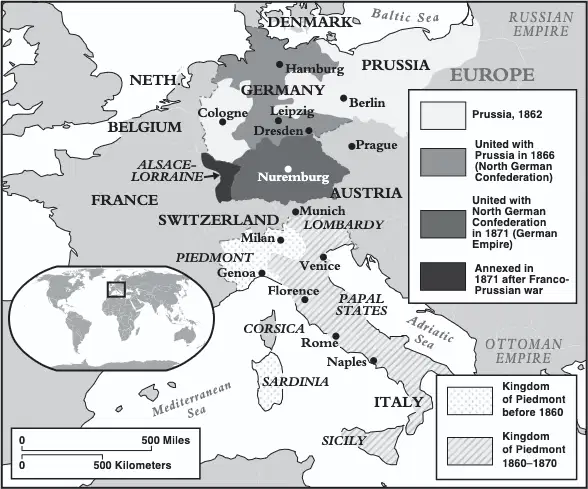
On the same map, the Italian region that expanded from the Kingdom of Piedmont before 1860 to the Kingdom of Piedmont 1860–1870 is labeled as (a) .
Match each explanation to the corresponding description of the rise of Balkan nationalism.
It emerged solely from medieval religious disputes
Balkan nationalism was influenced by religious conflicts from earlier centuries.
It developed largely due to Western European ideas and power involvement as Ottoman control waned
Balkan nationalism grew as Western European influence increased and Ottoman rule weakened.
It was driven by a single leader unifying all Balkan peoples
Balkan nationalism was unified under one prominent leader for all peoples in the region.
It resulted from the immediate collapse of Austria
Balkan nationalism surged after the sudden fall of the Austrian Empire.
How did Greece ultimately secure independence by 1832, according to the passage?
A quick uprising without external help
Negotiations directly with the Ottoman sultan
A prolonged civil war aided by British, French, and Russian naval intervention that destroyed an Ottoman fleet in 1827
Support from Prussian and Austrian armies only
Which cultural markers did Balkan peoples rally around to build nationalist movements as Ottoman power declined?
Colonial trade, industrial output, and taxation records
Language, folk traditions, shared history, and religion
Climate zones, geography, and agriculture
Royal dynastic claims from Western Europe
Which term refers to the Ottoman Empire’s late-19th-century effort to create a modern, unified state by minimizing ethnic, linguistic, and religious differences?
Pan-Slavism
Ottomanism
Realpolitik
Risorgimento
According to the passage, a major part of Ottomanism involved which action by officials?
Mandating a standard curriculum and taking control of local schools
Granting full autonomy to Balkan territories
Replacing the sultan with an elected parliament
Ending all religious instruction in the empire
What ironic effect did the push for Ottomanism have on subject peoples within the empire?
It eliminated ethnic differences completely
It decreased suspicion of Ottoman officials
It intensified feelings of difference and promoted desires for independence
It united all groups under one political party
Which development in Europe is used as evidence that nationalism may be declining?
A return to absolute monarchies
Countries agreeing to use the same currency and coordinate policies
The rise of city-states
The end of international travel
The passage suggests that nations might someday give way to other forms of political organization. Which comparison does it use to illustrate this possibility?
Like empires giving way to monarchies
Like city-states and empires giving way to other forms
Like democracies giving way to dictatorships
Like colonies giving way to protectorates
In the vocabulary bank, which key figure is associated with the Bolivar Revolutions?
Giuseppe Mazzini
Simón Bolívar
Toussaint L’Ouverture
Otto von Bismarck
Which term from the vocabulary bank is linked with the Haitian Revolution?
Bastille
Risorgimento
Toussaint L’Ouverture
Realpolitik
Which set of terms is associated with the French Revolution in the vocabulary bank?
Declaration of Independence; Bill of Rights
Philosophes; Declaration of the Rights of Man; Reign of Terror
Realpolitik; Risorgimento; Giuseppe Garibaldi
Immigration; Bastille; Italian Peninsula
Which phrase listed under Culture: France translates the revolutionary motto?
Liberté, égalité, et fraternité
Vive la monarchie
Pax Romana
Ein Volk, ein Reich
Which leader is specifically connected to German Unification in the vocabulary bank?
Giuseppe Garibaldi
Otto von Bismarck
Simón Bolívar
Toussaint L’Ouverture
Which cluster of terms belongs to Italian Unification in the vocabulary bank?
Realpolitik; Giuseppe Mazzini; Risorgimento; Giuseppe Garibaldi
Philosophes; Reign of Terror; Bastille
Ottomanism; Balkans; Maroons
Declaration of Independence; Haiti; Immigration
Under Society: Classes, which term refers to free Black communities formed by escaped enslaved people?
Peninsulares
Mestizos
Maroons
Mulattoes
Which social class term refers to people of mixed African and European ancestry?
Peninsulares
Mulattoes
Mestizos
Maroons
Which social class term refers to individuals of mixed Indigenous and European ancestry?
Peninsulares
Mestizos
Maroons
Creoles
In the vocabulary bank, which geographical term appears under Society: Europe?
Sahara Desert
Italian Peninsula
Andes Mountains
Balkan Peninsula
Which item in the vocabulary bank is a revolutionary fortress associated with the French Revolution?
Bastille
Alhambra
Acropolis
Colosseum
Which entry groups Puerto Rico with a revolutionary poet and activist?
Puerto Rico; Lola Rodríguez de Tió
Puerto Rico; Giuseppe Mazzini
Puerto Rico; Otto von Bismarck
Puerto Rico; Simón Bolívar
Which movement in the Philippines sought reforms through publications and advocacy, as listed in the vocabulary bank?
Young Turks
Propaganda Movement
Carbonari
Chartist Movement
Which term describes the 19th-century Italian movement for national revival and unification?
Risorgimento
Ottomanism
Realpolitik
Mestizos
Which concept, associated with pragmatic politics and power over ideals, is noted in the Italian unification context?
Realpolitik
Philosophes
Declaration of Independence
Immigration
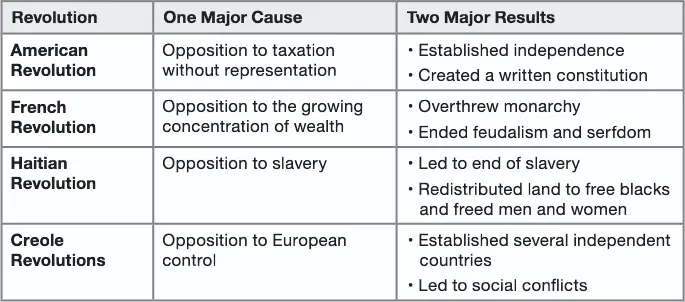
Refer to the table: American Revolution—Cause: opposition to taxation without representation; Results: independence, written constitution. French Revolution—Cause: opposition to growing concentration of wealth; Results: overthrew monarchy, ended feudalism and serfdom. Haitian Revolution—Cause: opposition to slavery; Results: ended slavery, redistributed land to free blacks and freed men and women. Creole Revolutions—Cause: opposition to European control; Results: established several independent countries, led to social conflicts. Which statement best explains how the Creole Revolutions were unlike the American, French, and Haitian Revolutions?
They were mostly directed against Spanish rule in the Americas.
They united all social classes without conflict.
They occurred more quickly than the other revolutions listed.
They were the only revolutions that achieved success.
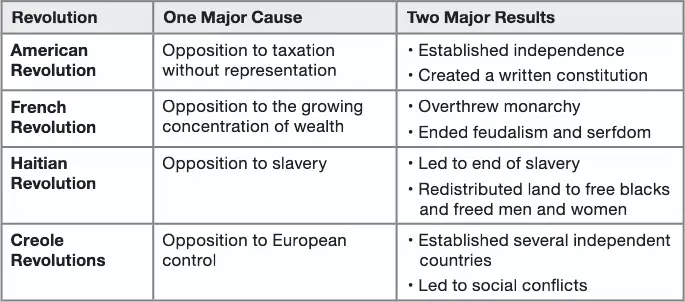
Based on the table, which revolution most directly targeted the unequal distribution of wealth and resources within society?
American Revolution
Haitian Revolution
French Revolution
Creole Revolutions
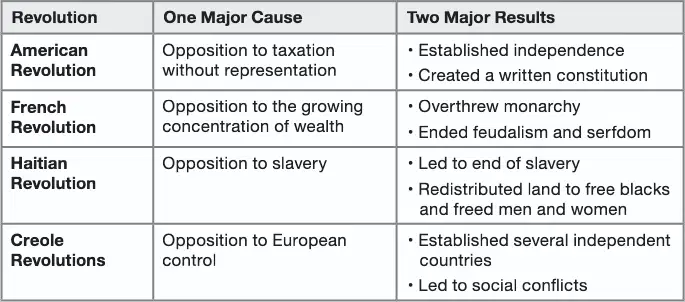
Which generalization applies to all four revolutions in the table, considering their listed causes and results?
All produced newly independent countries.
All promoted racial equality as a central goal.
All were reversed within one generation.
All drew inspiration from Enlightenment ideals.
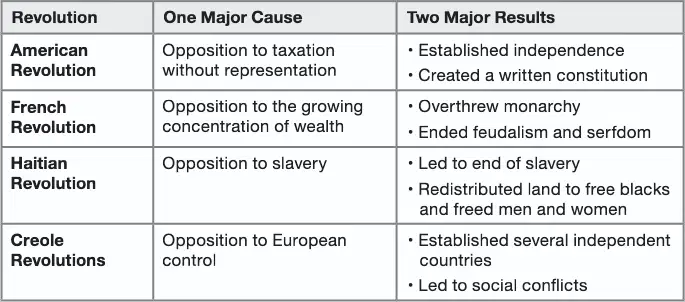
Which pair of cause-and-result is correctly matched according to the table?
American Revolution—opposition to slavery; result: land redistribution to freed people
Haitian Revolution—opposition to slavery; result: end of slavery and land distribution
French Revolution—opposition to taxation without representation; result: written constitution
Creole Revolutions—opposition to wealth concentration; result: end of feudalism
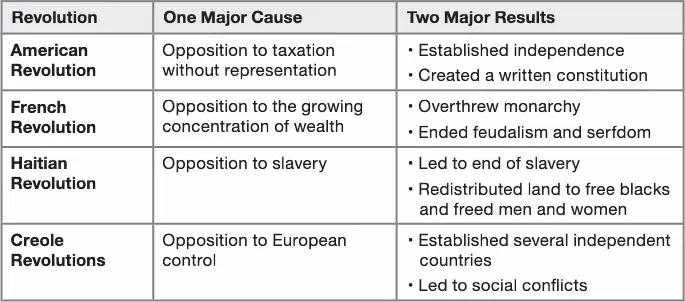
Which outcome uniquely distinguishes the American Revolution from the others listed in the table?
Overthrow of a monarchy and end of feudal obligations
Redistribution of land to formerly enslaved and free people
Creation of a written constitution following independence
Formation of several independent countries amid social conflicts
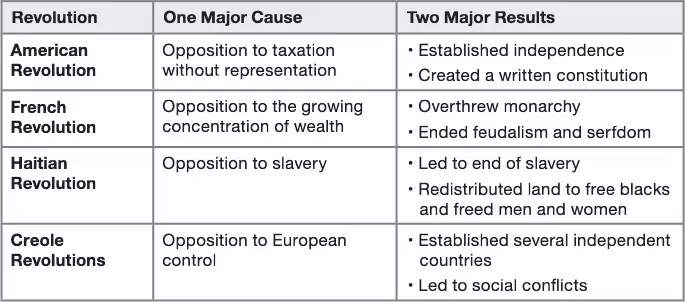
According to the table, what was the central grievance driving the Creole Revolutions?
Opposition to European control over colonies
Opposition to slavery and racial hierarchies
Opposition to taxation without representation
Opposition to the concentration of wealth in the nobility
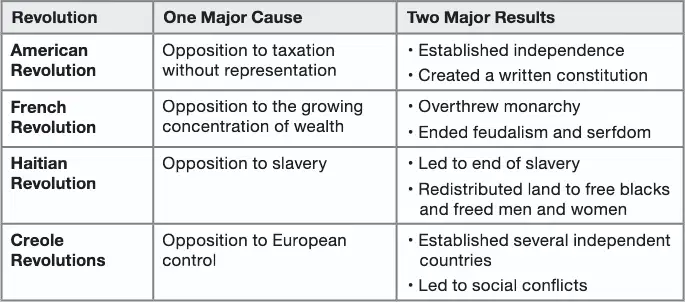
Using the table’s information, which revolution most clearly reflects Enlightenment ideas about popular sovereignty through its result?
American Revolution—established independence and a written constitution
French Revolution—overthrew monarchy and ended feudalism
Haitian Revolution—ended slavery and redistributed land
Creole Revolutions—established multiple independent states
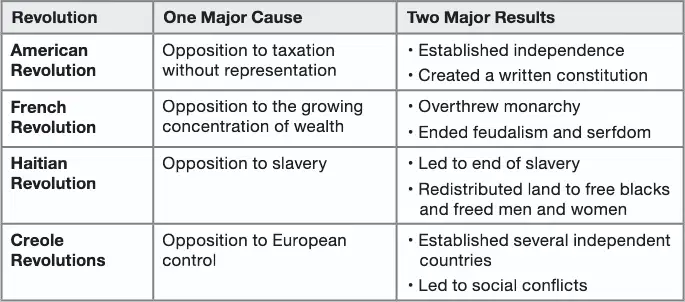
Which inference about social change is best supported by the table’s description of the French Revolution’s results?
It primarily expanded colonial territories overseas.
It dismantled hereditary privilege tied to feudalism and monarchical rule.
It focused on creating a federation of independent states in Latin America.
It centered exclusively on ending slavery across the Caribbean.
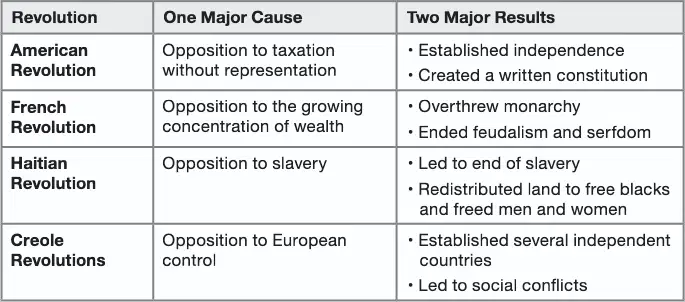
The most accurate comparison drawn from the table is (a) .

