
Font size
 Worksheets
BSP3153 CHAPTER 5 PART C
Total questions: 109
Worksheet time: 5hrs 27mins
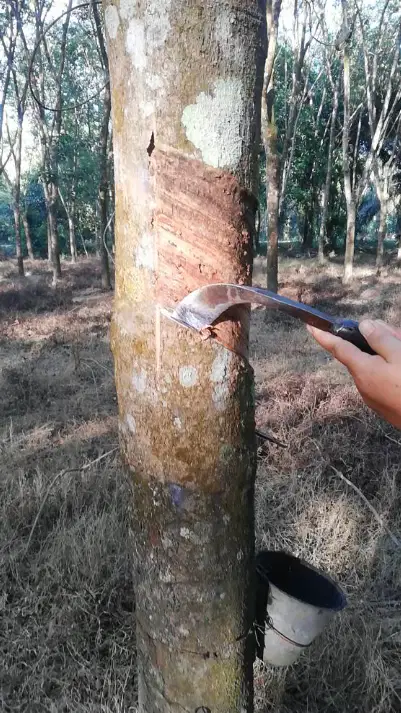
Refer to the images showing a person using a curved tapping knife to cut shallow grooves on a rubber tree, with latex dripping into a collecting cup. Explain how rubber tapping illustrates the origin and collection of natural rubber as a raw material, and discuss one chemical or materials-processing implication this has for turning latex into usable rubber products.
Explain how Charles Goodyear’s accidental observation led to the discovery of vulcanization and why this was significant for producing more stable rubbers. Include the role of sulfur and heat in your explanation.
Describe the historical context around 1834–1839 that framed Goodyear’s work with rubber, and explain how his personal circumstances influenced his persistence.
Analyze why the observation that the sulfur‑containing rubber did not melt on the hot stove but instead charred black was chemically meaningful. What property change did Goodyear confirm afterward?
Explain the practical impact of vulcanization on the rubber’s performance, based on Goodyear’s post‑experiment observations.
Evaluate the role of chance versus systematic experimentation in Goodyear’s discovery. Use details from the incident in Woburn, Mass. to support your reasoning.
Discuss why adding sulfur as a ‘drying agent’ inadvertently set the stage for vulcanization. What function did sulfur ultimately serve in the process?
Reflect on Goodyear’s quoted view of life regarding ‘dollars and cents’ and ‘when he sows and no one reaps.’ How does this sentiment align with his experience inventing vulcanized rubber?
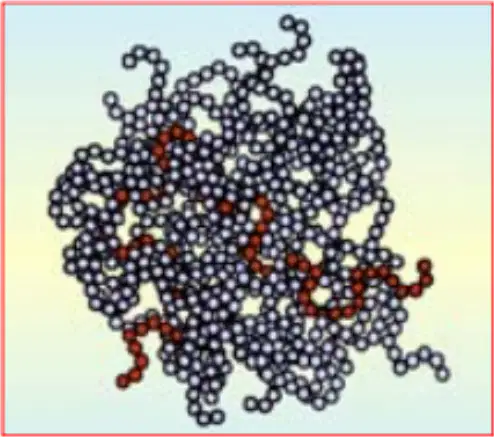
Explain the concept of glass transition temperature (Tg) for amorphous polymers and describe what happens to a polymer’s mechanical behavior above and below Tg. Provide a precise, concise explanation using the terms soft, flexible, hard, and glassy.
An amorphous polymer has Tg lower than room temperature (Troom). Predict whether it behaves as a rubber or a thermoplastic at room temperature and justify your answer in one or two sentences.
State the general rule relating Tg to whether an amorphous polymer is a rubber or a thermoplastic. Include how Tg compares qualitatively (low vs. high) for each class.
Why does the rule linking Tg to rubber versus thermoplastic behavior not apply to crystalline polymers? Provide a brief justification referencing polymer morphology.
Give two named examples from the material of polymers that behave as thermoplastics at room temperature due to Tg being higher than Troom, and briefly state the reason.
Define Tg using a single sentence that includes the threshold nature of the temperature and the resulting qualitative changes in polymer properties.
Summarize, in two sentences, how amorphous polymer examples (NR, SBR versus PS, PMMA) illustrate the dependence of material class on the position of Tg relative to room temperature.
Define rubber in terms of its mechanical response. Include the typical elongation range and the material’s behavior upon unloading.
A chart shows stress (MPa) versus strain for unvulcanized and vulcanized rubber with curved, non-linear traces. Explain why Hooke’s law is not obeyed and what this implies for classifying rubber’s elasticity.
Compare vulcanized and unvulcanized rubber using the typical stress–strain curve. Describe how vulcanization affects stress at a given strain and the material’s overall mechanical response.
When a piece of rubber is stretched far enough, the chains are forced to line up and crystallize along the stretch direction. Explain how this ordering affects entropy and why the chains tend to revert when the force is released.
State the molecular reason for rubber’s rapid elastic recovery after unloading, based on entropy considerations.
Explain how strain-induced crystallization occurs in rubber and identify the direction of crystallite formation relative to the applied force.
A comparative plot shows stress–strain curves for a glassy polymer, a semi-crystalline polymer, and rubber. Discuss how rubber’s curve differs and what this reveals about its elastic behavior up to 1000% elongation.
Describe the relationship between entropy and order in rubber chains before, during, and after stretching, and link this to macroscopic elasticity.
Give a concise definition of highly elastic materials using rubber as an example, and explain why the term applies even when Hooke’s law is not followed.
In polymer classification, what feature of rubber distinguishes it from glassy and semi-crystalline polymers in terms of elongation and linear elasticity? Provide the characteristic elongation value mentioned.
Explain, in your own words, how rubbers are built at the molecular level. Your answer should cover the role of repeating monomer units, the type of bonding between them, and why rubber is described as a long-chain polymer of high molecular weight.
Differentiate natural rubber from synthetic polymers based on their sources and how they are produced. Include the role of biological origin and polymerization processes in your explanation.
Describe the concept of polymerization in the context of rubber formation, and explain what the symbol n (integer) indicates in the polymer diagram.
Analyze how the production routes of synthetic polymers relate to thermoplastic (TP) and thermosetting (TS) polymers, and discuss what this implies about processing rubber-like materials.
Define high molecular weight in the context of rubber and explain how chain length contributes to mechanical properties such as tensile strength and damping.
Rubbers are described as crosslinkable. Explain what makes them highly reactive to crosslinking and how crosslink formation affects elasticity.
Weak chain–chain interactions are a characteristic of rubbers. Describe how secondary forces such as hydrogen bonding and dipole associations can both restrict segmental motion and still contribute to flexible structures.
Explain why rubbers are highly amorphous (do not pack well) and how high internal rotational freedom along the chain relates to high entropy and entropic elasticity. Include the influence of side chains on rotational freedom.
Describe the implications of a low glass transition temperature (Tg) for rubbers and connect it to crystallization and low-temperature performance.
Rubbers possess large free volume (segmental motion space). Define free volume in polymers and discuss how it enables segmental motion for rubber behavior.
Summarize why rubbers are highly elastic, linking crosslinked structure and high entropy to the observed macroscopic elasticity.
Define glass transition temperature (Tg) in polymers and explain why Tg must be below the operating temperature for rubber applications. Include how being below Tg influences the material’s mechanical behavior across the glassy, leathery, and rubbery regimes.
Natural rubber has Tg ≈ −70 °C. Discuss what this implies about its state and mechanical response at ambient room temperature (~20–25 °C) and at very low temperatures near −70 °C. Address rigidity versus elasticity.
A rubber component is heated progressively from well below Tg to temperatures far above Tg. Describe the expected trends in viscosity (resistance to flow) and modulus during this heating, and connect these trends to the identified regions on the temperature–modulus curve.
Explain the physical meaning of the ‘leathery’ region in the temperature–modulus curve. What molecular mobility changes occur there compared with the glassy and rubbery states, and how do these changes manifest in macroscopic mechanical properties?
In processing rubber, why is heating beyond the rubbery zone associated with a steady decrease in viscosity and modulus? Discuss how this facilitates flow and what risks or material states (e.g., sticky melt) may occur at very high temperatures.
Interpret the schematic DSC trace that shows glass transition, crystallization, and melting. Describe the qualitative features expected at each transition in differential heat flow versus temperature, including the role of Δcp at Tg and the characteristic peaks or steps for crystallization and melting.
Compare and contrast how Tg identified from a temperature–modulus curve relates to Tg identified on a DSC trace. Explain what each measurement reveals about polymer behavior and why both are useful in characterizing rubber materials.
Using the table of polymer thermal properties, compare glass transition temperature (Tg) and melting temperature (Tm) conceptually: explain what each temperature signifies for polymer behavior and why Tg can be negative for some materials while Tm is positive. Provide one example from the table to illustrate your explanation.
Select the polymer with the highest glass transition temperature (Tg) reported in the table.
Identify the polymer with the highest melting temperature (Tm) in the table and state its Tm.
Which polymer listed has a Tg of 100 °C and a Tm of 239 °C? Explain how these values might influence its rigidity at room temperature.
Compare high density polyethylene (HDPE) and low density polyethylene (LDPE) in terms of Tg and Tm from the table. What do these differences suggest about crystallinity and thermal behavior?
A polymer sample must remain flexible at −20 °C. Based on Tg values, name two polymers from the table that would be flexible at −20 °C and justify your choice.
Which polymer has Tg −14 °C and Tm 176 °C? Discuss its likely state at typical refrigeration temperatures (about 4 °C).
Explain why natural rubber, with Tg −70 °C and Tm 30 °C, can soften significantly at relatively low temperatures compared to plastics such as PVC.
Poly(methyl methacrylate) (PMMA) has Tg 105 °C and Tm 160 °C. What does this imply about processing windows for thermoforming compared with polystyrene (Tg 100 °C, Tm 239 °C)?
Given the table, which polymer lacks a reported melting temperature and what might that indicate about its structure or measurement?
Discuss why polytetrafluoroethylene (PTFE) and HDPE share the same Tg (−90 °C) but have markedly different Tm values (327 °C vs. 137 °C).
Which polymer would you select for a component that must remain rigid at 80 °C but not melt below 150 °C? Justify using Tg and Tm from the table.
Analyze the suitability of polycarbonate (Tg 150 °C, Tm 265 °C) for high-temperature glazing compared with polyester (Tg 73 °C, Tm 265 °C).
A material scientist wants a polymer that can be cold-flexed at −40 °C and maintains shape up to at least 200 °C without melting. Choose an appropriate polymer from the table and defend your choice with Tg and Tm.
Explain why polybutadiene, with Tg −102 °C and Tm 2 °C, behaves as a soft elastomer near room temperature and may lose strength near modest warming.
For a heat-resistant application requiring minimal creep at 120 °C, compare polycarbonate and polystyrene and recommend one based on Tg and Tm.
Refer to the diagram showing Young's modulus (psi) versus temperature (°C) for Styrene-butadiene rubber (SBR) and Polystyrene (PS). Explain how the glass transition temperature (Tg) is identified from the curves and compare the approximate temperature ranges where SBR and PS transition from a glassy to a rubbery state. Discuss how the corresponding change in Young's modulus reflects these transitions.
Using the diagram of Young's modulus versus temperature for SBR and PS, justify which material would remain rigid at room temperature (~25 °C) and which would be flexible. Base your reasoning on the relative positions of their Tg values and the labeled glassy and rubbery regions.
Analyze the temperature dependence of Young's modulus for polymers shown. Describe why the modulus changes by several orders of magnitude across Tg and explain how this behavior differs between elastomeric SBR and thermoplastic PS, using the labeled glassy and rubbery states to support your reasoning.
Rubbers exhibit unique combinations of useful properties. Explain what is meant by high elasticity in rubbers, including the modes of deformation involved and how rubber responds after deformation.
In tension, rubber can be stretched to more than 10 times its original length. Analyze the implications of this tensile extensibility for designing products such as tires or seals.
Compare the shear elasticity of rubber to steel as presented. What engineering consequences follow from rubber being 60,000 times more elastic than steel in shear?
Define resilience in the context of rubbers and explain its relation to elasticity. Why do rubbers generally exhibit high resilience?
Identify other useful properties of rubbers mentioned and evaluate how these properties complement high elasticity and resilience in real-world performance.
Due to their unique property combinations, rubbers are widely used in engineering. Describe at least four engineering applications listed and justify why rubber is suitable for each.
Natural rubber (NR) is cited with specific advantages. Discuss two advantages—good dynamic mechanical properties with low heat build‑up and good abrasion and cut growth resistance—and link them to example uses provided.
Explain how diene monomers influence polymers during polymerization. In your answer, address: (a) the variety of reactions possible, (b) the resulting differences in chain structures and molecular weights, and (c) the consequences for physical, processing, and rheological properties.
Describe the relationship between butadiene microstructure and the resulting polymer properties as illustrated in the diagram: butadiene undergoes polymerization to form polybutadiene with microstructures including cis-1,4; trans-1,4; 1,2-isotactic; 1,2-syndiotactic; 1,2-cyclized; and 1,2-aromatized. Explain why different microstructures lead to different molecular weights and physical behavior.
Using the table of butadiene rubber (BR) microstructures and properties, compare cis-1,4 addition with trans-1,4 addition in terms of melting point and whether the material is elastomeric or thermoplastic.
From the BR microstructure table, interpret how tacticity (1,2-isotactic vs 1,2-syndiotactic) affects melting point and mechanical classification.
Explain why 1,2-cyclized and 1,2-aromatized BR are described as plastics that are insoluble, based on the table’s notes.
Based on the listed processing property categories, analyze how variations in microstructure could alter tack, cure, extrusion, and cohesion during rubber processing.
Discuss how rheological flow behavior of a polymer can be linked to its microstructure, using the cis-1,4 versus trans-1,4 BR comparison to illustrate your explanation.
Explain why the presence of different chain structures/isomers from a single monomer (like butadiene) leads to a spectrum of physical properties such as varying glass transition or melting temperatures and classification as elastomeric versus thermoplastic.
Articulate the role of molecular weight variation arising from polymerization of diene monomers in determining processing properties such as extrusion and cure.
Synthesize the table’s insights to propose which BR microstructures would be most suitable for impact-resistant applications and which for electrical insulation, and justify your choices.
Molecular weight (degree of polymerization) determines key properties of rubber grades. Explain how low molecular weight (MW) affects viscosity, processability, vulcanization, crosslink network formation, and mechanical properties, using the exact relationships stated in the material.
Which statement best describes the typical behavior of low-MW rubber?
High MW rubber often presents processing challenges. Identify two remedies mentioned and state their intended benefits, then note the effect of oil extension on the mechanical properties of the vulcanizate.
Compare vulcanization behavior between high MW and low MW rubber and relate this to crosslink network formation as specified.
Explain why higher molecular weight leads to increases in tensile strength, creep resistance, and melting temperature, referencing the role of chain entanglement.
Define impact toughness (impact strength) in this context and describe how and why it changes with molecular weight, including the mechanism of energy transmission down longer chains.
Summarize a balanced set of trade-offs when selecting rubber grade by MW: list at least three advantages of high MW and two advantages of low MW, along with associated downsides for each, strictly using points given.
Consider rubber materials with different molecular weight distributions (MWDs). Explain how a narrow MWD affects softening behavior, processing characteristics such as extrusion temperature, and mixing quality. Provide a concise, integrated explanation linking each effect to the distribution of chain lengths.
Which statement best describes the role of low-molecular-weight portions in a broad molecular weight distribution for rubbers?
Broad MWDs are often preferred for mixing operations. Identify two processing advantages they provide and explain why these arise from the distribution of chain lengths.
Select the most accurate comparison between narrow and broad MWDs regarding softening behavior and processing temperature.
In rubbers with broad MWDs, why does tensile strength decrease compared to narrow MWDs? Choose the best explanation.
Impact strength is observed to decrease in rubbers with broad MWDs. Based on the chain-length argument, what is the mechanism for this reduction?
Which set of characteristics best matches rubbers exhibiting broad MWDs during compounding and processing?
Using the provided definitions, explain how polymer macrostructure (linearity, short chain branching, long chain branching, and crosslinking/gel) influences both processability and vulcanizate properties in rubber. Your response should compare the expected trends for mixing cycles, filler distribution, cold flow, extrusion rate, die swell, tensile strength, and abrasion across the four macrostructures.
According to the table of effects on processing properties, which macrostructure is most associated with a high extrusion rate and greater die swell?
Which pair of trends correctly describes the impact of crosslinking (gel) on processing: mixing cycles and filler distribution?
Identify the macrostructure that reduces cold flow and simultaneously reduces tensile strength and abrasion compared with linear chains.
Cold flow is defined in the section as the tendency to continue to deform under stress. Based on the table, which macrostructures increase cold flow and which reduce it? Provide a concise explanation linked to their chain architecture.
Consider the schematic polymer structures. Which diagram shows a coiled chain in practice, and why does this differ from the stretched linear chain depiction in terms of processability implications mentioned in the table?
The note states: “Gel can reduce mechanical properties, but improve processing characteristics for some rubbers.” Which table entries support this statement, and how do they contrast with linearity?
Define tack/tackiness in the context of rubber technology, and explain why this property is critical during tire building before the compound is placed in a mold for cure.
Differentiate between tack/tackiness and adhesion/stickiness in rubber processing. Include what each property describes and give one example surface pairing for adhesion mentioned in the material.
Explain green strength/cohesive strength of uncured rubber. Describe what happens in tire building if green strength is poor and identify a type of rubber that exhibits good green strength according to the material.
Describe cure/vulcanization/crosslinking in rubber technology. Include its nature (reversible or not), how it alters properties, how the best state of cure can depend on the property of interest, and the usual practical measurement mentioned.
Explain why rubber must have a glass transition temperature (Tg) lower than room temperature and the operating temperature. Include how this condition relates to elasticity in service.
Discuss how low secondary intermolecular forces combined with a moderate degree of crosslinking establish an elastomeric network in rubber. Address the balance between chain mobility and network integrity.
Analyze the term "high reversible extensibility or compressibility; superelasticity" in the context of rubber. Describe what reversible means here and connect it to practical performance.
Evaluate how abrasion resistance and good damping properties together contribute to the toughness of rubber components used in dynamic applications. Provide a brief mechanism-based rationale.
Explain how microstructure and macrostructure of rubber strongly influence mechanical properties and processing characteristics. Give two examples of microstructural or macrostructural features that could affect these outcomes.

