wayground logo

Free Printable Worksheets

NEW

Font size

S
M
L
XL
Worksheets

PBS Unit 2 Practice

Total questions: 56

Worksheet time: 1hrs 12mins

Name
Class
Date
1.

Henrietta Lacks is famous for:

a)

Being the first teacher in the state of Texas

b)

She was a famous research scientists who discovered the cure for polio

c)

Her cells being stolen and used to create the polio vaccine

d)

Being the first African American woman lawyer
2.

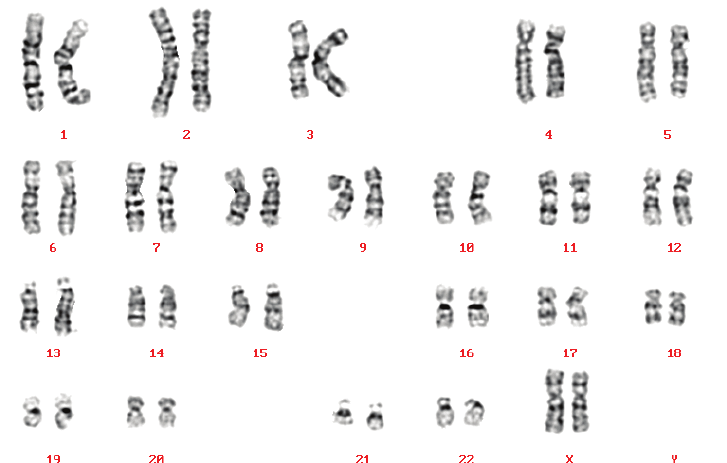
By looking at the chromosomes how can you tell that this person is biologically female?

a)

Because there are two X chromosomes

b)

Because there are more chromosomes than in a male
3.

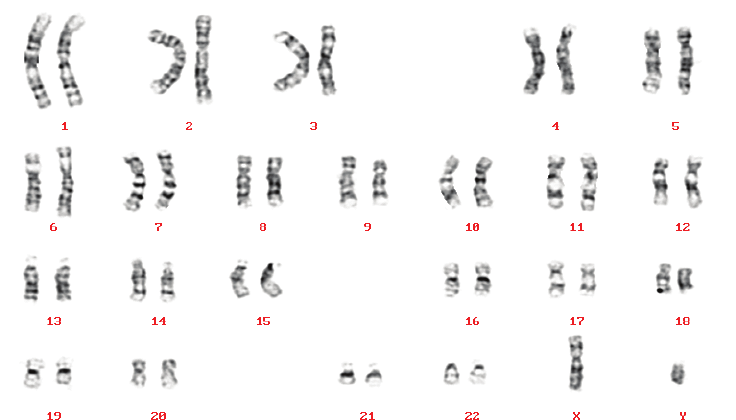
By looking at the chromosomes is this individual biologically male or female? How do you know?

a)

Female, because they have two X chromosomes

b)

Male, because they have one X and one Y chromosome

4.

Full set of chromosomes of a cell arranged with respect to size, shape, and number.

a)

chromatin

b)

karyotype

c)

phenotype

d)

genotype

5.
An example of a mutation where a piece of chromosome breaks off and attaches to another chromosome is called ___.
a)

trisomy

b)

translocation

c)

inversion

d)

deletion

6.
A chromosome is found to be shorter than it's homologous match.  Which type of mutation would this most likely be?
a)

insertion

b)

deletion

c)

translocation

d)

inversion

7.
What process occurs during meiosis that can result in chromosomal disorders?
a)

crossing over

b)

non-disjunction

c)

anaphase I

d)

prophase II

8.

A _______ is a picture of an individuals chromosomes. It helps scientists see if there are extra or missing chromosomes.

a)

genome

b)

gel electrophoresis

c)

karyotype

d)

PCR

9.

A karyotype for a typical human should have _____ chromosomes.

a)

46

b)

23

c)

22

d)

47

10.

Look at the Karyotype below. Is this a male or a female?

a)

Male

b)

Female

11.

In a typical human, how many chromosomes are found in the gametes?

a)

46

b)

23

c)

22

d)

47

12.

This type of cell division creates the gametes.

a)

Mitosis

b)

Meiosis

13.

In a _____, one chromosome is missing and in a ______, there is one extra chromosome in the pair.

a)

trisomy, monosomy

b)

monosomy, monosomy

c)

trisomy, trisomy

d)

monosomy, trisomy

14.

The image below shows which type of chromosomal mutation?

a)

Inversion

b)

Insertion

c)

Deletion

d)

Translocation

15.

The image below shows which type of chromosomal mutation?

a)

Duplication

b)

Insertion

c)

Deletion

d)

Translocation

16.

In the figure, which letter represents the chromosomal structural error of inversion?

a)

A

b)

B

c)

C

d)

D

e)

E

17.

Which of the following would be the karyotype of a person with Down syndrome (trisomy 21)?

a)

b)

c)

d)

e)

18.
a)
This karyotype shows Trisomy 21
b)
This karyotype has no abnormality
c)
This karyotype is missing a sex chromosome (monosomy x)
d)
This karyotype is from a gamete
19.
A pair of identical chromosomes shown in a karyotype, one inherited from mom, and one inherited from dad are called
a)
sister chromotids
b)
centromeres
c)
homologous chromosomes
d)
autosomes
20.

A piece of a chromosome is lost

a)

deletion

b)

duplication

c)

inversion

d)

translocation

21.

A piece of one chromosome detaches and reattaches to a different chromosome

a)

deletion

b)

duplication

c)

inversion

d)

translocation

22.

A piece of the chromosome detches, turns 180 degrees, and reattaches

a)

deletion

b)

duplication

c)

inversion

d)

translocation

23.

The chromosomal mutation shown in the image is a

a)

deletion

b)

duplication

c)

inversion

d)

translocation

24.

What were Riley's results?

a)

Monosomy of chromosome #23 - Turner's Syndrome

b)

Trisomy of chromosome #21 - Down's Syndrome

c)

Trisomy of chromosome #18 - Edward's Syndrome

d)

Partial monosomy of chromosome #5 - Cri du chat Syndrome

25.
In a heterozygous genotype, the ___________ allele takes over in the phenotype.
a)
recessive
b)
dominant
c)
lower case letter
d)
both 
26.
Which of the following alleles is homozygous (purebred) recessive?
a)
Tt
b)
tt
c)
TT
d)
t
27.
Which of the following is a phenotype?
a)
Aa
b)
red hair
c)
heterozygous genes
d)
mutated DNA
28.
Aa is
a)
homozygous (purebred)
b)
heterozygous (hybrid)
29.
How many alleles (letters) do each person carry for a trait?
a)
1
b)
2
c)
3
d)
4
30.
How many alleles (letters) does a child get from each parent for each trait?
a)
1
b)
2
c)
3
d)
4
31.
Is this punnet square true or false?
a)
False, because there should be 3 dominate alleles.
b)
True.
c)
False, because There should be 3 recessive alleles.
d)
I don't know....
32.
What does a filled in square represent?
a)
Not affected Female
b)
Not affected Male
c)
Affected Male
d)
Affected Female
33.
How many generations are shown in this pedigree?
a)
1
b)
2
c)
3
d)
4
34.
How many kids did the mother and father from the first generation have?
a)
2
b)
4
c)
5
d)
6
35.
What do half colored symbols represent?
a)
The individual is a carrier (heterozygous).
b)
The individual expresses the trait.
c)
The individual has both recessive alleles.
d)
The individual has both dominant alleles.
36.
What does an open circle represent?
a)
Not Affected Male
b)
Not Affected Female
c)
Affected Male
d)
Affected Female
37.
In the second generation-how many people are carriers of the trait?
a)
2
b)
3
c)
5
d)
6
38.
How many people in this whole pedigree have the trait/disease?
a)
2
b)
3
c)
4
d)
6
39.
How many females are in this pedigree?
a)
3
b)
4
c)
6
d)
7
40.
How many people in the pedigree are carriers for the disorder? 
a)
b)
8
c)
2
d)
9
41.
How many affected females are present? 
a)
1
b)
2
c)
3
d)
4
42.
Offsprings are represented by....
a)
Horizontal Line 
b)
Vertical Line 
43.
A carrier is represented by what symbol? 
a)
Clear 
b)
Shaded 
c)
Half Shaded
d)
1:4 ratio 
44.
What does a horizontal line between a square and a circle mean?
a)
They are siblings
b)
They are cousins
c)
They are married ("together")
d)
They are the children
45.
If a trait SKIPS a generation, it is an indication that the trait is....
a)
dominant
b)
recessive
c)
incompletely dominant
d)
co-dominant
46.
What is the mode of inheritance shown here?
a)
Autosomal Dominant
b)
Autosomal Recessive
c)
Sex Linked Recessive
47.
What is the mode of inheritance shown here?
a)
Sex Linked
b)
Autosomal Dominant
c)
Autosomal Recessive
48.
What is the mode of inheritance shown here?
a)
Autosomal Recessive
b)
Autosomal Dominant
c)
Sex Linked
49.
What is the mode of inheritance shown here?
a)
Autosomal Dominant
b)
Autosomal Recessive
c)
Sex Linked
50.
What is the mode of inheritance shown here?
a)
Autosomal Recessive
b)
Autosomal Dominant
c)
Sex Linked
51.
What is the relationship between person I 1 and III 2?
a)
Father and Son
b)
Father and Daughter
c)
Grandfather and Granddaughter
d)
Uncle and Niece 
52.
What allele combination should go in the missing box?
a)
AA
b)
Aa
c)
aa
d)
none of these
53.
If B = brown hair and b = blonde hair, what is the probability of brown hair?
a)
25%
b)
50%
c)
0%
d)
75%
54.
What is the probability of heterozygous offspring?
a)
25%
b)
50%
c)
0%
d)
100%
55.
What is the probability of homozygous dominant offspring?
a)
0%
b)
100%
c)
50%
d)
25%
56.

What type of scientist prepares chromosome spreads?

a)

Music Therapist

b)

Cytogeneticist

c)

Cytopathologist

d)

Genetic Counselor