
 Worksheets
MLSC1010 Final Review
Total questions: 50
Worksheet time: 25mins
Why must a procedure be discussed with a patient?
To inform the patient
To identify the patient
To relax the patient
To demonstrate competence
Why is documenting calibration activities important?
It helps lower operational costs.
It speeds up the overall testing time.
It reduces the need for future calibration
It provides a record that the instrument was properly calibrated.
A manual test for glucose is performed. A 5.0 mmol/L glucose standard is measured and an absorbance of 0.450 is obtained. What is the concentration of a patients glucose with an absorbance of 0.345?
3.8
7.6
6.5
1.70
Which of the following actions should a technologists take if a glucose specimen that has been drawn in sodium fluoride arrives at the laboratory for processing, 16 hours after it was collected?
Process the specimen only after addition of lithium heparin to the tube
Reject the specimen due to time delay of greater than 8 hours
Reject the specimen due to incorrect anticoagulant
Process the specimen as usual
Why are accurate measurements from calibrated instruments crucial in clinical settings?
They can influence diagnosis and treatment decisions
They simplify the documentation process
They reduce the cost of laboratory supplies
They make instruments last longer
Which of the following clinical chemistry tests is primarily used to diagnose and assess myocardial infarct?
Troponin
GGT
TSH
Glucose
What is the purpose of calibrating a new analyzer?
To set the accuracy of the assay
To make sure the manufacturer cleaned the machine properly
Calibration is not needed for a new analyzer
To set the expiry date for the analyzer
If a glucose meter shows a result of 15 mmol/L but the true level is 6 mmol/L due to lack of calibration, what is the most likely consequence?
The laboratory will save money on reagents.
The patient might receive inappropriate treatment
The instrument will automatically self-correct
The test will take less time to complete.
When running sodium testing, the technologist notices all the results are skewed downwards. What is the best way to ensure the analyzer is releasing the correct resuls?
Run quality assurance samples
Run 1 level of QC
Calibrate and QC the analyzer
Call the manufacturer and get them to help you
Which type of cuvette should be used when measuring absorbance at a wavelength of 320nm?
Amber glass
Plastic
Glass
Quartz
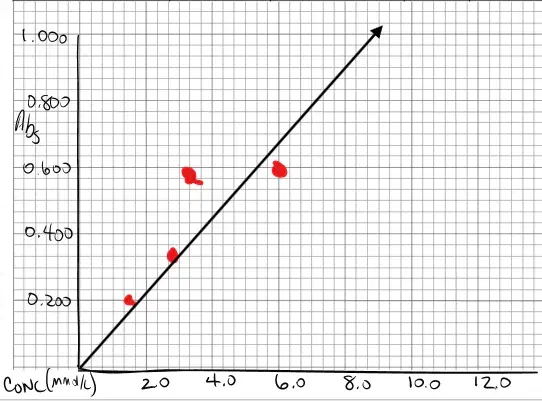
Is this calibration curve acceptable?
Yes, acceptable!
No, the line is not straight enough
No, the line does not go through all the calibration points
Yes, that's the best it will get.
A medical laboratory technologist runs two levels of quality control (QC) for a blood glucose assay. The results are:
Control 1 Result: 4.05 mmol/L
Control 2 Result: 7.15 mmol/L
The acceptable ranges are:
Control 1 Acceptable Range: 3.90 - 4.30 mmol/L
Control 2 Acceptable Range: 6.70 - 7.30 mmol/L
Based on these results, what is the appropriate action?
Reject the test run because Control 2 is too close to the upper limit
Reject the test run because two controls are required, and the control results are not identical.
Accept the test run only if a third control level is run and passes.
Accept the test run and report patient results, as both control results are within their acceptable ranges.
Which of the following is considered an engineering control?
Lab coat
The schedule
Gloves
Sharps safety shield
During a quality control check, the current result for Control 1 falls at 2 SD from the mean. No other points are out of range. Which Westgard rule is violated, and what action should the technician take?
1 3s is violated, reject the test run.
4 1s is violated; Accept the run, but check the patient results.
2 2s is violated, reject the test run.
1 2s is violated; This is a warning rule, so the run can be accepted, but it should be noted.
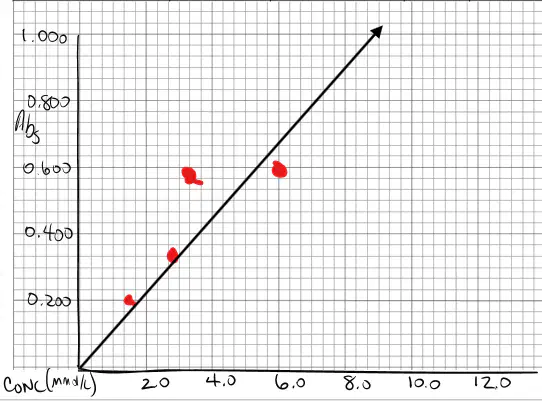
What is your next course of action if you calibrate an analyzer and get this calibration curve?
Re-calibrate
Run patient samples
Turn analyzer off and on
Run quality control
A blood test is run, and the control fails a rejection rule 1 3s. What is the immediate next step for the Medical Laboratory Technologist?
Reject the whole test run, then review the procedure and re-run controls
Immediately shut down the assay and refer samples to another lab.
Repeat the patient samples at 2-hour intervals since the last acceptable control.
Contact the instrument manufacturer and complete an incident report.
Which of the following pipettes offers the highest degree of accuracy?
Volumetric
Mohr
Mechanical
Serological
What is considered to be an acceptable practice when performing a venipuncture collection?
blowing on the area of the arm cleansed with alcohol in order to speed up the drying process
touching the vein on the intended puncture site with a gloved finger cleansed with alcohol
securely anchoring the vein with one finger above and one finger below the intended puncture site
keeping the tourniquet on the patient for 3 minutes
Which of the following preanalytical errors is commonly associated with prolonged tourniquet application?
Impaired hemostasis
Diluted hemoglobin
Hemolysis
Hemoconcentration
Sources of stray light in a spectrophotometer system can be reduced by all of the following EXCEPT:
Cuvettes free of scratches and dust
Placing the equipment in direct sunlight
A correctly aligned light source
Ensuring the sample does not emit fluorescence
A control has a mean of 5.5 with a standard deviation of 0.5. If the laboratory is using a 95% confidence interval, what range must the control values fall within?
5.0 to 6.5
4.0 to 7.0
5.0 to 6.0
4.5 to 6.5
When using a butterfly needle, why are a few mLs of blood collected into a discard tube prior to obtaining a light blue stoppered tube for the test?
To prevent loss of vacuum
To prevent over-filling
To ensure proper filling
To allow additional testing
What is the color of gram-negative bacterial cells after the decolorization step of the gram stain?
Red/pink
Iodine yellow
Purple/blue
Colorless
Which circumstance is most likely to have an effect on the linearity of a spectrophotometer?
Using a micropipette to prepare linearity standards
Presence of stray light hitting the detector
Using a water blank before reading the sample absorbance
Using a tungsten lamp for measurements in the visible range
While processing a blood sample, you accidentally spill some blood onto the bench top. What is the best way to clean the spill?
Wipe up the blood with an alcohol pad using concentric circles
Wait for the blood to dry and then scrape it into a biohazard bag
Absorb the blood with a damp cloth and wash the area with soap and water
Absorb the blood with a paper towel and wipe the area with a disinfectant
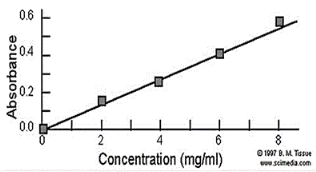
Given the displayed calibration curve, what is the concentration of a patient sample with an absorbance of 0.400?
6.0 mmol/L
5.5 mmol/L
Unable to determine the concentration with the given information
7.0 mmol/L
What is considered to be the objective of streaking an agar plate in clinical microbiology?
To produce isolated colonies of bacteria
To stain bacteria
To sterilize the agar plate
To destroy pathogenic bacteria
What is defined as energy reaching the spectrophotometer detector through the monochromator and exit slit that is not of the selected wavelength?
Spectral radiation
Reflective light
Stray light
Absorbance radiation
Plasma samples from the ER are routinely received in the lab, centrifuged, and brought to chemistry for testing. Recently, many samples have contained clots in the plasma. What is true regarding the lab’s quality control system regarding this problem?
The 10x multi-rule will eventually be violated and the clots discovered
The 1 2s rule routinely detects clots in plasma samples
Routine QC systems do not detect this type of pre analytical problem
Control rules can detect this problem if controls are properly reconstituted
A vacutainer with a green stopper normally contains
EDTA
Heparin
Sodium citrate
Thrombin
An MLT performs a 1:2 dilution, analyzes the diluted sample and obtains a reading of 20.0 mmol/L of glucose on the diluted sample. Which glucose result should the MLT report?
40.0 mmol/L
20.0 mmol/L
80.0 mmol/L
60.0 mmol/L
A laboratory has set their quality control acceptable limits to +/- 2 standard deviations. If the normal control is run 100 times in this laboratory, how many of the control values are expected to be out of the control range?
1
20
5
10
When an unlabeled blood specimen is received for routine testing in a laboratory, what is the best action to take?
The specimen should be returned to the ward for testing
The nurse should come to the laboratory to label the specimen
A new labelled specimen should be requested
The doctor can confirm the identification of the specimen by telephone
A chemistry procedure calls for the use of 0.1 mL serum and 4.9 mL of water. What is the dilution of the serum in the solution?
1/5
1/50
1/10
1/100
A tube manufacturer has made a tube with a purple shield over a yellow stopper. All you know about this tube is that it contains EDTA. Where would you put this tube in the recommended order of draw?
Between a light blue and a gold stoppered tube
First, before any other tubes
After a yellow stoppered tube
Between a green and a grey stoppered tube
How much 95% alcohol is required to prepare 5 L of 70% alcohol?
3.7 L
4.4 L
3.5 L
2.4 L
Which of the following analytes would be markedly decreased in the case of severe hyponatremia?
Sodium
Potassium
Bicarbonate
TSH
This test requires a specimen with a 9:1 ratio of blood to anticoagulant.
Ethanol
Prothrombin time
Glycohemoglobin
Zinc
After using a lancet device on a patient for a capillary puncture, no blood comes out. What's the best course of action to take?
Massage the area
Place the finger below the heart so gravity can draw blood out
Gently squeeze the finger
Put heat on the finger
A physician ordered a drug trough level on a patient. When should the phlebotomist go to collect the blood?
A soon as the patient wakes up
Right before the next dose of the drug
Right after the administration of the drug
30 minutes after the administration of the drug
You receive a cerebrospinal fluid (CSF) in the lab that is not labelled. As a lab technologist, what is your next course of action?
Reject the tubes and request a redraw
Get the physician to sign accountability of the specimen and accept it
Get the nurse to verbally state the patient identifiers to you
Label the specimen yourself and start testing it
You start a centrifuge, but as its accelerating, you hear a load crash and it starts to wobble off the bench. What actions should you take immediately?
Hold the centrifuge in place until it is done
Open the centrifuge and remove the samples quickly
This is normal. Let it do its thing
Turn off the centrifuge
You need to deliver 0.25mL of patient sample using a 100-1000μL pipette. What do you set the pipette to?
25μL
250μL
0.25mL
0.25μL
What is the Mode in the following set of numbers? 11,19,10,20,11,26,20,11
19
16
11
20
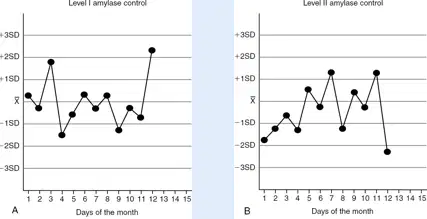
Which Westgard rule is violated in this chart?
R 4s
No rules have been violated
1 2s
1 3s
You run a patient's glucose level and their result comes across as 55.0 mmol/L (Ref. range= 4.0-6.0 mmol/L, Critical=>30.0 mmol/L). What is your next course of action?
Rerun the sample
Dilute the sample
Report the result
Call the nurse as this is a critical value
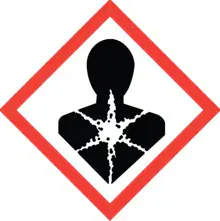
What does this pictogram represent?
May cause damage to ozone layer
Gases under pressure
May cause serious health effects
May cause death with short exposure
What is not required on a workplace label?
Product name
Signal word
Safety handling precautions
Reference to SDS
A technologist needs to perform a dilution. They want to perform a dilution factor of 11. What amount of plasma and dH20 should they use for this?
50uL plasma to 500uL dH20
50uL plasma to 1000uL dH20
50uL plasma to 50uL dH20
30uL plasma to 200uL plasma
You perform a 1/6 dilution on a patients glucose. You analyze the diluted sample and obtains a reading of 5.0 mmol/L. What result will you report?
5.0 mmol/L
20.0 mmol/L
30.0 mmol/L
10.0 mmol/L

