
 Worksheets
Biomaterials in Medical Devices
Total questions: 74
Worksheet time: 59mins
According to D. F. Williams, a (a) is a nonviable material in a medical device that is intended to interact with biological systems
True or false, a drug is considered to a biomaterial
True
False
True or false, gene therapy is not considered to a biomaterial
True
False
Which materials are common for joint replacements
Titanuium
Ti-Al-V alloy
Stainless Steel
Polyethylene
Which materials are common for bone plates for fracture fixation
Stainless Steel
Cobalt - Chromium Alloy
Titanium
Ceramics
Which materials are common for bone cement
Poly (Methyl Methacrylate)
Chromium-Plastic Alloy
Teflon
Silicon Rubber
Which materials are common for bony defect repairs?
Hydroxyapatite
Titanium
Polyurethane
Gelatin Hydrogel
Which materials are common for artificial tendons and ligaments?
Teflon
Dacron
Calcium Phosphate
Titanium
Which materials are common for dental implants?
Titanium
Alumina
Calcium Phosphate
Stainless Steel
Which materials are common for blood vessel prosthesis?
Dacron
Teflon
Polyurethane
Titanium
Which materials are common for heart valve replacements?
Reprocessed Tissue
Stainless Steel
Carbon
Teflon
Which materials are common for catheters?
Silicon Rubber
Stainless Steel
Carbon
Teflon
Which materials are common for an artificial heart?
Polyurethane
Silicon Rubber
Cellulose
Fish Skin
Which materials are common for a skin repair template
Silicone - Collagen Composite
Titanium
Stainless Steel
Ceramics
Which materials are common for an artificial kidney?
Cellulose
Polyacrylonitrile
Silicon Rubber
Ceramics
Which materials are common for an artificial heart and lung machine?
Silicone Rubber
Stainless Steel
Silicon Rubber
Fish Skin
Which materials are common for a cochlear replacement?
Platinum Electrodes
Stainless Steel
Titanium
Copper
Which materials are common for an intraocular lens?
Poly (Methyl Methacrylate)
Silicone
Rubber
Hydrogels?
Which materials are common for contact lens
Silicone - Acrylate
Hydrogel
Rubber
steel
Which materials are common for a corneal bandage
Collagen
Hydrogel
Rubber
steel
Which of the following are the requirements of a biomaterial?
The biomaterial must have functional characteristics that allow it to perform the desired task
The biomaterial must have sufficient mechanical properties to retain performance
The material must be biocompatible
The biomaterial must be cosmetically similar to the surrounding native tissue
What mechanical property relates the lateral contraction of a material to the linear extension of a material. (Hint, a rubber band has a large amount of this property, while concrete does not)
(a)
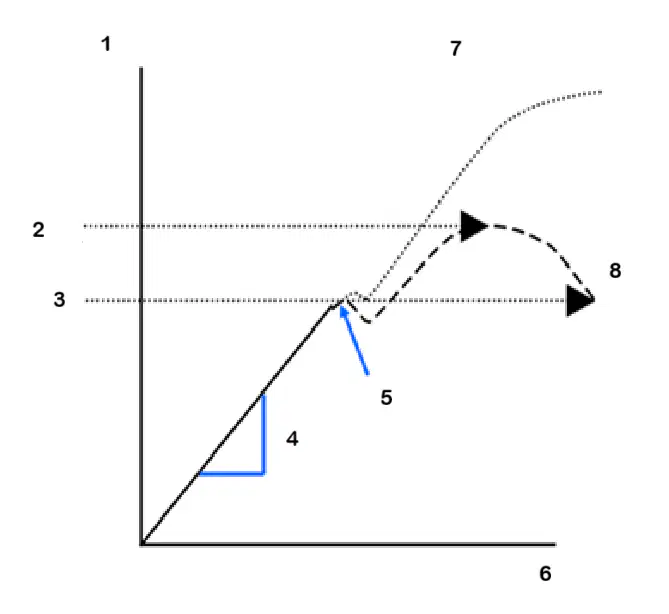
What is 1 in this chart?
(a)
What is 2 in this chart?
(a)
What is 3 in this chart?
(a)
What is 4 in this chart? (Hint Young's Modulus)
(a)
What is 5 in this chart? (Hint Young's Modulus)
(a)
What is 6 in this chart? (Hint Young's Modulus)
(a)
What is 7 in this chart? (Hint Young's Modulus)
(a)
What is 8 in this chart? (Hint Young's Modulus)
(a)
During what sort of deformation will the material return to its original state if the stress is removed prior to fracture.
(a)
a type of material failure characterized by little to no plastic deformation, occurring suddenly with little energy absorption
(a)
If the material undergoes this sort of deformation, then removing the stress will not return the material to the original state?
(a)
What is the mechanical property that indicates the amount of plastic deformation a material can undergo before failure. Also measured as the percent elongation.
(a)
What mechanical property indicates how much energy a material can absorb. It is also considered to be measured as the area under the stress-strain curve
(a)
A material that exhibits both viscous and elastic materials has the mechanical property known as
(a)
the progressive weakening of a material due to repeated or fluctuating stresses
(a)
How many times do we expect for a heart valve to cycle (open and close) per year.
40 million
10 million
20 million
30 million
Some of the bulk properties that we have already discussed are fatigue, viscoelasticity, ductility, and toughness. Select from the list other bulk properties that are important to consider.
Thermal Properties (Heat Transfer)
Optical Properties (Color, Refractive Index, Transparency)
Piezoelectric properties (Electrically influenced objects)
Electrochemical properties (Corrosion Potential)
An (a) material is one whose properties are the same in all directions
(a) materials have physical properties, such as strength or conductivity, that vary depending on the direction they are measured
(a) bonds consist of atoms in an organized structure surrounded by pools of shared electrons
True or False, When stainless steel has a chromium oxide cover, there is a greater amount of corrosion resistance but can weaken the overall material.
True
False
True or false, titanium materials will form a oxide layer with horrible corrosion resistance and a low modulus of elasticity.
True
False
Select the following examples of metallic biomaterials.
Bone Screws, Bone Plates, Joint Replacements
Dental Root Implants
Mechanical Heart Valve Housing, Struts, Pacemaker Leads, and Stents
Corneal Replacements
Within ceramic biomaterials, the ceramics are held together by what sort of bonds? (Hint, this is not a hard-and-fast rule. Diamonds do not contain these sort of bonds)
(a)
What are some qualities of ceramics biomaterials? Select all that apply?
Brittle
Non-Ductile
Difficult to Shear
Stronger in compression than tension
Stronger in tension than compression
Why are ceramic biomaterials generally stronger in compression than in tension
Ceramic biomaterials tend to piezoelectrically fill in damaged parts
Ceramic biomaterials tend to overlap electron orbitals
Tension typically causes some material vibration which the ceramic as a solid is weak to.
Hydrogen bonding within the ceramic
What is the chemical name for Ca10(PO4)6(OH)2?
(a)
What sort of carbons are traditionally used in biomedical implants.
(a)
_____ are large chains of organic molecules. They are named after the individual component that forms the chain. For example, polyethylene is a _____ of ethylene. (CH2 = CH2)
(a)
True or False, covalent links form between monomers within a polymer
True
False
Select all of the following that are commonly used as polymer biomaterial classifications
Thermosets
Elastomers
Thermoplastics
Viscoelastic
True or False, thermoset polymers are cross-linked with very little mobility
True
False
True or False, Elastomer polymers are not elastic materials
True
False
True or False, thermoplastic polymers are polymers that are linear or branched that can melt down. These range from amorphous to highly crystalline structures.
True
False
Which polymer classification do polyurethane fall under? Polyurethane is commonly used as biomaterials and formed by phase separation. They have high young's modulus and good fatigue properties.
Thermosets
Elastomers
Thermoplastics
Select of all of the following sterilization methods that can degrade biomaterials.
Steam Sterilization - water vapor can melt portions of the polymer
Chemical sterilization, which degrade individual monomers
radiation sterilization can reverse cross linking
Scrubbing really hard with soap and water
Synthetic fibers are fibers that make up wound dressing and bandages. In order to make these synthetic fibers engineers have come up with a variety of techniques. Select all of the techniques for the manufacturing of these devices.
Melt Spinning - the polymer is heated above its melting temperature and then extruded
Wet Spinning, the polymer is dissolved in solvent and extruded through spinnerets into nonsolvent in a spin bath.
Electrospinning, a polymer solution or melt is exposed to an electrostatic field by the application of a high voltage
Layer-Cutting, letting a layer of material form through precipitation before cutting into strips and weaving. (Like pasta)
What sort of fibers are the type that are absorbed into the body over time, either through hydrolysis or enzymatic degradation. Some of the common examples of these fibers are PGA, PLA, and various sutures
(a)
Select all of the following natural fibers that are used in medical fibers
Cellulose (Processed cotton or wood pulp)
Silk (silkworms)
Collagen (Bovine skin, ovine intestine)
Chitosan (Crustacean shells)
Keratin (Horse tail)
Which of the biomaterials are made of water-swollen, cross-linked polymeric structures. Typically, covalent bonds produced by reaction of one or more co-monomers. While made primarily of covalent bonds, hydrogen bonds and van der waals interactions help increase the strength of the material.
(a)
Where does degradation typically start in a biomaterial
(a)
We need a lot of information on a biomaterial to understand how the body will physiologically react. Select all of the parameters that we are interested in
Surface Energy
Surface Chemistry
Surface Topography
Internal heating components
Select all of the ways that one can measure the amount of surface energy a material has.
Critical surface tension (Zisman method)
Sessile drop
Underwater contact angle measurements
Capillary Rise
WIhelmy Plate Method
True or False, infrared spectroscopy can be used to identify the functional groups on the biomaterial, and is used in quantification.
True
False
True or false, electron spectroscopy is used in chemical composition, and quantitative analysis.
True
False
What is the contact angle of bacteriological grade polystyrene.
50 degrees
60 degrees
70 degrees
80 degrees
Which of the following functional groups are present after exposing polystyrene to a glow discharge. Pick all that apply
O functional groups
N functional groups
F functional groups
P functional groups
True or false, tissue culture PS has a contact angle of 55 degrees
True
False
What are some of the types of wear consistent with the progressive loss of substance?
Abrasive
Adhesive
Fatigue
Chemical
Which of the following are types of corrosion?
Pitting
Fretting
Crevice
Intragranular
a chemical reaction that breaks down a compound into two or more smaller molecules by reacting it with water
(a)
True or false, phagocytic cells (neutrophils and monocytes) can lead to the development of a superoxide, cation
True
False

