
 Worksheets
ECON_2105_21_MC
Total questions: 69
Worksheet time: 35mins
What is protectionism in the context of international trade?
A policy of reducing tariffs and trade barriers
A strategy to increase consumer spending
A policy to restrict imports to protect domestic industries
A strategy to promote foreign direct investment
How does protectionism act as an indirect subsidy from consumers to producers?
By lowering the cost of production for foreign firms
By increasing prices for consumers to support domestic producers
By reducing government expenditure on subsidies
By ensuring free competition in the market
What is a common tool used in protectionist policies?
Income tax reductions
Export subsidies
Import tariffs
Foreign aid
Which of the following is a potential negative impact of protectionism?
Increased domestic employment
Reduced consumer choice and higher prices
Enhanced innovation and competition
Lower production costs for domestic industries
Why might a government implement protectionist policies?
To increase trade deficits
To promote foreign investment
To decrease domestic investment
To protect emerging industries from international competition
How can protectionism impact domestic innovation?
By reducing the incentive to innovate due to lack of competition
By increasing research and development funding
By encouraging foreign partnerships
By lowering production costs
Which of the following best describes a quota in the context of protectionism?
A tax on imported goods
A limit on the quantity of goods that can be imported
A subsidy for domestic producers
A government-imposed price control
What is the primary goal of protectionist measures?
To increase the volume of international trade
To enhance technological advancements
To raise revenue for the government
To shield domestic industries from foreign competition
Which industry is often cited as benefiting from protectionism in many countries?
Technology
Agriculture
Textiles
Pharmaceuticals
What is an example of a non-tariff barrier to international trade?
Safety regulations
Free trade agreements
Export incentives
Quotas
What is a potential negative impact of international trade on wages?
Increased wages in all sectors
Wage stagnation or employment decline in industries exposed to international competition
Guaranteed wage increases for all workers
Elimination of wage disparities
Which of the following is a positive effect of international trade on working conditions?
Universal improvement in all industries
The adoption of international labor standards and best practices
Guaranteed reduction in working hours
Elimination of all labor disputes
How does international trade promote economic efficiency?
By reducing competition and market size
By encouraging countries to specialize in goods and services where they have a comparative advantage
By increasing the need for protectionist policies
By limiting access to foreign markets
Which sector is most likely to benefit from increased exports due to international trade?
Import-dependent industries
Export-oriented industries with competitive advantages
Industries with high domestic tariffs
Non-tradable goods sectors
How can international trade lead to job losses in certain industries?
By decreasing productivity in all sectors
By increasing foreign competition in less competitive industries
By reducing consumer demand for domestic goods
By restricting technological advancements
What is a common criticism of international trade regarding working conditions?
It always improves labor standards
It ensures equal working conditions globally
It eliminates the need for labor regulations
It can lead to a race to the bottom, where countries lower labor standards to attract business
Which of the following best describes the impact of trade liberalization on wage inequality?
It eliminates wage disparities between skilled and unskilled workers
It can increase wage inequality by benefiting skilled workers more than unskilled workers
It guarantees wage increases for all workers
It reduces the demand for skilled labor
What is a common argument in favor of restricting imports?
To increase foreign competition
It will raise consumer prices
To protect domestic industries from foreign competition
It will enhance out exports
Which of the following is a potential economic benefit of import restrictions?
Increased consumer choice
Higher domestic employment in protected industries
Lower production costs for domestic firms
Greater access to foreign markets
What is the infant industry argument for restricting imports?
To protect well-established industries from new entrants
To encourage the import of innovative technologies
To promote export-led growth
To allow new and developing industries to grow without foreign competition
How can import restrictions impact consumer prices?
By raising prices due to reduced competition and supply
By lowering prices through increased competition
By ensuring uniform pricing across markets
By eliminating price fluctuations
How can import restrictions affect international relations?
By fostering global cooperation
By leading to trade disputes and retaliation from other countries
By promoting free trade agreements
By enhancing diplomatic relations
How might import restrictions impact domestic innovation?
By encouraging firms to innovate due to increased competition
By reducing the incentive to innovate due to lack of foreign competition
By guaranteeing technological advancements
By increasing research and development funding
Assume a tariff generates $200 million in revenue from a 5% tax on imports. What was the total value of the imports taxed?
$2 billion
$4 billion
$6 billion
$8 billion
What is the primary purpose of enacting trade policies?
To reduce all forms of trade
To manage imports and exports for national economic benefit
To eliminate all tariffs and quotas
To promote protectionism exclusively
How do regional trade agreements benefit member countries?
By imposing higher tariffs on inter-regional trade
By ensuring identical economic policies
By increasing restrictions on exports to other countries
By reducing trade barriers between member countries
What is a common goal of global trade organizations like the World Trade Organization (WTO)?
To promote free trade and resolve trade disputes
To restrict global trade
To increase tariffs on developing countries
To eliminate competition between countries
Why might a government use a trade embargo?
To encourage free trade
To promote foreign investment
To increase domestic production costs
To punish or pressure another country for political reasons
How do bilateral trade agreements differ from multilateral agreements?
Bilateral agreements involve multiple countries, while multilateral involve two
Bilateral agreements always include tariff increases
Bilateral agreements involve two countries, while multilateral involve multiple countries
Multilateral agreements are less complex than bilateral agreements
Suppose a country signs a trade agreement that reduces tariffs on imported goods from 15% to 5%. If the imported good sold for $200 (including the tariff), what is the new price after the tariff reduction?
$182
$180
$220
$210
What is a potential disadvantage of trade liberalization?
Reduced consumer choice
Job losses in industries unable to compete with foreign imports
Increased domestic employment
Guaranteed trade surpluses
How can trade policy influence environmental standards?
By eliminating the need for environmental regulations
By encouraging industries to relocate to countries with lax standards
By promoting international cooperation to enhance environmental protections
By decreasing global environmental awareness
Assume two countries, Thailand (T) and Japan (J), have one good: cameras. The demand (d) and supply (s) for cameras in Thailand and Japan is described by the following functions:
Country
Demand
Supply
Thailand
QdT = 80 – P
QsT = –8 + 0.30P
Japan
QdJ = 100 – P
QsJ = –12 + 0.50P
P is the price measured in a common currency used in both countries, such as the Thai Baht. Compute the equilibrium price (P) and quantities (Q) in Thailand without trade.
67.69 Bahts; 25.33 units
67.69 Bahts; 12.31 units
74.67 Bahts; 25.33 units
74.67 Bahts; 12.31 units
Assume two countries, Thailand (T) and Japan (J), have one good: cameras. The demand (d) and supply (s) for cameras in Thailand and Japan is described by the following functions:
Country
Demand
Supply
Thailand
QdT = 80 – P
QsT = –8 + 0.30P
Japan
QdJ = 100 – P
QsJ = –12 + 0.50P
P is the price measured in a common currency used in both countries, such as the Thai Baht. Compute the equilibrium price (P) and quantities (Q) in Japan without trade.
67.69 Bahts; 25.33 units
67.69 Bahts; 12.31 units
74.67 Bahts; 25.33 units
74.67 Bahts; 12.31 units
Assume two countries, Thailand (T) and Japan (J), have one good: cameras. The demand (d) and supply (s) for cameras in Thailand and Japan is described by the following functions:
Country
Demand
Supply
Thailand
QdT = 80 – P
QsT = –8 + 0.30P
Japan
QdJ = 100 – P
QsJ = –12 + 0.50P
P is the price measured in a common currency used in both countries, such as the Thai Baht. Assume that free trade occurs. What is the new equilibrium price?
67.69 Bahts
70.00 Bahts
74.67 Bahts
71.42 Bahts
Assume two countries, Thailand (T) and Japan (J), have one good: cameras. The demand (d) and supply (s) for cameras in Thailand and Japan is described by the following functions:
Country
Demand
Supply
Thailand
QdT = 80 – P
QsT = –8 + 0.30P
Japan
QdJ = 100 – P
QsJ = –12 + 0.50P
P is the price measured in a common currency used in both countries, such as the Thai Baht. Assume that free trade occurs. The free-trade price goes to 71.42 Bahts. Who exports cameras and in what quantities?
Japan exports approximately 5 cameras to Thailand
Japan exports approximately 12 cameras to Thailand
Thailand exports approximately 5 cameras to Japan
Thailand exports approximately 12 cameras to Japan
Consider two nations, Canada (C) and Germany (G), who produce one commodity: automobiles. The demand (d) and supply (s) for automobiles in both Canada and Germany is defined by the following functions:
Country
Demand
Supply
Canada
QdC = 45 – P
QsC = –15 + 0.70P
Germany
QdG = 65 – P
QsG = –20 + P
P is the price measured in a common currency used in both countries, such as the Euro. Compute the equilibrium price in thousands of euros(P) and quantities in thousands of cars (Q) in Canada without trade.
35.29 euros; 9.71 units
35.29 euros; 22.5 units
42.5 euros; 22.5 units
42.5 euros; 9.71 units
Consider two nations, Canada (C) and Germany (G), who produce one commodity: automobiles. The demand (d) and supply (s) for automobiles in both Canada and Germany is defined by the following functions:
Country
Demand
Supply
Canada
QdC = 45 – P
QsC = –15 + 0.70P
Germany
QdG = 65 – P
QsG = –20 + P
P is the price measured in a common currency used in both countries, such as the Euro. Compute the equilibrium price in thousands of euros(P) and quantities in thousands of cars (Q) in Germany without trade.
35.29 euros; 9.71 units
35.29 euros; 22.5 units
42.5 euros; 22.5 units
42.5 euros; 9.71 units
Consider two nations, Canada (C) and Germany (G), who produce one commodity: automobiles. The demand (d) and supply (s) for automobiles in both Canada and Germany is defined by the following functions:
Country
Demand
Supply
Canada
QdC = 45 – P
QsC = –15 + 0.70P
Germany
QdG = 65 – P
QsG = –20 + P
P is the price measured in a common currency used in both countries, such as the Euro. Assuming free trade occurs, what is the new market equilibrium price?
35.39 euros
38.58 euros
39.18 euros
42.5 euros
Consider two nations, Canada (C) and Germany (G), who produce one commodity: automobiles. The demand (d) and supply (s) for automobiles in both Canada and Germany is defined by the following functions:
Country
Demand
Supply
Canada
QdC = 45 – P
QsC = –15 + 0.70P
Germany
QdG = 65 – P
QsG = –20 + P
P is the price measured in a common currency used in both countries, such as the Euro. Assuming free trade occurs and the free-trade price goes to 39.18 Euros. Who exports and imports automobiles and in what quantities?
Germany exports approximately 6 thousand automobiles to Canada
Germany exports approximately 8 thousand automobiles to Canada
Canada exports approximately 6 thousand automobiles to Germany
Canada exports approximately 8 thousand automobiles to Germany
Imagine two countries, Australia (A) and New Zealand (NZ), with a single good: wool. The demand (d) and supply (s) for dairy products in Australia and New Zealand is specified by these functions:
Country
Demand
Supply
Australia
QdA = 50 – P
QsA = –20 + 0.50P
New Zealand
QdNZ = 80 – P
QsNZ = –25 + P
P is the price measured in a common currency used in both countries, such as the Australian Dollar. Compute the equilibrium price (P) and quantities (Q) in Australia without trade.
52.5 AUD, 27.5 units
52.5 AUD, 3.33 units
46.67 AUD, 27.5 units
46.67 AUD, 3.33 units
Imagine two countries, Australia (A) and New Zealand (NZ), with a single good: wool products. The demand (d) and supply (s) for dairy products in Australia and New Zealand is specified by these functions:
Country
Demand
Supply
Australia
QdA = 50 – P
QsA = –20 + 0.50P
New Zealand
QdNZ = 80 – P
QsNZ = –25 + P
P is the price measured in a common currency used in both countries, such as the Australian Dollar. Compute the equilibrium price (P) and quantities (Q) in New Zealand without trade.
52.5 AUD, 27.5 units
52.5 AUD, 3.33 units
46.67 AUD, 27.5 units
46.67 AUD, 3.33 units
Imagine two countries, Australia (A) and New Zealand (NZ), with a single good: wool products. The demand (d) and supply (s) for dairy products in Australia and New Zealand is specified by these functions:
Country
Demand
Supply
Australia
QdA = 50 – P
QsA = –20 + 0.50P
New Zealand
QdNZ = 80 – P
QsNZ = –25 + P
P is the price measured in a common currency used in both countries, such as the Australian Dollar. Assuming free trade occurs what is the new market equilibrium price?
52.50 AUD
50.00 AUD
46.67 AUD
52.00 AUD
Imagine two countries, Australia (A) and New Zealand (NZ), with a single good: wool products. The demand (d) and supply (s) for dairy products in Australia and New Zealand is specified by these functions:
Country
Demand
Supply
Australia
QdA = 50 – P
QsA = –20 + 0.50P
New Zealand
QdNZ = 80 – P
QsNZ = –25 + P
P is the price measured in a common currency used in both countries, such as the Australian Dollar. Assuming free trade occurs and the free-trade price goes to 50 Australian Dollars. Who exports and imports wool products and in what quantities?
Australia exports 5 units to New Zealand
Australia exports 10 units to New Zealand
New Zealand exports 5 units to Australia
New Zealand exports 10 units to Australia
Suppose two countries, Brazil (B) and Argentina (A), produce one item: coffee. The demand (d) and supply (s) for coffee in Brazil and Argentina is outlined by the following functions:
Country
Demand
Supply
Brazil
QdB = 40 – P
QsB = –15 + 0.8P
Argentina
QdA = 60 – P
QsA = –18 + 0.9P
P is the price measured in a common currency used in both countries, such as the Brazilian Real. Compute the equilibrium price (P) per ton and quantities in tons (Q) in Brazil without trade.
41.05 reals, 18.94 tons
41.05 reals, 0.45 tons
30.55 reals, 9.45 tons
30.55 reals, 18.94 tons
Suppose two countries, Brazil (B) and Argentina (A), produce one item: coffee. The demand (d) and supply (s) for coffee in Brazil and Argentina is outlined by the following functions:
Country
Demand
Supply
Brazil
QdB = 40 – P
QsB = –15 + 0.8P
Argentina
QdA = 60 – P
QsA = –18 + 0.9P
P is the price measured in a common currency used in both countries, such as the Brazilian Real. Compute the equilibrium price (P) per ton and quantities in tons (Q) in Argentina without trade.
41.05 reals, 18.94 tons
41.05 reals, 0.45 tons
30.55 reals, 9.45 tons
30.55 reals, 18.94 tons
Suppose two countries, Brazil (B) and Argentina (A), produce one item: coffee. The demand (d) and supply (s) for coffee in Brazil and Argentina is outlined by the following functions:
Country
Demand
Supply
Brazil
QdB = 40 – P
QsB = –15 + 0.8P
Argentina
QdA = 60 – P
QsA = –18 + 0.9P
P is the price measured in a common currency used in both countries, such as the Brazilian Real. Assuming free trade occurs, what is the new market equilibrium price (P) per ton?
41.05 reals
33.45 reals
30.55 reals
35.95 reals
Suppose two countries, Brazil (B) and Argentina (A), produce one item: coffee. The demand (d) and supply (s) for coffee in Brazil and Argentina is outlined by the following functions:
Country
Demand
Supply
Brazil
QdB = 40 – P
QsB = –15 + 0.8P
Argentina
QdA = 60 – P
QsA = –18 + 0.9P
P is the price measured in a common currency used in both countries, such as the Brazilian Real. Assuming free trade occurs and the free-trade price goes to 35.95 reals. Who exports and imports coffee and in what quantities?
Brazil exports approximately 10 tons to Argentina
Brazil exports approximately 5 tons to Argentina
Argentina exports approximately 10 tons to Brazil
Argentina exports approximately 5 tons to Brazil
The countries of Mando and Grogu both produce steel. Information for the quantity demanded (Qd) and quantity supplied (Qs) in each country are given in the below table. The columns for Mando represent the domestic demand and supply in that country. The columns for Grogu represent the domestic demand and supply in that county.
Price ($)
Mando Qd
Mando Qs
Grogu Qd
Grogu Qs
600
345
270
645
465
700
300
300
630
495
800
255
330
615
540
900
225
360
600
600
1000
210
375
585
660
In a world without trade, what is the equilibrium price and quantity in Mando?
900, 600
800,330
700, 300
900, 300
The countries of Mando and Grogu both produce steel. Information for the quantity demanded (Qd) and quantity supplied (Qs) in each country are given in the below table. The columns for Mando represent the domestic demand and supply in that country. The columns for Grogu represent the domestic demand and supply in that county.
Price ($)
Mando Qd
Mando Qs
Grogu Qd
Grogu Qs
600
345
270
645
465
700
300
300
630
495
800
255
330
615
540
900
225
360
600
600
1000
210
375
585
660
In a world without trade, what is the equilibrium price and quantity in Grogu?
900, 600
800,330
700, 300
900, 300
The countries of Mando and Grogu both produce steel. Information for the quantity demanded (Qd) and quantity supplied (Qs) in each country are given in the below table. The columns for Mando represent the domestic demand and supply in that country. The columns for Grogu represent the domestic demand and supply in that county. The "Total with Trade" columns represent the market for the two countries with free trade.
Price ($)
Mando Qd
Mando Qs
Grogu Qd
Grogu Qs
Total with Trade Qd
Total with Trade Qs
600
345
270
645
465
990
735
700
300
300
630
495
930
795
800
255
330
615
540
870
870
900
225
360
600
600
825
960
1000
210
375
585
660
795
1035
Assuming free trade opens up, what is the new equilibrium price and quantity across the two markets?
900, 600
800, 540
700, 300
800, 870
The countries of Mando and Grogu both produce steel. Information for the quantity demanded (Qd) and quantity supplied (Qs) in each country are given in the below table. The columns for Mando represent the domestic demand and supply in that country. The columns for Grogu represent the domestic demand and supply in that county. The "Total with Trade" columns represent the market for the two countries with free trade.
Price ($)
Mando Qd
Mando Qs
Grogu Qd
Grogu Qs
Total with Trade Qd
Total with Trade Qs
600
345
270
645
465
990
735
700
300
300
630
495
930
795
800
255
330
615
540
870
870
900
225
360
600
600
825
960
1000
210
375
585
660
795
1035
Assuming free trade opens up, what has happened to the equilibrium price in Mando?
price increased from 800 to 900
price decreased from 900 to 800
price increased from 700 to 800
price decreased from 800 to 700
The countries of Mando and Grogu both produce steel. Information for the quantity demanded (Qd) and quantity supplied (Qs) in each country are given in the below table. The columns for Mando represent the domestic demand and supply in that country. The columns for Grogu represent the domestic demand and supply in that county. The "Total with Trade" columns represent the market for the two countries with free trade.
Price ($)
Mando Qd
Mando Qs
Grogu Qd
Grogu Qs
Total with Trade Qd
Total with Trade Qs
600
345
270
645
465
990
735
700
300
300
630
495
930
795
800
255
330
615
540
870
870
900
225
360
600
600
825
960
1000
210
375
585
660
795
1035
Assuming free trade opens up, what has happened to the equilibrium price in Grogu?
price increased from 800 to 900
price decreased from 900 to 800
price increased from 700 to 800
price decreased from 800 to 700
The countries of Mando and Grogu both produce steel. Information for the quantity demanded (Qd) and quantity supplied (Qs) in each country are given in the below table. The columns for Mando represent the domestic demand and supply in that country. The columns for Grogu represent the domestic demand and supply in that county. The "Total with Trade" columns represent the market for the two countries with free trade.
Price ($)
Mando Qd
Mando Qs
Grogu Qd
Grogu Qs
Total with Trade Qd
Total with Trade Qs
600
345
270
645
465
990
735
700
300
300
630
495
930
795
800
255
330
615
540
870
870
900
225
360
600
600
825
960
1000
210
375
585
660
795
1035
Assuming free trade opens up, is Mando an importer or exporter and in what quantity?
importer, 75 units
exporter, 75 units
importer, 135 units
exporter,135 units
The countries of Mando and Grogu both produce steel. Information for the quantity demanded (Qd) and quantity supplied (Qs) in each country are given in the below table. The columns for Mando represent the domestic demand and supply in that country. The columns for Grogu represent the domestic demand and supply in that county. The "Total with Trade" columns represent the market for the two countries with free trade. Assuming free trade opens up, is Grogu an importer or exporter and in what quantity?
Price ($)
Mando Qd
Mando Qs
Grogu Qd
Grogu Qs
Total with Trade Qd
Total with Trade Qs
600
345
270
645
465
990
735
700
300
300
630
495
930
795
800
255
330
615
540
870
870
900
225
360
600
600
825
960
1000
210
375
585
660
795
1035
importer, 75 units
exporter, 75 units
importer, 135 units
exporter,135 units
Protectionist policies seek to shield domestic producers and domestic workers from foreign competition. Taxes placed on imported goods describes the protectionist policy of _________.
Nontariff Barriers
Quotas
Export Subsidies
Tariffs
Protectionist policies seek to shield domestic producers and domestic workers from foreign competition. Explicitly placing limits on the quantity of goods that can be imported describes the protectionist policy of _________.
Nontariff Barriers
Quotas
Export Subsidies
Tariffs
Protectionist policies seek to shield domestic producers and domestic workers from foreign competition. Safety regulations and rules of origin laws are examples of _________.
Nontariff Barriers
Quotas
Export Subsidies
Tariffs
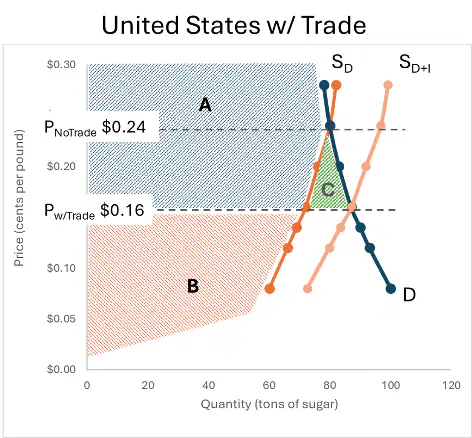
The above chart shows the US market for sugar after engaging in free trade with Brazil. Supply curve SD represents the domestic supply, and PNoTrade represents the equilibrium price without trade. When trade is introduced, the total supply shifts right to SD+I and the new equilibrium price with trade is given by Pw/Trade. What area represents the total consumer surplus with trade?
A
B
C
A + C
B + C
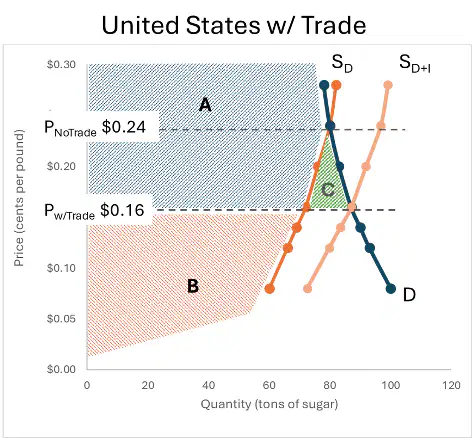
The above chart shows the US market for sugar after engaging in free trade with Brazil. Supply curve SD represents the domestic supply, and PNoTrade represents the equilibrium price without trade. When trade is introduced, the total supply shifts right to SD+I and the new equilibrium price with trade is given by Pw/Trade. What area represents the total domestic producer surplus?
A
B
C
A + C
B + C
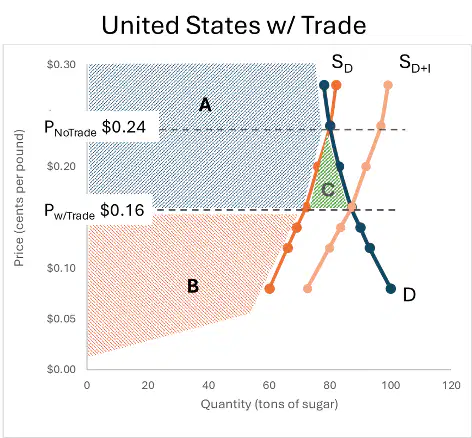
The above chart shows the US market for sugar after engaging in free trade with Brazil. Supply curve SD represents the domestic supply, and PNoTrade represents the equilibrium price without trade. When trade is introduced, the total supply shifts right to SD+I and the new equilibrium price with trade is given by Pw/Trade. What area represents the gains from trade for the US market?
A
B
C
A + C
B + C
Which of the following is not an impact of protectionist trade policies?
Domestic subsidies may destroy industries in low-income countries
Domestic consumers pay higher prices and lose surplus
Domestic producers benefit from higher prices, higher surplus and less competition
Consumers benefit from a greater variety of goods
There are many arguments in favor of protectionist policies. "Protecting nascent domestic industries so they can grow, achieve expertise and economies of scale" describes which argument?
Unsafe products
Environmental Protection
Anti-dumping
Infant Industry
There are many arguments in favor of protectionist policies. "Foreign producers are selling below production cost, trying to drive out domestic producers" describes which argument?
Unsafe products
Environmental Protection
Anti-dumping
Infant Industry
There are many arguments in favor of protectionist policies. "Imports from countries with looser environmental rules harms the planet." describes which argument?
Unsafe products
Environmental Protection
Anti-dumping
Infant Industry
There are many arguments in favor of protectionist policies. "Imported products from other countries (food, pharmaceuticals, etc) may not be safe for consumers" describes which argument?
Unsafe products
Environmental Protection
Anti-dumping
Infant Industry
There are many ways to reduce trade barriers. "Participants allow imports from each other without tariffs or quotas" describes which arrangement?
Free trade agreements
Common Markets
Economic Unions
Common Currency
There are many ways to reduce trade barriers. "Participants have a common external trade policy as well as free trade within the group" describes which arrangement?
Free trade agreements
Common Markets
Economic Unions
Common Currency
There are many ways to reduce trade barriers. "In addition to a common market, monetary and fiscal policies are coordinated" describes which arrangement?
Free trade agreements
Common Markets
Economic Unions
Common Currency

