wayground logo

Free Printable Worksheets

Font size

S
M
L
XL
Worksheets

orbital diagrams assessment

Total questions: 55

Worksheet time: 1hrs 9mins

Name
Class
Date
1.

What do orbital diagrams illustrate?

4 lines
2.

In an orbital diagram, what does each box represent?

4 lines
3.

Fill in the blank: Arrows in an orbital diagram represent ________.

a)

the electrons in the orbitals.

b)

the protons in the nucleus.

c)

the neutrons in the atom.

d)

the energy levels of the atom.

4.

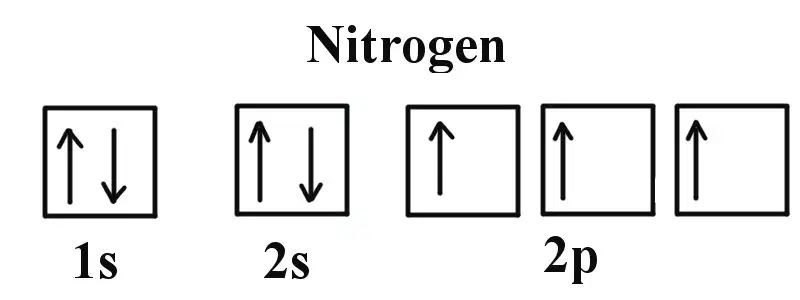
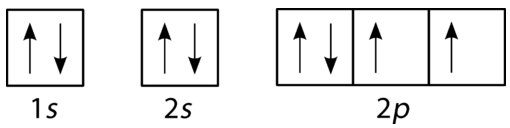
How many electrons are present in the 2p orbital of nitrogen according to the diagram?

4 lines
5.

Fill in the blank: There are four types of sublevels: ___, p, d, and f.

a)

s

b)

g

c)

h

d)

i

6.

To complete an orbital diagram, what must you first know about the atom?

a)

Number of protons

b)

Number of neutrons

c)

Number of electrons

d)

Atomic mass

7.

What is the Aufbau Principle?

a)

Electrons are added one at a time to the highest energy orbitals available.

b)

Electrons are added one at a time to the lowest energy orbitals available until all the electrons of the atoms have been accounted for.

c)

Electrons are added in pairs to the lowest energy orbitals available.

8.

According to the Pauli Exclusion Principle, an orbital can hold a maximum of ______ electrons.

a)

two

b)

three

c)

four

d)

one

9.

What does Hund's Rule state about electron occupation in orbitals of equal energy?

a)

Electrons will occupy them in pairs.

b)

Electrons will occupy them one at a time before filling orbitals in pairs.

c)

Electrons will occupy the highest energy orbitals first.

10.

Fill in the blank: The Aufbau Principle states that electrons fill the ______ energy orbitals first.

a)

lowest

b)

highest

c)

middle

d)

random

11.

According to the Pauli Exclusion Principle, can two electrons in the same orbital spin in the same direction?

a)

A) Yes

b)

B) No

12.

According to Hund's Rule, what must happen before any one orbital is doubly occupied?

a)

All orbitals must be empty

b)

Every orbital in a sublevel must be singly occupied with one electron

c)

All electrons must have opposite spins

d)

All orbitals must be doubly occupied

13.

What is the purpose of orbital diagrams?

a)

To represent the number of protons in an atom

b)

To represent where the electrons inside each atom live

c)

To represent the number of neutrons in an atom

d)

To represent the atomic mass of an atom

14.

Fill in the blank: Step 1 in filling an orbital diagram is to determine the number of _______ your atom has using a periodic table.

a)

electrons

b)

protons

c)

neutrons

d)

molecules

15.

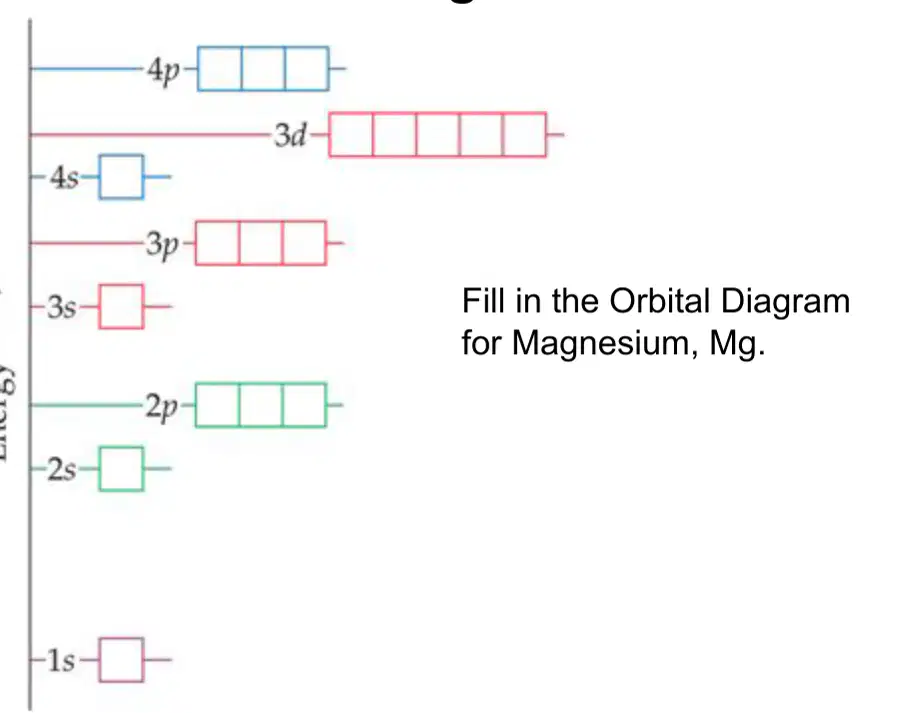
Fill in the Orbital Diagram for Magnesium, Mg.

a)

The question has a diagram associated with it. The diagram has been stored separately.

b)

1s² 2s² 2p⁶ 3s²

c)

1s² 2s² 2p⁶ 3p²

d)

1s² 2s² 2p⁶ 3d²

16.

What does the number in an electron configuration denote?

a)

The type of electron

b)

The energy level

c)

The charge of the electron

d)

The atomic number

17.

What does the letter in an electron configuration represent?

a)

Energy level

b)

Sublevel

c)

Number of electrons

18.

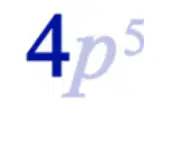
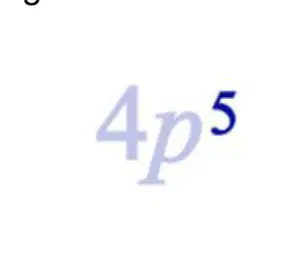
In the electron configuration 4p^5, what does the superscript '5' denote?

a)

Number of electrons

b)

Number of protons

c)

Number of neutrons

d)

Number of orbitals

19.

What is the electron configuration of Hydrogen (H)?

a)

1s¹

b)

2s²

c)

1s² 2s²

d)

2p¹

20.

What is the Ground State Electron Configuration for Phosphorous (P)?

a)

1s² 2s² 2p⁶ 3s² 3p³

b)

1s² 2s² 2p⁶ 3s² 3p⁴

c)

1s² 2s² 2p⁶ 3s² 3p²

d)

1s² 2s² 2p⁶ 3s² 3p⁵

21.

This orbital diagram represents:

a)

C

b)

B

c)

N

d)

O

22.
Which guideline, Hund’s rule or the Pauli exclusion principle, is violated in the following orbital diagrams?
a)
Aufbau's
b)
Hund's
c)
Pauli exclusive
23.
What is incorrect about this orbital diagram?
a)
Both arrows in the 2p box should be pointing up
b)
There is nothing incorrect with this diagram
c)
In the 2p box there should only be 1 electron in the first 2p box and one in the 2nd 2p box
d)
All the arrows should be pointing up.
24.
Which guideline, Hund’s rule or the Pauli exclusion principle, is violated in the following orbital diagrams?
a)
Hund's
b)
Aufbau's
c)
Pauli's Exclusive
25.
All orbitals of equal energy are occupied by one electron before any single orbital is occupied by a second electron.
a)
Aufbau principle
b)
Pauli exclusion principle
c)
Hund’s rule
d)
Core Notation
26.
Maximum number of electrons that can be placed in an s orbital.  
a)
2
b)
6
c)
10
d)
14
27.
The maximum number of electrons that can be placed in an p orbital.  
a)
2
b)
6
c)
10
d)
14
28.

what are valence electrons ?

a)
Valence electrons are the total number of electrons in an atom.
b)
Valence electrons are the electrons that do not participate in bonding.
c)
Valence electrons are the protons in an atom's nucleus.
d)

Valence electrons are the electrons in the outermost shell

29.

How many orbitals are contained in the third energy level (n = 3) of a given atom?

a)
6
b)
9
c)
12
d)
3
30.

Which element would have the configuration 5s2 for its valence electrons?

a)
Calcium (Ca)
b)
Magnesium (Mg)
c)
Strontium (Sr)
d)
Barium (Ba)
31.
Which element is pictured?
a)
neon
b)
fluorine
c)
magnesium
d)
argon
32.
This orbital diagram represents:  
a)
C
b)
B
c)
N
d)
O
33.
What is incorrect about this orbital diagram?
a)
Both arrows in the 2p box should be pointing up
b)
There is nothing incorrect with this diagram
c)
In the there should only be 1 orbital in the first 2p box and one in the 2nd 2p box
d)
All the arrows should be pointing up.
34.
 The diagram above represents two electrons with 
a)
a. opposite spins.
b)
 b. the same spin.
c)
c. different energies.
d)
d. different energy levels.
35.

Which example shows a violation of Hund's Rule?

a)

A

b)

B

c)

C

d)

D

36.

Which of the following is written correctly?

a)

A

b)

B

c)

C

d)

D

37.
What is the atomic number of this atom?
a)
2
b)
4
c)
6
d)
none of the above
38.
How many valence electrons?
a)
2
b)
3
c)
5
d)
10
39.
What's a valence electron?
a)
electrons in the second energy level
b)
electrons in the outermost energy level
c)
the atomic number
d)
electrons in the first level
40.

On the periodic table, Periods are

a)

Horizontal rows

b)

Vertical columns

41.

How many electrons can go in the Second energy level?

a)

2

b)

8

c)

18

d)

32

42.

What is the max number of electrons that can be placed on the 3rd energy level/ring?

a)

2

b)

6

c)

8 or 18

d)

10 or 18

43.
Which element is pictured?
a)
neon
b)
fluorine
c)
magnesium
d)
argon
44.
How many d electrons are in zirconium?
a)
2
b)
12
c)
40
d)
10
45.
How many p electrons are in bromine?
a)
5
b)
12
c)
17
d)
6
46.
This orbital diagram represents:  
a)
C
b)
B
c)
N
d)
O
47.
This orbital diagram represents:  
a)
C
b)
B
c)
N
d)
O
48.
Which orbital shows a violation of the Pauli Exclusion Principle?
a)
A
b)
B
c)
C
d)
D
49.
Which orbital shows a violation of the Aufbau Principle?
a)
A
b)
B
c)
C
d)
D
50.
Which orbital shows a violation of Hund's Rule?
a)
A
b)
B
c)
C
d)
D
51.
Which element is depicted from this atomic orbital diagram?
a)
Carbon
b)
Nitrogen
c)
Oxygen
d)
Phosphorus
52.
Which element is depicted from this orbital diagram
a)
Fluorine
b)
Neon
c)
Chlorine
d)
Argon
53.
Which guideline, Hund’s rule or the Pauli exclusion principle, is violated in the following orbital diagrams?
a)
Hund's
b)
Aufbau's
c)
Pauli's Exclusive
54.
Which guideline, Hund’s rule or the Pauli exclusion principle, is violated in the following orbital diagrams?
a)
Hund's
b)
Aufbau's
c)
Pauli's Exclusive
55.
Which guideline, Hund’s rule or the Pauli exclusion principle, is violated in the following orbital diagrams?
a)
Aufbau's
b)
Hund's
c)
Pauli exclusive