
 Worksheets
Energy Flow Review (Part 2)
Total questions: 57
Worksheet time: 29mins
Which term best describes an organism that is an autotroph and obtains energy from nonliving sources like sunlight?
Consumer
Producer
Detritivore
Carnivore
Which statement accurately characterizes a consumer?
Autotroph that relies on inorganic energy sources
Heterotroph that gets energy from living or once‑living sources
Organism that produces energy from dead matter
Species that only eats meat and no plant material
Which type of consumer obtains energy and nutrients specifically from dead matter?
Herbivore
Omnivore
Detritivore
Carnivore
True or False: A carnivore gets energy primarily from eating meat.
True; carnivores obtain energy by eating meat
False; carnivores obtain energy by eating vegetation
False; carnivores obtain energy from nonliving sources like the sun
False; carnivores obtain energy from dead organic matter
Which description best differentiates an omnivore from a herbivore?
Omnivores eat only vegetation; herbivores eat meat and vegetation
Omnivores eat meat and vegetation; herbivores eat only vegetation
Omnivores get energy from nonliving sources; herbivores eat meat
Omnivores feed on dead matter; herbivores eat meat and vegetation
A scientist observes an organism feeding on fallen leaves and decaying carcasses. Based on the vocabulary definitions, which classification is most appropriate?
Producer, because it uses sunlight
Herbivore, because it eats only vegetation
Detritivore, because it derives energy from dead matter
Carnivore, because it eats meat exclusively
Recall the definitions: Which statement correctly distinguishes autotrophs from heterotrophs based on how they acquire energy?
Autotrophs obtain energy by consuming other organisms; heterotrophs make food from sunlight or chemicals
Autotrophs are self-nourishers that make their own food from nonliving sources; heterotrophs consume other organisms for food
Autotrophs and heterotrophs both rely exclusively on detritus for energy
Autotrophs use only chemical energy, while heterotrophs use only sunlight
Identify the role described: In a food chain, detritivores (decomposers) primarily contribute by doing which of the following?
Producing glucose from carbon dioxide and water via sunlight
Fixing nitrogen directly into plant tissues
Returning nutrients from dead matter back to the soil, which plants can absorb
Transferring energy from sunlight to chemical bonds in methane
Based on energy sources, which organism would most likely be classified as an autotroph?
A wolf that hunts deer
A cyanobacterium that synthesizes food using sunlight
A mushroom that feeds on decaying logs
A tapeworm living in an intestine
What is the source of energy for photosynthesis?
Sunlight
Sulfur compounds such as H2S
Methane
Heat from deep sea vents
Which statement correctly describes chemosynthesis?
It uses sunlight as the energy source and occurs in plants
It uses chemicals like sulfur and methane as energy sources and occurs in deep sea vent bacteria
It requires oxygen to be the energy source
It is identical to photosynthesis in energy source but uses different organisms
According to the rule of 10 described in the energy pyramid concept, what proportion of energy is transferred to the next trophic level?
100%
50%
10%
1%
Which statement best explains why energy, biomass, and numbers are often represented with a pyramid shape?
Energy increases at higher trophic levels, expanding the top of the pyramid
Only a small fraction of energy is passed upward at each level, so fewer organisms and less biomass can be supported at higher levels
Organisms at higher levels reproduce faster, widening the top of the pyramid
Decomposers remove energy from the base, narrowing it
In a stable ecosystem, which group should constitute the majority of organisms and why?
Top-level consumers, because they lose the least energy as heat
Primary consumers, because they receive 90% of the producers’ energy
Producers, because only about 10% of energy is passed to each higher level
Secondary consumers, because they are more efficient at energy transfer
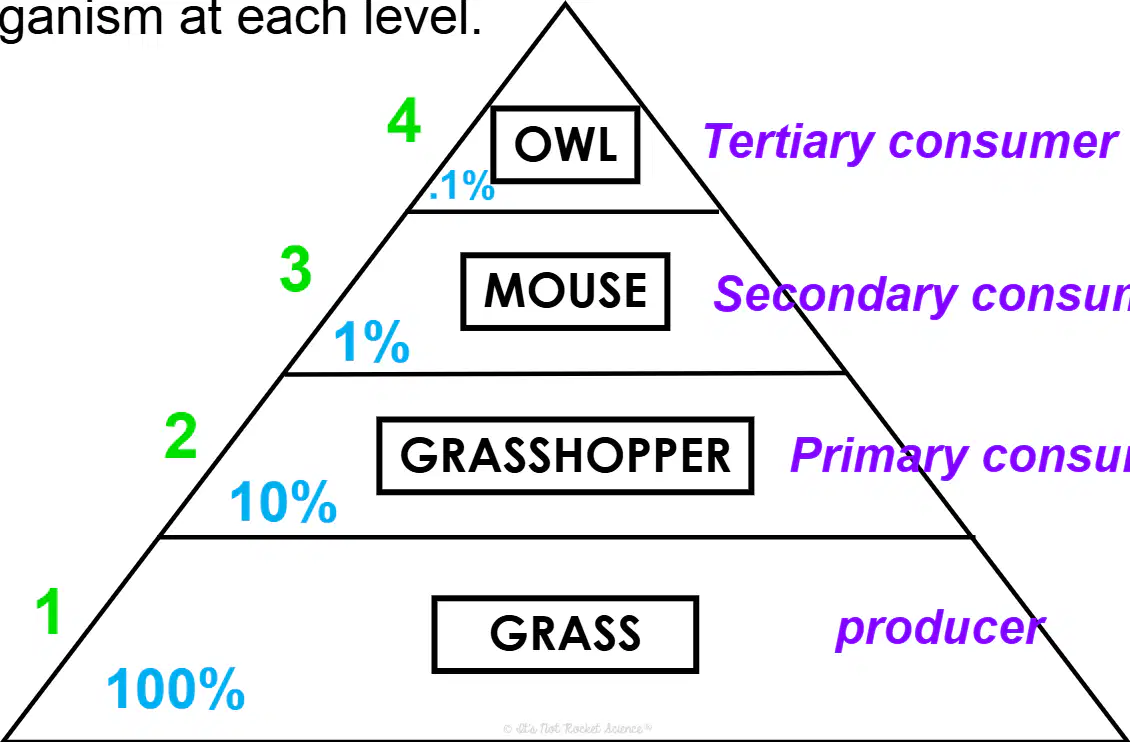
Refer to the energy pyramid diagram showing grass → grasshopper → mouse → owl. Which organism is a primary consumer in this pyramid?
Grass
Grasshopper
Mouse
Owl
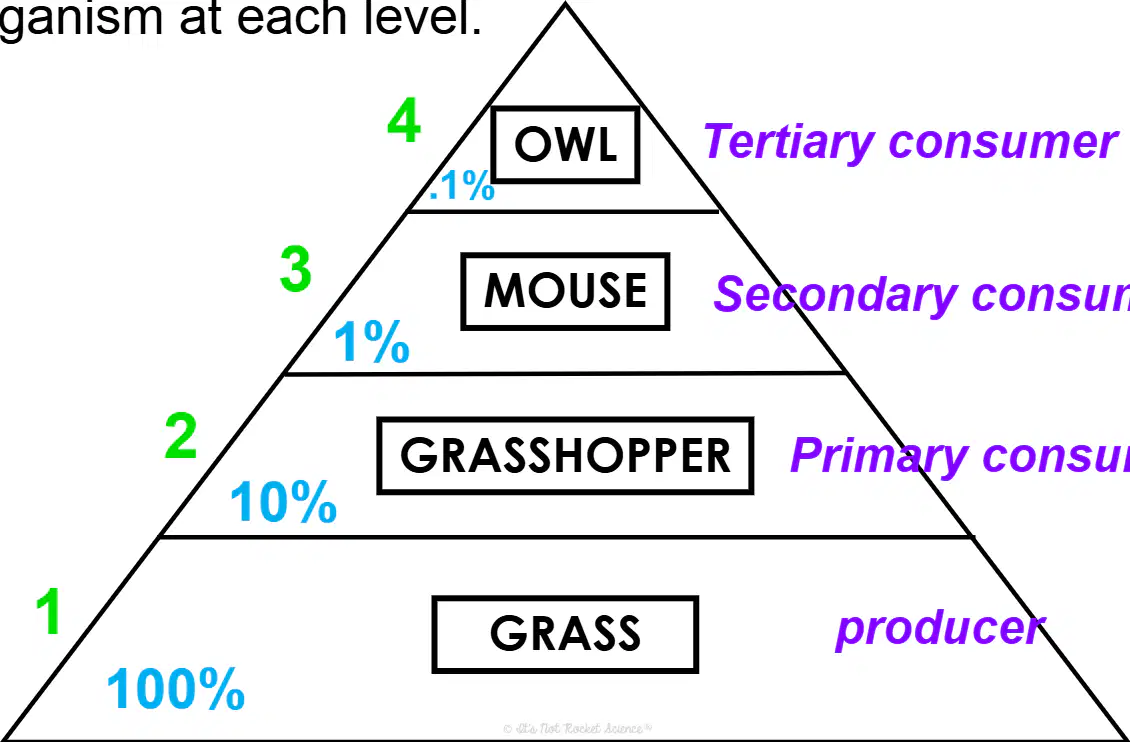
In the illustrated energy pyramid (grass at the base up to owl at the top), approximately what percentage of the original energy at the producer level reaches the tertiary consumer?
10%
1%
0.1%
0.01%
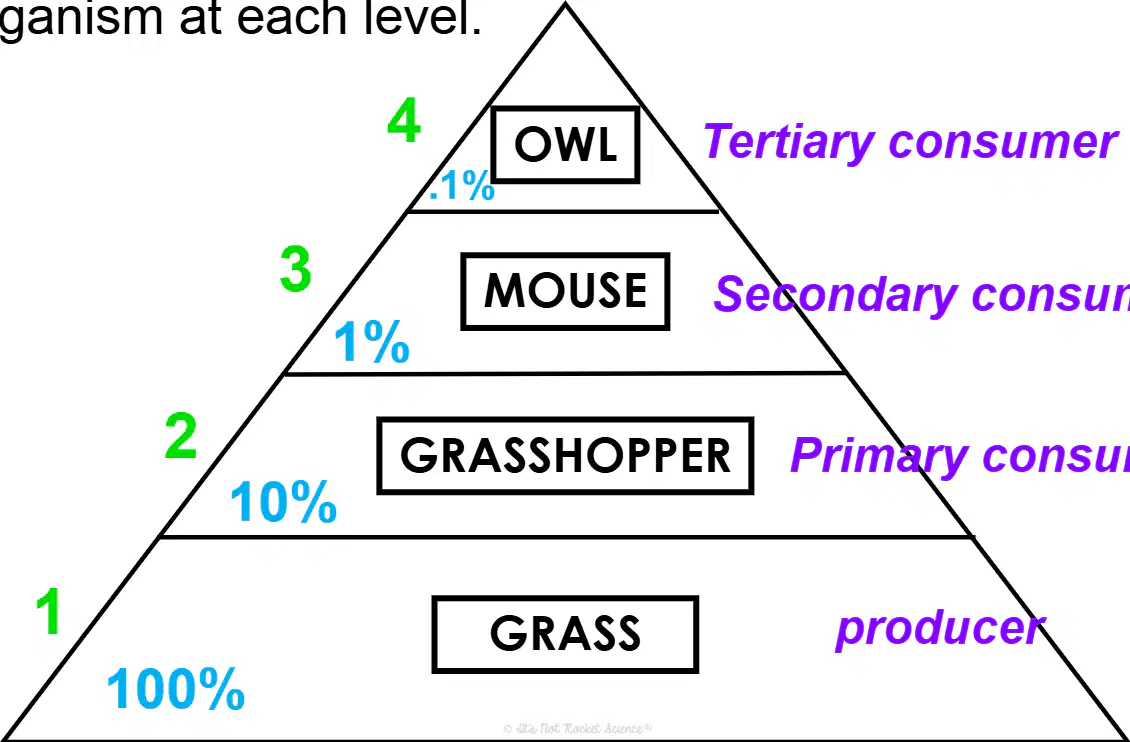
Which classification correctly matches each trophic level label in the depicted pyramid?
Grass—primary consumer; Grasshopper—producer; Mouse—secondary consumer; Owl—tertiary consumer
Grass—producer; Grasshopper—primary consumer; Mouse—secondary consumer; Owl—tertiary consumer
Grass—producer; Grasshopper—secondary consumer; Mouse—primary consumer; Owl—tertiary consumer
Grass—decomposer; Grasshopper—primary consumer; Mouse—secondary consumer; Owl—quaternary consumer
An organism is described as obtaining energy by producing its own food through photosynthesis. Based on the objectives, how should this organism be classified?
Primary consumer
Autotroph
Heterotroph
Detritivore
A diagram shows a grass → grasshopper → frog → snake sequence. Using the objectives, what trophic level does the frog occupy?
Producer
Primary consumer
Secondary consumer
Tertiary consumer
You are given a food pyramid with 10,000 kJ at producers and typical 10% transfer efficiency between levels. Approximately how much energy is available to secondary consumers?
10,000 kJ
1,000 kJ
100 kJ
10 kJ
What is photosynthesis?
Stacks of thylakoid membrane in the chloroplast
The fluid-filled region inside the chloroplast
The overall process by which sunlight, water, and carbon dioxide are chemically converted into chemical energy stored in glucose
The pigment in the thylakoid membrane that enables light capture
Recall: What are grana within a chloroplast?
Fluid compartments between chloroplast membranes
Stacks of thylakoid membrane in the chloroplast
Pigment molecules that absorb light energy
Channels that transport glucose out of chloroplasts
Skill/Concept: A researcher isolates the fluid portion of a chloroplast to analyze soluble enzymes. Which chloroplast region is being studied according to the vocabulary bank?
Grana
Stroma
Thylakoid lumen
Cell cytosol
Skill/Concept: Which term names the specific pigment located in thylakoid membranes that allows plants to capture sunlight?
Carotene
Chlorophyll
Stroma
Grana
What is the ultimate source of energy for most life on Earth?
Glucose stored in plant cells
The sun
ATP produced in mitochondria
Heat from Earth’s interior
Which statement best describes why consumers rely on plants in the overall energy process?
Consumers directly capture sunlight using chlorophyll
Consumers depend on plants to convert solar energy into glucose they can eat
Consumers synthesize glucose without external energy
Consumers use photosynthesis to make ATP
Interpret the balanced chemical formula for photosynthesis: 6CO2 + 6H2O → C6H12O6 + 6O2. Which set correctly identifies reactants and products?
Reactants: CO2 and H2O; Products: glucose and O2
Reactants: glucose and O2; Products: CO2 and H2O
Reactants: CO2 and glucose; Products: H2O and O2
Reactants: H2O and O2; Products: CO2 and glucose
Which output of the light-dependent reactions is released as waste rather than carried to the next stage?
ATP
NADPH
Oxygen
Hydrogen ions (H+)
Where within the chloroplast do the light-dependent reactions primarily occur?
Stroma
Grana/thylakoid membrane
Matrix
Outer membrane
Which statement accurately summarizes the role of light energy in the light-dependent reactions?
Light energy is used to split carbon dioxide to release glucose
Light energy is captured and stored in ATP and NADPH
Light energy directly forms glucose without intermediates
Light energy converts ATP into ADP to release energy
During the light-dependent reactions, what happens to water?
It is synthesized from oxygen
It is broken apart
It is stored in the stroma unchanged
It catalyzes glucose formation without being altered
Which molecules move on from the light-dependent reactions to the Calvin Cycle according to the objectives?
ATP, NADPH, and H+
O2 and CO2
Glucose and H2O
ADP and NADP+
In the Calvin Cycle (light-independent reactions), which inputs are used to make glucose?
ATP and NADPH with carbon dioxide
Oxygen and water
Light energy and oxygen
Glucose and ATP
Where do the reactions of the Calvin Cycle occur within the chloroplast?
Thylakoid lumen
Grana/thylakoid membrane
Stroma
Outer membrane
Which statement best connects the two stages of photosynthesis based on the objectives?
ATP and NADPH are produced in the Calvin Cycle and power the light-dependent reactions
ATP and NADPH are produced in the light-dependent reactions and power glucose synthesis in the Calvin Cycle
Glucose made in the light-dependent reactions is broken down in the Calvin Cycle
Oxygen generated in the Calvin Cycle is used to split water in the light-dependent reactions
Recall the definition provided: What is cellular respiration?
The breakdown of glucose to release usable chemical energy in the form of ATP
The physical transport of oxygen from lungs to tissues
The synthesis of glucose from carbon dioxide and water
The conversion of ATP into glucose for storage
According to the vocabulary list, what is the inner membrane in mitochondria?
A rigid outer covering that protects the organelle
The folded membrane within the mitochondria
The fluid that fills the mitochondria
A separate nucleus-like compartment
Which term correctly matches the definition "the fluid that fills the mitochondria"?
Matrix
Cristae
Cytosol
Stroma
Select the statement that best distinguishes aerobic from anaerobic processes as defined in the vocabulary list.
Aerobic occurs with oxygen; anaerobic occurs without oxygen
Aerobic occurs in plants; anaerobic occurs in animals
Aerobic produces glucose; anaerobic breaks down lipids
Aerobic is faster than anaerobic under all conditions
Which description best fits fermentation in the provided vocabulary?
Aerobic respiration that requires oxygen
Anaerobic respiration that occurs without oxygen
Photosynthetic conversion of light energy
Storage of ATP in the inner membrane
What is the primary goal of cellular respiration for consumers?
To convert chemical energy in food into ATP that cells can use
To capture sunlight directly and make glucose
To store energy long-term in glycogen only
To convert ATP into glucose for immediate use
Which statement best explains why cellular respiration is necessary for humans?
Humans cannot use glucose directly for energy and must convert it to ATP
Humans produce glucose from sunlight and therefore do not need ATP
Humans can store sunlight directly in mitochondria
Humans convert ATP into sunlight for cellular processes
Identify the reactants in the summarized chemical formula of cellular respiration: C6H12O6 + 6O2 → 6CO2 + 6H2O + energy (ATP).
C6H12O6 and 6O2
6CO2 and 6H2O
ATP and CO2
NADH and pyruvate
In the chemical equation for cellular respiration, which are the products that result from 1 glucose and 6 oxygen molecules?
6CO2, 6H2O, and a large amount of ATP
C6H12O6 and 6O2 only
2 pyruvates and NADH only
Sunlight and glucose
Which condition and ATP yield correctly describe aerobic respiration?
Occurs in the presence of oxygen and can produce up to 36–38 ATP
Occurs without oxygen and produces 2–4 ATP
Occurs in the cytoplasm only and yields 2 ATP
Occurs with oxygen but produces no ATP
Which statement accurately contrasts aerobic and anaerobic respiration?
Aerobic uses oxygen and generates much more ATP; anaerobic occurs without oxygen and yields far less ATP
Aerobic does not require oxygen and yields 2–4 ATP; anaerobic requires oxygen and yields 36–38 ATP
Both aerobic and anaerobic require oxygen but differ in glucose use
Aerobic and anaerobic produce identical ATP amounts under all conditions
Where in the cell does glycolysis occur?
In the cytoplasm
In the mitochondrial matrix
On the inner mitochondrial membrane
In the nucleus
Which set lists the immediate products formed in glycolysis and what moves to the next stage?
2 pyruvates (move on), plus 2 ATP and 2 NADH are made
6CO2 and 6H2O move on, plus ATP is made
Glucose and oxygen move on, plus many ATP are made
Acetyl-CoA and FADH2 move on, plus 36–38 ATP are made
Which statement best summarizes a key event of glycolysis regarding glucose?
Glucose is split in half and used to form pyruvate
Glucose is converted directly into CO2 and H2O
Glucose is assembled from ATP and NADH
Glucose is stored unchanged in the cytoplasm
Where in the mitochondria does the Krebs cycle occur?
Intermembrane space
Outer membrane
Mitochondrial matrix
Inner membrane
Which molecule is released as waste during the Krebs cycle?
Oxygen
Carbon dioxide
Water
Glucose
Which set best describes what is produced by the Krebs cycle?
A lot of ATP, water, and oxygen
2 ATP, NADH, and FADH2
Pyruvate and lactic acid
Alcohol and carbon dioxide
Electrons and hydrogens leaving the Krebs cycle will most directly feed into which process?
Glycolysis
Electron Transport Chain
Alcohol fermentation
Calvin cycle
What reactant is explicitly used in the Electron Transport Chain?
Carbon dioxide
Oxygen
Pyruvate
Glucose
Which combination identifies the products of the Electron Transport Chain?
Water and a lot of ATP
Lactic acid and 2 ATP
Alcohol and carbon dioxide
2 ATP, NADH, FADH2
Which organisms perform lactic acid fermentation?
Yeast
Plant chloroplasts
Some bacteria and animal cells
Only fungi
Which of the following correctly distinguishes alcohol fermentation from lactic acid fermentation?
Alcohol fermentation uses oxygen, while lactic acid fermentation does not
Alcohol fermentation makes alcohol and carbon dioxide, while lactic acid fermentation makes lactic acid
Alcohol fermentation occurs in the mitochondrial matrix, while lactic acid fermentation occurs in the inner membrane
Alcohol fermentation produces NADH and FADH2, while lactic acid fermentation produces water

