
NEW
Font size
 Worksheets
Social Facilitation and Inhibition in Sport
Total questions: 66
Worksheet time: 33mins
What is social facilitation in the context of sporting performance?
The tendency for the presence of others to improve a person's sporting performance
The tendency for athletes to perform worse when alone
The process of learning new skills without an audience
The negative impact of coaching on performance
Which of the following best describes social inhibition?
The beneficial impact on sporting performance caused by performing in front of an audience
The negative impact on sporting performance caused by performing in front of an audience
The improvement of skills through practice alone
The effect of weather on sporting performance
How can the presence of an audience affect an athlete's performance, according to the material?
It always causes anxiety and poor performance
It brings about the predominant response depending on how well the skill has been learned
It has no effect on performance
It only benefits professional athletes
Which term describes the phenomenon where introverts struggle to perform at higher levels of arousal in front of an audience?
Social Facilitation
Social Inhibition
Evaluation Apprehension
Information Processing
What is the effect of an audience on extroverts during performance?
Extroverts struggle to perform
Extroverts tend to thrive in high energy situations
Extroverts require less attention
Extroverts experience evaluation apprehension
How does the presence of an audience affect beginners compared to experts?
Both experience social facilitation
Beginners experience social inhibition, experts experience social facilitation
Both experience social inhibition
Beginners experience social facilitation, experts experience social inhibition
Why do complex skills tend to be inhibited by the presence of an audience?
They require less attention
They require more attention due to the multitude of actions needed
They are performed better at higher arousal
They do not need information processing
Which type of skill is most likely to benefit from social facilitation in front of an audience?
Complex skills
Fine skills
Simple skills
Skills requiring high decision making
What is evaluation apprehension?
The ability to perform better in front of an audience
The feeling of being evaluated by a crowd, causing increased arousal
The process of making decisions during performance
The tendency to thrive in high energy situations
Which group is more likely to suffer from evaluation apprehension?
Athletes with high self-confidence
Athletes who are extroverts
Athletes who suffer from anxiety or low self-confidence
Expert performers
Why do fine skills often require lower arousal levels to be performed successfully?
They need less decision making
They need higher levels of decision making
They require more attention
They are performed better with social facilitation
What happens when a performer perceives evaluators to be of higher status than themselves?
The effect of evaluation apprehension is reduced
The effect of evaluation apprehension is magnified
The performer experiences social facilitation
The performer requires less attention
Which type of skill does not need a high level of information processing to be performed successfully?
Fine skills
Complex skills
Gross skills
Simple skills
Which of the following is a method of blocking out irrelevant cues such as crowd noise to help prevent arousal from rising too high?
Selective attention
Physical training
Nutritional planning
Time management
Which of the following is an example of a cognitive method to reduce anxiety in performers?
Positive self-talk
Increasing physical activity
Changing the venue
Wearing new uniforms
Which strategy is recommended for building confidence and reducing anxiety in performers?
Positive reinforcement and social support from coach and team mates
Ignoring feedback from others
Practicing alone only
Focusing on opponents’ strengths
Why is it important for a performer to manage levels of arousal?
To operate in their optimal zone for best performance
To impress the audience
To avoid physical injury
To increase the length of the game
Which of the following is a benefit of skills being autonomous for a performer?
They need little attention
They require constant supervision
They are always changing
They are difficult to learn
Which of the following strategies involves focusing on the most appropriate cues during performance?
Practice selective attention
Changing the rules of the game
Increasing the size of the audience
Wearing bright uniforms
What is the purpose of using appropriate attribution in sports psychology?
To help maintain optimum levels of arousal
To increase the number of competitions
To reduce the need for training
To focus only on winning
Which of the following best describes the Drive Theory in relation to performance?
The presence of an audience increases arousal, which affects performance.
The presence of an audience decreases arousal, which improves performance.
Arousal levels have no effect on performance.
Performance is only affected by skill level, not arousal.
Who proposed the term "Social Facilitation" to describe the effect of an audience on arousal and performance?
Zajonc (1965)
Freud (1920)
Skinner (1957)
Maslow (1943)
What is social inhibition?
A decrease in performance due to increased arousal in the presence of an audience.
An increase in performance due to increased arousal.
A type of training method for athletes.
A way to improve concentration before a game.
According to the Drive Theory, what happens to players in the cognitive phase of learning when performing in front of an audience?
They experience increased arousal, leading to mistakes and poor performance.
They perform better due to increased arousal.
Their performance remains unchanged.
They become less aroused and more relaxed.
How does arousal affect a performer in the autonomous phase according to the Drive Theory?
Arousal improves performance with the dominant response of correct skills.
Arousal causes more mistakes and poor performance.
Arousal has no effect on performance.
Arousal only affects beginners, not experienced performers.
If a boxer has low arousal levels before a fight, what is likely to happen?
Their reaction time will be slower and performance will be lower.
They will perform at their best.
Their concentration will be higher.
They will have an optimum level for sport.
How does the presence of a large audience typically affect a performer's arousal according to the Drive Theory?
It increases arousal.
It decreases arousal.
It has no effect on arousal.
It only affects the audience, not the performer.
According to Zajonc, what effect does the presence of an audience have on an athlete's arousal level?
Raises arousal
Lowers arousal
Has no effect on arousal
Only affects professional athletes

Which of the following is most likely to increase arousal in athletes, according to the table in the image?
A larger crowd
A smaller crowd
Performing alone
Playing at home
At which stage of learning is high arousal most likely to cause mistakes due to incorrect dominant behaviour?
Associative stage (beginner)
Autonomous stage (expert)
Cognitive stage (advanced)
Professional stage
According to the information provided, why might a professional golfer rarely "slice" or "hook" the ball in front of an audience?
Because the golf swing is a well-learned task
Because the audience is quiet
Because the weather is good
Because they use better equipment
According to Drive Theory, what is likely to happen to a beginner golfer's performance in front of a large audience?
They are more likely to make mistakes due to high arousal
They will always perform better
Their performance will not change
They will become less aroused and more relaxed
What is evaluation apprehension according to Cottrell (1968)?
When a performer feels they are being evaluated by a crowd member, causing increased arousal levels
When a performer feels confident in front of an audience
When a performer ignores the presence of spectators
When a performer is only judged by their coach
Which of the following is MOST likely to increase evaluation apprehension in a performer?
The judges are of high status like team selectors
The audience is silent and supportive
The performer has high self-efficacy
The event is not important
Evaluation apprehension can occur in which of the following situations?
When parents or friends are watching and making judgments
When the performer is alone
When the audience is not paying attention
When the performer is practicing privately
Which of the following is NOT a factor that increases evaluation apprehension?
The performer’s ability level is high
The perceived evaluator is of the opposite sex
The audience are openly and verbally critical
The previous performance was poor
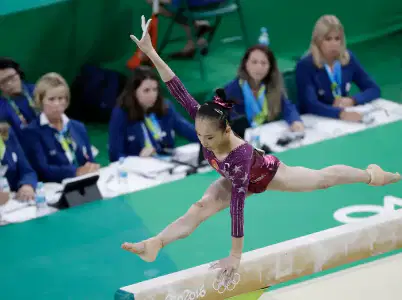
Select the option that best represents evaluation apprehension in the context of a gymnast performing in front of judges and an audience.
This image best represents evaluation apprehension because the performer is being judged by an audience and officials.
This image best represents evaluation apprehension because the performer is practicing alone.
This image best represents evaluation apprehension because the performer is in a non-competitive setting.
This image best represents evaluation apprehension because the performer is not being watched.
Which situation is most likely to cause a performer’s anxiety to increase due to evaluation apprehension?
The event is important and the result is critical
The performer is practicing at home
The audience is supportive and quiet
The performer has just won a previous event
Explain how evaluation apprehension could both enhance and inhibit an athlete’s performance. Choose the best reasoning.
Evaluation apprehension can enhance performance if the athlete is motivated by being judged, but can inhibit performance if anxiety overwhelms their ability to focus.
Evaluation apprehension always enhances performance regardless of the situation.
Evaluation apprehension only inhibits performance and never enhances it.
Evaluation apprehension has no effect on performance.
According to the Distraction-Conflict Theory, what is the main effect of an audience on a performer's attentional capacity?
It increases the performer's focus on the task
It causes distraction due to competition for attentional space
It helps the performer ignore environmental cues
It makes complex actions easier to perform
Which of the following is most likely to be impaired in front of a large crowd, according to Baron (1986)?
Simple tasks requiring little attention
Complex actions requiring more attention
Automatic responses
Routine habits
What is one recommended way for performers to cope with the distraction caused by an audience?
Ignore the audience completely
Train more with an audience and learn how to prevent distraction
Avoid performing in front of crowds
Focus only on the audience
Which of the following statements best summarizes the conclusion about the effect of an audience on performance?
An audience always improves performance
An audience has no effect on performance
An audience can distract the performer, leading to poor performance
An audience only affects experienced performers
Why do spectators create a conflict for the performer’s attention, according to the Distraction-Conflict Theory?
Spectators are always silent
Spectators demand the same amount of attention as other players
Spectators help the performer focus
Spectators reduce the number of environmental cues
A performer is distracted by both the presence of others and the task itself. According to the Distraction-Conflict Theory, what is the likely outcome?
Improved performance on complex actions
Impaired performance on complex actions
No change in performance
Enhanced memory recall
What is the term used to describe the advantage that a home team receives from playing in front of a large supportive crowd?
Home field advantage
Away game effect
Neutral ground benefit
Audience neutrality
Which of the following is NOT a reason for the home field advantage in sports?
Comforts of familiarity with the home environment
Larger and supportive crowd
Pressure to win for home fans
Lack of rules in home games
According to studies, how often do home performers defeat visiting performers in professional sports?
In more than half of total games played
In less than a quarter of total games played
Only during championship matches
Only when the weather is favorable
Which of the following sports is mentioned as having home-field advantage effects?
Football and tennis
Swimming and cycling
Golf and archery
Skiing and snowboarding
How does a supportive home crowd influence the performance of athletes, according to the text?
It increases confidence and motivation
It makes athletes tired
It causes athletes to forget their skills
It leads to more injuries
What is one psychological factor that contributes to home field advantage?
Familiarity with the environment
Unfamiliar equipment
Lack of audience
Frequent travel
Imagine you are a coach preparing your team for an away game. Based on the concept of home field advantage, what strategies could you use to minimize the home team's advantage?
Simulate the home team's environment during practice
Ignore the crowd and focus only on the referee
Change the rules of the game
Only allow experienced players to play
Which theory suggests that the mere presence of others increases arousal, thereby enhancing the dominant response?
Zajonc’s Drive Theory
Evaluation Apprehension Theory
Distraction-Conflict Theory
Home Field Advantage Theory
According to Zajonc’s Drive Theory, what happens when a performer is faced with a new or complex skill in the presence of others?
Performance deteriorates
Performance improves
Performance remains unchanged
Performer becomes more relaxed
Which theory emphasizes that arousal increases not just due to the presence of others, but because of the perception of being judged?
Evaluation Apprehension Theory
Zajonc’s Drive Theory
Distraction-Conflict Theory
Home Field Advantage Theory
What is a key factor in the Evaluation Apprehension Theory that leads to increased arousal?
Belief of being evaluated by others
Familiar surroundings
Reduced travel fatigue
Information overload
According to the Distraction-Conflict Theory, what effect does the presence of others have on a performer?
Causes attentional conflict and distraction
Improves performance on all tasks
Reduces arousal
Increases travel fatigue
How does performance typically change on complex tasks when an audience is present, according to the Distraction-Conflict Theory?
Performance suffers
Performance improves
Performance remains unchanged
Performer becomes more focused
Which of the following is NOT a reason why teams often perform better at home?
Unfamiliar surroundings
Supportive crowd
Reduced travel fatigue
Familiar surroundings
What is the proximity effect in the context of home field advantage?
Closer audience increases arousal
Audience is less supportive
Travel fatigue is increased
Performance is unaffected by audience location
A coach wants to maximize their team’s performance in a closed roof stadium. Based on the theories summarized, what should they consider about the audience?
The closer the audience, the higher the arousal, which can affect performance
The farther the audience, the better the performance
Audience presence has no effect on performance
Only the size of the audience matters, not proximity
Which of the following is considered a passive other in a sports performance setting?
Audience
Competitive co-actors
Social reinforcers
Coach
What is the main difference between passive and interactive others in sports performance?
Passive others compete directly with the performer, while interactive others do not.
Passive others observe without direct interaction, while interactive others engage with the performer.
Passive others are always coaches, while interactive others are always spectators.
Passive others are only present during training, while interactive others are present during competitions.
According to the Zajonc Model, what effect does the presence of an audience or co-actors have on early learning of a skill?
It enhances early learning.
It impairs early learning.
It has no effect on early learning.
It makes learning faster.
Who are considered social reinforcers in a sports performance setting?
Spectators
Coaches
Competitors
Co-actors
When is the dominant response most likely to be correct according to the Zajonc Model?
During early learning of a skill
When the skill or task is well learned
When there are no others present
When the performer is alone

