wayground logo

Free Printable Worksheets

Font size

S
M
L
XL
Worksheets

Cell Structure and Function

Total questions: 88

Worksheet time: 1hrs 7mins

Name
Class
Date
1.

According to Cell Theory all living things are made of cells. Based on this theory all living things must contain _____, _____, and ______.

a)

nucleus

b)

mitochondria

c)

cell membranes

d)

ribosomes

e)

genetic material

2.

Cells only come ___

a)

from prokaryotes

b)

from other cells dividing

c)

from fungi

d)

from eukaryotes

3.

The smallest unit of life is ____

a)

a protist

b)

an atom

c)

bacteria

d)

a cell

4.

Prokaryote ___

a)

contain simple cells

b)

are unicellular

c)

alway have a flagellum

d)

are a product of endosymbiosis

5.

True or False. Prokaryotes contain cytoplasm.

a)

True

b)

False

6.

An organelle involved in breaking down lipids, proteins, carbohydrates, damage organelles, and bacteria are ___

a)

Golgi Appaparatus

b)

Vesicles

c)

Vacule

d)

Lysosomes

7.

Both mitochondria and chloroplasts ____

a)

contain their own unique ribosomes that are different than the cells

b)

contain their own unique DNA that are different than the cells

c)

are specialized organelles that capture and release energy

d)

are found in both in plants and animals

8.

The cell semipermeable membrane governs what comes in and out of the cell through

a)

Diffusion

b)

Osmosis

c)

Facilitated Diffusion

d)

Protein Pumps

9.

The Fluid Mosaic Model __

a)

describes the process of making proteins through the fluid movement of ribosomes to the golgi apparatus

b)

describes the movement of RNA through the nuclear pore into the cytoplasm

c)

describes the cell's boundary composed of the cell wall and the cytoskeleton

d)

describes the cell membrane as made of many different parts that are not fixed in one place.

10.

Cholesterol

a)

Is bad

b)

provides stiffness and structure to the cell's semipermeable membrane

c)

Is good

d)

helps with facilitated diffusion

11.

In diffusion

a)

water moves from a high concentration to a low concentration

b)

water moves from a low concentration to a high concentration

c)

molecules move from a high concentration to a low concentration

d)

molecules move from a low concentration to a high concentration

12.

Water, oxygen and carbon dioxide move across the permeable cell membrane by ____

a)

diffusion

b)

facilitated diffusion

c)

endocytosis

d)

exocytosis

13.

Osmosis is ____

a)

a special kind of diffusion

b)

the movement of water across a permeable cell membrane

c)

a passive transport mechanism

d)

an active transport mechanism

14.

A hypertonic solution is one where

a)

the concentration of a solution outside the cell is higher than the concentration than inside the cell

b)

the concentration of a solution outside the cell is lower than the concentration than inside the cell

c)

the concentration of a solution outside the cell is equal to the concentration than inside the cell

15.

Timmy places a freshwater amoeba on a wet mount slide with freshwater. Timmy examines the amoeba using a compound microscope using high power. What happens to the amoeba body?

a)

Hypertonic setting: the amoeba shrivels up as water in the amoeba moves across it's semi-permeable membrane into the jar of water.

b)

Hypotonic setting: the amoeba swells up as water in the jar moves across the amoeba's semi-permeable membrane into the amoeba's body.

c)

Isotonic setting: nothing happens as the concentration of the freshwater in the jar is equal to the concentration of freshwater in the amoeba's body

16.
Which is a Prokaryotic cell?
a)
Left Cell
b)
Right Cell
c)
Both Cells are prokaryotic
d)
Neither Cell is Prokaryotic
17.
Which is an example of a Eukaryotic cell?
a)
Left cell
b)
Right cell
c)
Both cells are eukaryotic
d)
Neither cells are eukaryotic
18.
The cell shown is a(n) ______ cell.
a)
Eukaryotic
b)
Prokaryotic
19.
These cells contain ribosomes...
a)
Eukaryotic
b)
Prokaryotic
c)
Both Eukaryotic and Prokaryotic do
d)
Neither Do
20.
Eukaryotic cells have...
a)
Membrane bound organelles
b)
One chromosome
c)
Plasmids in the cytoplasm
d)
None of these
21.

Both prokaryotic and eukaryotic cells can have...

a)
Flagellum and many chromosomes
b)
Have a cell membrane and plasmids in the cytoplasm
c)

Ribosomes and a linear shape chromosomes

d)
DNA and flagellum
22.
These cells have only one chromosome present...
a)
Prokaryotic
b)
Eukaryotic
c)
Both prokaryotic and eukaryotic
d)
Neither do
23.
How many chromosomes are present in a Eukaryotic cell?
a)
One
b)
None
c)
Many
24.

These cells have a circular/loop shaped chromosomes...

a)
Eukaryotic
b)
Prokaryotic
c)
Neither
d)
Both prokaryotic and eukaryotic
25.

Eukaryotic chromosomes are always _______ in shape.

a)

Circular

b)

Spherical

c)

Linear

d)

Oval

26.
These cells have DNA surrounded by a nuclear membrane...
a)
Eukaryotic
b)
Prokaryotic
c)
Neither
d)
Both prokaryotic and eukaryotic
27.
These cells contain plasmids in the cytoplasm...
a)
Eukaryotic
b)
Neither
c)
Both prokaryotic and eukaryotic
d)
Prokaryotic
28.
Prokaryotic cells are how big?
a)
1 micrometer
b)
10-100 micrometers
c)
Larger than 100 micrometers
29.
Animal, fungi, plant, and protista cells are all examples of which type of cell?
a)
Eukaryotic
b)
Prokaryotic
c)
Both prokaryotic and eukaryotic
30.
Bacteria cells are an example of which type of cell?
a)
Both prokaryotic and eukaryotic
b)
Prokaryotic
c)
Eukaryotic
31.
Prokaryotic cells have...
a)

70S ribosomes (simple)

b)

80S ribosomes (complex)

32.
Eukaryotic cells have...
a)

70S ribosomes (simple)

b)

80S ribosomes (complex)

33.
Prokaryotic cell walls are composed of ______.
a)
Cellulose
b)
Peptidoglycan
c)
Either cellulose or peptidogylcan
d)
Neither of these
34.
These cell walls are composed of cellulose...
a)
Both prokaryotic and eukaryotic cell walls are made of cellulose
b)
Prokaryotic
c)
Eukaryotic
35.
These cells divide using mitosis...
a)
Eukaryotic
b)
Prokaryotic
c)
Both prokaryotic and eukaryotic
d)
Neither cells
36.
These cells divide by binary fission...
a)
Neither
b)
Both prokaryotic and eukaryotic
c)
Prokaryotic
d)
Eukaryotic
37.
Prokaryotic cells are older than Eukaryotic cells
a)
Flase
b)
True
38.

What is the main function of the cell membrane?

a)

A. To provide structure to the cell

b)

B. To control the movement of substances in and out of the cell

c)

C. To produce energy for the cell

d)

D. To store genetic information

39.

Which type of transport does not require energy?

a)

A. Passive Transport

b)

B. Active Transport

c)

C. Diffusion

d)

D. Osmosis

40.

Which type of transport requires energy?

a)

A. Passive Transport

b)

B. Active Transport

c)

C. Diffusion

d)

D. Osmosis

41.

What is diffusion?

a)

A. The movement of water across a semipermeable membrane

b)

B. The movement of molecules from an area of high concentration to an area of low concentration

c)

C. The movement of molecules from an area of low concentration to an area of high concentration

d)

D. The movement of ions across a membrane

42.

What is osmosis?

a)

A. The movement of water across a semipermeable membrane

b)

B. The movement of molecules from an area of high concentration to an area of low concentration

c)

C. The movement of molecules from an area of low concentration to an area of high concentration

d)

D. The movement of ions across a membrane

43.

Which of the following is an example of passive transport?

a)

A. Facilitated diffusion

b)

B. Sodium-potassium pump

c)

C. Endocytosis

d)

D. Exocytosis

44.

Which of the following is an example of active transport?

a)

A. Facilitated diffusion

b)

B. Sodium-potassium pump

c)

C. Endocytosis

d)

D. Exocytosis

45.

What happens to a cell placed in a hypertonic solution?

a)

A. It swells

b)

B. It shrinks

c)

C. It remains the same

d)

D. It bursts

46.

What happens to a cell placed in a hypotonic solution?

a)

A. It swells

b)

B. It shrinks

c)

C. It remains the same

d)

D. It bursts

47.

What happens to a cell placed in an isotonic solution?

a)

A. It swells

b)

B. It shrinks

c)

C. It remains the same

d)

D. It bursts

48.

Cells only come ___

a)

from prokaryotes

b)

from other cells dividing

c)

from fungi

d)

from eukaryotes

49.

The smallest unit of life is ____

a)

a protist

b)

an atom

c)

bacteria

d)

a cell

50.

Prokaryote ___

a)

contain simple cells

b)

are unicellular

c)

alway have a flagellum

d)

are a product of endosymbiosis

51.

True or False. Prokaryotes contain cytoplasm.

a)

True

b)

False

52.

An organelle involved in breaking down lipids, proteins, carbohydrates, damage organelles, and bacteria are ___

a)

Golgi Appaparatus

b)

Vesicles

c)

Vacule

d)

Lysosomes

53.
What is the structure labeled #1?
a)
Chloroplast
b)
Nucleus
c)
Cell Membrane
d)
Mitochondria
54.
What is the structure labeled #5?
a)
Vacuole
b)
Chloroplast
c)
Mitochondria
d)
Lysosome
55.
What is the structure labeled #3?
a)
Golgi body
b)
Endoplasmic reticulum
c)
Vacuole
d)
Mitochondria
56.
What is the structure labeled #9?
a)
Cell Wall
b)
Cytoplasm
c)
Chloroplast
d)
Mitochondria
57.
What is the structure labeled #6?
a)
Smooth ER
b)
Golgi Body
c)
Nucleus
d)
Rough ER
58.
What is the structure labeled #8?
a)
Vacuole
b)
Golgi body
c)
Nucleus
d)
Lysosome
59.
What is the structure labeled #4?
a)
Vacuole
b)
Cell wall
c)
Cytoplasm
d)
Cell membrane
60.
What is the structure labeled #7?
a)
Rough ER
b)
Smooth ER
c)
Golgi body
d)
Flagella
61.
What is the structure labeled #2?
a)
Lysosome
b)
Vesicle
c)
Ribosome
d)
Mitochondria
62.
What is the structure labeled #10?
a)
Cell membrane
b)
Cell wall
c)
Cytoplasm
d)
Centriole
63.
What is the function of the chloroplast?
a)
site of digestive enzymes
b)
site of ATP (energy) production
c)
site of photosynthesis
d)
site of protein production
64.
What is the function of the lysosome?
a)
site of digestive enzymes
b)
site of ATP (energy) production
c)
site of photosynthesis
d)
site of protein production
65.
A collection of cells with similar functions form ____
a)
an organ
b)
a tissue
c)
an organism
d)
an organ system
66.
What is considered to be the lowest level of organization in a multicellular organism?
a)
cell
b)
organ system
c)
tissue
d)
organ
67.
The stomach, small intestines, and large intestine are all organs.  When they work together to process food, they form a functional unit known as _____
a)

an organism

b)
an organ system
c)
a tissue
d)
a cell
68.
Which of the following correctly orders the organization in plants and animals from least to complex?
a)
Cell --> Organ --> Tissue --> Organ System --> Organism
b)
Atom --> Cell --> Organ --> Tissue --> Organism
c)
Cell --> Tissue --> Organ --> Organ System --> Organism
d)
Organism --> Organ System --> Organ --> Tissue --> Cell
69.
Tissues working together to perform specialized functions are called ___
a)
an organ
b)
an organism
c)
a population
d)
a cell
70.
In the sequence from simplest to most complex level of organization, which level is one level more complex than cells?
a)
Cells
b)
Tissues
c)
Organ Systems
d)
Organisms
71.
Viruses are...
a)
prokaryotic
b)
eukaryotic
c)
non-living
d)
endospores
72.
Needs host cell to reproduce.
a)
Virus
b)
Bacteria
c)
Fungus
d)
Protozoan
73.
How does a virus cause a person to develop the common cold?
a)
invades the host cell to reproduce
b)
removes energy from the host cell
c)
produces toxins in the host cell
d)
protects the host cell from bacteria
74.
What do viruses have in common with living cells? They both...
a)
store genetic information
b)
have chloroplasts
c)
use glucose for cellular respiration
d)
have endoplasmic reticulum
75.
Antibiotics kill viruses
a)
True
b)
False
76.
How could you describe the size of a virus?
a)
Smaller than bacteria
b)
Larger than a parasite
c)
About the size of a dime
d)
Smaller than a proton
77.
Which is not one of the 6 characteristics of all living things?
a)
Needs oxygen 
b)
Grows and Develops
c)
Reproduces
d)
Made of Cells
78.
Which is bigger, a bacteria or a virus?
a)
Bacteria
b)
Virus
79.
What do viruses need to reproduce?
a)
they need genetic material
b)
They need a host cell
c)
They need  bacteria
d)
They need insulin
80.
Viruses are larger than bacteria
a)
True
b)
False
81.

The 3 parts of the Cell Theory are...?

a)

All living things are composed of cells

Cells are the basic units of structure and function in living things

All cells are produced from other cells

b)

All living things are composed of cells

Cells are the basic units of dance and vibes in living things

All cells are destroyed from other aliens

c)

All living things are composed of Jell-O

Cells are the basic units of structure and function in living things

All cells are produced from factories in Canada

d)

All living things are composed of cells

Cells do karate and practice eating whole pies in their free time

All cells are produced from other cells

82.
Where are proteins made in the cell? 
a)
Golgi body
b)
mitochondrion
c)
nucleus
d)
ribosomes
83.
All cells come from___________ cells.
a)
pregnant
b)
pre-existing
c)
paternal
d)
pin size
84.

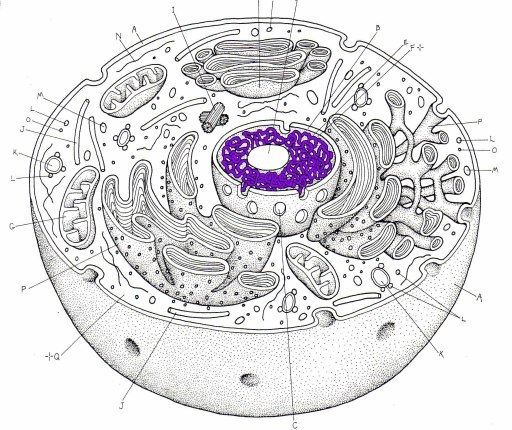
What type of cell is this?

a)

Plant

b)

Animal

c)

Eukaryote

d)

Prokaryote

85.
What kind of cell is this?
a)
Eukaryotic
b)
Prokaryotic
86.
Using this dichotomous key, identify the name of the circled Fish, J.
a)
peacock flounder
b)
band-tail puffer
c)
trumpet fish
d)
spotted goat fish
87.
Which type of cell is not eukaryotic?
a)
plant
b)
animal
c)
bacteria 
d)
they all are
88.
Which type of cell is not eukaryotic?
a)
plant
b)
animal
c)
bacteria 
d)
they all are