
 Worksheets
Constitution Review
Total questions: 154
Worksheet time: 1hrs 26mins
Use the word bank (Articles of Confederation; Bill of Rights; State constitutions; Northwest Ordinance; Northwest Territory) to choose the best term that completes the statement: The _____ limited the power of the governors because the people did not want to repeat the problems that had caused the Revolution.
Articles of Confederation
Bill of Rights
State constitutions
Northwest Ordinance
Northwest Territory
Use the word bank (tax; regulate trade; Northwest Territory; Bill of Rights) to select the pair of powers that Congress was denied under the Articles of Confederation.
to tax and to regulate trade
to tax and to control the Northwest Territory
to regulate trade and to create a Bill of Rights
to regulate trade and to declare war
Use the word bank (Articles of Confederation; Bill of Rights; State constitutions; Northwest Ordinance; Northwest Territory) to choose the best term that completes the statement: The _____ of 1787 provided a system for a territory to become a state.
Articles of Confederation
Bill of Rights
State constitutions
Northwest Ordinance
Northwest Territory
Use the word bank (Articles of Confederation; Bill of Rights; State constitutions; Northwest Ordinance; Northwest Territory) to choose the best term that completes the statement: Because of the weakness of the central government, British troops still held forts in the _____.
Articles of Confederation
Bill of Rights
State constitutions
Northwest Ordinance
Northwest Territory

Read the quotation and answer the question. Noah Webster, New England schoolteacher: “So long as any individual state has the power to defeat the measures of the other twelve, our pretended union is but a name.” Which statement best reflects Noah Webster’s position in the above quotation?
Smaller states have more power than larger states.
States should have the right to ignore national legislation.
States in the same region can form alliances to defeat actions of other regions.
Individual states have too much power to form a true union.
Besides representation, what other major issue required delegates to compromise during the Constitutional Convention?
Writing an introduction to the Constitution
Continuing the slave trade
Choosing the person who led the executive branch
Giving free African Americans the right to vote
The opening phrase of the Constitution, “We, the people,” means that the Constitution gets its authority from the
Executive branch
State legislatures
citizens
Congress

Use the flow chart and your knowledge of Social Studies to answer: Shays’ Rebellion helped to persuade
Congress to give itself greater power to tax citizens.
Government leaders to revise the Articles of Confederation.
State governments to print more money.
The central government to pass new land ordinances.
Use the flow chart and your knowledge of Social Studies to answer: Which event belongs in Box 5?
Shays’ army attacks the state militia.
Massachusetts’ leaders lower taxes on farmers.
Shays is invited to attend the upcoming convention in Philadelphia.
The Massachusetts militia arrests Shays and other leaders.
Refer to the Virginia Plan vs. New Jersey Plan diagram. Smaller states opposed the Virginia Plan because they
Feared they would not have enough power in the new Congress
Preferred to keep the Articles of Confederation
Wanted a weak executive
Disliked James Madison
What is one reason many people called for changes to the Articles of Confederation?
They opposed the Northwest Ordinance
They wanted a plan of government made up of two branches
They believed that a weak central government was ineffective
They thought the state governments were too weak
Why did some people oppose ratification of the Constitution?
It did not include protection of individual rights.
It eliminated state governments.
It made slavery illegal.
It failed to include checks and balances.
How did Shays’ Rebellion encourage people to push for a plan to revise the Articles of Confederation?
It made people worry about how a weak central government might respond to future rebellions.
It encouraged farmers to petition state governments for economic relief.
It gave members of the rebellion more political power.
It convinced leaders of the importance of individual rights and freedom of speech.
What did most state constitutions have that the original United States Constitution did not have?
Bill of Rights
Legislature
power to declare war
power to make laws
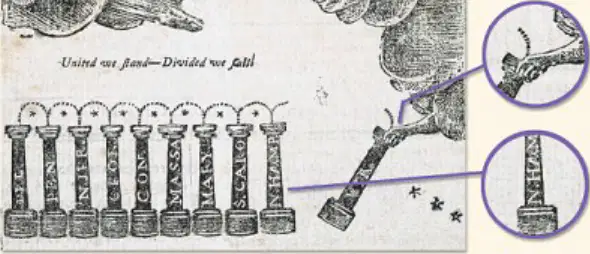
Which political argument is supported in the cartoon?
The Constitution balances the three branches of the federal government.
In order for the Union to last, the states must form a strong federal government.
The states will be weakened if the Constitution is ratified.
Virginia should leave the union.
Under the Bill of Rights, which of the following is NOT protected?
Freedom of speech
Freedom of the military
freedom of religion
freedom of the press
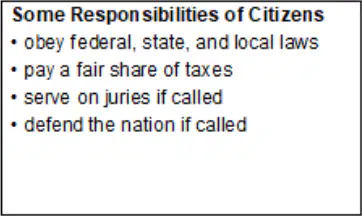
Refer to the boxes labeled Some Rights of Citizens and Some Responsibilities of Citizens. Which of the following could be considered a responsibility of citizens?
To petition the government for lower taxes
To attend weekly religious services
To vote in elections
To attend adult education courses to get a diploma
As part of the Great Compromise, what fraction of the enslaved people in a state were included when determining representation in Congress?
One-quarter
One-half
three-fifths
two-thirds
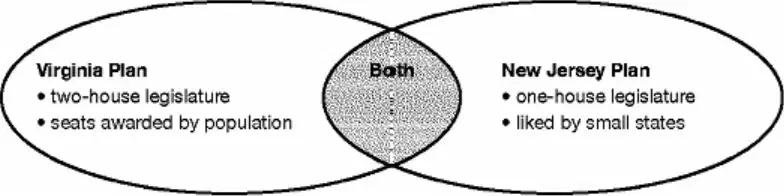
Use the Venn diagram comparing the Virginia Plan and the New Jersey Plan to answer: Which of these resolved the conflict between the two plans of government shown in the diagram?
The Great Compromise
The Articles of Confederation
the Bill of Rights
the Northwest Ordinance
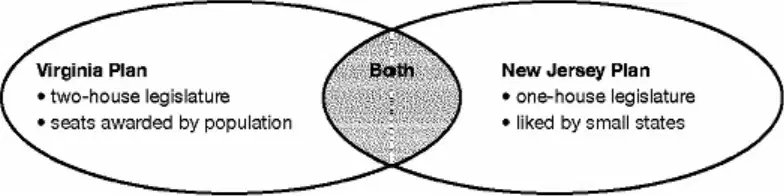
Use the Venn diagram comparing the Virginia Plan and the New Jersey Plan to answer: Which of these could appear under the New Jersey Plan in the diagram?
No executive branch of government
One vote per state
no judicial branch of government
one branch of government
Which of the following was one reason that trade between the states was difficult under the Articles of Confederation?
The nation was at war with Great Britain
The nation had no common national currency (money)
The nation was in the middle of a depression
The nation could not use the Mississippi River
Match each government term to its definition.
System of courts
Judicial branch
Agreement in which each side gives up some demands
Compromise
To approve a document
Ratify
Rules under which a government will operate
Constitution
Person in government who carries out laws
Executive
Which Amendment bans cruel and unusual punishments?
First Amendment
Fifth Amendment
Eighth Amendment
Tenth Amendment
Which Amendment states that you do not have to testify against yourself, requires states to compensate for eminent domain, and protects against double jeopardy?
Fourth Amendment
Fifth Amendment
Sixth Amendment
Ninth Amendment
Which Amendment includes the freedoms of speech, religion, press, assembly, and petition?
First Amendment
Second Amendment
Third Amendment
Fourth Amendment
Which Amendment protects against search and seizure without a warrant from the court?
Second Amendment
Fourth Amendment
Sixth Amendment
Tenth Amendment
Which Amendment states that citizens may bear arms as part of a well-regulated militia?
First Amendment
Second Amendment
Third Amendment
Ninth Amendment
Which Amendment guarantees that civil trials can have a jury?
Fourth Amendment
Sixth Amendment
Seventh Amendment
Tenth Amendment
Which Amendment gives citizens the right to confront their accusers and have a lawyer?
Fifth Amendment
Sixth Amendment
Seventh Amendment
Eighth Amendment
Which Amendment states that powers not given specifically to the federal government belong to the states or to the people?
First Amendment
Fourth Amendment
Tenth Amendment
Ninth Amendment
Which Amendment forbids quartering troops in private homes during peacetime?
First Amendment
Third Amendment
Seventh Amendment
Eighth Amendment
After a change to the constitution has been proposed by 2/3 of both Houses of Congress, what fraction of the state legislatures must ratify (approve) the amendment before it is added to the U.S. Constitution?
2/3
1/2
3/4
1/3
What fraction of the House of Representatives and Senate must pass a proposed amendment before it goes to the state legislatures for ratification?
2/3
3/4
1/2
1/4

Which amendment is represented in the picture?
19th
24th
26th
15th

Which amendment is represented in the picture?
15th
19th
23rd
26th
It is difficult to amend the constitution because the framers wanted to make sure _____.
changes were only made when absolutely necessary
no one ever changed the Constitution
hardly anyone got a say
the President got all the say
Changed the voting age from 21 to 18 years of age.
15th Amendment
26th Amendment
23rd Amendment
24th Amendment
Gave citizens who live in Washington, DC the right to vote in presidential elections.
15th Amendment
16th Amendment
24th Amendment
23rd Amendment
Gave citizens the right to vote regardless of race, color, or previous conditions of servitude.
23rd Amendment
24th Amendment
15th Amendment
19th Amendment
Gave women the right to vote
19th Amendment
15th Amendment
23rd Amendment
26th Amendment
Made charging a poll tax to vote illegal.
23rd Amendment
24th Amendment
18th Amendment
15th Amendment
Allows citizens to have the right to
speak
Freedom of Assembly
Freedom of Press
Freedom of Religion
Freedom of Speech
Right to Petition
Allows citizens to worship freely
Freedom of Assembly
Freedom of Press
Freedom of Religion
Freedom of Speech
Right to Petition
gives citizens the right to access different sources of information or broadcasts
Freedom of Assembly
Freedom of Press
Freedom of Religion
Freedom of Speech
Right to Petition
gives citizens the right to formally ask for government changes
Freedom of Assembly
Freedom of Press
Freedom of Religion
Freedom of Speech
Right to Petition
gives citizens the right to gather in groups
Freedom of Assembly
Freedom of Press
Freedom of Religion
Freedom of Speech
Right to Petition
Which two amendments declare that no person can be deprived "of life, liberty, or property without due process of law”?
5th Amendment
14th Amendment
15th Amendment
19th Amendment
23rd Amendment
Freedom of speech, press, petition, religion, and assembly.
Amendment 1
Amendment 2
Amendment 3
Amendment 4
Right to bear Arms
Amendment 5
Amendment 8
Amendment 2
Amendment 4
Troops could not be lodged in private (citizen owned) homes
Amendment 1
Amendment 10
Amendment 19
Amendment 3
No search and seizure of people, property, or homes unless a warrant is issued with probable cause.
Amendment 19
Amendment 4
Amendment 7
Amendment 10
A person cannot be tried or act as a witness against oneself and cannot be tried for the same crime twice.
Amendment 4
Amendment 18
Amendment 5
Amendment 21
The right to a public and speedy trial by a jury of their peers.
Amendment 7
Amendment 6
Amendment 8
Amendment 15
Right to a civil trial where the value of the assest exceeds $20.
Amendment 7
Amendment 8
Amendment 25
Amendment 17
No excessive bails, no excessive fines, and no cruel and unusual punishments.
Amendment 18
Amendment 21
Amendment 8
Amendment 9
Implied powers to the people not stated in the Constitution (just because its not stated doesn't mean we do not have that right.)
Amendment 9
Amendment 10
Amendment 21
Amendment 27
Powers not stated in the Constitution are left for the states to determine.
Amendment 9
Amendment 10
Amendment 13
Amendment 21
Which Amendments were passed as a result of the Civil War
13-15
1-10
18-21
The 13th Amendment ended which practice in the United States
Slavery
Women's Suffrage
Poll Tax
Government Tyranny
Which Amendments are known as the Bill of Rights
1-10
13-15
18-21
11-19
Which amendment guarantees citizenship to a person born in the United States?
Amendment 13
Amendment 19
Amendment 14
Amendment 1
Which Amendment states voting cannot be discriminated against based on a person's race or background?
Amendment 13
Amendment 19
Amendment 9
Amendment 15
Which Amendment prohibited the consumption of Alcohol?
Amendment 19
Amendment 21
Amendment 18
Amendment 10
Which Amendment granted women the right to vote?
Amendment 19
Amendment 1
Amendment 9
Amendment 21
Which Amendment repealed the 18th Amendment
Amendment 21
Amendment 20
Amendment 19
Amendment 22
Which Amendment limited the number of terms an individual can be President?
Amendment 22
Amendment 21
Amendment 27
Amendment 10
How many Amendments are there to the Constitution?
26
30
27
28

What was America's first Constitution?
The Declaration of Independence
The Bill of Rights
The Articles of Confederation
The US Constitution

According to the idea of Popular Sovereignty, who has the power?
The President of the United States
The Supreme Court
The Senate
The people

What is the name of the current President of the United States?
George Bush
Barack Obama
Joe Biden
Donald Trump

Who was Daniel Shays?
The President of the Proclamation of 1763
A farmer who loved his country and never did anything illegal
A founding father
A farmer who led a revolt in Massachusetts

Which branch of government was included in the Articles of Confederation?
The Legislative branch
The Executive branch
The Federal
The Judicial

What is a Constitution?
A former plan for government
A formal plan of government
A formal pair of shoes
A formal plan of action

The idea that a group of states would be held under a federal government?
Articles of Consideration
Declaration of Dependence
The US Constitution
Federalism

Under the Articles of Confederation, how many states had to agree to approve a law?
3/13
7/13
9/13
12/13

Which was NOT a power of Congress under the Articles of Confederations?
Raising an army
Dealing with foreign countries
Issuing taxes
Printing money

What diplomatic problem was America having with England under the Articles of Confederation?
The British kept American merchants out of the West Indies
The British loyalists were owed money from the American government.
The British would not leave valuable forts in the Great Lakes Region
All of the above

What officially ended the American Revolutionary War?
The Treaty of Paris
The Declaration of Independence
The Stamp Act
The Treaty of America

What was the biggest weakness of the Articles of Confederation that lead to problems with Britain?
They could not tax
States were not required to meet military quotas
They could not deal with foreign governments
None of the above

What diplomatic problems was America having with Spain under the Articles of Confederation?
The Spanish kept American merchants out of the West Indies
The Spanish taxed the Americans
The Spanish closed off the Mississippi River to American trades
The Spanish were actually the French in disguise
The national government under the Articles of Confederation...
Was very strong
Was very weak
_______ had the ability to tax citizens under the Articles of Confederation.
The Federal Government
The courts
State governments
The British
One of the biggest problems facing the US after the Revolution was...
George Washington's retirement
The huge amount of debt the country had
The British dragging their feet to sign the Treaty of Paris
The number of people still loyal to the king
Many veterans (soldiers who fought in the Revolution) were angry because...
They weren't allowed to keep their weapons
They weren't given much credit for their win
They did not believe the war ended fairly
They didn't get paid for their service
How could the national government get money under the Articles of Confederation?
By taxing citizens
By trading with Native Americans
By asking states for donations
Were states interested in giving donations to the national government to help pay off debt?
Yes
No
States were able to have militias. Who was responsible for training and funding the militias?
The national government
State governments
Were state governments allowed to tax citizens of their state under the Articles of Confederation?
Yes
No
Why did Daniel Webster called the Articles of Confederation "a cobweb?"
It would not be able to survive any pressure (problems) because it was so weak
It was made by men who could not be trusted
It was very similar to the British system and would only lead to tyranny
It was very complicated and put together in a way that gave the states lots of support
Why were farmers in Massachusetts so upset in 1786 and 1787?
The US was getting ready to go to war with France and they'd have to be soldiers again
The national government kept raising taxes on farmers to pay off the war debt
They were losing their farms because they could not afford the taxes on them
No one would buy their crops because they were over priced
What is one reason the farmers in Massachusetts could not afford to pay the taxes on their farms?
There was a drought that ruined their crops
Most were soldiers who'd never been paid of their service
People were not interested in buying the crops they were selling
Who was Daniel Shays?
A former soldier and farmer who was worried about losing his farm, so he started a rebellion
A tax collector from Massachusetts who had to go and collect money from the poor
He was the Governor of Massachusetts at the time of a huge rebellion by farmers
What did Daniel Shays' and his men do?
Burned down government buildings all over Massachusetts
Took over courthouses to stop the courts from meeting
Paid Native Americans to raid the houses of the wealthy and powerful
Challenged the US military to a battle
How long did the rebellion last?
3 days
5 days
10 days
20 days
Why didn't the Articles of Confederation stop the rebellion sooner?
They were afraid of the militia and didn't want to make it worse
The militia was too well trained and had the support for the French military
They didn't have a military or the authority to stop it
They didn't want it to end, they supported what Shays and is men were doing
How was the rebellion eventually stopped?
Other states, like Maryland, sent in militias to stop the rebellion in Massachusetts
The French stepped in on the side of the US to stop the rebellion
Shays and his men got tired and gave up
The president ordered the US military to Massachusetts to stop rebellion
Did Shays' and his men believe their rebellion was successful?
Yes
No
What happened to Shays and his men once the rebellion was stopped?
They were immediately forgiven
They left the US and went to Canada
They were put on trial and found guilty, so they fled
They surrendered to the US army
What did Shays' rebellion reveal about the Articles of Confederation?
That it was too similar to the British system
That it was too weak to succeed
That it was strong and resilient
That it was a successful model of government
In the fall of 1787, because of Shays' Rebellion, what did government leaders do?
They decided Massachusetts couldn't be a state anymore
They allowed all the states to become independent countries
They met in Philadelphia to fix the Articles of Confederation
They switched to a French model of government
What are the Articles of Confederation?
The name of the first system of government used by the United States
The name of the peace treaty between Great Britain and the United States
The name of one of the first newspapers in the United States
The name of the first Congressional meeting
Why did the authors of the Articles of Confederation create such a weak national government?
They did not understand how to create a strong national government.
They wanted to avoid creating a dictatorship or monarchy where states were told what to do by a larger national power.
They wanted to make it easier for citizens to rebel when they were upset at the government.
All of the above.
What were some of the weaknesses of the Articles of Confederation government? Select all that apply:
No chief executive (president)
All laws had to be passed by a basic majority vote
No national court system
No Congress
What weakness of the Articles of Confederation contributed to Shays' Rebellion? Select all that apply:
The U.S. couldn't tax citizens.
There was no national currency.
There was no president.
There was no national army.
Why were many farmers poor and in debt in Massachusetts?
They lost money trying to convert their currency between states.
They were not paid for their service as soldiers in the Revolutionary War.
They had to pay too much money in national taxes.
They had large medical bills to pay after the Revolutionary War.
What did Massachusetts courts do when farmers could not pay their debts in gold or silver?
They forced the farmers to become soldiers.
They made the farmers into slaves.
They sentenced the farmers to death.
They seized and sold farmers' land, livestock, and crops.
How many farmers were involved in Shays' Rebellion?
100,000
1,500
2,000
10,000
What did the army of farmers do during Shays' Rebellion? Select all that apply.
They threw British tea into Boston Harbor.
They freed inmates from debtors' prison.
They tarred and feathered tax collectors.
How long did Shays' Rebellion last?
One year
A year and a half
Two years
Six months
What happened as a result of Shays' Rebellion?
A national army was immediately created through a unanimous vote in Congress.
The Constitutional Convention meeting was called to discuss the weaknesses of the Articles of Confederation.
Massachusetts changed its laws so that farmers would not have their land seized.
Revolutionary War veterans were finally paid for their service.
Executive (carries out the laws) President
Judicial (interprets the laws) Supreme Court and lower courts
Popular Sovereignty
Judicial Review
Government officials are limited to only certain powers as stated in the Constitution.
Our government gains its power from consent of the people.
Popular Sovereignty
Limited Government
Checks and Balances

The power of a court to determine the constitutionality government actions is an example of:
Judicial Review
Federalism
Implied Powers
The first three words of the constitution are "we the people." Which constitutional principle does this reflect?
Popular Sovereignty
Judicial Review
Separation of Powers
Checks and Balances
government is not ALL powerful to what it wants
limited government
separation of powres
checks and balances
federalism
national and state government share power
separation of power
checks and balances
federalism
limited government
Which of the following is the best definition of Popular Sovereignty
The people hold the power in the government
Powers are divided and shared between the national government and the states
Powers are divided between 3 branches of government
The people must approve of the governments actions
The sharing of powers between the federal, state and local governments
Federalism
Republicanism
Checks and Balances
Separation of Powers

When the Congress disagrees with a law the President is trying to pass they can veto the law. This action is an example of...
Checks and balances
Separation of powers
Individual rights
When a powerful Senator is pulled over for speeding he too will receive a ticket. This is an example of ...
individual rights
federalism
limited government
The government has only the powers that the Constitution gives to it
Federalism
Limited Government
States' Rights
- Congress-legislative branch makes laws.
- President-executive branch carries out the laws.
- Courts-judicial branch explains and interprets the laws.
Checks and Balances
Separation of Powers
Federalism

