
 Worksheets
Unit 5 Heredity Test Review
Total questions: 70
Worksheet time: 1hrs 12mins
The form of a gene that is always expressed if present is the _______ form.
recessive
dominant
homologous
heterozygous
Which of Mendel’s laws BEST explains why an organism with a heterozygous genotype will show a dominant phenotype?
A. Law of Dominance
B. Law of Segregation
C. Law of Independent Assortment
D. Chromosome Theory of Inheritance
Two parents have the genotype Gg for a genetic disorder caused by a recessive allele. What is the chance that any of their children will inherit the disorder?
25%
50%
75%
100%
Which of Mendel’s laws states that organisms inherit two copies of each gene and donate one copy to each of their offspring?
Law of Dominance
Law of Segregation
Law of Independent Assortment
Chromosome Theory of Inheritance
In pigs, the allele for a wavy, rough coat (R) is dominant to the allele for a soft, fine coat (r). A rough coat boar and a soft coat sow mate. They produce several litters, 50% are rough coat and 50% are smooth coat. What must be the genotypes of the parents to create this phenotypic ratio?
Homozygous dominant and homozygous recessive
Heterozygous and homozygous recessive
Homozygous dominant and heterozygous
Both heterozygous
If two parents with dominant phenotypes produce an offspring with a recessive phenotype, then probably
one parent is homozygous recessive.
only one parent is heterozygous.
both parents are homozygous dominant.
both parents are homozygous recessive.
both parents are heterozygous.
Given a dihybrid cross for a plant, where P (purple) is dominant to p (white) and S (spherical seeds) is dominant to s (dented seeds), what is the predicted phenotypic ratios if two plants are mated that are both heterozygous for both traits?
1 purple, spherical: 1 purple, dented: 1 white, spherical: 1 white, dented
8 purple, spherical: 8 purple, dented: 0 white, spherical: 0 white, dented
9 purple, spherical: 3 purple, dented: 3 white, spherical: 1 white, dented
The American Curl is a breed of cat that has curly ears. The allele for the curly ears is dominant (E). Suppose a cat with the heterozygous genotype is bred to a female cat with the homozygous recessive genotype. What is the expected number of kittens with curly ears if the cross produces six kittens?
2 kittens
3 kittens
4 kittens
6 kittens
For an XX female to express a recessive sex-linked trait, she must have ____________.
A. a Y chromosome
B. one recessive allele
C. two recessive alleles
D. two dominant alleles
Human height occurs in a continuous range because it is affected by the interaction of many genes, making it a(n)
autosomal trait.
sex-linked trait.
polygenic trait.
codominant trait.
Red hair and freckles are commonly inherited together. Which of following patterns of inheritance explains this?
Linked genes
Multiple alleles
Sex-linked
Codominance
In a newly discovered species of flower, it was discovered that the color of the flowers is determined by two different genes. Which of the following inheritance patterns is this?
Multiple alleles
Incomplete dominance
Linked genes
Polygenic inheritance
What is the main reason that sex-linked disorders are most often observed in males?
The X chromosome only has genes for genetic disorders.
The Y chromosome cannot have genes that cause genetic disorders.
The Y chromosome cannot mask alleles on the X chromosome.
The X chromosome has genes only for sex determination.
A man with Type A blood marries a woman with Type AB blood. Based on what you know about blood types, which blood type is NOT possible in any of their children?
Type O
Type A
Type B
Type AB
A man who is normal for color vision marries a woman who is colorblind. What is the probability of having a colorblind male? Show a Punnett square to support your answer.
25%
50%
0%
100%
In order for a mutation to be passed on from parent to offspring, the mutation must occur in
somatic cells.
gametes.
brain cells.
any cell of the body.
On a pedigree, how would a female individual with a disease be notated?
As a shaded circle
As an unshaded circle
As a shaded square
As an unshaded square
If a child has Tay Sach's disease, what would her parents' genotypes have to be?
Her father is homozygous dominant; her mother is homozygous recessive.
Her father is heterozygous; her mother is homozygous dominant.
Her father is homozygous dominant; her mother is homozygous dominant.
Her father is heterozygous; her mother is heterozygous.
If a mutation only changes the nucleotide sequence for a single protein, then it is known as a
gene mutation.
chromosomal mutation.
translocation.
nondisjunction mutation.
What kind of mutation occurred in the sex chromosome of an individual with the genotype XXY?
Nucleotide deletion
Translocation
Nucleotide insertion
Nondisjunction
How would you categorize a genetic disorder that is equally likely in males and females and is caused by the presence of two affected alleles?
Autosomal recessive disorder
Sex-linked disorder
Autosomal dominant disorder
Sex chromosome disorder
When getting an X-ray taken at the doctor's office, you notice the technician cover you with a heavy vest. This vest, you are told, contains lead, a metal that can block X-rays, which are a form of radiation. The technician covers your torso, and folds the vest over double across your reproductive organs (testes/ovaries). This is done because radiation can damage the DNA of these organs, causing a mutation you may pass to children. Substances like radiation and other certain chemicals are known as mutagens because
they cause cancer.
they cause mutations in the sequence of DNA.
they generate muteness.
they damage proteins, which then changes the sequence of DNA.
Nondisjunction of autosomal chromosomes, such as chromosome number 21, can result in disorders like
Down syndrome
Klinefelter’s syndrome
Turner’s syndrome
Sickle-cell anemia
Explain the difference between gene mutations and chromosome mutations, and give an example of a genetic disorder caused by each.
Gene mutations affect individual genes, while chromosome mutations affect entire chromosomes; cystic fibrosis is caused by a gene mutation, and Down syndrome is caused by a chromosome mutation.
Gene mutations affect entire chromosomes, while chromosome mutations affect individual genes; Down syndrome is caused by a gene mutation, and cystic fibrosis is caused by a chromosome mutation.
Gene mutations and chromosome mutations both affect entire chromosomes; cystic fibrosis and Down syndrome are both caused by chromosome mutations.
Gene mutations and chromosome mutations both affect individual genes; cystic fibrosis and Down syndrome are both caused by gene mutations.
Selective breeding produces ________.
more offspring
less offspring
transgenic offspring
desired traits in offspring
The goal of the Human Genome Project was to
create maps showing where genes are located on human chromosomes.
create maps showing where chromosomes are located on human genes.
treat patients with genetic diseases.
identify people with genetic diseases.
A technique that allows engineers to artificially amplify a section of DNA by copying it over and over again in a lab is known as ________.
Polymerase chain reaction
Personal genome sequencing
Recombinant DNA
Gene therapy
Which of the following lists two positive and two negative societal implications of genetic engineering for society?
Positive: Improved disease resistance, increased food production; Negative: Ethical concerns, potential loss of biodiversity.
Positive: Increased pollution, higher food prices; Negative: Improved health, more job opportunities.
Positive: Reduced crop yields, increased allergies; Negative: Better nutrition, more efficient farming.
Positive: Less food security, more pests; Negative: Enhanced crop quality, reduced malnutrition.
Name two examples of biotechnology and genetic engineering and describe them.
Genetically modified crops and insulin production: GM crops are engineered for traits like pest resistance, and insulin is produced using genetically modified bacteria.
Cloning and photosynthesis: Cloning is a natural process in plants, and photosynthesis is how plants make food.
Vaccination and fermentation: Vaccination is a medical procedure, and fermentation is a chemical process in food production.
Antibiotic resistance and cell division: Antibiotic resistance is a health issue, and cell division is a basic biological process.
During interphase a cell grows, duplicates organelles, and _____________.
copies DNA.
divides the cytoplasm.
divides the nucleus.
produces a new cell.
Two chromosomes containing the same types of genes that you inherit from your parents (one from mom and one from dad) are called _____________.
homologous chromosomes
sex chromosomes
sister chromatids
homozygous alleles
Which organelle supplies energy in a usable form to the cell?
ribosomes
vacuoles
mitochondria
centrosomes
Which organelle would make restriction enzymes for cutting DNA into fragments?
ribosomes
vacuoles
mitochondria
centrosomes
Plants are able to absorb sunlight and because they have a pigment called _______________. They can then convert solar energy to chemical energy in the form of _____________.
glucose; chlorophyll
glucose; ATP
chlorophyll; glucose
ATP; chlorophyll
Explain the difference between a mistake made in mitosis and a mistake made in meiosis.
A mistake in mitosis affects somatic cells, while a mistake in meiosis affects gametes.
A mistake in mitosis only occurs in plants, while a mistake in meiosis only occurs in animals.
A mistake in mitosis leads to genetic diversity, while a mistake in meiosis leads to cancer.
A mistake in mitosis always results in twins, while a mistake in meiosis always results in triplets.


How many alleles does a person carry for a trait?
1
2
3
4
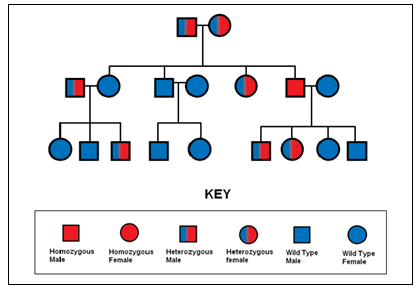
In a pedigree, which shape represents a male?
circle
square

On a pedigree, this symbol represents a ---
not affected female.
not affected male.
affected male.
affected female.

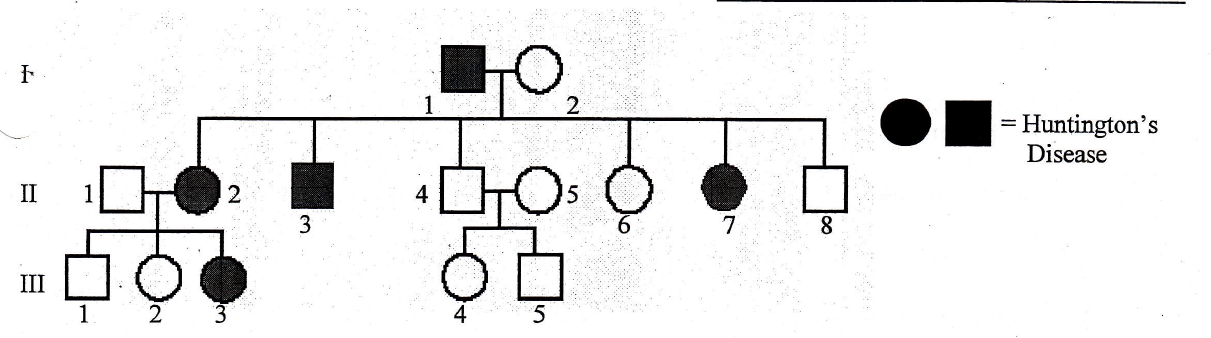
How many individuals are there in the 3rd generation?
1
2
4
6

How are individuals III-2 and II-4 related?
Brother and sister
Dad and daughter
Uncle and niece
Grandfather and granddaughter

The trait this pedigree traces is recessive because it skips a generation and individuals can be carriers. What is the most likely genotype for person III-3?
GG
Gg
gg

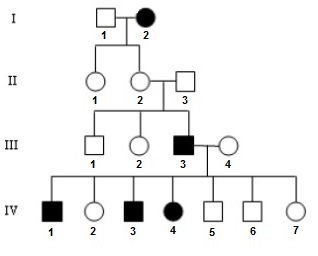
If this pedigree shows a recessive disorder, what MUST the genotype of individual 4 be?
HH
Hh
hh

Cystic fibrosis is an autosomal recessive disorder in humans. What is the probability that an offspring will have cystic fibrosis if both parents are carriers of cystic fibrosis?
25%
50%
75%
100%

What goes in box 3
Aabb
AABB
AAbb
aaBb


This type of inheritance pattern is a MIXTURE of two traits. This is known as ---
incomplete dominance.
codominance
Red is incompletely dominant to white in snapdragons. Which cross would result in 100% pink flowers?
RR x rr
rr x rr
Rr x Rr
RR x RR
In humans, curly hair is dominant to straight hair, and wavy hair is an intermediate texture. Which explanation most likely accounts for wavy hair?
a mutation occurred, producing wavy hair
a different set of genes resulted in wavy hair
inheritance occurred through incomplete dominance
inheritance occurred as a result of a gene from only one parent
In a certain breed of cattle, both red and white hairs show up together. This is an example of which type of inheritance pattern?
incomplete dominance
codominance
multiple alleles
polygenic inheritance
What is name for traits that are controlled by many genes such as height and skin color?
complete dominance
incomplete dominance
co dominance
polygenic
multiple alleles
What are the genotypes for type A blood?
IAIA
IAIB
IAi
IBIB
ii
A child has blood type AB. Which blood types would his parents most likely have?
B and O
O and A
A and B
AB and O
Which could NOT result from a cross between IAIB and IAi?
Type A Blood
Type B Blood
Type AB Blood
Type O Blood


This is an example of ---
Incomplete dominance
Codominance

Incomplete dominance occurs in cats, which allows them to be Black, White, or gray as shown on this Punnett square. What percentage of the offspring will be black?
25
50
75
100



