
Font size
 Worksheets
OSE 7.2 TEST PRACTICE - thermal energy
Total questions: 60
Worksheet time: 58mins
Things the design needs to do in order to be successful
Good directions
Money
Criteria
Constraints
Limitations on the design (rules to adhere to)
Suggestions
Reactions
Criteria
Constraints
Process that changes one set of chemicals into another set of chemicals
Chemical reaction
Physical change
Combination
Energy transfer
A reaction that releases energy in the form of heat
Baking soda and vinegar
Neutral reaction
Endothermic reaction
Exothermic reaction
A reaction in which energy is absorbed (the reaction feels cold)
particle change
exothermic reaction
phase change
endothermic reaction
A measure of the average energy of motion of the particles of a substance
phase change
constraints
temperature
endothermic reaction
Movement of energy from one particle to another
endothermic reaction
exothermic reaction
energy transfer
criteria
What do the particles of substances do in a chemical reaction?
they stay the same
they create completely different elements
they break apart and reform as new substances
there are no particles
What is a stakeholder?
people who are interested in building things, like designers
any group or individual who is affected by the decisions of the engineer/designer
a person who cooks food like steaks
someone who hands out money like a bank
What is an exothermic reaction?
releases energy and feels hot to the touch
absorbs energy and feels cool to the touch
releases energy and feels cool to the touch
absorbs energy and feels hot to the touch
What is an endothermic reaction?
releases energy and feels hot to the touch
absorbs energy and feels cool to the touch
releases energy and feels cool to the touch
absorbs energy and feels hot to the touch

How many atoms of sodium are in this molecule?
3
6
5
0

What is this in molecular formula?
3water
3H₂O
H3O3
3O6H
Matter cannot be _____ or ______.
created, destroyed
changed, destroyed
energy, changed
flipped, flopped
Why is it important to identify the criteria and constraints of a project before building and testing a prototype?
So that the prototype will be the right size
so that you do not go over budget
so that it will solve the problem
All of the above
If the same amount of energy is transferred but there is more food in the system, what would happen to the temperature?
The temperature change would be less.
The temperature would increase more.
The temperature would stay the same.
The temperature would decrease.
Which factors affect the energy transfer in a chemical reaction?
The number of reactants used.
The color of the reactants.
The shape of the container.
The time of day the reaction is performed.
What happens to particles when the temperature increases?
Particles move faster.
Particles stop moving.
Particles shrink.
Particles combine.
How can the energy transfer between a reaction system and its surroundings be visually represented in a model?
By using arrows to indicate direction and thickness of arrows to show the amount of energy transferred
By using different colors to represent heat and cold zones only
By drawing circles around the reaction system
By labeling each molecule with its energy value
What is one way a model can show that a chemical reaction has taken place?
The arrangement of atoms in the reactants is different than in the products
The temperature of the surroundings remains constant
The amount of energy in the system decreases with more reactants
The mass of the reactants is the same as the products
Are equal proportions of reactants the best combination to use?
No; different proportions may yield better heat
Yes, because it produces consistent results
Maybe; but it doesn’t really matter
Unsure; the size of the container matters more
Conduction is...
heat transfer through liquids and gasses (forms a current).
heat transfer through touch.
used in a microwave.
used in an oven.
Convection is...
heat transfer through liquids and gasses (forms a current).
heat transfer through touch.
used in an oven.
Radiation is...
heat transfer through touch.
heat transfer through liquids and gasses (forms a current).
felt by touch.
felt next to a fire.

Food being heated from touching a hot pan.
conduction
convection
radiation

Food being heated in a microwave.
conduction
convection
radiation

Hot air making a hot air balloon rise.
conduction
convection
radiation

Heat from standing next to a fire.
conduction
convection
radiation

Egg cooking from the heat of the sidewalk.
conduction
convection
radiation
Two atoms stuck together would be called...
A team
A molecule
A chemical
A duet

Look at the picture. How many atoms do you see?
3 atoms
6 atoms

Look at the picture. How many molecules do you see?
3 molecules
6 molecules

Look at the picture. This is a molecule of ammonia, which we use for cleaning. How many individual atoms are in it?
One
Two
Three
Four
Water is clear, wet, and easy to pour. These are its...
Matter
Properties
Atoms
Mixture
How many atoms are in O2 ?
1
2
3
How many atoms of each element are in NaCl?
Na=1, Cl=1
Na=2. Cl=2
Na=1, Cl-2
C12H22O11 has how many carbon atoms?
1
11
12
45
4 NaCl represents several molecules of table salt. How many atoms of chlorine are present in this example?
1
4
8
2 H2O gives us life! How many total atoms are represented here?
2
4
6

Which is the correct formula for:
three hydrogen (H), one sulfur (S), four oxygen (O)?
H3SO4
HSO4
H4S3O
H2O
What is a coefficient?
Big number to the right of the chemical formula
Indicates how many molecules are represented; multiplies by every atom involved
The small number to the right of the element; indicates how many atoms of that element there are
Find one equivalent ratio for 5 : 8
10 : 24
15 : 24
15 : 16
What does Rxn mean?
Reaction
Product
Medicine
None of these
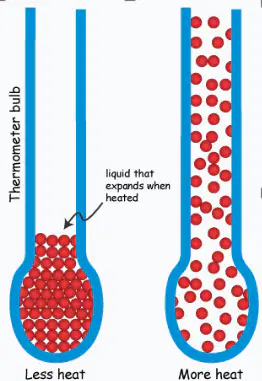
A student places a thermometer into a beaker where a chemical reaction is happening. After a few minutes, the student notices the level of liquid in the thermometer rises. What does this observation tell you about the reaction?
The reaction is endothermic because it absorbs heat from the thermometer, causing the thermometer liquid to warm up and rise.
The reaction is exothermic because it releases heat into the thermometer, causing the thermometer liquid to warm up and rise.
The reaction is endothermic because it releases heat into the thermometer, causing the thermometer liquid to warm up and rise.
The reaction is exothermic because it absorbs heat from the thermometer, causing the thermometer liquid to cool down and fall.
In a ____ RXN, the thermometer ___.
Exothermic RXN
gets hot
Endothermic RXN
gets cole
No RXN
stays the same
Very slow exothermic RXN
warms slowly
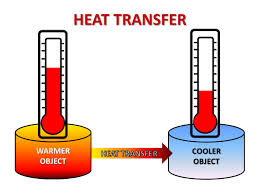

The diagram represents two solids and the temperature of each. What occurs when the two solids are placed in contact with each other?
Heat energy flows from solid A to solid B. Solid A decreases in temperature
Heat energy flows from solid A to solid B. Solid A increases in temperature
Heat energy flows from solid B to solid A. Solid B decreases in temperature.
Heat energy flows from solid B to solid A. Solid B increases in temperature.

Which state of matter has the most Potential Energy?
Solid
Liquid
Gas

Heat transfers until
one object is warmer
both objects are at equilibrium
both objects are the same temperature
one object loses all thermal energy

