
 Worksheets
6th Grade PMA 2 Review
Total questions: 80
Worksheet time: 1hrs 11mins
Which process transfers heat through direct contact between materials?
Convection
Radiation
Conduction
Evaporation
What is the main source of energy for weather patterns on Earth?
The Moon
The Sun
Earth's core
Ocean currents
Which of the following best describes kinetic energy?
Stored energy due to position
Energy of motion
Energy from the sun
Energy in food
Which sphere of the Earth contains all living things?
Atmosphere
Lithosphere
Biosphere
Hydrosphere
What is the difference between weather and climate?
Weather is long-term, climate is short-term
Weather is short-term, climate is long-term
Weather only happens at night
Climate changes every day
Which type of heat transfer occurs when warm air rises and cool air sinks?
Conduction
Convection
Radiation
Reflection
A ball is sitting at the top of a hill. What type of energy does it have, and what will happen to this energy as the ball rolls down?
Kinetic; it will turn into potential energy
Potential; it will turn into kinetic energy
Thermal; it will turn into chemical energy
Electrical; it will turn into sound energy
If the net force on an object is zero, what will happen to the object?
It will speed up
It will slow down
It will stay at rest or move at a constant speed
It will change direction
Which of the following is an example of energy transfer by radiation?
Boiling water in a pot
Feeling warmth from the Sun on your skin
Heating a pan on a stove
Stirring soup with a spoon
A student observes that after a rainstorm, the temperature drops and the sky becomes clear. Which Earth's spheres are interacting in this situation?
Biosphere and geosphere
Atmosphere and hydrosphere
Lithosphere and biosphere
Hydrosphere and geosphere
A box is pushed with a force of 10N to the right and a force of 4N to the left. What is the net force acting on the box, and in which direction?
6N to the right
14N to the right
6N to the left
14N to the left

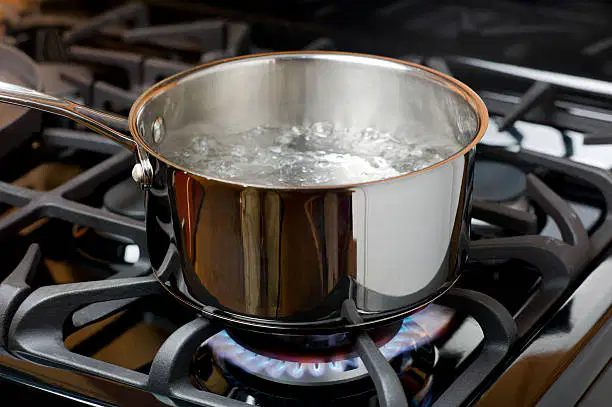
Look at the picture of a stove burner heating a pan on water. How is heat being transferred?
Convection from the burner to the pan and conduction through the air.
Conduction from the stove to the pan and convection through the water.
Radiation from the water to the pan and conduction from the burner to the water.
Radiation from the stove to the pan and convection through the pan.
Which statement best explains why air movement (wind) occurs on Earth?
The Sun heats Earth's atmosphere evenly.
The ocean heats faster than land during the day.
Radiation heats the ocean more than the land.
The Sun heats Earth's surfaces unevenly, causing air to move.
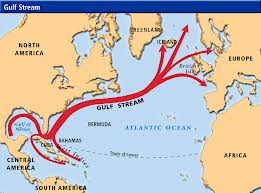
Which one is the transfer of heat through direct contact/touching?
Conduction
Convection
Radiation
Transpiration
Which one of these is the transfer of heat through our atmosphere due to the movement of liquids and gases?
Conduction
Convection
Radiation
Weathering

Sun burn is an example of....
Conduction
Convection
Radiation
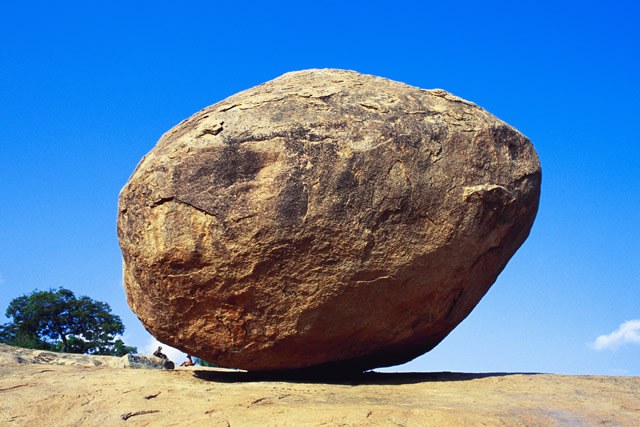
A huge boulder at the state park gets so hot during the day.
Convection
Conduction
Radiation
Temperatures in the Artic are usually below freezing year round.
weather
climate
James grabbed a rain coat before catching the school bus. It was already cloudy and the TV news reported that there would be rain all day long in Houston.
weather
climate
The highest recorded temperature for Austin, Texas is 112 degrees fahrenheit.
Weather
Climate
The average yearly rainfall in Hawaii is 78 inches.
Weather
Climate
It is usually raining in Seattle.
Weather
Climate
In a tropical rainforest it is very humid and rains almost every day.
Weather
Climate
Maria looked out her window and noticed it was a cloudy day.
Weather
Climate
What is weather?
Can change within a few minutes or hours!
Takes a very long time to change!
What is climate?
Can change within a few minutes or hours!
Takes a very long time to change!

The forces represented by the arrows in the diagrams are applied to the four objects that are at rest on a table. Which object is most likely to have the greatest net force?
Object W
5 Net Force
Object X
10 Net Force
Object Y
80 Net Force
Object Z
0 Net Force
Which of the following best describes normal force?
A. A pulling force that acts through ropes or strings
B. A pushing force that acts upward on objects resting on surfaces
C. A resistive force that slows motion between surfaces
D. A pulling force between two objects due to mass

Friction
NonContact
Contact
Gravitational
Contact
NonContact
Magnetic
Contact
NonContact
Air Resistance
Contact
Noncontact
Electrictial
NonContact
Contact
Applied Force
Contact
NonContact
Normal Force
Contact
NonContact
The part of the Earth that is made up of all the gases in Earth's air
atmosphere
biosphere
geosphere
hydrosphere
The part of the Earth that is made up of all solid and liquid water
atmosphere
biosphere
geosphere
hydrosphere
the part of the Earth that is made up of all rock and soil
atmosphere
biosphere
geosphere
hydrosphere
The part of the Earth that is made up of all living things
atmosphere
biosphere
geosphere
hydrosphere

Frozen water
Cryosphere
Geosphere
Biosphere
Atmosphere

A glacier melting in the ocean is which 2 spheres?
Atmosphere and biosphere
Geosphere and hydrosphere
Hydrosphere and biosphere
Cryosphere and hydrosphere

A person drinking water is which 2 spheres?
Biosphere and hydrosphere
Atmosphere and geosphere
Cryosphere and atmosphere
Biosphere and geosphere

A dolphin lives in the ocean, and breathes air. Which 2 spheres does a dolphin need to survive?
Geosphere and atmosphere
Cryosphere and biosphere
Hydrosphere and atmosphere
Atmosphere and geosphere

When a plant dies, it is broken down into the soil. Which 2 spheres is this?
Hydrosphere and atmosphere
Cryosphere and biosphere
Atmosphere and geosphere
Biosphere and geosphere
Why is it important to repeat an experiment multiple times?
so you can memoize the data
to get only the best data
for more accurate results

What is another word for hypothesis?
evidence
graph
investigation
prediction
What is a well supported explanation of how something happens?
Theory
Law
Hypothesis
Independent variable
What is the difference between a scientific law and a scientific theory?
A scientific law explains what happens(rule), while a scientific theory explains why something happens
A scientific law explains why something happens, while a scientific theory explains what happens
A scientific theory explains what happens(rule), while a scientific law explains why something happens
Both scientific theories and scientific laws explain why something happens

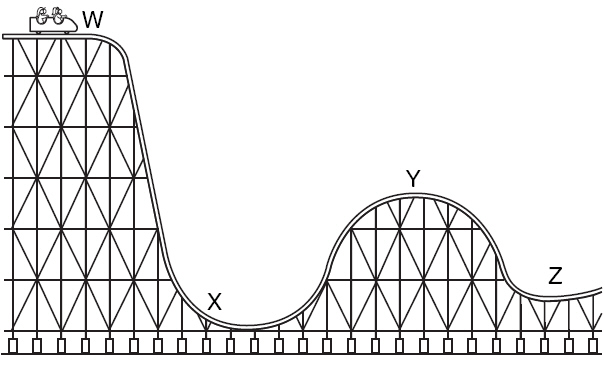
A blue arrow indicates a point on the track.
What type of energy is highest at this point?
Kinetic Energy
Potential Energy

A blue arrow indicates a point on the track.
What type of energy is highest at this point?
Kinetic Energy
Potential Energy
Both Kinetic & Potential Energy are the same

When a roller coaster is at the top of a hill it has
High potential energy
low potential energy

When the roller coaster is at Point B (the bottom of a hill) it has
High Potential Energy
Low Potential Energy
Kinetic and Potential Energy are equal.

On cool mornings, snakes can often be seen lying on warm rocks. How is heat transferred to the snake?
The warm air transfers heat to the snake through convection.
Heat from the rocks is transferred to the snake through conduction.
Heat from the Sun is transferred to the snake through conduction.
Water vapor in the air transfers heat to the snake through radiation.
Which of the following is caused by a non-contact force?
A magnet attracting a paperclip
A person lifting a box
Rubbing hands together to produce heat
A car stopping due to brakes
Why do scientists replicate other scientists experiments?
To make sure the results are valid and replicable.
To conduct multiple or repeated trials.
Why should scientists conduct repeated or multiple trials?
To make sure the results are accurate.
So other scientists can get the same or similar results.
What should scientists expect when experiments are replicated?
They should get the same or similar results.
They should get different results.

The graph shows Ashley riding her bike to Maria's house.
What was occurring from point B to point C?
She was increasing her speed.
She stopped for 4 minutes
She was decreasing in speed

Which describes the motion of the train?
the train traveled at a constant speed for 300 miles in 1 hour, stopped for an hour, then returned to its original train station
The train accelerates for 1 hour, has a constant speed for 1 hour, and the decelerates back to its original train station for an hour
the train travels at a constant speed for 1 hour, stops for an hour, and then decelerates back to its original trains station for an hour
the train decelerates for 300 miles in 1 hour, stops for 1 hour, and decelerates back to its original train station
A car drives at a constant speed away from its original position, which graph shows this?


Which graph shows that a person is standing still?


Which graph shows a person returning to their original starting position?


During which interval is the object not moving?
B to C
A to B
E to F
only at point A

During which interval is the object moving back to its original position?
A to B
D to E
E to F
G to H
Annual high temperatures in the South have increased over many decades.
weather
climate
The rainy season is from March-June every year.
weather
climate
Do sea breezes typically happen during the day or night?
Day
Night

What is always true when there is a sea breeze?
The ocean will be warmer than the land.
The land will be warmer than the ocean.
The land and ocean will be the same temperature.
What is always true when there is a land breeze?
The ocean will be warmer than the land.
The land will be warmer than the ocean.
The land and ocean will be the same temperature.
What heats up and cools down faster?
Land
Water
You and your friend are moving a couch from one side to another. You push with a force of 20 N to the right and your friend pushes with a force of 25 N to the right.
5 N to the right
45 N to the left
45 N to the right

