
 Worksheets
integumentary function/ disorders
Total questions: 43
Worksheet time: 23mins
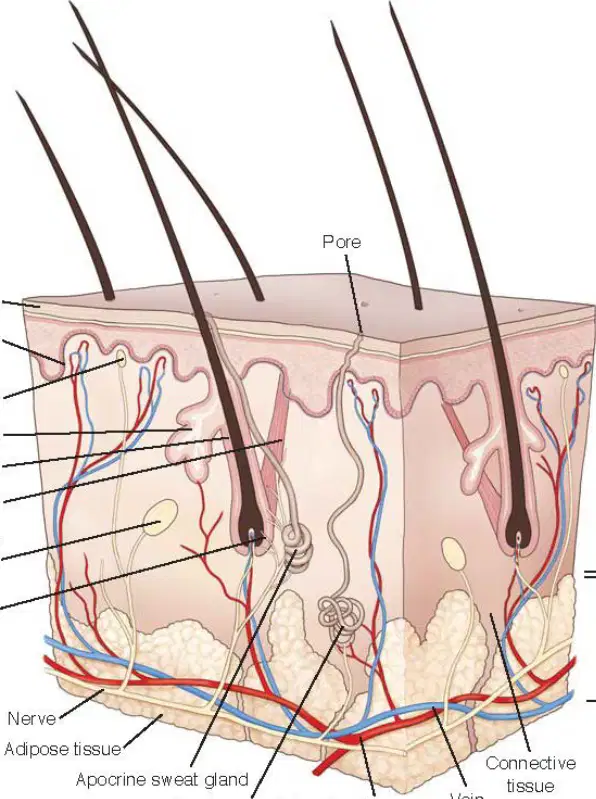
Name the fat-rich layer beneath the dermis that helps insulate the body and store energy.
(a)
Fill in the blank: The primary photoprotective benefit of scalp hair is (a) .
Name the vascular structure that nourishes the growing hair within the bulb.
(a)
Which pair correctly matches a follicle sheath with its broader category?
Internal root sheath — epithelial
Dermal root sheath — epithelial
External root sheath — dermal
Medulla — epithelial sheath
Observing whether the skin surface is free of debris, oils, or contaminants relates to which category?
Cleanliness of the skin
Tissue perfusion status
Lesion morphological type
Thermoregulatory function
Choose the distinction that correctly pairs the factor with its primary focus: thickness vs quantity.
Thickness measures strand diameter; quantity counts hairs
Thickness counts hairs; quantity measures diameter
Both measure color saturation; different tools
Both assess lubrication; different regions
Fill in the blank: Evaluating how smooth, coarse, or curly the hair feels relates to (a) .
Fill in the blank: In nail assessment, suspicious growths or breaks are documented as (a) .
You suspect fungal involvement due to crumbly nail plates. Which category should be emphasized in your notes?
Shape category primarily
Color category primarily
Consistency category primarily
Lesions category primarily
Which clinical finding requires additional investigation by the nurse?
CRT less than two seconds
New-onset petechial rash
Macule with symmetrical regular border
Pale nail bed after cold exposure
Which finding most strongly suggests a systemic bleeding disorder requiring prompt workup?
Symmetrical macule with even color
New-onset widespread petechiae
CRT faster than two seconds
Cold-induced nail bed cyanosis
Plan care for a patient with new-onset petechiae. Which step is most appropriate first?
Review medications for thrombocytopenia
Document normal capillary refill time
Advise wearing warmer gloves
Measure macule border symmetry
A 79-year-old female with incontinence has a Braden score of 14 and mobility score of 2. Which action best prevents moisture-associated skin damage after an episode?
Gently cleanse and dry the skin promptly
Delay cleaning until the next scheduled care
Use hot water and vigorous scrubbing
Apply occlusive ointment without cleaning
Which instruction about skin hygiene after incontinence is most appropriate?
Use gentle, pH-balanced cleansing
Scrub aggressively to remove residue
Apply bleach-based antiseptics
Avoid drying to keep moisture
A patient has limited mobility and incontinence. Which nursing priority reduces pressure injury risk?
Reposition at least every two hours
Keep patient sitting continuously
Use restraints to prevent movement
Elevate heels without repositioning
Given a Braden score of 14, what does this indicate about risk level for pressure injury?
Moderate risk requires preventive measures
No risk so routine care only
Extreme risk requires surgery
Low risk without interventions
Why is aggressive scrubbing after incontinence discouraged in older adults?
It increases skin trauma and irritation
It fully sterilizes the skin
It strengthens dermal barriers
It improves circulation significantly
Which tissue culturing method involves collecting material with a swab from a lesion surface?
Swab sampling from lesion surface
Needle aspiration of fluid pocket
Core biopsy of deeper tissue
Surgical excision of entire mass
Which choice correctly groups laboratory studies listed under diagnostic studies for infection workup?
CBC, albumin, lactate, BUN, creatinine
CXR, ECG, spirometry, audiometry
PT/INR, aPTT, fibrinogen level
Urinalysis, pap smear, allergy testing
Select the virus that commonly produces orolabial lesions and can establish latency in trigeminal ganglia.
Herpes simplex virus type 1
Measles morbillivirus
Human papillomavirus 16
Rubella togavirus

What are the 3 layers of the skin?
Epidermis, dermis, hair
Dermis, hypo dermis, nails
Epidermis, dermis, fatty layer

This outer layer of the skin is called the
Dermis
Fatty Tissue
Hair Bed
Epidermis
Analyze how the skin's structure contributes to its function as a barrier.
The epidermis is thin and allows easy passage of substances.
The dermis contains blood vessels that nourish the skin.
The multiple layers of the epidermis provide a tough barrier.
The hypodermis stores fat for insulation.


Check all the main layers of the skin
Alveoli layer
Dermis
Epidermis
Subcutaneous fat layer
Semi permeable layer


Label F
Epidermis
Reticular Tissue
Adipose Tissue
Hair Root


Which of the following conditions is characterized by the formation of blisters?
Eczema
Psoriasis
Herpes Zoster
Acne
Which of the following is a sign of skin cancer?
A wound that heals quickly
A mole that changes in size, shape, or color
Smooth, unblemished skin
A decrease in the number of freckles
Acne is a disorder associated with:
Sweat glands
Hair follicles and sebaceous glands
Melanocytes
Keratinocytes
Psoriasis is a skin condition that causes:
Thick, red areas covered with white or silver scales
Excessive sweating
Decreased melanin production
Increased oil production
Melissa has been to tanning bed frequently. She has a lesion with irregular borders and different colors and is getting bigger.
Melanoma
psoriasis
dermatitis
scabes
Which of the following is an indication of melanoma?
a very symmetrical mole
a red, dome-shaped bump
a pigmented spot that is black
a pigmented spot that contains areas of different color
Which of the following produces a substance to keep skin soft and moist and also fights against bacteria on the skin?
Apocrine gland
Eccrine gland
Sebaceous gland


Check ALL facts that are false about the integumentary system
Blood is pumped to the nephrons in the epidermis
The sun is essential for Vitamin D production in the skin
Dark haired, dark skinned, dark eyed people are most at risk of skin cancer
Cancer is uncontrolled cell growth

