
 Worksheets
Human Neuroanatomy Exam 1
Total questions: 40
Worksheet time: 3600secs
Which of the following words will always mean “the opposite direction from rostral”?
Posterior
Coronal
Sagittal
Caudal
Frontal
Between which two parts of the brain is the diencephalon found?
Medulla and pons
Cerebellum and medulla
Midbrain (mesencephalon) and telencephalon
Medulla and midbrain (mesencephalon)
Frontal lobe and the parietal lobe
What is the meaning of the word “sulcus”?
A. A groove or fissure on the surface of the brain
B. A bump or swelling on the surface of the brain
C. The dorsolateral part of the diencephalon
D. The part of the skull on which the ventral pons rests
E. The behavior of an ancient Roman child whose parent confiscated their iPhonus.
Which of the following is NOT a function of glia?
Local modulation of neural activity
Scavenging dead cells
Lining ventricles
Create myelin around neurons
None of the above. All of these are functions of glia.
The portion of the central nervous system that expands to the greatest extent during human development is the:
Medulla
Pons
Midbrain
Diencephalon
Telencephalon
The closing of the neural tube is sometimes incomplete. If the rostral end fails to close, what fatal condition results?
Spina bifida
Anorexia nervosa
Wylie-Davis syndrome
Anencephaly
Diencephaly
Ectodermal cells transform into the neural plate due to the influence of what cell group?
Lens placode
Neural crest cells
Mesoderm
Endoderm
Retinal pigment epithelium
Which of the following cell groups do NOT develop from neural crest?
Spinal cord motoneurons
Enteric neurons in the gut
Autonomic ganglion cells
Pigment cells in the skin
Dorsal-root ganglion neurons
Which of the following statements about the cell cycle is FALSE?
The “S” in “S-phase” stands for “DNA Synthesis”
The “M” in “M-phase” stands for “Mitosis”.
M-phase is immediately preceded by S-phase
A cell can exit the cell cycle by going into G0-phase
None of the above is false; all are true.
Where is the falx cerebri found?
Between the two cerebellar hemispheres
Between the occipital lobes and the cerebellum
Between the temporal lobe and the frontal lobe
Between the two cerebral hemispheres
Between the cerebellum and the brain stem
Which layer of the meninges has nerves that sense pain?
Dura mater
Arachnoid mater
Pia mater
What structure produces most of the cerebrospinal fluid (CSF)?
Brachial plexus
Choroid plexus
Sacral plexus
Celiac plexus
Pterygoid plexus
The arachnoid granulations allow cerebrospinal fluid to move between what two spaces?
Between the fourth ventricle and the subarachnoid space
Between the lateral ventricles and the third ventricle
Between the fourth ventricle and the foramen of Luschka
Between the subarachnoid space and the dural venous sinuses
Between the third ventricle and the fourth ventricle
Which of the following statements about the vascular system is FALSE?
The internal carotid arteries supply the brain stem
The vertebral arteries supply blood to the posterior parts of the brain
The middle cerebral arteries supply blood to the lateral parts of the cerebral cortex
The anterior cerebral arteries supply blood to the medial parts of the cerebral cortex
All of the above are true. None is false.
How will severe hypoxia affect blood flow to the brain?
A. A slight decrease in blood flow
B. A large increase in blood flow
C. A large decrease in blood flow
D. A slight increase in blood flow
E. Hypoxia will have no effect on blood flow
Which of the following is TRUE regarding the dural venous sinuses?
A. Blood pools in these structures prior to flowing into the brain
B. These structures drain into the nasal cavity and can be sites of secondary respiratory tract infections in susceptible individuals
C. The walls of these structures are made of arachnoid mater
D. Blood flows through these structures prior to entering the internal jugular vein
Which of the following are things that you can do to reduce your risk of stroke?
Have your blood pressure checked. Seek treatment if it's over 140 mm Hg systolic.
Improve your cardiovascular fitness: run, bicycle, get aerobic exercise
Have your blood cholesterol checked and ask your doctor if it needs to be lower
Stop smoking and/or vaping
All of the above
Which of the following statements about the brain capillaries that form the blood-brain barrier is TRUE?
They allow drugs to pass in and out of the brain freely
They allow oxygen and CO2 to pass in and out of the brain freely
Their tight junctions improve the diffusion of nutrients and minerals into the brain
They are surrounded by the end-feet of oligodendrocytes
All of the above
The cell membrane or plasma membrane continuously covers the entire outside surface of a neuron except the …
dendrites.
soma.
axon.
axonal terminals.
None of the above is correct since the cell membrane covers the entire neuron.
Which of the following is NOT a function of the cytoskeleton in a cell?
maintenance of cell shape
transport of molecules and organelles inside the cell
cell movement
None of the above. All are functions of the cytoskeleton.
The synthesis of mRNA takes place in what cell organelle?
nucleus
ribosome
endoplasmic reticulum
golgi apparatus
mitochondria
Which of the following statements is TRUE regarding ribosomes?
A. A strand of DNA is read by a ribosome and used to determine the sequence in which amino acids are linked together.
B. A strand of DNA is read by a ribosome and used to determine the sequence in which nucleotides are linked together.
C. A strand of mRNA is read by a ribosome and used to determine the sequence in which amino acids are linked together.
D. A strand of mRNA is read by a ribosome and used to determine the sequence in which nucleotides are linked together.
E. A strand of protein is read by a ribosome and used to determine the sequence in which amino acids are linked together.
Which of the following is true regarding Schwann cells?
They are the most abundant cell type in the brain and spinal cord.
They line the ventricles.
They are described as housekeeping cells that clean up cellular debris after injury or disease.
They are the neurons of ganglia.
They myelinate axons in peripheral nerves.
What happens in the initial segment of an axon immediately after it reaches threshold?
The lipid bilayer flips so that the inner surface becomes the outer surface.
Voltage-gated sodium channels open to generate an action potential.
Voltage-gated sodium channels close resulting in the refractory period.
Sodium-potassium pumps are activated.
Potassium channels repolarize the membrane.
An action potential 'hopping' between the Nodes of Ranvier is known as …
hyper conduction.
axonal conduction.
ultraconduction.
super conduction.
saltatory conduction.
Which of the following is TRUE regarding the resting membrane potential of a neuron?
The sodium-potassium pump pumps sodium (Na+) out of the neuron and potassium (K+) into the neuron at rest.
No energy is required to maintain the resting membrane potential.
Chloride is actively pumped into the cell, creating the characteristic negative resting membrane potential.
All ion channels are closed when the neuron is at rest.
What is a key characteristic of a positively charged ion that is dissolved in water?
The ion borrowed an electron from another atom.
The ion has fewer electrons than protons.
The ion will be tightly bound to an ion with a negative charge.
The ion will be radioactive.
The ion borrowed a proton from another atom.
When an action potential depolarizes an axon terminal, what change will be initiated in the terminal?
voltage-gated calcium channels will open
voltage-gated potassium channels will close
non-selective cation channels will open
SNARE proteins will be deactivated
neurotransmitter receptors will be released into the synaptic cleft
What is the effect of tetanus toxin on interneurons in the spinal cord?
It degrades neurotransmitter receptors.
It degrades synaptic vesicles so neurotransmitter is released inside the neuron.
It increases neurotransmitter release into the synaptic cleft.
It prevents neurotransmitter release into the synaptic cleft.
G-proteins...
are needed in axons terminals for fusion of synaptic vesicles.
are needed in the initial segment of axons for generation of action potentials.
mediate the actions of some neurotransmitter receptors.
are components of blood.
SNARE proteins are required ...
in the initial segment of axons for the generation of action potentials.
in axon terminals for release of neurotransmitter.
in synaptic clefts for degradation of neurotransmitter.
in dendrites to allow activation of excitatory neurotransmitter receptors.
in somata for synthesis of neurotransmitters.
Which of the following structures is NOT normally found in an intervertebral foramen?
spinal cord
sensory ganglion
ventral root
dorsal root
What level of the spinal cord has the most white matter?
sacral
cervical
lumbar
thoracic
Where do axons in the spinothalamic tract synapse?
dorsal horn of the spinal cord
ventral horn of the spinal cord
thalamus
cerebellum
muscles
The spinocerebellar tract runs in what region of the spinal cord?
ventral funiculus
lateral funiculus
dorsal funiculus
central gray
ventral horn
The stretch reflex is initiated by …
stretching muscle spindles.
stretching motor axons.
muscle paralysis.
injury to a tendon.

What type of brain section would result from a vertical knife cut along the line below?
Coronal section
Sagittal section
Horizontal section
Parasagittal section
Diagonal section
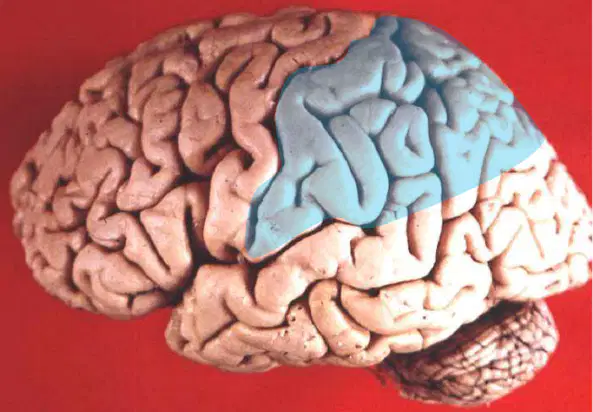
What lobe of the human brain is shaded in the image below?
Occipital lobe
Temporal lobe
Parietal lobe
Frontal lobe
Limbic lobe
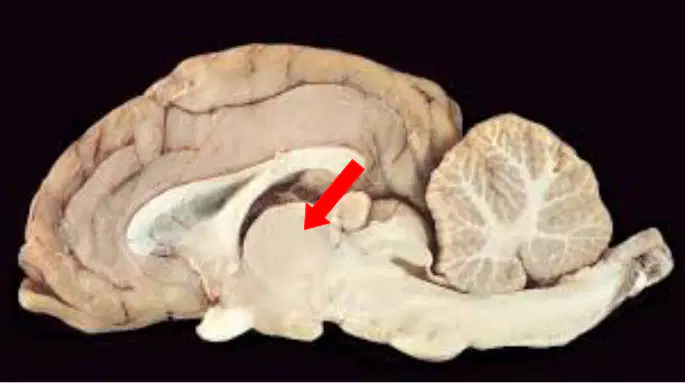
What structure is at the tip of the arrow?
Hypothalamus
Thalamus
Pituitary gland
Pineal gland
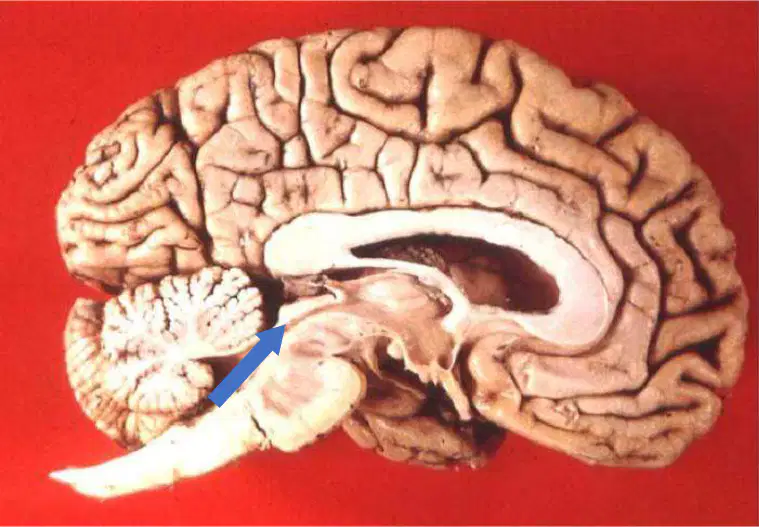
Refer to the diagram of the brain. What structure is indicated by the blue arrow?
Lateral ventricle
Third ventricle
Cerebral aqueduct
Fourth ventricle
Arachnoid granulations

