
 Worksheets
Cloud Computing Quiz 2
Total questions: 100
Worksheet time: 50mins
What is the primary responsibility of hypervisors in the Hypervisor Clustering Architecture?
Managing physical servers directly
Creating and hosting multiple virtual servers
Ensuring zero downtime for cloud services
Balancing workloads across multiple data centers
What are "heartbeats" in the context of Hypervisor Clustering Architecture?
Signals exchanged between physical servers
System-level messages exchanged between hypervisors, virtual servers, and VIMs
Notifications sent to users during server downtime
Alerts for resource reservation in cloud environments
Which of the following architectures is NOT mentioned in the list of cloud technology architectures explored in this chapter?
Resilient Disaster Recovery
Virtual Private Cloud
Distributed Data Sovereignty
Physical Server Management
Why can failure conditions affecting a hypervisor cascade to its virtual servers?
Because hypervisors directly manage physical servers
Because virtual servers depend on hypervisors for hosting and creation
Because hypervisors control the network infrastructure
Because virtual servers operate independently of hypervisors
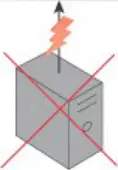
What happens to the virtual servers hosted by a hypervisor when the physical server hosting the hypervisor fails?
The virtual servers continue to operate normally.
The virtual servers are moved to another physical server automatically.
The virtual servers fail along with the physical server.
The virtual servers switch to a backup hypervisor on the same physical server.
What is the purpose of the hypervisor clustering architecture?
To ensure that virtual servers are permanently tied to a single physical server.
To establish a high-availability cluster of hypervisors across multiple physical servers.
To reduce the number of physical servers required for hosting virtual servers.
To prevent the need for hypervisors in virtual server environments.
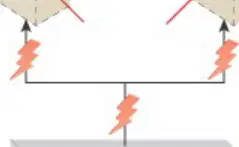
What happens to hosted virtual servers if a hypervisor or its underlying physical server becomes unavailable in a hypervisor clustering architecture?
The virtual servers are permanently lost.
The virtual servers are moved to another physical server or hypervisor to maintain runtime operations.
The virtual servers are paused until the original physical server is restored.
The virtual servers are automatically deleted.
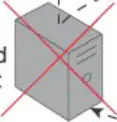
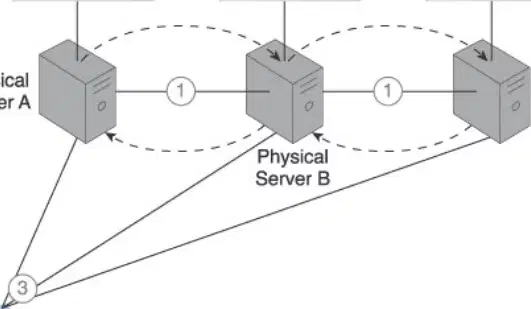
What happens when Physical Server A becomes unavailable?
Virtual Server A is permanently shut down.
Virtual Server A is migrated to Physical Server B.
Physical Server B becomes unavailable as well.
The hypervisor cluster stops functioning entirely.
What is the role of the central VIM in the hypervisor cluster?
It permanently stores virtual servers.
It sends regular heartbeat messages to confirm hypervisors are operational.
It shuts down hypervisors when they fail.
It directly migrates virtual servers without using hypervisors.
What triggers the live VM migration program in the hypervisor cluster?
A manual command from the administrator.
Unacknowledged heartbeat messages from hypervisors.
A scheduled migration process.
A failure in the shared cloud storage device.
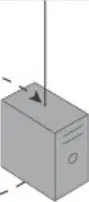
What is live VM migration capable of?
Relocating virtual servers or instances at runtime.
Permanently storing virtual servers in a single host.
Shutting down virtual servers during runtime.
Preventing hypervisor failures entirely.
What type of storage device does the hypervisor cluster use for live VM migration?
Local hard drives.
Shared cloud storage device.
External USB drives.
Physical server storage.

What is the role of hypervisors in the system shown in the diagram?
Hypervisors manage the physical servers directly without creating virtual servers.
Hypervisors are installed on physical servers and create virtual servers.
Hypervisors store virtual server configuration files in the shared cloud storage device.
Hypervisors act as the central VIM for managing the system.
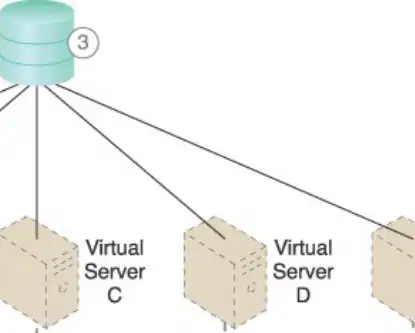
What is the purpose of the shared cloud storage device in the system?
To store virtual server configuration files for access by all hypervisors.
To act as a backup for the central VIM.
To directly manage the physical servers.
To create virtual servers on its own.
How is the hypervisor cluster enabled in the system?
By directly connecting the physical servers to the shared cloud storage device.
By installing hypervisors on the virtual servers.
By using a central VIM to manage the three physical server hosts.
By creating virtual servers on the shared cloud storage device.

Which component in the system is responsible for creating virtual servers?
The central VIM.
The shared cloud storage device.
The hypervisors.
The physical servers.
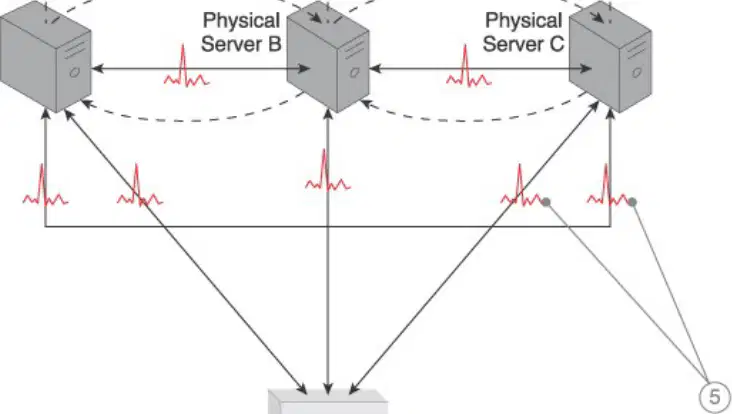
What is the purpose of heartbeat messages exchanged between physical servers and the VIM?
To monitor the health and status of physical servers.
To transfer data between virtual servers.
To establish communication between hypervisors.
To allocate resources dynamically to virtual servers.
Which component is responsible for managing virtual servers in the given system architecture?
Hypervisor.
Physical server.
Virtual server.
VIM.
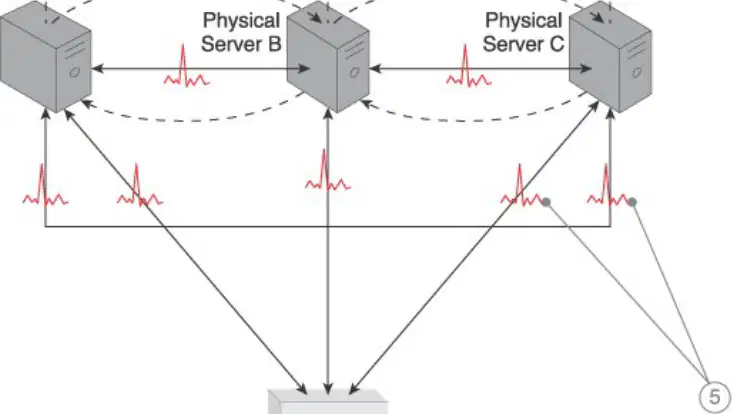
How do physical servers communicate with each other in the system shown?
Through direct data transfer.
By exchanging heartbeat messages.
Using virtual server connections.
Through hypervisor synchronization.
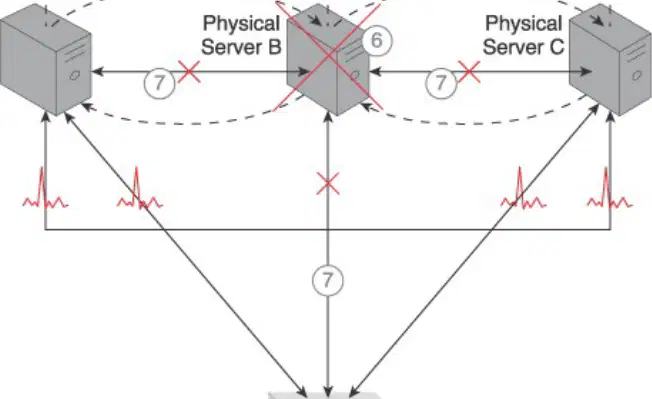
What happens when Physical Server B fails in the given system architecture?
Virtual Server C becomes jeopardized, and heartbeat messages from Physical Server B stop being received by other physical servers and the VIM.
Virtual Server A becomes jeopardized, and heartbeat messages from Physical Server A stop being received by other physical servers and the VIM.
Virtual Server D becomes jeopardized, and heartbeat messages from Physical Server D stop being received by other physical servers and the VIM.
Virtual Server E becomes jeopardized, and heartbeat messages from Physical Server E stop being received by other physical servers and the VIM.
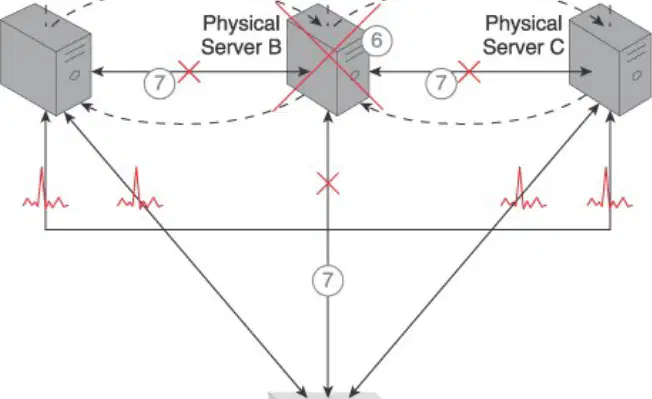
Which component stops receiving heartbeat messages when Physical Server B fails?
Hypervisor
Virtual Server A
VIM and other physical servers
Virtual Server E
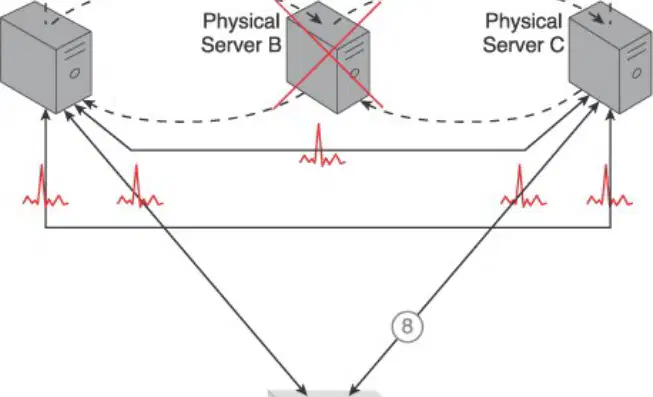
What does the VIM do when Physical Server B becomes unavailable in the cluster?
It shuts down all virtual servers in the cluster.
It chooses Physical Server C as the new host for Virtual Server C.
It migrates Virtual Server C to Physical Server A.
It restarts Physical Server B to restore operations.
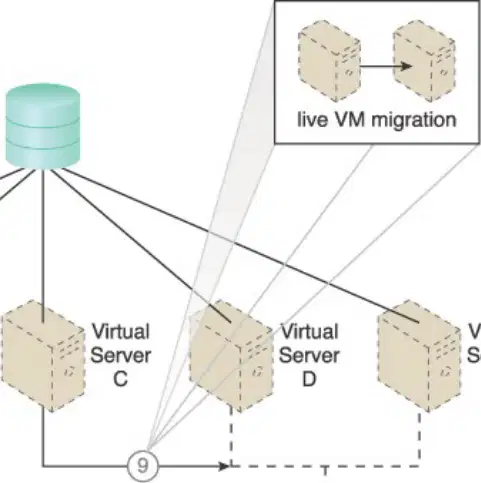
What is the process called when Virtual Server C is moved to another physical server without shutting it down?
Cold migration
Live VM migration
Server replication
Hypervisor shutdown
Why might restarting be necessary after Virtual Server C is live-migrated to Physical Server C?
To ensure the hypervisor is updated.
To restore normal operations.
To reconfigure the virtual server settings.
To assess the capacity of other hypervisors.
What is the purpose of the Logical Network Perimeter mechanism in a clustered environment?
To ensure hypervisors in the same cluster inform one another about their status and availability.
To create logical boundaries that prevent hypervisors of other cloud consumers from being accidentally included in a given cluster.
To replicate updates on changes such as the creation or deletion of a virtual switch to all hypervisors via the VIM.
To deploy virtual servers on physical hosts running hypervisors.
Which mechanism ensures hypervisors in the same cluster inform one another about their status and availability?
Logical Network Perimeter
Resource Replication
Virtual Server Clustering Architecture
Distributed NoSQL Databases
What is the main focus of a virtual server clustering architecture?
To create logical boundaries for hypervisors.
To replicate updates across hypervisors.
To leverage efficiency, resiliency, and scalability through virtualization.
To configure clusters for big data analytics only.
What is one of the purposes for which virtual server clusters can be configured?
Logical Network Perimeter
Big data analytics
Resource Replication
Virtual switch creation
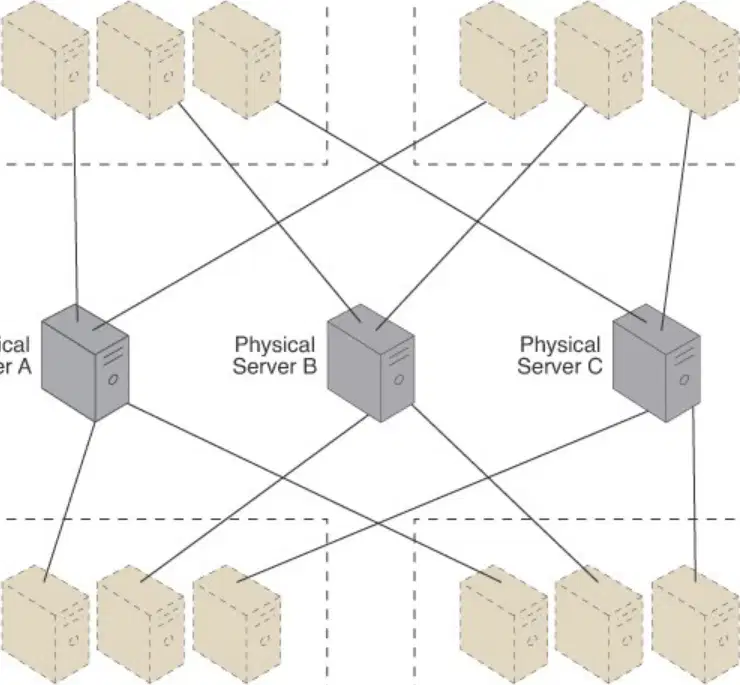
What is the role of a hypervisor in the architecture shown in the diagram?
To manage the physical servers directly without virtualization.
To allow multiple virtual servers to be hosted on each physical server.
To ensure secure communication between virtual server clusters.
To replicate resources across virtual servers in different clusters.
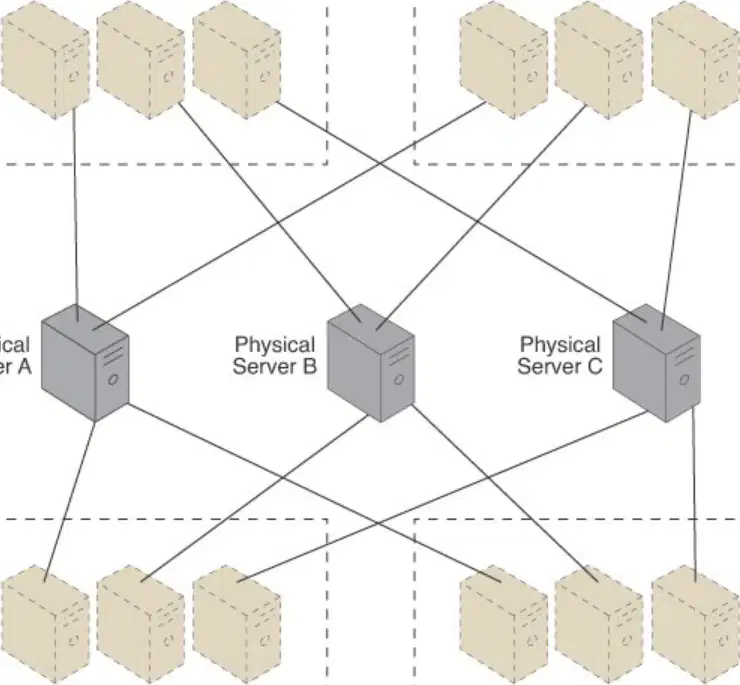
What does the Logical Network Perimeter ensure in the virtual server cluster architecture?
It ensures that virtual servers in the same cluster replicate resources.
It ensures that virtual server clusters are enclosed in a secure environment for communication.
It ensures the deletion of virtual switches across all servers.
It ensures the physical servers are connected directly to each other.
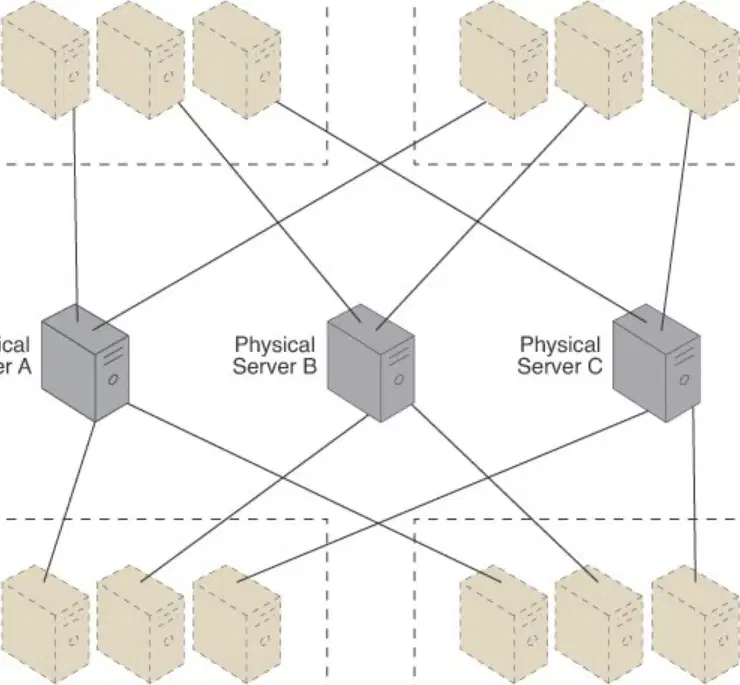
What is the purpose of Resource Replication in the virtual server cluster architecture?
To allow virtual servers to communicate securely with each other.
To inform virtual servers in the same cluster about their status and availability.
To manage the physical servers directly without virtualization.
To configure virtual servers into clusters.
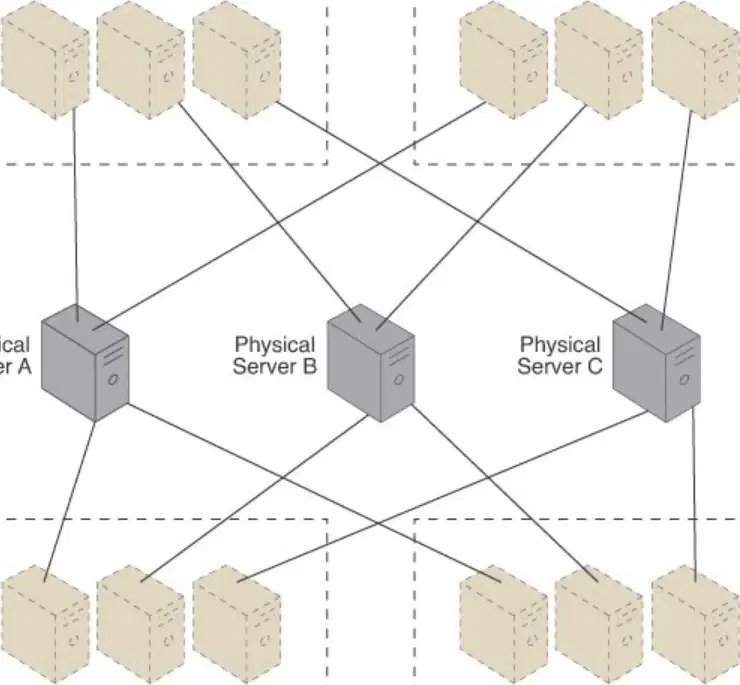
Which of the following actions requires Resource Replication in the virtual server cluster architecture?
Creation or deletion of a virtual switch.
Enclosing virtual server clusters in a secure environment.
Hosting multiple virtual servers on physical servers.
Connecting physical servers directly to virtual servers.
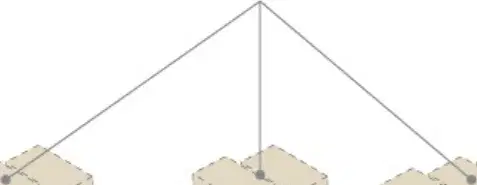
What is the primary challenge in maintaining load-balanced virtual server instances architecture?
Ensuring physical servers are isolated from each other.
Balancing workloads evenly across physical servers.
Increasing the number of physical servers.
Reducing the number of virtual servers.
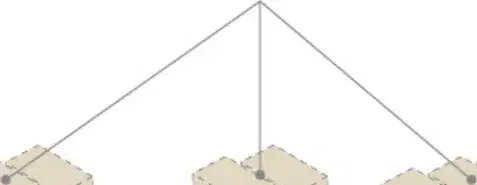
What does the load-balanced virtual server instances architecture aim to achieve?
It reduces the number of physical servers required.
It dynamically calculates virtual server instances and distributes workloads across physical servers.
It isolates physical servers from virtual servers.
It increases the processing power of individual physical servers.
What is the consequence of overutilization of physical servers?
Increased processing potential.
Ongoing performance challenges.
Reduced virtual server instances.
Improved workload distribution.
What role does the capacity watchdog system play in the load-balanced virtual server instances architecture?
It isolates physical servers from virtual servers.
It calculates virtual server instances and associated workloads dynamically.
It increases the number of virtual servers.
It reduces the processing power of physical servers.
What is the primary role of the capacity watchdog monitor in the capacity watchdog system?
To dynamically calculate physical server computing capacities against virtual server capacity requirements.
To track physical and virtual server usage and report significant fluctuations.
To move virtual servers to another host to distribute workload.
To define policies and thresholds for virtual server instances.
Which component of the capacity watchdog system is responsible for moving virtual servers to another host to distribute workload?
Capacity planner
Capacity watchdog monitor
Live VM migration program
Hypervisor
What does the hypervisor cluster architecture provide in the context of virtual server instances?
A mechanism to report over-utilization to the VIM.
A foundation for load-balanced virtual server instances architecture.
A tool to compare physical server capacities with virtual server processing.
A system to dynamically calculate server capacities.
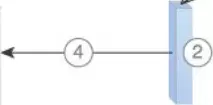
What happens when the capacity watchdog monitor reports over-utilization to the VIM?
The hypervisor cluster architecture is redefined.
The capacity planner calculates new server capacities.
A virtual server is moved to another host to distribute workload.
Policies and thresholds are updated.

What is the role of the VIM in the process of live VM migration?
It directly moves virtual servers from one physical host to another.
It signals the load balancer to redistribute the workload based on predefined thresholds.
It acts as a hypervisor for managing virtual servers.
It initiates the live VM migration program.
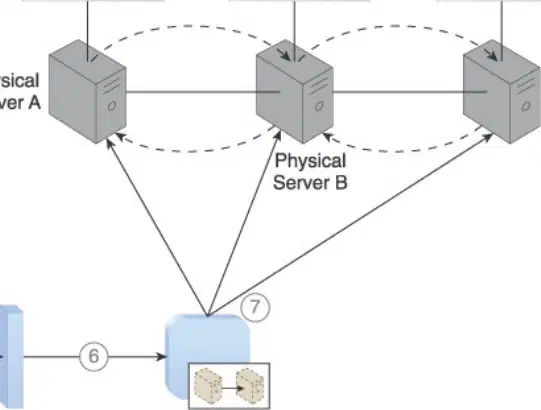
What is the function of the load balancer in the live VM migration process?
It signals the VIM to redistribute the workload.
It initiates the live VM migration program to move virtual servers.
It acts as a physical server for hosting virtual machines.
It moves virtual servers directly from one host to another.
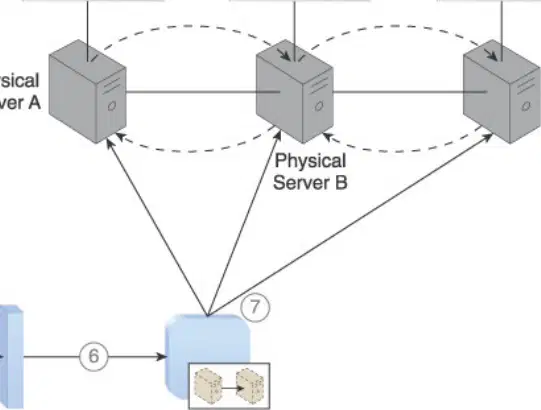
What happens during live VM migration?
Virtual servers are redistributed across hypervisors.
Selected virtual servers are moved from one physical host to another.
The load balancer signals the VIM to redistribute the workload.
Physical servers are converted into virtual servers.
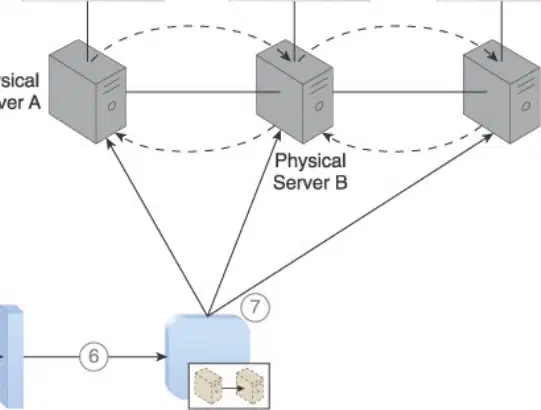
Which component initiates the live VM migration program?
Hypervisor
Physical server
Load balancer
VIM
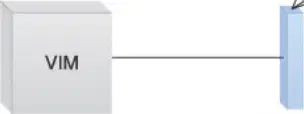
What is the primary function of the Automated Scaling Listener in a cloud architecture?
To replicate virtual server instances as part of load balancing.
To ensure compliance with SLA and privacy regulations.
To initiate load balancing and dynamically monitor workload coming to virtual servers.
To distribute the workload of virtual servers between hypervisors.
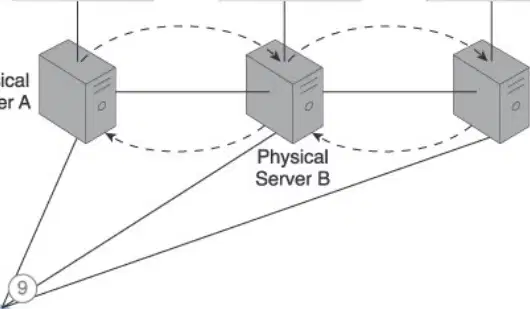
Which mechanism in a cloud architecture is responsible for distributing the workload of virtual servers between hypervisors?
Automated Scaling Listener
Load Balancer
Logical Network Perimeter
Resource Replication
What is the role of the Logical Network Perimeter in a cloud architecture?
To monitor workload and resource consumption.
To ensure the destination of a relocated virtual server complies with SLA and privacy regulations.
To replicate virtual server instances for load balancing.
To dynamically monitor workload coming to virtual servers.
Why is Resource Replication important in a cloud architecture?
It ensures compliance with SLA and privacy regulations.
It replicates virtual server instances as part of load balancing functionality.
It monitors workload and resource consumption.
It distributes workload between hypervisors.
What is the purpose of the capacity watchdog monitor in the workload balancing architecture?
To replicate virtual server instances.
To monitor workload and resource consumption.
To distribute workload between hypervisors.
To ensure compliance with SLA and privacy regulations.
What is one of the primary reasons for rejecting cloud service consumer requests?
The cloud service is running on outdated hardware.
The cloud service becomes unavailable due to runtime usage demands exceeding its processing capacity.
The cloud service is not compatible with consumer devices.
The cloud service is undergoing a software update.
What does the nondisruptive service relocation architecture aim to achieve?
Scaling cloud services by adding more physical servers.
Temporarily diverting cloud service activity to another hosting environment without disruption.
Permanently shutting down cloud services during maintenance.
Reducing the number of cloud service consumer requests.
What is a key aspect of the nondisruptive service relocation architecture?
The original cloud service implementation is deactivated before the new one is set up.
The new cloud service implementation is guaranteed to respond to requests before the original is deactivated.
The cloud service is scaled only after consumer requests are rejected.
The cloud service is permanently migrated to a new host without duplication.
What mechanism can be used to trigger the redirection of cloud service consumer requests?
Automated scaling listener and/or load balancer mechanisms.
Manual intervention by the cloud service administrator.
A scheduled downtime notification system.
A consumer-side application update.
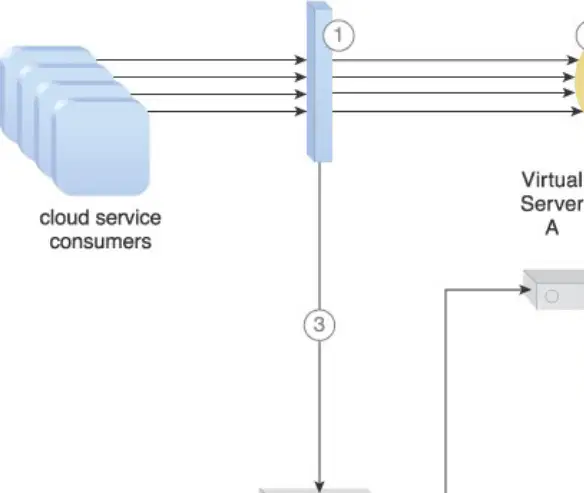
What is the role of the automated scaling listener in the cloud service architecture?
It monitors the workload and signals the VIM to initiate relocation when the predefined threshold is reached.
It directly migrates virtual machines between physical servers.
It acts as a hypervisor for managing physical servers.
It defines the threshold for workload without monitoring it.
What happens when the cloud service's predefined workload threshold is reached?
The automated scaling listener signals the VIM to initiate relocation.
The hypervisor directly migrates the virtual machine.
The physical server shuts down to reduce workload.
The cloud service stops accepting requests from consumers.
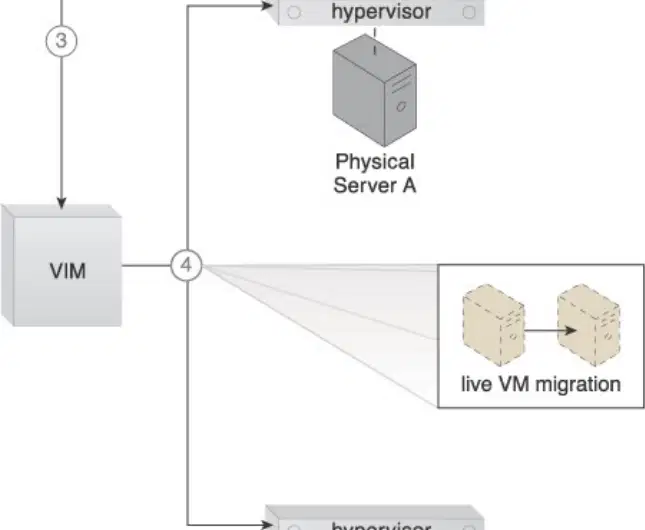
Which program does the VIM use to carry out runtime relocation of virtual machines?
Live VM migration program.
Automated scaling listener program.
Hypervisor management program.
Cloud service consumer program.

What is the function of the hypervisor in the cloud service architecture?
It manages the physical servers and virtual machines.
It monitors workload thresholds for the cloud service.
It signals the VIM to initiate relocation.
It defines the scaling policies for the cloud service.

What is the role of the hypervisor in the process shown in the diagram?
It manages the automated scaling listener.
It creates and manages virtual servers on physical servers.
It acts as the cloud service consumer.
It directly hosts the cloud service without virtualization.
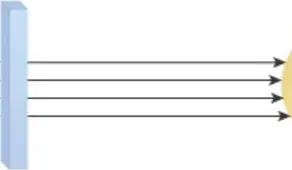
What is the purpose of the automated scaling listener in the diagram?
To create virtual servers on physical servers.
To monitor and manage the scaling of cloud services.
To act as a hypervisor for physical servers.
To directly host cloud services.
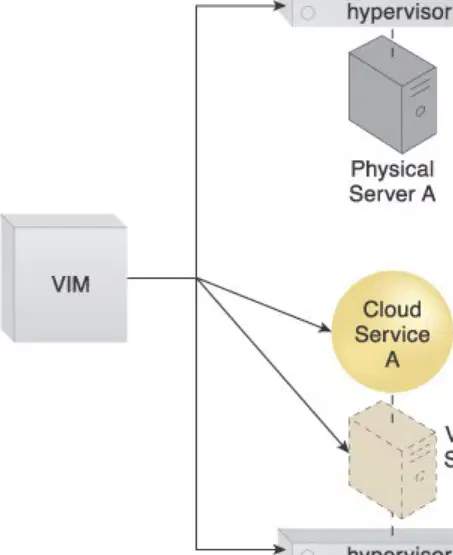
What happens when a second copy of the virtual server is created, as shown in the diagram?
The original virtual server is deleted.
The second copy is created on the same physical server as the original.
The second copy is created on a different physical server via a hypervisor.
The second copy is created without using a hypervisor.
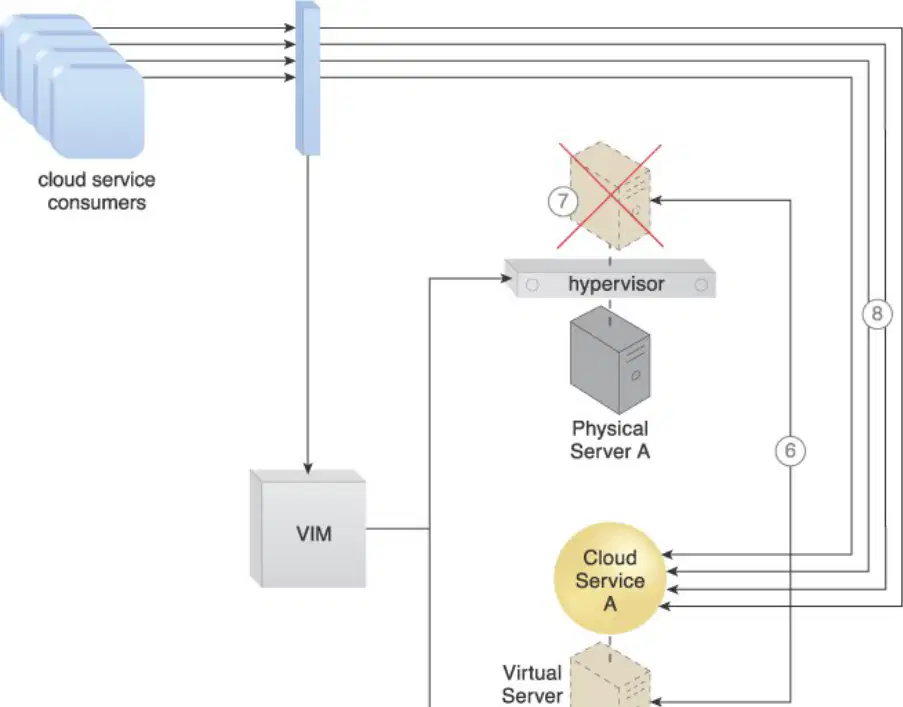
What happens to the first virtual server instance on Physical Server A after cloud service consumer requests are confirmed to be successfully exchanged with the cloud service on Physical Server B?
It continues to operate on Physical Server A.
It is removed from Physical Server A.
It is duplicated on Physical Server A.
It is paused on Physical Server A.
What is one of the ways virtual server migration can occur when the virtual server disks are stored on a local storage device or non-shared remote storage?
The virtual server disks are deleted from the source host.
A copy of the virtual server disks is created on the destination host.
The virtual server disks are moved to a shared storage device.
The virtual server disks are compressed and sent to the destination host.
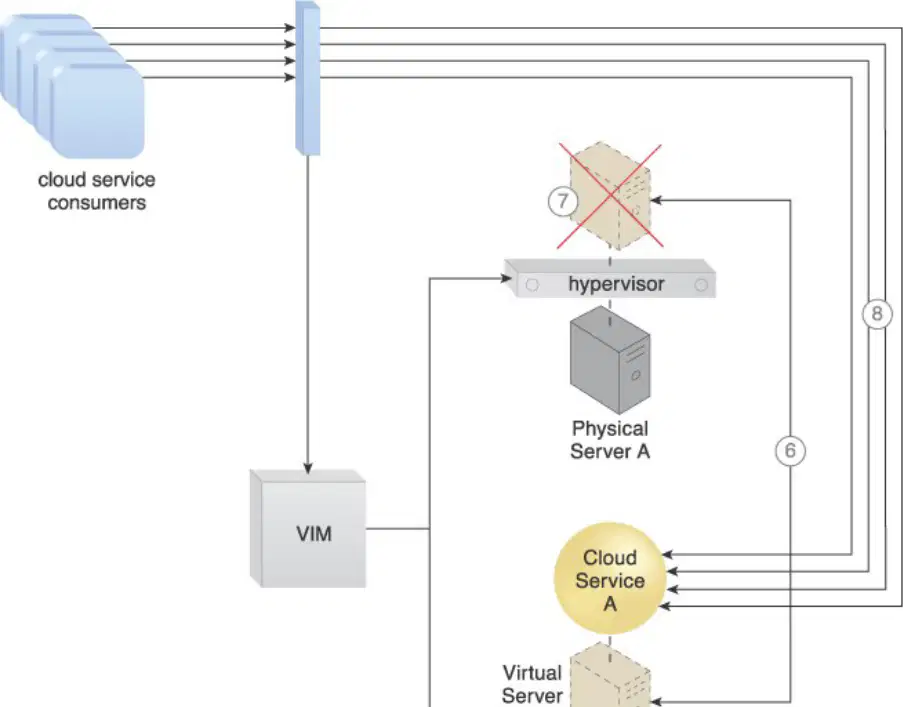
What is the role of the automated scaling listener in the virtual server migration process?
It manages the physical servers directly.
It synchronizes the state of virtual server instances.
It listens to and manages cloud service consumer requests.
It creates copies of virtual server disks.
What is the purpose of the Cloud Usage Monitor in the nondisruptive service relocation technology architecture?
To replicate resources at the destination
To continuously track IT resource usage and system activity
To process SLA data for cloud service availability assurances
To calculate pay-per-use costs for IT resources
Which mechanism is responsible for collecting SLA information required by the SLA management system in the nondisruptive service relocation technology architecture?
Cloud Usage Monitor
Pay-Per-Use Monitor
SLA Monitor
Resource Replication
What is the primary challenge in achieving zero downtime architecture for virtual servers?
The inability to replicate resources at the destination
The physical server acting as a single point of failure
The lack of SLA monitoring systems
The absence of pay-per-use cost calculations
What does the zero downtime architecture aim to achieve in the event of a physical server failure?
Locking virtual servers into their physical server hosts
Dynamically moving virtual servers to different physical server hosts
Replicating resources at the source location
Eliminating the need for SLA management systems
Which mechanism is used to instantiate a shadow copy of the cloud service at its destination in the nondisruptive service relocation technology architecture?
SLA Monitor
Resource Replication
Pay-Per-Use Monitor
Cloud Usage Monitor
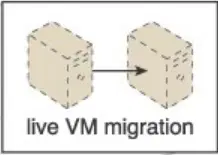
What is the primary purpose of the live VM migration program in a high-availability cloud architecture?
To permanently shut down the failed physical server.
To dynamically move virtual servers from one physical server to another without interruption.
To delete all data stored on the failed physical server.
To create new virtual servers on a different physical server.
What ensures that virtual servers can access their files even after being migrated to a secondary physical server?
Persistent virtual network configuration architecture.
Temporary storage on the failed physical server.
Manual data transfer by administrators.
A backup system that stores data offline.
Which of the following mechanisms is used to monitor the actual IT resource usage of cloud consumers to ensure virtual server capacities are not exceeded?
Audit Monitor.
Cloud Usage Monitor.
Fault Tolerance System.
Live VM Migration Program.
What is the role of the Audit Monitor in the high-availability cloud architecture?
To monitor the IT resource usage of cloud consumers.
To check whether the relocation of virtual servers also relocates hosted data to prohibited locations.
To ensure that virtual servers are stored on a shared volume.
To manage the live VM migration process.
What is the main benefit of the fault tolerance system in a high-availability cloud architecture?
It allows physical servers to operate without any virtual servers.
It ensures that virtual servers are permanently deleted after a physical server failure.
It enables the migration of virtual servers to a secondary physical server in case of failure.
It prevents any physical server from failing.
Which of the following will impact the price paid for an EC2 instance? (Choose two)
The Availability Zone where the instance is provisioned
Instance Type
Compute time consumed
Storage capacity
The IAM identity that uses the instance
Which of the following is a fully-managed, petabyte-scale data warehouse service in the AWS Cloud?
Amazon Kinesis
Amazon Redshift
Amazon RDS
Amazon DynamoDB
Your company's upper management is getting very nervous about managing governance, compliance, and risk auditing in AWS. What service should you enable and inform upper management about?
CloudAudit
CloudTrail
Cloud Compliance
CloudWatch
Which of the following AWS services can be used as a compute resource? (Choose two)
Amazon S3
Amazon EC2
Amazon VPC
AWS Lambda
You are planning to offload some of your batch processing workloads to AWS. These jobs can be interrupted and resumed at any time. Which of the following instance types would be the most cost effective to use?
On-Demand
Spot
Full Upfront Reserved
Partial Upfront Reserved
Which of the following storage mechanisms can be used to store and reliably deliver messages effectively across distributed systems?
Amazon Glacier
Amazon EBS Volumes
Amazon EBS Snapshots
Amazon SQS
Which of the following reserved instance payment options result in you paying a discounted hourly rate throughout the duration of the term? (Choose two)
All Upfront option
Partial Upfront option
Percentage Upfront option
No Upfront option
Which statement is correct with regards to service limits? (Choose two)
You can use the AWS Trusted Advisor to monitor your service limits.
There are no service limits on AWS.
You can contact support to increase the service limits.
The AWS Simple Email Service is responsible for sending email notifications when usage approaches a service limit.
Each IAM user has the same service limits.
What does Amazon Elastic Beanstalk provide?
A scalable storage appliance on top of Amazon Web Services.
An application container on top of Amazon Web Services.
A service by this name doesn't exist.
A scalable cluster of EC2 instances.
Sarah has created a web application, placing its underlining infrastructure in the N. Virginia (US-East-1) region. After several months, Sarah notices that much of her website’s traffic is coming from Japan. What can she do to reduce latency for her users in Japan?
Migrate the application to a Japanese hosting service.
Create a CDN using CloudFront, so that content is cached at Edge locations close to and in Japan.
Recreate the website content
None of the above
You are working on two projects that require a completely different network configuration. Which of the following would allow you to isolate resources and network configurations for each of them?
Security Groups
Edge Locations
Virtual Public Cloud
Virtual Private Cloud
Which of the following are important design principles when architecting cloud-based systems? (Choose two)
Build Tightly-coupled components
Use as many services as possible
Assume everything will fail
Build loosely-coupled components
There are performance issues with your under-development application, being built using microservices architecture. Which of the following AWS services would help you analyze these issues?
X-Ray
AWS CodePipeline
AWS Inspector
AWS Config
Which of the following AWS offerings is a MySQL-compatible database that has the ability to grow in storage size on its own?
DynamoDB
Aurora
RDS Microsoft SQL Server
RDS PostgreSQL
What is the primary storage service used by Amazon RDS DB instances?
Amazon S3
Amazon EFS
Amazon EBS
Amazon Glacier
A corporation want to connect to AWS from a distant office through a private, low-latency connection. Which strategy is advised for meeting these requirements?
A. Create a VPN tunnel
B. Connect across the public internet
C. Use VPC peering to create a connection.
D. Use AWS Direct Connect.
Which service should a client utilize to integrate and manage several Amazon Web Services accounts centrally?
A. AWS IAM
B. AWS Organizations
C. AWS Schema Conversion Tool
D. AWS Config
A business need software solutions that are either hosted on the AWS platform or are linked with it. Independent software providers, as well as management and security vendors, are required to provide solutions. Which organization or team is capable of providing these solutions?
A. AWS technical account managers (TAMs)
B. AWS Partner Network (APN) Consulting Partners
C. AWS Concierge Support
D. AWS Partner Network (APN) Technology Partners
Which AWS service enables the use of the AWS Cloud to host a NoSQL database?
A. Amazon Aurora
B. Amazon DynamoDB
C. Amazon RDS
D. Amazon Redshift
A user may create a master payer account in order to access aggregated billing data via:
A. AWS Budgets.
B. Amazon Macie.
C. Amazon QuickSight.
D. AWS Organizations.
A business wishes to deliver managed Windows virtual desktops and programs through secure network connections to its distant workers. Which AWS services does the business have access to in order to achieve these requirements? (Select two.)
A. Amazon Connect
B. Amazon AppStream 2.0
C. Amazon WorkSpaces
D. AWS Site-to-Site VPN
E. Amazon Elastic Container Service (Amazon ECS)
Which AWS services are globally specified rather than regionally defined? (Select two.)
A. Amazon Route 53
B. Amazon EC2
C. Amazon S3
D. Amazon CloudFront
E. Amazon DynamoDB
A business has a stateless application workload that can withstand brief periods of outage. The program conducts calculations in massively parallel fashion. Which Amazon EC2 pricing model should the business choose to save costs?
A. On-Demand Instances
B. Spot Instances
C. Reserved Instances
D. Dedicated Instances
Which of the following are support categories for AWS Trusted Advisor? (Select two.)
A. Operational excellence
B. Cost optimization
C. Security
D. Well-Architected Framework
E. Rightsizing
For its steady-state database, a corporation runs a self-managed Oracle database directly on Amazon EC2. The corporation wishes to cut its computing expenses. Which option should the business choose in order to optimize savings over a three-year period?
A. EC2 Dedicated Instances
B. EC2 Spot Instances
C. EC2 Reserved Instances
D. EC2 On-Demand Instances
Which AWS services enable an on-premises infrastructure to be extended to the AWS Cloud? (Select two.)
A. Amazon EBS
B. AWS Direct Connect
C. Amazon CloudFront
D. AWS Storage Gateway
E. Amazon Connect
A business's operations are conducted on-site. The business want to anticipate the costs associated with hosting a major application on AWS. Which AWS service or tool does the business have access to in order to collect this information?
A. AWS Pricing Calculator
B. AWS Budgets
C. AWS Trusted Advisor
D. Cost Explorer

