
 Worksheets
Knee Review
Total questions: 27
Worksheet time: 20mins
Where are the quadriceps located?
on the back of the thighs
on the kneecap
on the front of the thighs
on the arms
What does PCL stand for?
posterior collateral ligament
medial collateral ligament
anterior cruciate ligament
posterior cruciate ligament
What does the acronym RICE stand for?
Fill in the blank: An injury to a muscle or tendon or called a ?
(a)
Which one of the following is not a symptom of a PCL tear?
dizziness
swelling
instability
pain
Check all of the following that are bones in the knee.
femur
tibia
hamstring
patella
fibula
What do ligaments connect?
bones to bones
muscles to bones
bones to muscles
muscles to muscles
What is the definition of the valgus stress test?
Tests the lateral collateral ligament
Tests how much stress you have
Tests the medial collateral ligament
The knee cap
Fill in the blank: The LCL stands for (a) collateral ligament
Select all that are rehab exercises for an ACL injury.
heel raises
hamstring curls
pushups
planks
bench press
What is the definition of posterior?
What do we call a muscle or tendon tear?
sprain
strain
dislocation
subluxation
Fill in the blank: (a) is a joint that is partially out of normal position.

What is #7 pointing to?
LCL
MCL
fibula
PCL

What is #13 pointing to?
patella
chondromalacia
patellar tendon
meniscus
The Valgus stress test is for...
pain with movement of the patella
a click along the joint line or pain at the joint line
lateral knee pain and/or varus movements
medial knee pain and/or increased valgus movements
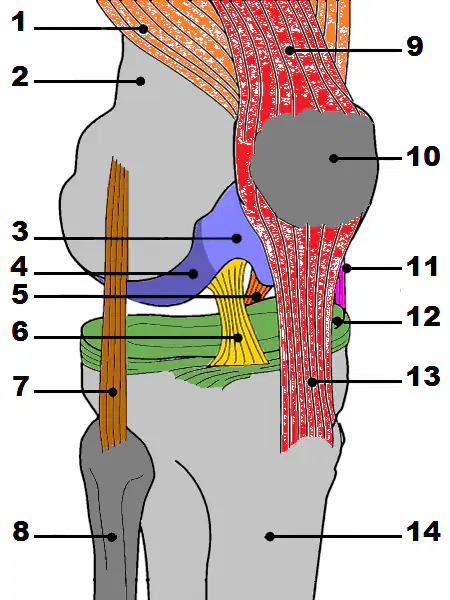
What is #6 pointing to?
PCL
ACL
LCL
MCL
What is the purpose of the meniscus?
prevents hyper extension of the knee during weight bearing activities
cushions stress placed on the knee
protects the knee against lateral forces
accounts for the most stability of the knee
Patellar tendinitis is also known as...
runners knee
arthritis
jumpers knee
dashboard injury
what special test can you use for a ACL tear?
Anterior Drawer
posterior drawer
Posterior Drawer
Varus
what is torn in the Unhappy Triad?
MCL
MCL
Meniscus Tear
ACL

What force is this?
valgus
varus
hyperextension
twisting
Genu varum
Is also known as knock knees
Typically resolves itself through normal growth
Causes degeneration of the lateral meniscus
Is also known as bow legged
The biceps femoris __________ the knee.
Flexes
Is a ligament of
Prevents a varus force of
Extends
The vastus medialis
Is a hamstring muscle
Is a quadriceps muscle
Flexes the knee
Attaches to the fibula
The medical term for hyperextension at the knee joint is
Genu valgum
Tensor fasciae latae
Genu varum
Genu recurvatum
People with an abnormally enlarged tibial tuberosity had _________ when they were younger.
A patellar dislocation
Genu Recurvatum
Osgood Schlatter's disease
A sprained ACL

