
Font size
 Worksheets
Forensics Semester 1 Review
Total questions: 107
Worksheet time: 54mins
Define Forensic Science.
The science of relating to the application of scientific knowledge to legal questions.
The study of ancient civilizations and their artifacts.
The process of diagnosing diseases in living organisms.
The art of creating visual representations through drawing or painting.
What is the most important tool of a forensic investigator?
Observation
Magnifying glass
Fingerprint powder
Camera
Observation or an inference? The shell casings are isolated to the northwest corner of the room.
Observation
Inference
Observation or an inference? The shots came from a point approximately 46 inches above the ground, which means the shooter must be a woman.
Observation
Inference
List 3 things that influence eyewitness testimony.
Level of interest, stress, concentration, amount and kind of distraction present, prejudices, personal beliefs, motives, time lapse between event and interview.
Weather conditions, clothing style, favorite color of the witness.
Eyewitness's handwriting, ability to cook, musical taste.
Type of vehicle involved, number of pets owned by the witness, witness's vacation history.
What is the purpose of the Innocence project?
To reexamine post-convictions cases using DNA evidence to provide conclusive proof of guilt or innocence.
To provide legal representation for all criminal cases.
To advocate for harsher sentencing laws.
To support victims of crime through counseling services.
During the Innocence Project research, what is the result of the cases they have investigated?
87% of eyewitness identification convictions were wrongful convictions.
50% of eyewitness identification convictions were wrongful convictions.
25% of eyewitness identification convictions were wrongful convictions.
Eyewitness identification had no impact on wrongful convictions.
What are the characteristics of a good observer?
Consciously observe everything no matter how small or how familiar, no matter what our emotions or previous experience.
Only observe things that are new or unusual, ignoring familiar details
Jump to conclusions quickly based on first impressions.
c. Avoid documenting observations to save time.
Why is observation important to a crime investigation?
Observation is as much about finding evidence as it is about spotting patterns of criminal behavior which can help to solve crimes.
Observation is only important for recording the weather conditions at the crime scene.
Observation is mainly used to identify the type of clothing worn by witnesses.
Observation is important for determining the age of the crime scene.
Define Ethics.
A sub-field of philosophy that aims at clarifying the nature of right and wrong, good and bad; tells us how we ought to behave.
A scientific study of physical laws governing the universe.
A branch of mathematics focused on numbers and equations.
A set of rules for conducting laboratory experiments.
Explain why ethical behavior is important during an investigation.
Damage to reputation (individual and organizational)
It allows investigators to work faster.
It helps investigators avoid public scrutiny.
Define deductive reasoning
deriving a conclusion from the facts using a series of logical steps
making assumptions without evidence
drawing conclusions based on emotions
accepting statements without questioning
What is an exemplar?
Sample of someone’s handwriting to be used as comparison to a questioned document to determine the origin or authorship.
Type of ink used in document analysis, while a questioned document is a paper with unknown ink.
Document with verified signatures, while a questioned document is always unsigned.
Printed document, while a questioned document is always handwritten.
Which is not a technology used to analyze handwriting:
Biometric signature pads
Ultraviolet light
Infrared spectroscopy
Computerized analysis
What is one handwriting characteristic used in forensic science to compare handwriting samples?
Line Quality
Paper Color
Ink Brand
Page Size
What is one handwriting characteristic used in forensic science to compare handwriting samples?
Spacing
Color of ink
Paper size
Type of pen
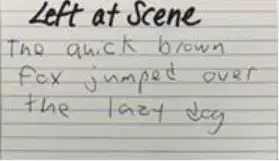
Identify 3 of the 12 handwriting characteristics learned in class that can be used to determine which handwriting sample matches.
Slant, spacing, and line habits
Color, paper size, and ink type
Font style, page margin, and text alignment
Word count, paragraph length, and punctuation usage
Provide one example of a forgery and one example of a fraud:
Forgery: Signing someone else's name on a check; Fraud: Lying about income on a loan application.
Forgery: Copying homework; Fraud: Forgetting to pay a bill.
Forgery: Using a fake ID for age verification; Fraud: Telling a joke.
Forgery: Writing a story; Fraud: Making a mistake on a test.
How is a forgery accomplished by using the following? Additions – ________
Adding marks that change the intent (changing from 1 to a 4)—can be determined by ultraviolet and infrared light.
Erasing marks to remove information—can be detected by magnification.
Using invisible ink to write hidden messages—can be revealed by heat.
Changing the color of the paper—can be identified by touch.
How is a forgery accomplished by using the following? Cross-outs – ________
Obliterate by inking over—solvents can expose the writing.
Erase completely—no trace remains.
Add extra strokes—makes writing illegible.
Use pencil—easy to remove.
How is a forgery accomplished by using the following? Erasure (removal) – ________
By pencil erasure or chemicals—can be determined by stereomicroscope, ultraviolet and infrared light.
By using invisible ink—can be detected by heating the paper.
By photocopying documents—can be identified by pixel analysis.
By using watermarks—can be detected by holding paper to light.
How is a forgery accomplished by using the following? Burning – ________
By destroying the original document—traces can be analyzed for differences.
By adding chemicals to alter ink color.
By freezing the document to preserve evidence.
By soaking the document in water to remove signatures.
What is a way counterfeit currency can be detected?
Security thread – UV light is used to detect it
Using a magnet to check for iron content
Smelling the currency for a specific scent
Listening to the sound when currency is dropped
What is evidence?
anything that tends to establish or disprove a fact.
a type of punishment for a crime.
a method of conducting experiments.
a form of entertainment.
Define trace evidence:
small but measurable amounts of physical or biological material found at a crime scene.
large and easily visible objects found at a crime scene.
evidence that can be seen without any scientific tools.
only DNA samples collected from suspects.
Define Locard's Principle of Exchange
When a person comes in contact with an object or another person, a cross transfer of physical evidence can occur indicating the two were in contact.
It states that only living organisms can exchange genetic material during contact.
It refers to the principle that only digital evidence can be transferred between two computers.
It is the idea that evidence can only be transferred if both parties are aware of the exchange.
Define the following type of evidence: Direct
Firsthand observation (eyewitness accounts, confessions, police dashboard video cameras)
Circumstantial evidence based on inference
Physical evidence such as fingerprints
Expert testimony from specialists
Define the following type of evidence: Circumstantial
Indirect evidence that can be used to imply a fact but does not prove it.
Direct evidence that proves a fact without inference.
Evidence obtained from eyewitness testimony only.
Evidence that is always biological in nature.
Define the following type of evidence: Class
Narrows the identity to a group of persons or things.
Identifies a specific individual with certainty.
Is based solely on eyewitness testimony.
Relates only to circumstantial evidence.
Define the following type of evidence: Individual
Narrows the identity to a single person or thing (DNA, fingerprint)
Is only found at crime scenes
Is used to determine the time of death
Is always visible to the naked eye
What is an example of physical evidence?
Weapons
DNA
Bloodstains
Eyewitness testimony
Describe the responsibilities of each member of the crime scene team: First responders
Usually the first to arrive at the crime scene. They secure the scene and direct activity.
They analyze evidence in the laboratory only.
They interview witnesses and suspects exclusively.
They are responsible for media relations and public statements.
Describe the responsibilities of each member of the crime scene team: Detectives
Interview witnesses and talk to the crime scene investigators about the evidence.
Collect physical evidence from the scene.
Take photographs of the crime scene.
Analyze laboratory results.
Describe the responsibilities of each member of the crime scene team: Specialists
Such as forensic scientists, entomologists, and forensic psychologists may be consulted if the evidence requires their expertise.
Are responsible for securing the perimeter of the crime scene and preventing contamination.
Collect and catalog all physical evidence found at the scene.
Interview witnesses and suspects to gather information about the crime.
List the seven S’s of a crime scene investigation.
Securing the scene, Sketching the scene, Separating the witnesses, Searching for evidence, Scanning the scene, Securing and collecting evidence, Seeing the scene
Securing the scene, Sketching the scene, Separating the witnesses, Searching for evidence, Scanning the scene, Securing and collecting evidence, Sampling the scene
Securing the scene, Sketching the scene, Separating the witnesses, Searching for evidence, Scanning the scene, Securing and collecting evidence, Summarizing the scene
Securing the scene, Sketching the scene, Separating the witnesses, Searching for evidence, Scanning the scene, Securing and collecting evidence, Supervising the scene
Define crime scene.
Anywhere evidence can be found
A place where only the victim is found, regardless of evidence.
Any location where police officers gather for meetings.
A courtroom where the trial of the crime takes place.
What must be included on a crime scene sketch?
Position of items as measured from immovable landmarks, Compass direction, Distance scale, All objects in the vicinity, Case number, Date, Location, Name of artist
Only the name of the artist and the date
Just the case number and compass direction
Only the objects found at the scene
What are the 4 primary search patterns?
Grid, Zone/Quadrant, Spiral, Linear
Grid, Circular, Zigzag, Random
Spiral, Circular, Grid, Random
Linear, Circular, Zigzag, Grid
What is the purpose of a paper bindle?
To be an ideal packaging for small, dry, trace evidence.
To store large liquid samples.
To preserve biological fluids for DNA analysis.
To transport heavy metal objects.
What are the best practices when collecting evidence to avoid contamination?
allow evidence to air dry and package in a paper bindle or paper bag to avoid contamination
seal wet evidence in a plastic bag immediately
mix all evidence together for convenience
handle evidence with bare hands
Define Chain of Custody
A documentation log that shows all persons that have had contact with the evidence.
A legal process for transferring property ownership.
A method for encrypting digital files.
A chain of command in a corporate structure.
Define Probative Value
Ability to prove a fact
A type of legal penalty
A method of cross-examination
A form of evidence exclusion
What constitutes probative value of evidence?
The level of individualization of the evidence
The age of the evidence at the crime scene.
The color of the evidence found.
The location where the evidence was collected.
Define a long gun
require the use of two hands
require the use of 1 hand
semi-automatic.
automatic
Define a handgun
requires 1 hand, easy to carry & conceal
requires 2 hands to use properly
requires 2 hands, easy to carry & conceal
requires 1 hand, not easily carried or concealed
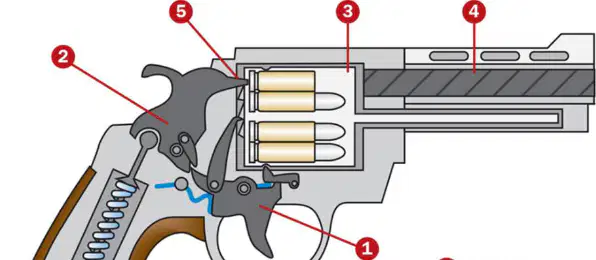
Label the parts of a firearm (refer to the diagram): 1. ________ 2. ________ 3. ________ 4. ________ 5. ________
1. Trigger 2. Hammer 3. Cylinder 4. Barrel 5. Firing pin
1. Magazine 2. Slide 3. Grip 4. Muzzle 5. Safety
1. Stock 2. Bolt 3. Chamber 4. Sight 5. Magazine
1. Safety 2. Slide 3. Magazine 4. Grip 5. Barrel
Define caliber and explain how caliber is determined: Caliber is ________ and is determined by ________.
Caliber is the measure of the diameter of the bullet and is determined by the diameter of the inside of a firearm’s barrel.
Caliber is the length of the bullet and is determined by the weight of the bullet.
Caliber is the speed of the bullet and is determined by the type of gunpowder used.
Caliber is the color of the bullet and is determined by the material of the casing.
Rifling patterns are:
the lands & grooves cut inside a gun barrel to make the bullet spin
the arrangement of bullets in a magazine
the pattern left by gunpowder residue
the design of a gun's exterior
Lands and grooves are features found on a bullet and are produced by which process?
By the rifling process inside a gun barrel
By the impact with a hard surface
By the manufacturing of the bullet casing
By the chemical reaction with gunpowder
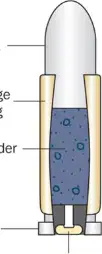
Which of the following correctly describes the parts of a cartridge?
Cartridge casing, primer, powder, bullet
Barrel, trigger, magazine, sight
Handle, spring, pin, lock
Chamber, grip, slide, safety
The difference between rimfire and centerfire on a cartridge is:
Rimfire cartridges have the primer in the rim, while centerfire cartridges have the primer in the center.
Rimfire cartridges are always larger than centerfire cartridges.
Centerfire cartridges do not use primers at all.
Rimfire cartridges are only used in shotguns.
How can you distinguish between entrance and exit wounds?
Entrance wounds are smaller than exit wounds.
Entrance wounds are always larger than exit wounds and contain bullet fragments.
Entrance and exit wounds are identical in size and shape.
Entrance wounds are circular while exit wounds are triangular.
Nitrates are a part of the GSR evidence. What is GSR?
Gunshot Residue
General Sample Report
Gasoline Spill Residue
Gross Sample Reaction
What is tattooing as related to ballistics evidence?
Contact within 6 inches, GSR can be driven into the skin.
A type of ink used to mark bullets.
A method for cleaning firearms.
A process for identifying gun serial numbers.
How does an investigator know if a bullet wound is from several feet away?
If contact is within 6 inches, GSR can be driven into the skin, which is known as tattooing. Beyond 4 feet, only a bullet hole is visible. Close range wound is star shaped or radial.
The wound will always have a star-shaped pattern regardless of distance.
There will be visible gunpowder residue on the skin at any range.
The bullet wound will show clear signs of burning and charring from the muzzle flash.
Explain the difference between a low velocity and high velocity firearm wound
Low velocity: Small caliber, bullets are more likely to lodge within the body. High velocity: Large caliber, wounds are more likely to pass through the body.
Low velocity: Large caliber, wounds are more likely to pass through the body. High velocity: Small caliber, bullets are more likely to lodge within the body.
Low velocity: Both wounds and bullets pass through the body. High velocity: Bullets always lodge within the body.
Low velocity: Wounds are always fatal. High velocity: Wounds are never fatal.
What does the acronym NIBIN stand for? Pg 596
National Integrated Ballistic Information Network
National Informative Bureau of Investigation Network
National Information Ballistics Identification Number
National Investigative Bureau of Information Network
What type of information does NIBIN have? Pg 596
NIBIN has images of ballistic evidence from crime scenes, or a test fired firearm.
NIBIN stores DNA profiles from suspects and victims.
NIBIN contains fingerprints collected from crime scenes.
NIBIN holds criminal records and arrest histories.
What three items make up the “fingerprint” of a firearm? Pg 597
Breech face impression, firing pin impression, and ejector mark
Barrel rifling, trigger mechanism, and magazine type
Grip texture, safety switch, and serial number
Hammer shape, recoil spring, and slide material
What type of impression is hidden until lifted using special techniques?
Patent
Latent
Plastic
What type of impression is visible and can be transferred?
Patent
Latent
Plastic
What type of impression is 3-D and left in soft material?
Patent
Latent
Plastic
Explain why shoe prints, tire marks, and tool marks are considered class evidence.
They may identify brand and size, but do not identify a specific individual or tire.
They always identify the exact person or object involved.
They are only found at crime scenes involving vehicles.
They are never used in forensic investigations.
Which of the following is an example of impression evidence that can be used to identify a suspect in a criminal investigation?
DNA samples
Tire tracks
Eyewitness testimony
Surveillance video
When analyzing shoe tread patterns at a crime scene, which of the following factors is most important to consider for accurate identification?
The color of the shoe
The size and depth of the tread pattern
The brand of the shoe
The age of the shoe
What can be inferred from a car's track width and wheelbase measurements?
The color of the car
The make and model of the car
How the car was being driven
The speed of the car
Does shoe size directly predict a person's height?
Yes, it is a direct indicator of height
Yes, but only in children
No, but foot size does predict height
No, neither foot size nor shoe size relate to a person's height
How can investigators preserve 3-D footprints in sand?
By using a flashlight
By spraying them with hairspray, then casting them in plaster
By spraying them with water
By using ultraviolet light
What materials can be used to lift latent shoe prints?
Water
A hard brush
Electrostatic dusting or gel
Sandpaper
What can multiple shoe prints tell us about a person's movement?
The direction of the wind
The person's mood
If someone was walking or running
The type of surface they were walking on

What type of impression is shown in the picture?
Plastic
Latent
Patent
Shoe

What type of impression is shown in the picture?
Plastic
Patent
Latent
Shoe
Which type of walking speed would the shoe impressions be MORE spread out?
Walking
Running
Select the correct category of tool mark for the following statement.
Created along the edge of a surface which has been cut by a tool
Abrasion Marks
Cutting Marks
Indentation Marks
Select the correct category of tool mark for the following statement.
Created by a tool when it is pressed onto a softer surface
Abrasion Marks
Cutting Marks
Indentation Marks
Select the correct category of tool mark for the following statement.
Created when a tool and another surface are slid across one another
Abrasion Marks
Cutting Marks
Indentation Marks
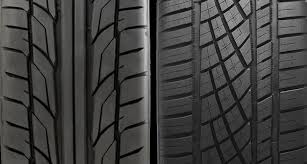
The design on the surface of a tire is known as _____________
Ridge pattern
Tread pattern
Tire grooves
Tire impressions
True or False: Loops are the most common form of fingerprints.
True
False
Match the following minutiae patterns.

Eye

Fork

Dot

Bridge

Trifurcation
The use of fingerprint identification is not perfect because ___.
The current technology depends on humans to input and analyze the information and humans make mistakes.
Many people have the exact same fingerprints.
People can easily change their fingerprints
AFIS shuts down from time to time making it hard for forensic examiners to use.

A print that has no delta is called:
A plain arch
A tented arch
An ulnar loop
A radial loop

What pattern is shown?
Plain Arch
Tented Arch
Plain whorl
Accidental whorl

This is an example of what type of fingerprint
central pocket whorl
arch
plain whorl
double loop whorl

ID this print
plain whorl
central pocket loop whorl
double loop whorl
accidental whorl

ID this print
plain whorl
central pocket whorl
double loop whorl
accidental whorl

ID this print
plain whorl
central pocket whorl
double loop whorl
accidental whorl

IAFIS is the...
FBI fingerprint database.
CIA DNA database.
International union of forensic scientists.
national child database.

The lines on your fingers that make a pattern are called...
cores.
deltas.
ridges.
arches.
The center of a loop or whorl is called...
Delta
Latent
Arch
Core

The area indicated by "B" in the diagram is known as a(n)
Core
Delta
Whorl
Arch


What type of fingerprint evidence is this?
Latent
Visible/Patent
Plastic
Lateral

What type of fingerprint evidence is this?
Latent
Visible/Patent
Plastic
Lateral
What is a latent fingerprint?
An impression left in soft material such as putty, wax or soap.
A fingerprint made by paint.
A fingerprint made by blood.
A fingerprint that is invisible to the eye.

Twins have the same fingerprints.
True
False
Identify the loop fingerprint pattern.


A fingerprint pattern will remain unchanged for the life of an individual; however, the print itself may change due to scars and disease.
True
False

When are fingerprints formed?
When you are a teenager
10 weeks gestation (in the womb)
By the time you are two years old
At birth
Fingerprints are a result of oil, salts, and water that are transferred to a surface by the ridges of one's finger.
True
False
In order to "erase" your fingerprints, this deep layer in the skin must be damaged:
Dermis
Basal Layer
Pores
Epidermis

