
 Worksheets
Exam 3
Total questions: 100
Worksheet time: 50mins
Corneal ulcer in calf is caused by ________.
Moraxella bovis.
Escherichia coli.
Streptococcus agalactiae.
Pasteurella multocida.
After thyroidectomy, what is seen in cats?
Hypocalcemia.
Hypercalcemia.
Hypertension.
Polycythemia.
Drug approved for cows is ________.
Sulfadimethoxine.
Amoxicillin.
Ibuprofen.
Paracetamol.
Mydriasis and cycloplegia are due to ________.
Atropine.
Pilocarpine.
Physostigmine.
Neostigmine.
Inflammation on metatarsal is seen in ________.
Popliteal lymph node.
Inguinal lymph node.
Axillary lymph node.
Cervical lymph node.
Triglyceride test is for ________.
Aspirated pleural fluid.
Urine sample.
Blood glucose level.
Cerebrospinal fluid.
Abortion in cattle near Yellowstone national park is caused by ________.
Brucella abortus.
Leptospira interrogans.
Bovine herpesvirus 1.
Campylobacter fetus.
Treatment for complicated strangles is ________.
Beta lactams antibiotics.
Antiviral drugs.
Non-steroidal anti-inflammatory drugs.
Antifungal agents.
Air observed in lungs is due to which type of bacteria?
Aerobe or anaerobe.
Streptococcus.
Lactobacillus.
Clostridium.
Cats are deficient in ________.
Glucuronidation.
Oxidation.
Hydrolysis.
Sulfation.
Best way to avoid toxoplasma is by ________.
Cleaning litter daily.
Eating undercooked meat.
Drinking untreated water.
Not washing fruits and vegetables.
Squamous cell carcinoma description is given on ________.
White cat ears.
Black dog nose.
Brown horse tail.
Grey rabbit paw.
Healthy rabbit has anorexia due to ________.
Trichobezoar.
Coccidiosis.
Pasteurellosis.
Myxomatosis.
Spinal fracture in rabbit is due to ________.
Mishandling.
Vitamin deficiency.
Old age.
Genetic mutation.
Inguinal hernia in rabbit is due to ________.
Open inguinal ring.
Closed inguinal ring.
Weak abdominal muscles.
Excessive fat deposition.
Which infiltration technique delays wound healing?
Line block.
Ring block.
Field block.
Local infiltration.
Thermoregulation involves which two mechanisms?
Cremaster muscle and skin vasoconstriction.
Sweat glands and hair follicles.
Adrenal gland and pancreas.
Liver and kidney.
Which drug delays wound healing?
Corticosteroids.
Antibiotics.
Antihistamines.
Vitamins.
Safe ectoparasite for dogs and cats is ________.
Fipronil and Methoprene.
Permethrin and Piperonyl butoxide.
Lindane and Malathion.
Diazinon and Carbaryl.
R. equi is treated with ________.
Rifampin and macrolides.
Penicillin and tetracycline.
Ciprofloxacin and metronidazole.
Amoxicillin and clavulanic acid.
Triple anesthetic protocol for horses includes ________.
Xylazine, ketamine and guaifenesin.
Xylazine, acepromazine and thiopental.
Ketamine, diazepam and halothane.
Guaifenesin, propofol and isoflurane.
Anesthetic induced myopathy in horse is due to ________.
Acidosis.
Alkalosis.
Hypoglycemia.
Hypercalcemia.
Diet for polysaccharide storage myopathy is ________.
Low carbohydrates with high fat and high protein.
High carbohydrates with low fat and low protein.
Low protein with high carbohydrates and high fat.
High fat with high carbohydrates and low protein.
Equine respiratory signs are managed by ________.
Dust control.
Increased exercise.
High protein diet.
Frequent bathing.
Antibiotics should be given ________ before surgery.
30 minutes.
2 hours.
Immediately after surgery.
1 day.
Dissociative anesthesia is caused by ________.
Ketamine.
Propofol.
Thiopental.
Halothane.
Detomidine side effects include ________.
Bradycardia.
Hypertension.
Tachycardia.
Diarrhea.
Propofol side effects are ________.
Transient apnea.
Hypertension.
Persistent insomnia.
Increased salivation.
Dog stops breathing during anesthesia is managed by ________.
Positive pressure ventilation.
Administering oral medications.
Increasing anesthesia dosage.
Withholding oxygen supply.
Pulse oximeter measures ________.
Percentage of saturated hemoglobin.
Blood pressure.
Respiratory rate.
Body temperature.
What diagnosis requires arterial blood?
Hypoxia.
Anemia.
Leukemia.
Thrombocytopenia.
Hypertrophic cardiomyopathy in cats, treatment is ________.
Diltiazem and furosemide.
Amoxicillin and prednisolone.
Insulin and metronidazole.
Enalapril and omeprazole.
Cat with skin and respiratory signs is likely to have ________.
Cryptococcus.
Feline asthma.
Ringworm.
Panleukopenia.
Diarrhea in cats is due to ________.
Feline panleukopenia (feline parvovirus).
Feline leukemia virus.
Feline immunodeficiency virus.
Feline calicivirus.
Listeria is due to ________.
Silage.
Contaminated water.
Spoiled meat.
Unpasteurized milk.
Cranial nerve with three functions is ________.
Oculomotor nerve.
Trigeminal nerve.
Facial nerve.
Abducens nerve.
Long question regarding eye examination, what nerves are damaged?
Left optic (II) and right facial (VII).
Right optic (II) and left facial (VII).
Left oculomotor (III) and right trigeminal (V).
Right abducens (VI) and left trochlear (IV).
Risk factor for enterotoxemia is ________.
High fermentable feed.
Low protein diet.
Excessive exercise.
Cold weather exposure.
Old dog with megaesophagus and thymoma is likely to have ________.
Myasthenia gravis.
Addison's disease.
Diabetes mellitus.
Cushing's syndrome.
Moldy sweet clover poisoning causes ________.
Hemorrhage.
Convulsions.
Paralysis.
Jaundice.
Which toxicity signs are there in a horse with hypocalcemia, hypomagnesemia and mouth ulcers?
Cantharidin toxicity.
Lead toxicity.
Copper toxicity.
Selenium toxicity.
Cells in macrocytic hypochromic anemia are ________.
Reticulocytes.
Lymphocytes.
Neutrophils.
Erythrocytes.
Largest stomach part in newborn calf is ________.
Abomasum.
Rumen.
Reticulum.
Omasum.
Hepatogenous photosensitization is seen most likely in ________.
Bovine.
Canine.
Equine.
Feline.
Suburethral diverticulum in bovine is called ________.
Bovine
Urethral cyst
Parovarian cyst
Gartner's duct cyst
Most common heart disease in dogs is ________.
Dilated cardiomyopathy
Mitral valve prolapse
Aortic stenosis
Pulmonary stenosis
Salivary gland mucocele is also known as ________.
Sublingual
Parotid
Submandibular
Lingual
Lactase producing bacteria, treatment is ________.
Amoxicillin and Clavulanic Acid
Metronidazole
Ciprofloxacin
Azithromycin
Glandular portion of the stomach in birds is called ________.
Proventriculus
Gizzard
Crop
Cloaca
Reabsorption of toxin principle is possible from urinary bladder in ________.
Chocolate toxicity
Ethylene glycol poisoning
Lead poisoning
Paracetamol toxicity
Which muscles are affected in sweeny (suprascapular neuropathy)?
Supraspinatus and infraspinatus
Deltoid and trapezius
Biceps brachii and triceps brachii
Latissimus dorsi and pectoralis major
Intervertebral disc disease description is ________.
Disc herniation
Bone fracture
Muscle strain
Ligament tear
Horse with proximal jejunitis first action to take is ________.
Decompression
Antibiotics
Surgery
Fluid restriction
Bulge on the right abdomen of the horse is ________.
Cecum
Colon
Stomach
Liver
Horse cribbing is a stereotypical behavior that should be addressed.
True
False
Maybe
Not sure
Dog separated from owner in sunlight room shows ________.
Separation anxiety
Excitement
Aggression
Hunger
Biochemistry in traumatic reticuloperitonitis shows ________.
Hyperglobulinemia
Hypoproteinemia
Hypoglycemia
Hypercalcemia
Which joint block affects the two adjacent joints?
Tarsocrural and proximal intertarsal
Metacarpophalangeal and distal interphalangeal
Carpal and radioulnar
Stifle and femoropatellar
Mast cell tumor description is ________.
Round cells and granules
Spindle cells and collagen
Squamous cells and keratin
Glandular cells and mucus
Multiple myeloma shows ________.
Gammaglobulinemia
Leukocytosis
Hypoglycemia
Thrombocytopenia
Thoracocentesis is performed at the cranial border of the ________ rib.
6th
5th
7th
8th
Auscultation in horses, location is ________ rib, ________ rib to the olecranon.
11th rib, 9th rib
10th rib, 8th rib
12th rib, 10th rib
13th rib, 11th rib
Normal presentation, position and posture of the fetus is ________.
Dorsosacral position, cranial longitudinal with the forelimbs extended and the head in rest on it
Dorsolumbar position, caudal longitudinal with the hindlimbs flexed
Ventral position, transverse with the head turned backward
Lateral position, cranial longitudinal with the forelimbs flexed
Pig estrous cycle is ________ days.
21
28
14
35
Dog vaginal cytology shows high number of keratinized cells and few RBCs, this indicates ________.
Estrus phase
Proestrus phase
Anestrus phase
Diestrus phase
Which nerve block affects the lower lip?
Mental nerve block
Inferior alveolar nerve block
Buccal nerve block
Lingual nerve block
Maxillary nerve block acts on which structures?
Upper lip, maxilla and nostrils
Lower lip, mandible and chin
Tongue, floor of mouth and lower teeth
Scalp, forehead and eyelids
Horse upper eyelid suturing uses ________.
Auriculopalpebral and supraorbital nerve block
Infraorbital and mental nerve block
Maxillary and mandibular nerve block
Retrobulbar and zygomatic nerve block
Test for exocrine pancreatic insufficiency in German shepherd is ________.
Trypsin-like immunoreactivity (TLI)
Serum amylase estimation
Bile acid stimulation test
Serum creatinine measurement
Portosystemic shunt leads to ________.
Hyperammonemia
Hypokalemia
Hyperglycemia
Hypocalcemia
Toxoplasma resides in which organ in the definite host?
Intestine
Liver
Lung
Kidney
Which anesthetic drug doesn’t have analgesic effects?
Xylazine and ketamine
Ketamine
Xylazine
Propofol
Foal born 24 hours ago has aganglionosis, what to do?
Euthanize
Administer antibiotics
Perform blood transfusion
Provide vitamin supplements
Flunixin meglumine acts on ________.
COX-1 and COX-2
Histamine receptors
Beta-adrenergic receptors
Dopamine receptors
Horse feels pain during palpation on dorsal aspect of the metacarpus, this is called ________.
Bucked shin
Ringbone
Navicular disease
Splints
What will happen when you’re removing upper teeth in canines?
Oronasal fistula
Mandibular fracture
Tooth resorption
Gingival hyperplasia
Round eggs in a horse’s fecal sample typically indicate what?
A roundworm infection, specifically ascarids (Parascaris equorum)
Tapeworm infection (Anoplocephala perfoliata)
Pinworm infection (Oxyuris equi)
Strongyle infection (Strongylus vulgaris)
WNV detection by ________.
IgM capture ELISA
Western blot
PCR
Rapid antigen test
Site for OVH in cats is ________.
Middle third to middle second third of the abdomen
Caudal third of the abdomen
Cranial third of the abdomen
Lateral aspect of the abdomen
Meningitis and arthritis in pig, which disease?
Streptococcus
Swine Influenza
Foot and Mouth Disease
Porcine Parvovirus
Which two joints of the tarsus are desensitized with one injection?
Tarsocrural and proximal intertarsal
Distal intertarsal and tarsometatarsal
Calcaneocuboid and talonavicular
Tarsometatarsal and talocalcaneal
Rabbit with crusts and ulcers on external genitalia is diagnosed with ________.
Rabbit syphilis (Treponema cuniculi)
Pasteurellosis
Coccidiosis
Myxomatosis
Dictyocaulus arnfieldi in horse is diagnosed via ________.
Fecal flotation / Baermann technique
Blood smear examination
Skin scraping
Urine sedimentation
Dog has depigmentation and ulcer in the upper eyelid and it’s rubbing the eye. What is the diagnosis?
Uveodermatologic syndrome.
Conjunctivitis.
Entropion.
Glaucoma.
Bird recovery from anesthesia. What should you use?
Use a towel.
Give cold water.
Turn off the lights.
Feed immediately.
Cortex of adrenal gland related to the medulla. What is its echogenicity?
Hypoechoic.
Hyperechoic.
Isoechoic.
Anechoic.
Drug contraindicated in food animals.
Metronidazole.
Amoxicillin.
Enrofloxacin.
Tylosin.
Streptococcus equi in horse, from where would we take a sample?
Guttural pouch.
Hoof wall.
Tail hair.
Ear canal.
Organism on surfaces of RBCs in feline, splenomegaly and anemia. What is the organism?
Mycoplasma haemofelis.
Babesia felis.
Cytauxzoon felis.
Haemobartonella canis.
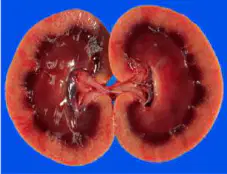
Picture of a cat kidney with hemorrhage on it, what is the etiology?
Morbillivirus (feline morbillivirus).
Feline calicivirus.
Feline leukemia virus.
Feline infectious peritonitis virus.
Cat having buccal ulcers symptoms. What is the causative agent?
Calicivirus.
Feline herpesvirus.
Bordetella bronchiseptica.
Chlamydia felis.
Dogs to prevent dental plaque, what to do?
Toys, scaling of teeth, brushing.
Feed only soft food.
Give more treats and bones.
Avoid cleaning teeth completely.
Use only water to clean teeth.
Yellow color fluid observed in cat. What is the diagnosis?
Feline infectious peritonitis.
Pancreatitis.
Renal failure.
Diabetes mellitus.
Megaesophagus diagnostic test.
Acetaminophen antibody test.
Barium swallow radiography.
Urine glucose test.
Electrocardiogram.
Hyperkalemia is present, what will you see in ECG?
Absent P wave, T wave spike and bradycardia.
Tall P wave, flattened T wave and tachycardia.
Normal ECG findings.
ST elevation and deep Q waves.
Johne’s disease main outcome.
Emaciation and weight loss.
Fever and cough.
Skin rash and itching.
Joint pain and swelling.
Nasal discharge and sneezing.
In cat after thoracocentesis you retrieve cloudy fluid, what is your next step?
Check triglyceride concentration.
Send fluid for cytology only.
Discard the fluid and repeat thoracocentesis.
Administer antibiotics immediately.
Neonatal isoerythrolysis condition. What are the sire and mare genotypes?
Sire Aa+ Qq+ and mare Aa- Qq-.
Sire Aa- Qq+ and mare Aa+ Qq-.
Sire Aa+ Qq- and mare Aa- Qq+.
Sire Aa- Qq- and mare Aa+ Qq+.
Immune mediated hemolytic anemia is which type of hypersensitivity?
Type II.
Type I.
Type III.
Type IV.
Which route is nasogastric tube passed in a horse without bleeding?
Ventral meatus.
Dorsal meatus.
Middle meatus.
Nasal septum.

