
 Worksheets
Nutrients
Total questions: 50
Worksheet time: 25mins
What are nutrients defined as?
The substances found in food that keep your body functioning.
The vitamins found in fruits.
The minerals found in water.
The proteins found in meat.
Which of the following are functions of nutrients in your body?
Fuel your energy
Help you grow
Repair itself
Maintain basic bodyily functions
Make you sleepy
No growth
Damage body
Lose feeling
Cause illness
High Blood Pressure
Diabetes
Fever
Reduce water intake
Tired
Balance diet
Hunger Feeling
Fill in the blank: One of the 6 essential nutrients is _________.
Water
Sugar
Fiber
Caffeine

Fill in the blank: One of the 6 essential nutrients is _________
Carbohydrates
Fiber
Caffeine
Alcohol
Fill in the blank: One of the 6 essential nutrients is _________.
Protein
Fiber
Caffeine
Sugar
Fill in the blank: One of the 6 essential nutrients is _________.
Fat
Sugar
Fiber
Caffeine
Fill in the blank: One of the 6 essential nutrients is _________.
Vitamins
Sugar
Caffeine
Fiber
Fill in the blank: One of the 6 essential nutrients is _________.
Minerals
Fiber
Caffeine
Sugar
What proportion of the human body consists of water?
1/4 to 1/2
1/2 to 3/4
3/4 to 1
1/3 to 2/3
Functions in the Body: What does water do for your cells?
Carries nutrients and waste
Provides energy
Builds muscle
Increases fat
Functions in the Body: What does water help regulate in your body?
Body temperature
Blood sugar level
Bone density
Hair color
It is recommended that teens drink how many glasses (8 fl.oz each) of water each day?
2-4
4-6
6-8
8-10

What is the main function of carbohydrates in the body?
Build muscles
Provide energy
Help with breathing
Improve eyesight

Carbohydrates are the body's main source of energy and provide the body's need for dietary fiber. Which of the following is NOT a food source of carbohydrates?
Pasta
Breads
Fish
Rice
Carbohydrates are the body's main source of energy and provide the body's need for dietary fiber. Fill in the blank: Two types of carbohydrates are ________ and simple carbohydrates.
Starches or Complex Carbohydrates
Proteins
Fats
Vitamins
Which of the following is NOT a food source of starches or complex carbohydrates?
Whole grain breads
Vegetables
Rice
Chicken
What is one function of starches or complex carbohydrates in the body?
They are an excellent source of fuel (energy) for the body.
They help build muscles.
They are a source of fat.
They provide water.
What are simple carbohydrates?
Nutrients that are broken down slowly by the body
Nutrients that are broken down quickly by the body to be used as energy
Nutrients that are not broken down by the body
Nutrients that are only found in vegetables
Fill in the blank: Simple carbohydrates are broken down quickly by the body to be used as _______.
energy
protein
fiber
vitamins
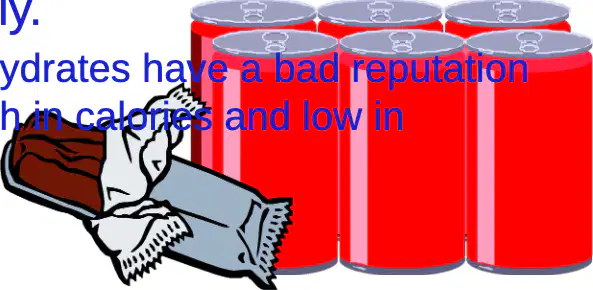
Candy, soda, and jelly are examples of food sources of simple carbohydrates.
True
False
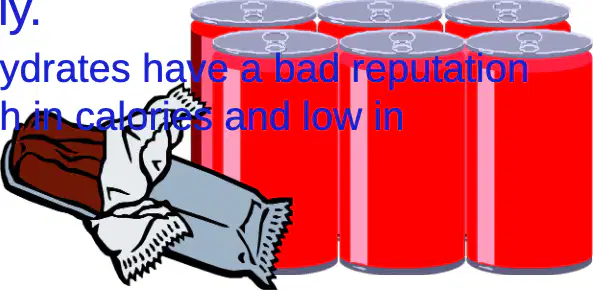
These simple carbohydrates have a bad reputation because they are high in calories and low in nutritional value.
True
False

What is fiber?
A) A type of protein
B) The plant material that doesn’t break down when you digest food
C) A type of fat
D) A vitamin

Fill in the blank: Fiber aids in ________.
digestion
hearing
vision
breathing

Which of the following is a function of fiber in the body?
Helps promote regularity
Increases blood pressure
Causes weight gain
Reduces bone strength

Which of the following is NOT a major food source of protein?
Meat
Fish
Dairy products
Candy
How many amino acids are there?
20
10
15
25
Proteins are made up of chemical compounds called amino acids.
True
False
The best way to give the body complete proteins is to eat a wide variety of foods throughout the day.
True
False
What is the most concentrated form of food energy (calories)?
Protein
Carbohydrate
Fat
Vitamin
The body uses fat as a fuel source, and fat is the major storage form of energy in the body.
True
False
Fat is required to carry ______ vitamins throughout the body.
fat-soluble
water-soluble
protein-based
carbohydrate-based
Fat provides energy.
True
False
What type of fat is usually solid at room temperature?
Saturated Fat
Unsaturated Fat
Polyunsaturated Fat
Monounsaturated Fat
Saturated fat is most strongly linked to high cholesterol and increased risk of heart disease.
True
False
Fats that are liquid at room temperature are called ________.
Unsaturated Fat
Saturated Fat
Trans Fat
Hydrogenated Fat
Cholesterol aids in _______.
digestion
respiration
photosynthesis
excretion
Unlike carbohydrates, fats, and proteins, vitamins provide energy (calories).
True
False
How many different vitamins are known to be required each day for good health?
5
10
13
20
Vitamins are separated into two types: ________ Soluble & ________ Soluble Vitamins.
Fat, Water
Protein, Mineral
Sugar, Salt
Acid, Base
Which of the following are fat soluble vitamins?
Vitamins A, D, E, K
Vitamins C and B-complex
Vitamins A, C, E, K
Vitamins D and B-complex
Fat soluble vitamins can be stored in the body for later use.
True
False
Which of the following are water soluble vitamins?
Vitamins A, D, E, K
Vitamins C and B-complex
Vitamins A, C, E, K
Vitamins D and B-complex
Water soluble vitamins require ______ for absorption.
water
fat
protein
fiber
Water soluble vitamins are easily absorbed and passed through the body as ______.
waste
energy
proteins
hormones
What is a nonfood source of Vitamin D?
The sun
Water
Meat
Cheese
Vitamin D plays a role in building strong ______ and teeth.
bones
muscles
nerves
skin
Which of the following is considered a bad fat?
Monosaccharide
Unsaturated fat
Saturated fat
Carbohydrate
Bad fats can be very unhealthy.
True
False
Vitamin C
Water-soluble and fights infections
Fat-soluble and helps with bones
Water-soluble and helps with skin
Fat-soluble and fights diabetes
Too much sodium can lead to
High Blood Pressure
Diabetes
Common Cold
Sprained Ankle

