
 Worksheets
Cardiac Cycle Overview
Total questions: 84
Worksheet time: 42mins
Which statement best defines the cardiac cycle?
One complete heartbeat sequence
Only atrial contraction phase
Only ventricular relaxation period
Electrical conduction without pumping
During atrial systole, what event on the ECG is most closely associated with its initiation?
Crest of the P wave
Start of the QRS complex
End of the T wave
Isoelectric TP segment
Which phases are primarily systolic rather than diastolic?
Isovolumic ventricular contraction
Rapid ventricular ejection
Rapid ventricular filling
Reduced ventricular filling
Isovolumic ventricular relaxation
Match each cardiac phase to its dominant mechanical event.
Atrial systole
Atrial contraction adds atrial kick
Isovolumic ventricular contraction
Ventricular pressure rises at fixed volume
Rapid ventricular ejection
Blood expelled swiftly from ventricles
Isovolumic ventricular relaxation
Ventricular pressure falls at fixed volume
Rapid ventricular filling
Early diastolic inflow into ventricles
Approximately how does atrial systole contribute to ventricular filling under resting conditions?
Adds a small atrial kick volume
Provides most of the diastolic inflow
Occurs after the QRS complex entirely
Closes AV valves to aid suction
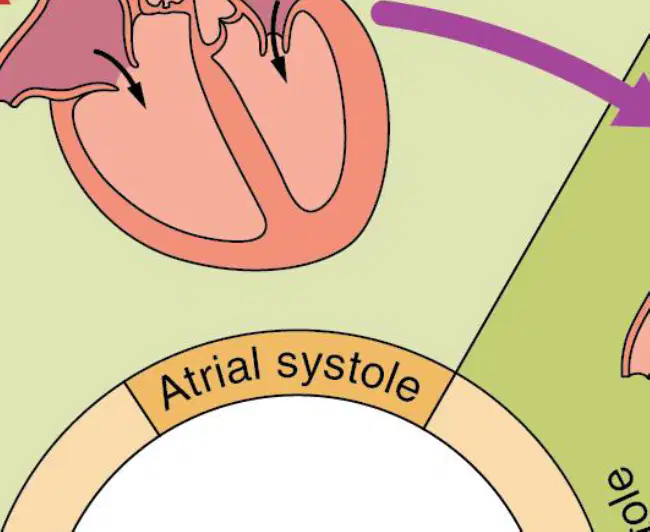
In the phase labeled atrial contraction in the diagram, which statement best describes valve status and blood flow?
Atrioventricular valves open; blood enters ventricles
Semilunar valves open; blood exits ventricles
All valves closed; volume remains constant
Atrioventricular valves closed; blood enters atria
During isovolumetric ventricular contraction shown in the slide, which valves are closed immediately after ventricular systole begins?
Mitral valve
Aortic valve
Tricuspid valve
Pulmonary valve
Match each cardiac cycle phase to the predominant valve state depicted.
Atrial contraction
AV valves open, semilunars closed
Isovolumetric contraction
All valves closed, pressure rising
Ventricular ejection
Semilunars open, AV valves closed
Isovolumetric relaxation
All valves closed, pressure falling
Which event initiates closure of the mitral valve during early systole, as highlighted in the slide?
Left ventricular pressure exceeds left atrial pressure
Left atrial pressure exceeds aortic pressure
Aortic pressure falls below ventricular pressure
Ventricular volume increases during filling
Which combination correctly characterizes isovolumetric ventricular contraction?
Rising pressure with constant volume in ventricles
Falling pressure with constant volume in atria
Rising volume with constant pressure in ventricles
Rising pressure with open semilunar valves
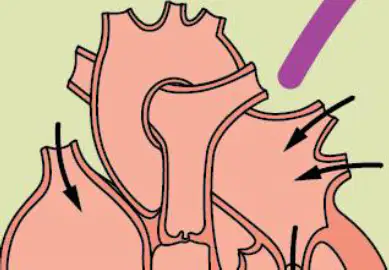
During ventricular ejection, which pressure relationship must be satisfied for the aortic valve to open?
Left ventricular pressure exceeds aortic pressure
Aortic pressure exceeds left atrial pressure
Left atrial pressure exceeds ventricular pressure
Pulmonary pressure exceeds right atrial pressure

Which phase immediately follows ventricular ejection in the cardiac cycle, and what is the valve configuration at its onset?
Isovolumetric relaxation; all valves closed
Atrial systole; AV valves open
Ventricular filling; semilunars open
Isovolumetric contraction; AV valves open
During rapid ventricular ejection, which event occurs first to permit blood to leave the ventricle?
Mitral valve opens widely
Aortic valve opens fully
Atria contract forcefully
Pulmonary valve closes
Ventricles relax isovolumically
Which change characterizes the transition from rapid ventricular ejection to reduced ventricular ejection?
Ejection velocity progressively decreases
Ventricular pressure rapidly increases
Atrioventricular valves abruptly open
Aortic valve closes immediately
Ventricular volume begins to rise
At the end of reduced ventricular ejection, what is the state of the aortic valve?
Fully open for peak flow
Partially open with regurgitation
Finally closed at phase end
Opening during early diastole
Prolapsed into left ventricle
Which statement best describes atrial activity during ventricular ejection?
Atrium actively contracts throughout
Atrium relaxes and begins filling
Atrium remains empty and tense
Atrium empties via open mitral
Atrium undergoes isovolumic phase
Which sequence correctly matches phase to hallmark event?
Rapid ventricular ejection
Aortic valve opens and blood exits
Reduced ventricular ejection
Ejection velocity decreases over time
Isovolumic ventricular relaxation
Aortic valve closure initiates phase
Early diastolic filling
Ventricular pressure falls below atrial
Once the aortic valve has closed, which phase begins and what is the left ventricular volume at this time?
Isovolumic relaxation; volume lowest
Isovolumic contraction; volume highest
Rapid filling; volume increasing
Atrial systole; volume maximal
Reduced ejection; volume stable
Which pair of statements about isovolumic ventricular relaxation is accurate?
Semilunar valves are closed throughout
Atrioventricular valves are open throughout
Left ventricular pressure is falling
Left ventricular volume increases steadily
Phase begins immediately after aortic closure
Which event initiates atrial systole in the cardiac cycle?
Atrial excitation spreads through atria
Ventricular excitation begins in septum
Closure of semilunar valves occurs first
Mitral valve snaps shut from pressure
During atrial systole, what primary contribution does the atria make to ventricular filling?
It provides the atrial kick volume
It opens the aortic valve actively
It raises venous pressure greatly
It shortens ventricular systole
The P wave on a standard ECG corresponds most directly to which mechanical phase?
Atrial depolarization before systole
Ventricular repolarization in diastole
Isovolumetric ventricular contraction
Rapid ventricular ejection phase
Match each ventricular filling phase with its description.
Rapid ventricular filling
Blood flows quickly after AV opening
Reduced filling (diastasis)
Both chambers relaxed, slow inflow
Atrial systole contribution
Final boost from atrial contraction
Calculate stroke volume given EDV = 120 ml and ESV = 50 ml.
70 ml per beat
60 ml per beat
55 ml per beat
80 ml per beat
Which statements about ejection fraction are correct?
EF equals SV divided by EDV
Normal EF is roughly 55%–75%
EF is used to assess heart failure
EF equals EDV minus ESV directly
EF rises when SV falls with constant EDV
During isovolumic ventricular contraction, which valves are closed while ventricular pressure rises without a change in volume?
Mitral and aortic valves
Mitral and tricuspid valves
Aortic and pulmonary valves
Tricuspid and pulmonary valves
Which event marks the end of isovolumic ventricular contraction and the beginning of ventricular ejection?
Opening of aortic valve
Opening of mitral valve
Closure of aortic valve
Opening of tricuspid valve
What immediate mechanical consequence follows mitral valve closure at the onset of ventricular systole?
Rapid pressure rise at constant volume
Rapid volume rise at constant pressure
Slow pressure fall with volume loss
No change in pressure or volume
Select all statements that accurately describe isovolumic ventricular contraction.
Occurs early in ventricular systole
Atrioventricular valves are closed
Semilunar valves are open
Ventricular volume remains constant
Intraventricular pressure declines progressively
Match each structure with its state during isovolumic ventricular contraction.
Left ventricle volume
Constant (no ejection)
Intraventricular pressure
Rising steeply
Mitral valve
Closed
Aortic valve
Closed
A sudden increase in aortic pressure would most directly affect which aspect of the isovolumic ventricular contraction phase?
Duration until aortic valve opens
Timing of mitral valve closure
End-diastolic volume at start
Presence of atrial contraction
During rapid ventricular ejection, which event directly permits blood to leave the left ventricle into the aorta?
Opening of the aortic valve
Closure of the aortic valve
Opening of the mitral valve
Closure of the tricuspid valve
Which statement best distinguishes rapid from reduced ventricular ejection?
Rapid ejection shows peak flow; reduced ejection shows declining flow
Rapid ejection occurs after valve closure; reduced ejection before closure
Rapid ejection empties atria; reduced ejection fills ventricles
Rapid ejection needs low afterload; reduced ejection needs no afterload
Select all features that occur during reduced ventricular ejection.
Aortic valve remains open initially
Ventricular pressure gradually falls
Atrial relaxation continues
Blood accelerates to peak velocity
Match each phase with the predominant flow pattern.
Rapid ventricular ejection
Maximal outflow from ventricle
Reduced ventricular ejection
Declining outflow from ventricle
Isovolumetric contraction
No outflow; valves closed
Which event signals the end of ventricular ejection and the start of isovolumetric relaxation?
Aortic valve closure
Mitral valve opening
Aortic valve opening
Atrial contraction
During rapid ventricular ejection, what is the typical state of the atria?
They are relaxing and filling
They are contracting strongly
They are isovolumetric
They are empty and closed
During isovolumic ventricular relaxation, which statement is most accurate about the left ventricle and aortic valve?
LV volume decreases while aortic valve open
LV volume constant with aortic valve closed
LV volume increases with aortic valve open
LV volume constant with aortic valve open
Which events define the transition from systole to early diastole in the left heart?
Aortic valve closure occurs
Mitral valve opens immediately
Left ventricular pressure falls rapidly
Left ventricular volume rises sharply
Isovolumic relaxation begins
Match each term to its description in isovolumic ventricular relaxation.
Aortic valve
Closed during the phase
Left ventricular volume
Remains unchanged
Ventricular diastole
Begins after systole
Isovolumic relaxation
Pressure falls with no filling
What triggers the end of isovolumic ventricular relaxation?
Aortic valve reopening causing ejection
Mitral valve opening allowing filling
Left ventricular volume decreasing further
Atrial systole increasing LV pressure
During early diastole, what mechanical event primarily allows rapid ventricular filling to occur?
Mitral valve opening with atrial–ventricular gradient
Aortic valve closure generating suction in ventricles
Active ventricular relaxation increasing atrial pressure
Atrial systole forcing blood across closed valves
Which sequence best describes the transition from rapid to reduced ventricular filling in a normal heart?
Large atrioventricular gradient diminishes, flow slows to diastasis
Atrial pressure rises steadily, flow accelerates progressively
Ventricular compliance decreases suddenly, flow becomes turbulent
Mitral valve partially closes, atrial kick maintains rapid flow
Select all features characteristic of reduced ventricular filling (diastasis) in late diastole.
Minimal atrioventricular pressure gradient
Passive flow continues at a slow rate
Occurs before atrial contraction phase
Mitral valve is closed throughout
Dominant determinant is heart rate duration
Match each phase or event with its description.
Rapid ventricular filling
High early-diastolic inflow driven by AV gradient
Reduced filling (diastasis)
Low-flow period with near pressure equilibrium
Mitral valve opening
Begins when LV pressure falls below LA pressure
Atrial systole
Final boost to ventricular volume before systole
Which condition would most reduce the proportion of diastasis time in the cardiac cycle for a given stroke volume?
Tachycardia shortening diastole significantly
Increased venous return at constant rate
Enhanced ventricular compliance at rest
Slight rise in aortic systolic pressure
Which set correctly defines the volumes used to calculate ejection fraction?
End-diastolic and end-systolic volumes
Stroke volume and cardiac output
End-diastolic and stroke volumes
End-systolic volume and preload
A patient's EDV is 140 mL and ESV is 70 mL. What is the stroke volume?
210 mL
70 mL
140 mL
35 mL
Ejection fraction is best described as which ratio?
Stroke volume to end-diastolic volume
End-systolic volume to stroke volume
End-diastolic volume to cardiac output
Cardiac output to end-systolic volume
Select all statements that correctly relate ventricular volumes and heart failure risk.
Low ejection fraction suggests systolic dysfunction
High ESV with unchanged EDV lowers ejection fraction
Increased stroke volume increases ejection fraction
Ejection fraction falls when EDV rises and SV constant
Match each metric with its most accurate definition.
End-diastolic volume (EDV)
Volume in ventricle after filling
End-systolic volume (ESV)
Volume remaining after contraction
Stroke volume (SV)
EDV minus ESV per beat
Ejection fraction (EF)
SV divided by EDV
A patient has EDV 160 mL and EF 50%. What is the ESV?
80 mL
40 mL
120 mL
60 mL
Which clinical scenario most likely reflects reduced ventricular efficiency?
Elevated ESV with reduced EF
Normal EF with stable EDV
High SV with moderate EF
Low ESV with increased SV
Cardiac output equals the product of which two variables?
Stroke volume and heart rate
Stroke volume and preload
Afterload and heart rate
Contractility and preload
Systemic resistance and preload
If heart rate increases while stroke volume remains constant, what happens to cardiac output?
It increases proportionally
It decreases slightly
It remains unchanged
It fluctuates randomly
It doubles then falls
Which factor primarily reflects left ventricular end-diastolic wall stress and volume?
Preload of the LV
Afterload of the LV
Contractility of LV
Systemic venous tone
Pulmonary resistance
Afterload is best defined as which of the following?
The pressure the ventricle ejects against
The volume that fills the ventricle
The intrinsic inotropy of myocardium
The venous return to the atria
The rate of electrical depolarization
An increase in venous return most directly increases which determinant of stroke volume?
Preload
Afterload
Contractility
Heart rate
Peripheral resistance
Sympathetic stimulation that increases intracellular calcium most directly changes which variable?
Myocardial contractility
Ventricular preload
Arterial afterload
End-systolic volume
Venous compliance
Which combination typically increases stroke volume?
Increased preload
Decreased afterload
Increased contractility
Decreased heart rate
Increased systemic resistance
For a fixed contractility and afterload, raising preload will most likely have what effect on end-diastolic sarcomere length and stroke volume?
Both increase together
Both decrease together
Length increases, volume decreases
Length decreases, volume increases
Neither changes appreciably
Left ventricular afterload rises sharply with which change?
Increased aortic pressure
Increased venous capacitance
Decreased arterial elastance
Increased diastolic filling
Decreased systemic resistance
Match each determinant with its most direct physiological descriptor.
Preload
Ventricular filling before systole
Afterload
Arterial load opposing ejection
Contractility
Inotropic state independent of load
Heart rate
Beats per minute
If contractility decreases while preload and afterload are unchanged, what happens to stroke volume and end-systolic volume?
Stroke volume falls, ESV rises
Stroke volume rises, ESV falls
Both remain unchanged
Both rise markedly
Both fall markedly
Which scenario is most likely to decrease cardiac output, assuming HR is constant?
Increased afterload with unchanged preload
Mild preload increase with stable afterload
Enhanced contractility after exercise
Reduced afterload with steady preload
Balanced venous return and arterial tone
Which statement best defines myocardial contractility?
Force of contraction at constant preload and afterload
Rate at which pacemaker cells depolarize at rest
Ability to eject a fixed stroke volume regardless of load
Extent of ventricular filling before systole begins
Inotropy primarily reflects changes in which intracellular mediator in cardiac myocytes?
Free cytoplasmic calcium concentration
Intracellular sodium concentration
Mitochondrial ATP availability
Sarcolemmal potassium efflux
Positive inotropic effect is most directly associated with which cellular event?
Increased calcium binding to troponin C
Reduced calcium uptake by SERCA pump
Decreased L‑type calcium channel opening
Enhanced sodium extrusion via Na⁺/K⁺‑ATPase
Which pair correctly matches an agent with its inotropic effect?
Norepinephrine
Positive inotropy via β1 stimulation
Digoxin
Positive inotropy via Na⁺/K⁺‑ATPase inhibition
Beta‑blocker
Negative inotropy via β1 antagonism
Calcium channel blocker
Negative inotropy via reduced Ca²⁺ entry
Stimulation of the sympathetic nervous system typically causes which combination of effects on the heart?
Increased inotropy through β1 signaling
Decreased chronotropy via vagal activation
Enhanced calcium influx during plateau
Reduced cytoplasmic calcium during systole
Faster relaxation via phospholamban phosphorylation
Which change would most likely decrease myocardial contractility?
β1‑adrenergic blockade with propranolol
Phosphodiesterase III inhibitor infusion
Administration of low‑dose dobutamine
Increased extracellular calcium concentration
A patient on digoxin shows increased contractile force. The primary mechanism is best described as:
Inhibition of Na⁺/K⁺‑ATPase increasing intracellular Ca²⁺
Direct agonism of β1‑adrenergic receptors in myocytes
Opening of sarcolemmal K⁺ channels reducing afterload
Blocking ryanodine receptors limiting SR Ca²⁺ release
During exercise, what mechanism most consistently accounts for increased inotropy?
Sympathetic activation raising cAMP and Ca²⁺ entry
Withdrawal of parasympathetic tone to ventricles
Increased preload independent of calcium dynamics
Reduced afterload enhancing ejection fraction
Which statement best contrasts contractility with preload?
Contractility is load‑independent; preload is load‑dependent
Contractility reflects volume; preload reflects calcium
Contractility changes stroke volume only at rest
Contractility decreases with β1 stimulation while preload rises
Select all negative inotropic influences on ventricular myocardium.
Non‑dihydropyridine calcium channel blockers
Acidosis decreasing myofilament Ca²⁺ sensitivity
β1‑agonists increasing cAMP signaling
Severe hypoxia limiting ATP availability
Phosphodiesterase III inhibitors increasing Ca²⁺
In resting skeletal muscle, which molecular state prevents myosin from binding actin strongly?
Tropomyosin blocks sites on actin filaments
Troponin C occupies the myosin ATP pocket
Myosin heads lack bound nucleotides entirely
Actin is phosphorylated by CaMKII constitutively
Which event directly exposes the myosin‑binding sites on actin filaments?
Ca2+ binding to troponin C shifts tropomyosin
ATP binding to myosin rotates the lever arm
ADP release from myosin unlocks the head
Action potential depolarizes the sarcolemma only
Order the cross‑bridge cycle starting from a myosin head tightly bound to actin in rigor state.
ATP binds to myosin
Step 1
Myosin head detaches
Step 2
ATP hydrolysis cocks head
Step 3
Pi release triggers power stroke
Step 4
ADP release restores rigor
Step 5
During the power stroke of a myosin head, which immediate chemical change most directly drives filament sliding?
Inorganic phosphate release from myosin active site
ATP synthesis by actin‑bound myosin head
Calcium dissociation from troponin complex
ADP binding to the nucleotide pocket
Which statements about calcium in excitation–contraction coupling are correct?
Cytosolic Ca2+ rises after the action potential
Ca2+ binds troponin C to move tropomyosin
Ca2+ is required for ATP hydrolysis by myosin
Ca2+ decline promotes cross‑bridge detachment
Myosin head detachment from actin requires which event?
ATP binding to the myosin head
ADP tightly locking onto myosin
Complete absence of nucleotides
Troponin I phosphorylation event
Which scenario best explains muscle relaxation after a twitch?
Sarcoplasmic Ca2+ is resequestered into SR
Myosin generates extra power strokes repeatedly
Troponin C binds additional Ca2+ persistently
ATP levels fall sharply preventing detachment
Which pair is correctly matched to its role in contraction?
Troponin C
Binds Ca2+ to permit binding
Tropomyosin
Covers myosin sites at rest
Myosin ATPase
Hydrolyzes ATP to cock head
Actin filament
Tracks for cross‑bridge cycling
In a hypothetical experiment, ADP is trapped on the myosin head and cannot dissociate. Predict the immediate effect on the cross‑bridge cycle.
Myosin remains strongly bound after power stroke
Myosin cannot attach to actin at any step
Power stroke cannot occur under any conditions
ATP cannot bind and head stays detached

