
 Worksheets
Population Dynamics — Section I
Total questions: 44
Worksheet time: 27mins
Directions: Explain what a population is and how it can change using the terms exponential growth, logistic growth and carrying capacity. Which statement best completes the explanation?
A population is a group of individuals of the same species in an area; exponential growth occurs when resources are abundant and numbers rise rapidly; logistic growth slows as resources become limited and levels off at carrying capacity.
A population is all organisms on Earth; exponential growth happens when predators are present; logistic growth means a constant increase forever, and carrying capacity is the birth rate.
A population is the number of ecosystems in a region; exponential growth is slow and steady; logistic growth is a sudden crash, and carrying capacity is the fastest possible growth rate.
A population is different species living together; exponential growth only occurs at carrying capacity; logistic growth happens with unlimited resources, and carrying capacity means the population goes extinct.
Directions: Select all density-dependent limiting factors.
Competition for food and space
Predation
Infectious disease spread
Drought
Hurricanes
Directions: Select all density-independent limiting factors.
Drought
Hurricanes
Wildfires
Severe cold spells
Food scarcity from competition
Fill in the blank with the correct term from the unit: ____ is the study of human populations.
Demography
Sociology
Ecology
Genealogy
When there are more adults than children, the population is ____.
Aging
Youthful
Growing rapidly
Experiencing a declining birth rate
____ refers to the number of people at each different age level.
Age structure
Population density
Life expectancy
Carrying capacity
When the largest population is children, the population is experiencing ____.
Rapid growth
Aging
Zero growth
Decline
____ refers to the number of live births per 1000 people in a year.
Birth rate
Fertility window
Infant mortality
Death rate
When the amount of people in each age level is equal, the population is ____.
Stable
Rapidly growing
Aging
Declining
____ refers to the number of deaths per 1000 people in a year.
Death rate
Mortality window
Birth rate
Life expectancy
Select the human activities that have impacted the biosphere.
Clearing forests and converting land for agriculture or cities
Releasing pollutants into air, water, and soil
Overharvesting wildlife and fish populations
Introducing non-native species that outcompete native species
Changing Earth’s orbit and seasons
Choose the actions that help conserve biodiversity.
Establishing protected areas and wildlife corridors
Enforcing sustainable harvest and fishing limits
Draining wetlands for development
Releasing non-native species to control pests
For the resource Land, identify whether it is renewable or nonrenewable. Follow the directions: identify the resource type (renewable or nonrenewable), then answer this part of the prompt.
Renewable
Nonrenewable
For the resource Land, choose an issue that arises due to human involvement.
Soil erosion from poor farming practices
Natural volcanic activity creating new land
Increase in biodiversity without human action
Spontaneous land expansion due to tectonic uplift
For the resource Land, select a possible sustainable development or solution to the problem.
Plant cover crops and use contour plowing
Remove all vegetation to expose soil
Expand urban areas into farmland without planning
Ignore soil conservation practices
For the resource Forest, identify whether it is renewable or nonrenewable. Follow the directions: identify the resource type (renewable or nonrenewable), then answer this part of the prompt.
Renewable
Nonrenewable
For the resource Forest, choose an issue that arises due to human involvement.
Deforestation from logging and land clearing
Natural seasonal leaf fall
Tree growth in spring
Increased rainfall in forest regions
For the resource Forest, select a possible sustainable development or solution to the problem.
Selective logging with replanting and habitat protection
Clear-cutting without replanting
Burning forests to make farmland
Ignoring biodiversity concerns
For the resource Fishing, identify whether it is renewable or nonrenewable. Follow the directions: identify the resource type (renewable or nonrenewable), then answer this part of the prompt.
Renewable
Nonrenewable
For the resource Fishing, choose an issue that arises due to human involvement.
Overfishing that reduces fish populations
Natural ocean currents
Tides caused by the Moon
Seasonal migration of fish
For the resource Fishing, select a possible sustainable development or solution to the problem.
Set catch limits and protect breeding areas
Increase net size to catch more fish
Ignore endangered species
Fish during spawning seasons to maximize catch
For the resource Water, identify whether it is renewable or nonrenewable. Follow the directions: identify the resource type (renewable or nonrenewable), then answer this part of the prompt.
Renewable
Nonrenewable
For the resource Water, choose an issue that arises due to human involvement.
Pollution from agricultural runoff and industrial waste
Natural evaporation
Snowmelt in spring
Ocean tides
For the resource Water, select a possible sustainable development or solution to the problem.
Treat wastewater and reduce fertilizer use
Release untreated sewage into rivers
Use more chemicals to speed runoff
Drain wetlands to expand housing
Select the best explanation for Ecosystem Diversity.
The variety of habitats, communities, and ecological processes in an area
The number of different species living in one habitat
The differences in DNA within a single species
The total population size of one animal in a region
Select the best explanation for Species Diversity.
The number and variety of species in a given area
The variety of genes within a single species
The total number of organisms in one habitat
The range of climates across a continent
Select the best explanation for Genetic Diversity.
The variety of genes and heritable traits within a species or population
The number of species that live in a region
The range of ecosystems such as forests, grasslands, and wetlands
The rate at which populations grow or decline
Match Extinction with the correct definition.
When a species completely disappears
Damage to habitats caused by pollution
When developed land separates ecosystems
A species whose population is declining
Match Endangered species with the correct definition.
A species whose population is declining
When a species completely disappears
When developed land separates ecosystems
Damage to habitats caused by pollution
Match Habitat fragmentation with the correct definition.
When developed land separates ecosystems
Damage to habitats caused by pollution
Species that lack predators for population control
When a species completely disappears
Match Habitat degradation with the correct definition.
Damage to habitats caused by pollution
When a species completely disappears
Species that lack predators for population control
A species whose population is declining
Match Invasive species with the correct definition.
Species that lack predators for population control
When a species completely disappears
Damage to habitats caused by pollution
A species whose population is declining

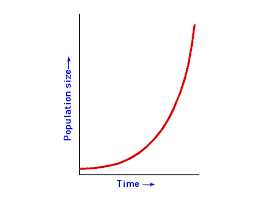


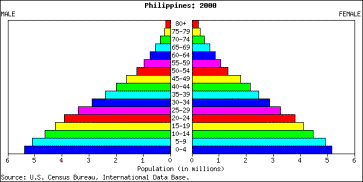


Exponential population growth can be described as
growth when resources are limited
a j-shaped curve
a s-shaped curve
growth that reaches carrying capacity

Which country will have the most rapid population growth?
Sweeden
United States
Mexico
None

