
 Worksheets
Energy Work and Simple Machines Optional Review
Total questions: 65
Worksheet time: 50mins
Which statement best defines energy?
The ability to do work or cause change
Energy stored because of an object’s position or condition
Energy due to an object’s motion
Energy stored in the bonds of substances
Which statement best defines kinetic energy?
Energy due to motion
Energy stored in chemical bonds
Energy stored because of position or condition
The rate at which work is done
Which statement best defines potential energy?
Stored energy due to position or condition
Energy of motion
Energy released by burning fuel
Energy transferred by waves
Determine which type of potential energy each item describes. A pogo stick
Elastic potential energy
Chemical potential energy
Gravitational potential energy
Determine which type of potential energy each item describes. Stretching a bow and arrow
Elastic potential energy
Chemical potential energy
Gravitational potential energy
Determine which type of potential energy each item describes. Sling shot
Elastic potential energy
Chemical potential energy
Gravitational potential energy
Determine which type of potential energy each item describes. Heating wood
Elastic potential energy
Chemical potential energy
Gravitational potential energy
Determine which type of potential energy each item describes. Using gas to fuel a car
Elastic potential energy
Chemical potential energy
Gravitational potential energy
Determine which type of potential energy each item describes. A lemon in a tree falling
Elastic potential energy
Chemical potential energy
Gravitational potential energy
Determine which type of potential energy each item describes. Photosynthesis
Elastic potential energy
Chemical potential energy
Gravitational potential energy
Determine which type of potential energy each item describes. Holding a ball and dropping it
Elastic potential energy
Chemical potential energy
Gravitational potential energy
Anything that can fall has ______ potential energy.
gravitational
mechanical
chemical
elastic
The law of ___________ states that energy may change form, but it cannot be created or destroyed under ordinary conditions.
conservation
transformation
potential
kinetic
Energy stored in chemical bonds is __________ energy.
chemical
mechanical
kinetic
elastic
Energy that is stored is called _________ energy.
potential
kinetic
thermal
nuclear
_________ energy is energy in motion.
kinetic
potential
chemical
elastic
An object's total amount of potential and kinetic energy is _______ energy.
mechanical
thermal
gravitational
nuclear
_________ energy can stretch or compress.
elastic
chemical
potential
kinetic
Directions: Use your knowledge of energy to answer the questions below. Write the equation for mechanical energy.
ME=PE+KE
ME=PE×KE
ME=PE−KE
ME=KE−PE
Directions: Use your knowledge of energy to answer the questions below. What is the best explanation the law of conservation of energy.
Energy cannot be created or destroyed; it can change form.
Energy is always increasing in a closed system.
Energy can be created by machines but not destroyed.
Energy only exists as heat.
Directions: Use your knowledge of energy to answer the questions below. Give two of your own examples of a change in energy.
A roller coaster converts potential energy to kinetic energy as it descends.
A lit bulb converts electrical energy to light and heat.
A book resting motionless on a table.
A balanced rock that never moves.
Directions: Use your knowledge of energy to answer the questions below. How do we obtain energy from plants?
By eating plants (or animals that eat plants), releasing stored chemical energy.
By touching leaves to absorb electrical energy.
By breathing near plants to gain kinetic energy.
By listening to plants to get sound energy.
Directions: Use your knowledge of energy to answer the questions below. What are some other sources of energy?
Sunlight (solar)
Wind
Moving water (hydroelectric)
Geothermal heat
Fossil fuels
Using your knowledge of work and power, explain how the person paddling a canoe is doing work and how the canoe’s shape makes paddling easier.
By applying a force to move the canoe a distance; the streamlined hull reduces water resistance, making paddling easier.
By holding the paddle still so no energy is transferred; the wider hull increases drag, making paddling easier.
By applying force without movement; the flat sides increase friction with water, making paddling easier.
By moving only the paddle in place; the boxy hull creates more turbulence, making paddling easier.
Based on the equation W=F×d , what does W stand for?
Work
Weight
Watts
Waves
Based on the equation W=F×d , what does F stand for?
Force
Friction
Frequency
Fuel
Based on the equation W=F×d , what does d stand for?
Distance
Density
Diameter
Displacement of water only
Using the equation P=W/t , what does P stand for?
Power
Pressure
Potential energy
Percent
Using the equation P=W/t , what does W stand for?
Work
Watts
Weight
Width
Using the equation P=W/t , what does t stand for?
Time
Temperature
Torque
Thickness
Bobby pushes the wheelbarrow 10 m with a force of 200 N. How much work did he do? Use W=F×d .
200 J
2000 J
20{,}000 J
2 J
Sarah expends 750 J of energy skating around town for 30 minutes. What was her power output? Use P=W/t and convert time to seconds.
0.42 W
25 W
405 W
0.04 W
A machine is best described as which statement?
A device that makes work easier by changing the size or direction of a force or the distance over which it acts
Any object that uses electricity to move
A device that increases energy without losses
A tool that always reduces the time needed to do a task
Two forces are involved when a machine does work. Select both.
Input force
Output force
Gravitational force only
Thermal force
What is efficiency in the context of machines?
The ratio of useful output work to input work, often expressed as a percent
The maximum speed a machine can reach
The total energy stored in the machine
The amount of force a machine can apply regardless of input
Which of the following are examples of work made easier by machines? Select all that apply.
Using a pulley to lift a heavy load
Pushing a box up a ramp instead of lifting it straight up
Carrying groceries without any device
Using a wheelbarrow to move soil
Which equation correctly represents mechanical advantage (MA)?
MA = output force ÷ input force
MA = input force ÷ output force
MA = work ÷ time
MA = force × distance
What is the best definition of input force?
The force applied to a machine by the user
The force the machine exerts on the object
The gravitational pull on the machine
The force lost to friction only
What is the best definition of output force?
The force the machine exerts on the object
The force applied to the machine by the user
The friction opposing motion inside the machine
The weight of the machine itself
What is a simple machine? Choose the best definition.
A device that changes the size or direction of a force to make work easier, with few or no moving parts
A system that produces electrical energy from chemical reactions
Two or more devices combined to perform complex tasks
Any machine powered by electricity rather than by people
What is a compound machine? Choose the best definition.
A single device that changes force without moving parts
Two or more simple machines working together to perform a task
An object that stores potential energy without doing work
A machine that only changes the direction of a force
Read each statement and choose the simple machine it best describes: Bar that is free to pivot around a fixed point.
lever
wheel & axle
inclined plane
screw
wedge
Read each statement and choose the simple machine it best describes: Inclined plane wrapped in a spiral around a cylindrical post.
pulley
inclined plane
screw
lever
wheel & axle
Read each statement and choose the simple machine it best describes: An inclined plane with one or two sloping sides.
wheel & axle
wedge
pulley
screw
lever
Read each statement and choose the simple machine it best describes: Grooved wheel with a rope, chain, or cable running along the groove.
pulley
wedge
inclined plane
lever
screw
Read each statement and choose the simple machine it best describes: An axle attached to the center of a wheel, so they rotate together.
inclined plane
wheel & axle
pulley
wedge
screw
Read each statement and choose the simple machine it best describes: Sloping surface used to raise objects.
lever
pulley
inclined plane
wheel & axle
screw
Explain the difference between a fixed and moveable pulley by choosing the statement that best describes each: A fixed pulley changes the direction of the effort force but does not provide mechanical advantage; a moveable pulley travels with the load and provides mechanical advantage.
Fixed pulleys and moveable pulleys both increase force equally and neither changes direction
A fixed pulley changes direction without multiplying force, while a moveable pulley multiplies force by moving with the load
A fixed pulley multiplies force more than a moveable pulley
Neither fixed nor moveable pulleys affect force or direction
Identify the arrangement that defines a first-class lever.
Fulcrum between effort and load
Load between fulcrum and effort
Effort between fulcrum and load
Fulcrum and load at the same point
Identify the arrangement that defines a second-class lever.
Effort between fulcrum and load
Fulcrum between effort and load
Load between fulcrum and effort
Fulcrum and effort at the same point
Identify the arrangement that defines a third-class lever.
Fulcrum between effort and load
Load between fulcrum and effort
Effort between fulcrum and load
Fulcrum and load at the same point
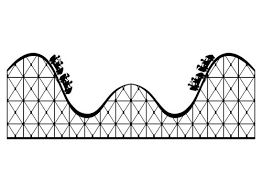
When a roller coaster is at the bottom of a hill it has
high potential energy
high kinetic energy
low kinetic energy
equal amounts of kinetic and potential energy


I released a balloon that was full of air and it is flying around the room, the balloon has
kinetic energy
potential energy


Select the two examples of kinetic energy.
A rock sitting at the top of a hill.
A car driving down the highway
A dog playing fetch
A stretched rubber band, but not moving.

Which location has the least potential energy but the most kinetic energy.
W
X
Y
Z

A 60-kg skater on the photo is about to move. At this point, what is his kinetic energy?
0 Joule
3,528 Joules
588 Joules
360 Joules

(enlarge the picture if needed)

According to the above diagram, at what point would the roller coaster car have the greatest kinetic energy?
3
4
5
6

A softball is hit high in the air, as it rises, the softball _____________.
gains kinetic energy and loses potential energy
loses kinetic energy and gains potential energy
loses kinetic energy and loses potential energy
gains kinetic energy and gains potential energy

For the picture of the roller coaster above. Which letter represents the point where the car has the most kinetic energy?
W
X
Y
Z


