
 Worksheets
Ch-09 Ray Optics and Optical Instruments
Total questions: 100
Worksheet time: 1hrs 15mins
How does the magnifying power of a telescope change on increasing the linear diameter of its objective?
Power increases on increases diameter
Power decreases on decreases diameter
Power remain constant on increases diameter
Power doesn’t depends on diameter
An astronomical telescope has a large aperture to
increase span of observation
have low dispersion
reduce spherical aberration
have high resolution
Two lenses of focal lengths 20 cm and -40 cm are held in contact. If an object lies at infinity, image formed by the lens combination will be a
infinity
20cm
40cm
60cm
The characteristic feature of light which remains unaffected on refraction is
speed
frequency
wavelength
velocity of light
The air bubble inside water shine due to
Reflection
Refraction
T.I.R
None of these
How does the focal length of a convex lens changes if mono chromatic red light is used instead of violet light?
Focal length is increased when red light is used
Focal length is decreased when red light is used
Focal length is remain same when red light is used
Not depends on color of light.
When a convex lens placed inside a transparent medium of refracting index greater than that of its own material
It behave as concave lens
It behave as convex lens
It behave as a glass slab
It behave as a glass prism
The deviation of a ray on passing through a prism is (μ-1)A FOR
All conditions
small angle A
Large angle A
In minimum angle of deviation case.
A thin prism of 12° angle gives a deviation of 6°. The refracting index of a material of the prism
1.2
1.5
1.6
1.7
The radius of curvature of the convex surface of a plano-convex lens, whose focal length is 0.3m & the refractive index of material is 1.5 is
1.5m
0.15m
0.5m
1.25m
The magnifying power of an astronomical telescope in the normal adjustment position is 100. The distance between objective & the eyepiece is 101cm. What is the focal length of objective?
100cm
1cm
50cm
11cm
A tank is filled with water to a height of 12.5cm. The apparent depth of a needle lying at bottom of tank is measured by a microscope to be 9.4cm. What is the refractive index of water?
1.33
1.5
1.13
1.45
Two thin lenses with focal lengths of 20 cm and 25 cm are placed in contact. The effective power of the combination is:
45 D
9 D
19 D
6 D
Tara is experimenting with a glass prism in her science lab. She shines a beam of light through the prism and observes the different colors that emerge. She notices that the angle of deviation for the colors varies. Which color does she find has the greatest angle of deviation?
violet
red
orange
yellow
An astronomical refractive telescope has an objective of focal length 20 m and an eyepiece of focal length 2 cm. Then
the magnification is 1000
the length of the telescope tube is 20.02 m
the image formed is inverted
all of these
An astronomical refractive telescope has an objective of focal length 20 m and an eyepiece of focal length 2 cm. Which one of the following is not possible?
The length of the telescope tube is 20.02 m.
The magnification is 1000.
The image formed is inverted.
An objective of a larger aperture will increase the brightness and reduce chromatic aberration of the image.
A convex lens is dipped in a liquid whose refractive index is equal to the refractive index of the lens. Then its focal length will
become zero
become infinite
become small, but non-zero
remain unchanged
Which of the following is not a property of light?
It can travel through vacuum
It has a finite speed
It requires a material medium for its propagation
It involve transportation energy
Two concave mirrors have the same focal length but the aperture of one is larger than that of the other. Which mirror forms the sharper image?
Plane
Concave
Convex
Prism
An object is placed at a distance of 40 cm from a concave mirror of focal length 15 cm. If the object is displaced through a distance of 20 cm towards the mirror, the displacement of the image will be:
30 cm away from the mirror
36 cm away from the mirror
30 cm towards the mirror
36 cm towards the mirror
A man stands in front of a mirror of special shape. He finds that his image has a very small head, a fat body, and legs of normal size. What can we say about the shapes of the three parts of the mirror?
Convex, Concave, Plane
The plane, Concave, Convex
Concave, Convex, Plane
Convex, Plane, Concave
The refractive indices (R.I.) of glass and water with respect to air are 3/2 and 4/3 respectively. The R.I. of glass w.r.t. to water is:
8/9
9/8
7/6
2
Which of the following colour of white light deviated most when passes through a prism?
Red light
Violet light
Yellow light
Both (i) and (ii)
Two lenses of focal lengths 20 cm and –40 cm are held in contact. The image of an object at infinity will be formed by the combination at
10 cm
20 cm
40 cm
infinity
A convergent lens will become less convergent in :
oil
water
both of (i) and (ii)
none of these
Two beams of red and violet color are made to pass separately through a prism (angle of the prism is 60°). In the position of minimum deviation, the angle of refraction will be
30° for both the colors
greater for the violet color
greater for the red color
equal but not 30° for both the colors
When light is refracted into a medium,
its wavelength and frequency both increase
its wavelength increases but frequency remains unchanged
its wavelength decreases but frequency remains unchanged
its wavelength and frequency both decrease
A ray of light incident at an angle θ on a refracting face of a prism emerges from the other face normally. If the angle of the prism is 5° and the prism is made of a material of refractive index 1.5, the angle of incidence is
7.5°
5°
15°
2.5°
Digital movie projectors work on the principle of
Reflection from micromirrors
Refraction from thin lenses
Dispersion from thin prisms
Total internal reflection from optical fibres
Day and night settings for rearview mirrors uses
Thin mirrors
Thick wedge-shaped mirrors
Convex mirrors
Concave mirrors
When a beam of light is incident on a plane mirror, it is found that a real image is formed. The incident beam must be
Converging
Diverging
Parallel
Formation of real image by a plane mirror is impossible
An object is placed symmetrically between two plane mirrors, inclined at an angle of 72°, then the total number of images observed is
5
4
2
Infinite
A person 1.6 m tall is standing at the centre between two walls three metre high. What is the minimum size of a plane mirror fixed on the wall in front of him, if he is to see the full height of the wall behind him?
0.8 m
1 m
1.5 m
2.3 m
While capturing solar energy for commercial purposes we use
Parabolic mirrors
Plane mirrors
Convex mirrors
Concave mirrors
A convex mirror is used to form an image of a real object. Then mark the wrong statement
A convex mirror has a focal length f. A real object is placed at a distance f in front of it, from the pole. It produces an image at
Infinity
f
f/2
2f
An object placed in front of a concave mirror of focal length 0.15 m produces a virtual image, which is twice the size of the object. The position of the object with respect to the mirror is
-5.5 cm
-6.5 cm
-7.5 cm
-8.5 cm
When a light ray from a rarer medium is refracted into a denser medium, its
Speed increases, wavelength increases
Speed decreases, wavelength increases
Speed increases, wavelength decreases
Speed decreases, wavelength decreases
A glass lens is immersed in water. What will be the effect on the power of lens?
increase
decrease
constant
not depends
An astronomical telescope has a large aperture to:
increase span of observation
have low dispersion
reduce spherical aberration
have high resolution
Two lenses of focal lengths 20 cm and -40 cm are held in contact. If an object lies at infinity, image formed by the lens combination will be at
infinity
20cm
40cm
60cm
In the minimum deviation position, the refracted ray in the prism is
Parallel to the base of prism.
Perpendicular to the base of prism.
Parallel to the any side of prism
None of the above
Due to refraction, the depth of an optically denser medium appears to be
less than its actual depth
greater than its actual depth
equal to its actual depth
unaffected by refraction
A convergent lens made of crown glass has focal length 20cm in air. If it is immersed in a liquid of refractive index 1.60, its focal length will be
160 cm
80 cm
-160 cm
-80 cm
A man runs towards a mirror at a rate of 6 m/s if we assume the mirror to be at rest, the image will have velocity -
+12 m/s
-12 m/s
+6 m/s
-6 m/s
Refractive index of water is 5/3. A light source is placed in water at a depth of 4 m. Then what must be the maximum radius of disc placed on water surface so that the light of source can be stopped?
3 m
4 m
5 m
Infinity
A short linear object of length b lies along the axis of a concave mirror of focal length f at a distance u from the pole of the mirror. The size of image is approximately equal to
b ((u-f)/f)1/2
b ((f/u)-f)1/2
b ((u-f)/f)
b ((f/u-f)2
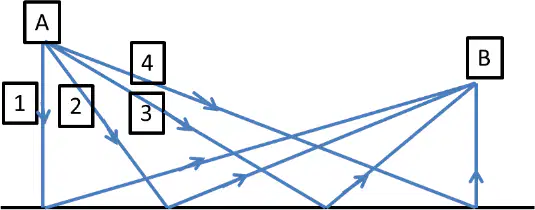
A ray of light travels from the point A to B with a uniform speed. On its way, it is reflected by the surface XX'. The path followed by the ray to take least time is
1
2
3
4
A Convex mirror of focal length f produces an image magnified m times. The distance of the object from the mirror is
(m-1)f/m
(m+1)f/m
(m-1)f
A Thin lens of focal length f and its aperture has diameter d. it forms an image of intensity 3. Now the central part of aperture upto diameter d/2 is blocked by an opaque paper. The focal length and image intensity would change to
f/2, 1/2
f, 1/4
3f/4, 1/2
F, 3/4
When a light ray from a rarer medium is refracted into a denser medium, its
Speed increases, wavelength increases
Speed decreases, wavelength increases
Speed increases, wavelength decreases
Speed decreases, wavelength decreases
Which of the following is possible application of fibre optics?
Endoscopy
High speed internet traffic
Radio, TV & Telephone signals
All of these
Two transparent media A and B are separated by a plane boundary. The speed of light in medium A is 2.0 x 10^8 ms^-1 and in medium B is 2.5 x 10^8 ms^-1. The critical angle for which a ray of light going from A to B suffers total internal reflection is
sin−121
sin−152
sin−154
sin−143
An object is placed at a distance of f/2 from a convex lens. The image will be
At one of the foci, virtual and double its size
At 3f/2, real and inverted
At 2f, virtual and erect
At f, real and inverted
A glass concave lens is placed in a liquid in which it behaves like a convergent lens. The refractive index of glass is
Greater than the refractive index of the liquid
Less than the refractive index of the liquid
Cannot be decided
None of the above.
The radii of curvatures of each of the surfaces of a convex lens (refractive index of the material is 1.5) is 20 cm. The focal length of the lens in air is
20 cm
-20 cm
40 cm
10 cm
A glass lens is immersed in water. Its power will
Decrease
Increase
Remains same
None of the above
A thin equiconvex glass lens of refractive index 1.5 has power of 5D. When the lens is immersed in a liquid of refractive index μ, it acts as a divergent lens of focal length 100 cm. The value of μ of liquid is _______.
1.7
1.2
1.4
1.6
At the minimum deviation of condition in a prism
The refracted ray is parallel to the base of the prism.
The incident angle is equal to the angle of emergence.
Angle of refraction is half of the angle of prism
All of the above
Focal length of the objective and eyepiece of a telescope are respectively 50 cm and 5 cm. The magnifying power of the telescope in its normal adjustment is
0.1
10
11
1.1
The equivalent focal length of a combination of a convex and a concave length is
Positive
Negative
May be positive or negative
None of the above.
Two convex lenses are separated by a distance equal to the sum of their focal lengths. A beam of light parallel to the principal axis incidence on one of the lenses. They will emerge from the second lens as
A beam of parallel rays
As a beam of diverging rays
As a beam of converging ray
None of the above
When a telescope is adjusted for normal vision, the distance of the objective from the eye-piece is found to be 80 cm. The magnifying power of the telescope is 19. What are the focal lengths of the lenses?
61 cm, 19 cm
40 cm, 40 cm
76 cm, 4 cm
50 cm, 30 cm
While measuring refractive index of glass using a glass slab of thickness 3 cm and a travelling microscope a student observes that he needed to shift the microscope by 1 cm to refocus the mark on the base of the travelling microscope when the slab is kept on it. The refractive index of the material of the glass slab is
2/3
1/3
3/2
1.8
Total internal reflection occurs when
Light travels from a denser to rarer medium
Light travels from a denser to rarer medium, and the angle of incidence is less than the critical angle
Light travels from a rarer to denser medium, and the angle of reflection is less than the critical angle
Light travels from a denser to rarer medium, and the angle of incidence is greater than the critical angle
Objects are visible in light due to:
Scattering
Refraction
Absorption
Fluorescence
Even in absolutely clear water, a diver cannot see very clearly:
Because rays of light get diffused
Because velocity of light is reduced in water
Because a ray of light passing through the water makes it turbid
A lens behaves as a converging lens in air and as a diverging lens in water. The refractive index of the material is:
Equal to unity
Equal to 1.33
Between unity and 1.33
Greater than 1.33
When a thin convex lens is put in contact with a thin concave lens of the same focal length, the resultant combination had focal length equal to:
f/2
2f
Zero
Infinity
A concave lens of focal length f produces an image 1/μ times the size of the object. The distance of the object from the lens is:
(μ - 1)f
(μ - 1 )f/ μ
(μ + 1 )f/ μ
( μ + 1 )f
When length of a microscope tube increases, its magnifying power:
Decreases
Increases
Does not change
May increase or decrease
A microscope has an objective of 5mm focal length and eye piece of 30 mm focal length and the distance between them is 150 mm. The magnification is:
50
100
200
250
The magnifying power of an astronomical telescope can be increased if we:
Increase the focal length of the objective
Increase the focal length of the eye piece
decrease the focal length of the objective
decrease the focal length of the objective and at the same time increase the focal length of the eye piece
Two convex lenses of focal lengths 0.3 m and 0.05 m are used to make a telescope. The distance kept between them is equal to:
0.35 m
0.25 m
0.175 m
0.15 m
When a ray of light goes from a rarer medium into a denser medium, then:
Speed of light is reduced
Frequency of light is increased
Wavelength of light is increased
None of the above effects will be observed.
A ray of light can suffer total internal reflection when it goes from:
Air to water
Water to glass
Glass to air
Air to glass
If refractive indices for water and glass are 4/3 and 5/3 respectively and light is tending to go from glass to water, the critical angle is:
Sin⁻¹(4/3)
Sin⁻¹(5/3)
Sin⁻¹(4/5)
Sin⁻¹(5/4)
Optical fibres use the phenomenon of:
Refraction
Total internal reflection
Polarisation
Interference
In a glass prism:
Blue light is dispersed more than red light
Red light is dispersed more than blue light
Both red light and blue light are equally dispersed
The angle of minimum deviation for a hollow prism filled with a liquid is 30 degree. A ray of light falling on the prism is refracted at 30 degree. The refractive index of the liquid is:
1.414
1.732
0.866
1.500
In an experiment for determination of refractive index of glass of a prism by i-δ plot, it was found that a ray incident at angle 35°, suffers deviation of 40° and that it emerges an angle 79°. In that case which of the following is closest to the maximum possible value of refractive index?
1.5
1.6
1.7
1.8
An object 2.4m in front of a lens form a sharp image on a film 12 cm behind the lens. A glass plate 1 cm thick, of refractive index 1.50 is interposed between lens and film with its plane faces parallel to film. At what distance (from lens) should object shifted to be in sharp focus on film?
7.2m
2.4m
3.2m
5.6m
A green light is incident from the water to the air-water interface at the critical angle (θ). Select the correct statement
The spectrum of visible light whose frequency is more than that of green light will come out to the air medium
The entire spectrum of visible light will come out of the water at various angles to the normal
The entire spectrum of visible light will come out of the water at an angle of 90° to the normal
The spectrum of visible light whose frequency is less than that of green light will come out to the air medium
The focal length of plano-convex lens, the convex surface of which is slivered is .3m, if μ of the lens is 7/4, the radius of curvature of the convex surface is
0.45m
1.05m
3m
0.9m
The magnification of a compound microscope is 30 and the focal length of its eye piece is 5m. Calculate the magnification produced by the objective, when the image is to be formed at least distance of distinct vision (25 cm).
5
6
8
A convergent double of separated lens, corrected for spherical aberration, are separated by 2 m and has an equivalent focal length of 10 cm. Calculate the focal length of its component lenses.
f1=18 cm, f2=10 cm.
f1=20 cm, f2=28 cm.
f1=20 cm, f2=18 cm.
f1=24 cm, f2=18 cm.
Calculate the time taken by the light to travel a distance of 500m in water of reflective index of 34 . (Given the velocity of light in vacuum = 3×1010cm/s )
3 x 10^{-10} s
2.22 x 10^{-6} s
4.3 x 10^{-5} s
3 x 10^{-6} s
A telescope consist of two lenses of focal lengths 10 cm and 1 cm. Calculate the length of telescope, when an object is kept at distance of 60 cm from the objective, and the final image is formed is at least distance of distinct vision.
15.05 cm
12.96 cm
13.63 cm
14.44 cm
An equilateral prism deviates a ray through 45° for the two angle of incidence differing by 20°. The angle of incidence is
60°
40°
120°
None of these
A compound microscope has an eyepiece of focal length 10 cm and an objective of focal length 4 cm. Calculate the magnification if an object is kept at a distance of 5 cm from the objective, then the final image is formed at the least distance of distinct vision.
10
11
12
13
An object approaches a convergent lens from the left of the lens with uniform speed 5 m/s and stops at the focus. The image
moves away from the lens with a uniform speed 5 m/s
moves away from the lens with uniform acceleration
moves away from the lens with non-uniform acceleration
moves towards the lens with non-uniform acceleration
Find the change in the focal length of the lens, if a convex lens of focal length 20 cm and refractive index 1.5, is emerged in water having refractive index 1.33.
62.2 cm
5.82 cm
58.2 cm
6.22 cm
Find the position of 1 cm tall object which is placed 8 cm in front of convex mirror of radius of curvature 24 cm.
24 cm
25 cm
26 cm
27 cm
If two mirrors are inclined at some angle an object is placed between the mirrors and there are seven images formed for an object. Then, what is an angle between the mirrors?
54°
50°
The shortest height of a vertical mirror required to see the entire image of a man will be
One third of the man’s height
Half the man’s height
Two third of the man’s height
Data insufficient
A beam of monochromatic blue light of wavelength 4200 Å in air travels in water (4 / 3). Its wavelength in water will be
2800 Å
5600 Å
3150 Å
4000 Å
A concave lens has a focal length of -10 cm. If an object is placed 15 cm from the lens, what is the position of the image formed?
15 cm on the opposite side
10 cm on the same side as the object
30 cm on the opposite side
5 cm on the same side as the object
What is the effect on the image distance when the object distance is decreased for a convex lens?
Image distance decreases
Image distance increases
Image distance remains constant
Image distance becomes negative
In a simple microscope, if the focal length of the convex lens is 5 cm, what is the maximum magnification achievable?
10
15
20
5
A person looks into a concave mirror and sees a larger image of themselves. What can we infer about the position of the object relative to the focal point of the mirror?
Object is beyond the center of curvature
Object is at the focal point
Object is between the focal point and the mirror
Object is at infinity

