
 Worksheets
APUSH Midterm Review P1-5
Total questions: 115
Worksheet time: 58mins


Which is an effect of the Colombian Exchange on Europe?
New diseases were introduced that killed millions of Europeans
Europeans gained so much new wealth that their economies shifted from Feudalism to Capitalism
Europe began to lose population because so many people moved to the Americas in an effort to become wealthy.
The Columbian Exchange had little impact on Europe because most of the major events happened in the Americas and European racism led them to believe that there was nothing of value from the Americas.
The Middle Passage is a term associated with which part of the Triangle trade between 1500 and 1600?
Columbian Exchange
Trans - African Slave trade
Joint-Stock Companies
Casta System
What was the purpose of Joint-Stock Companies?
The purpose was to create research facilities that would produce technology needed for ocean travel
These companies were invented to mediate disputes between European colonists and American Indians
To gain more land for Christianity
People could invest in exploration (like the stock market) and increase international trading
This was the enslavement of American Indians by the Spanish. Technically this was land given to the Spaniards by the king and the land included American Indian laborers who had to work and pay tribute to the Spaniards.
Asiento System
Encomienda System
Indentured Servitude
Chattle Slavery
The Spanish built a caste (Casta) System in their territory in the Americas. What was the system of social hierarchy based on?
Race
Employment
Royal heritage and birth order
Wealth
Economic theory that emphasizes creation of over seas colonies and only allows the colonies to trade with the mother country.
Mercantilism
Capitalism
Free Trade
Communism
Between 1607 and 1670, the main source of labor in the North American British colonies came from:
Enslaved West Africans
European Indentured Servants
Maroon Societies
Enslaved American Indians
This was the brutal trip from across the Atlantic to the Caribbean to import enslaved people to the Americas
Middle Passage
Triangle Trade
Mercantilism
Dominion of New England
In the Atlantic Economic System, what items were shipped from the Americas to European markets.
Raw Materials
Finished Manufactured Goods
Enslaved People
American Indian pottery
The political ideas about the natural rights to life and liberty are associated with:
Protestant Reformation
The Great Awakening
The Enlightenment
Toleration Act
"Anglicization" refers to the process of:
Spreading of peace between American Indians and British settlers
Spreading of Evangelical Christianity among the colonists
Spreading of English culture to all European colonists including Germans and the Dutch
The presence of diverse European backgrounds within the colonies
The British North American colonies were unique for other colonial regions in the world at the time because:
They were more committed to religion and moral living than most places
They were formed by mercantilism
They developed self governing institutions
They were able to peacefully coexist with native peoples in the region
Which Act(s) is this describing? The British closed Boston Harbor and sent more troops to the city to live among the people and police them.
Stamp Act
Sugar Act
Tea Act
Intolerable Acts
Which event is this describing? An angry mob stirred up by the Sons of Liberty started assaulting British soldiers who defended themselves by firing into the crowd.
Boston Tea Party
Boston Massacre
Shays Rebellion
Whiskey Rebellion
In 1775, the majority of white men in New York, New Jersey, Georgia, Quebec, and the West Indies were __________________ in their views of the Revolution.
Patriots
Loyalists
Neutral
In 1775, the majority of white men in Virginia and Massachusetts were __________________ in their views of the Revolution.
Patriot
Loyalist
Neutral
This document expressed that the colonists had a right to independence based off of the Enlightenment idea that "all men are created equal" and possess Natural Rights of life and liberty.
Common Sense
Declaration of Independence
Constituion
Federalist Papers
Which was a direct and immediate impact of the Enlightenment rhetoric after the American Revolution?
Women's Suffrage
Abolition of slavery
Abolition of slavery in the North
The end of all property requirements for White men to vote
The Northwest Ordinance did all of these things EXCEPT:
Made slavery illegal in the northwest territories.
Provided a path to eventual statehood for the territories
Promoted future public education opportunities in the territories
Guaranteed American Indian landownership rights in the territories
The Federalist Papers were an argument for:
Independence of the United States
Decrease in British taxation of the colonies
Ratification of the Constitution
Creation of the Articles of Confederation
Which party supported raising a tariff to help the growth of American businesses?
Federalist Party
Democratic-Republicans
Which Party did not think that the Constitution gave the federal government the right to create a National Bank?
Federalist Party
Democratic-Republican Party
Thomas Jefferson was not able to get all of his Democratic-Republican policies through because of the Federalist power that continued to remain in the:
Supreme Court
Congress
Cabinet
Executive Branch
The South's distrust of the North's growing abolitionist spirt and dislike of the American System which they thought only helped the North was an example of:
Sectionalism
Whig Party beliefs
Nativism
Corrupt Bargain
In Period 4 what is true of the politics of this era in American history?
Party politics was increasing and so was the amount of White men who could vote
Belief in republican values were growing more popular than democratic ideals.
America was falling far behind the rest of the world as democracy was spreading in Europe but stagnate in the United States
Nationalism and pride in the Union convinced many Americans to take George Washington's old advice and stop participation in party politics
Which was NOT an original value of the new Democratic Party?
Desire for lower tariffs
Desire to end the Bank of the United States
Belief in that the Federal government should have more power than individual states
Southern chattel slavery was protected by the Constitution
The vast majority of the 4 million immigrants who came to the United States between 1830 and 1860 were from:
China and England
England and Ireland
Ireland and Germany
Germany and China
What is meant by the "Cult of Domesticity?"
Changing demographics and urbanization during the Market Revolution
The new "ideal" for women, they should be isolated to the home and separate from the "public sphere"
The origins of feminism and the push for women's suffrage during the age of reform
Large amounts of young girls went to work in textile factories during the textile boom, moving away from their homes to live in dorms
The "Great Compromiser," and a founder of the Whig Party. As a leader in the House of Representatives, he pushed for war in 1812.
John Quincy Adams
Henry Clay
John C. Calhoun
William Lloyd Garrison
Andrew Jackson used the power of the veto to stop:
The Nullification of South Carolina
New charter of the Bank of the United States
Indian Removal Act
The Pet Banks System
America's Transcendentalist authors encouraged Americans to:
Support the War of 1812
Embrace the new changes of the fast pace life of the Market Revolution
Support the abolitionist and women's suffrage movements
Live simple and self-reliant lives and embrace nature
The popular ideology that led to the election of President Polk and justified westward expansion in the period between 1840 and 1860.
Enlightenment
Second Great Awakening
Majority views of slavery
Manifest Destiny
The major controversy over the Mexican Cession was:
If federal tax dollars should be used to make canals in the new territory
If American Indians in the new territory would be able to vote.
If the new territory would be "free-states" or "slave-states"
If Tejanos should be considered U.S. citizens or not
The Free Soil Movement was against slavery because:
They believed it was un-Christian
They were antiracists who wanted to prove that race was a modern myth and that all people were equal
They believed that the existence of slavery kept wages low for poor white workers and farmers
They believed that it gave the North to much economic advantage and would lead to increase of tariffs
The Compromise of 1850 allowed California to enter the Union as a "free state." What did the South get in return?
Guarantee to protect state's rights
Guarantee that Oregon, Washington, and Colorado would join the Union as Slave States
Passage of a new and more powerful "Fugitive Slave Act"
A ban on Catholicism which was being spread by new German and Irish Immigrants
Which is true of the Kansas-Nebraska Act?
It allowed Kansas and Nebraska to join the Union as "free states"
It allowed Kansas and Nebraska to join the Union as "slave states"
It allowed Southern human traffickers to look for "runaway slaves" in Kansas and Nebraska
It allowed Kansas and Nebraska decide for themselves if they wanted to be "free" or "slave" states
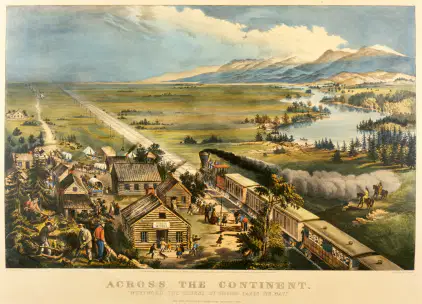
Which of the following was the primary cause for the development depicted in the painting?
A desire for economic opportunity through settlement and access to new resources
Persecuted groups searching for religious freedom and refuge in the West
Increased immigration resulted in less available land in the East
Slave-holding interests in the South demanded more land for cotton production
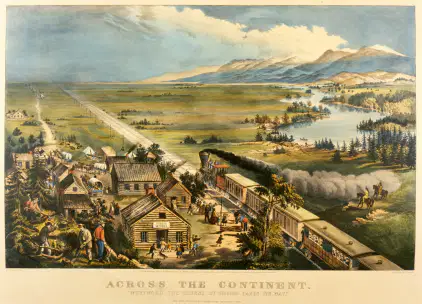
The painting represents a continuation of which of the following developments in the first half of the 19th Century?
Mexican-American War
Indian Removal Act
American System
Missouri Compromise
Which of the following was an effect of westward expansion?
Native Americans voluntarily and quickly assimilated to an idealized industrial-age lifestyle
Expanded diplomatic and economic ties between the United States and Asia
Only Agricultural production increased while industrial development greatly decreased
A decline in sectional tensions over the issue of slavery
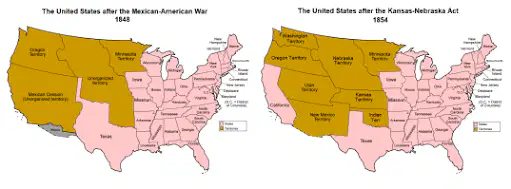
The United States after the Mexican-American War 1848 and The United States after the Kansas-Nebraska Act 1854.
Pink=States
Gold=Territories
The changes depicted in the maps were primarily caused by which of the following?
Unwillingness by Congress to engage in political compromise
The debate over the extension of slavery into western territories
Settlers in western territories voted on their new borders
Supreme Court decisions such as Scott v. Sanford
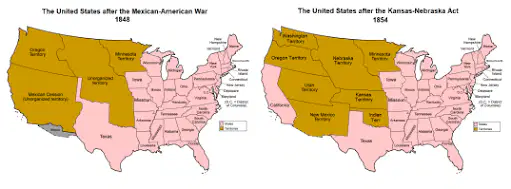
The United States after the Mexican-American War 1848 and The United States after the Kansas-Nebraska Act 1854.
Pink=States
Gold=Territories
Which of the following was a direct effect of the changes depicted in the maps?
Sectional tensions eroded political loyalties, ending the Second Party System
Lincoln’s election in 1860 without electoral votes from western states and territories
South Carolina seceded from the Union due to violence in Kansas
Emergence of violent conflict along the border of the Utah and New Mexico territories

