
 Worksheets
Semester exam review part 1
Total questions: 113
Worksheet time: 58mins
Point M lies on AB, AB=24 , BM=13 . What is AM ?
11
12
Points X, Y, and Z are collinear, and Y lies between X and Z. If XZ=72 , XY=2x+3 , and YZ=5x−8 , what is the length of YZ ?
43
45
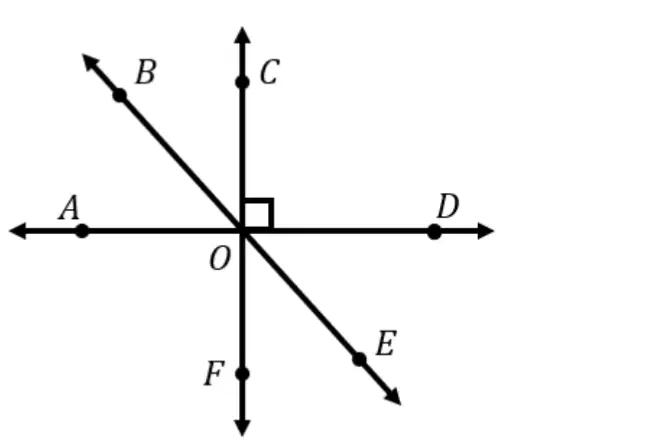
In the diagram below, AD , BE , and CF intersect at point O and ∠DOC is a right angle. Which of the following statements can be assumed from the diagram? Select all that apply.
OE bisects ∠FOD .
∠BOC and ∠EOF are vertical angles.
∠ABD and ∠DBC form a linear pair. Which of the following statements are true? Select all that apply.
∠ABD is a straight angle.
∠DBC is a straight angle.
∠BCA and ∠ACD form a linear pair. ∠BCA is represented by (2x−5)∘ and ∠ACD is represented by (3x+10)∘ . What is m∠ACD ?
35°
61°
∠EFH and ∠HFI are complementary angles. If m∠EFH = (2x + 2)° and m∠HFI = (x + 1)°, what is m∠HFI?
28°
30°
32°
34°
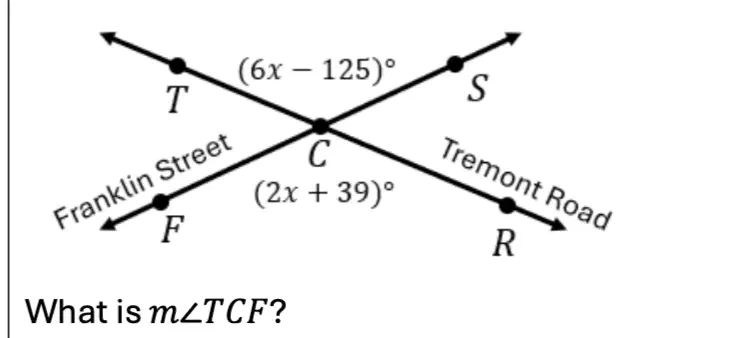
In the diagram, Franklin Street, represented by \overline{FS}, and Tremont Road, represented by \overline{TR}, intersect at point C. The angle at TCF is formed by the rays CT and CF, and the diagram labels adjacent angles around C as (6x − 125)° and (2x + 39)°. What is m∠TCF?
41°
53°
59°
67°
Use the answer choices below to complete the statement. “If MN = OP and OP = ST, then MN = ST” is an example of the ________ Property of Equality.
Reflexive
Symmetric
Transitive
Use the answer choices below to complete the statement. “m∠Q = m∠Q” is an example of the ________ Property of Equality.
Reflexive
Symmetric
Transitive
Use the answer choices below to complete the statement. “If AB = CD, then CD = AB” is an example of the ________ Property of Equality.
Reflexive
Symmetric
Transitive
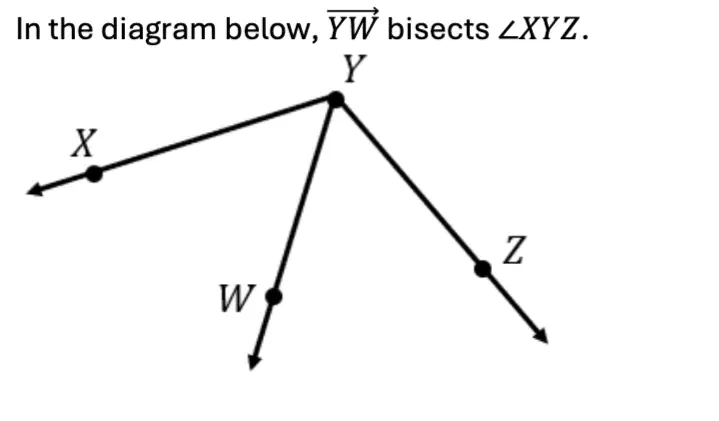
This question has two parts. First, answer Part A. Then, answer Part B. Part A: In the diagram, YW bisects ∠XYZ. What true statements can be concluded about the diagram? Select all that apply.
m∠XYZ = 1/2 m∠XYW
m∠XYZ = m∠ZYW
m∠XYZ = m∠ZYX
m∠XYW + m∠WYZ = m∠XYZ
m∠XYZ = 2m∠XYW
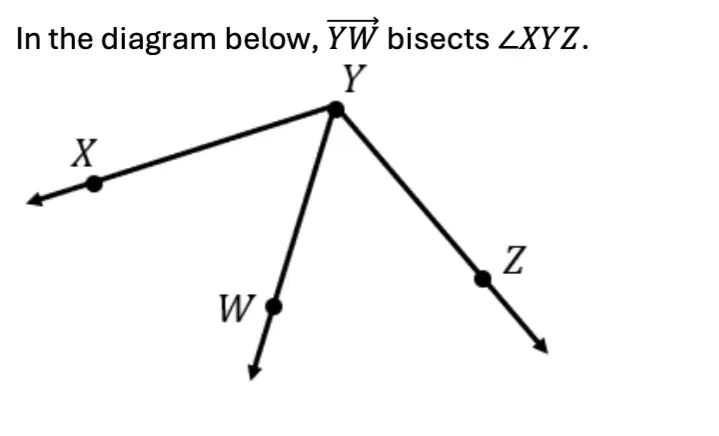
This question has two parts. First, answer Part A. Then, answer Part B. Part B: In the diagram, m∠XYW = (6x − 18)° and m∠WYZ = (3x + 15)°. What is the measure of ∠XYZ?
94°
96°
98°
100°
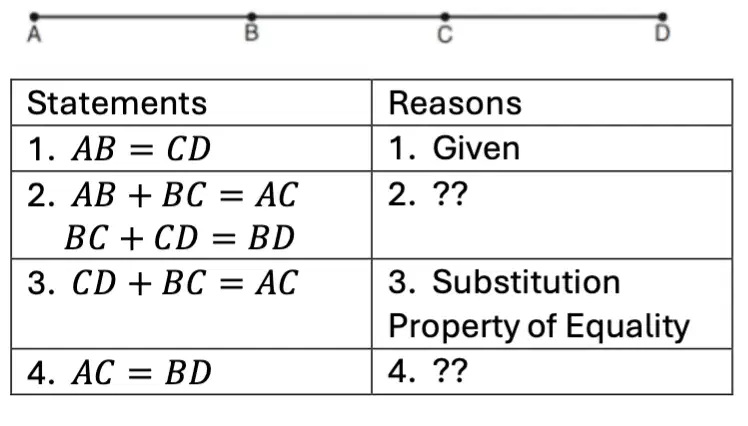
This question has two parts. First, answer Part A. Then, answer Part B. In the diagram, it is given that AB = CD. We want to prove that AC = BD. Part A: The reason for Step #2 is ________.
Angle Addition Postulate
Segment Addition Postulate
Linear Pair Postulate
Addition Property of Equality
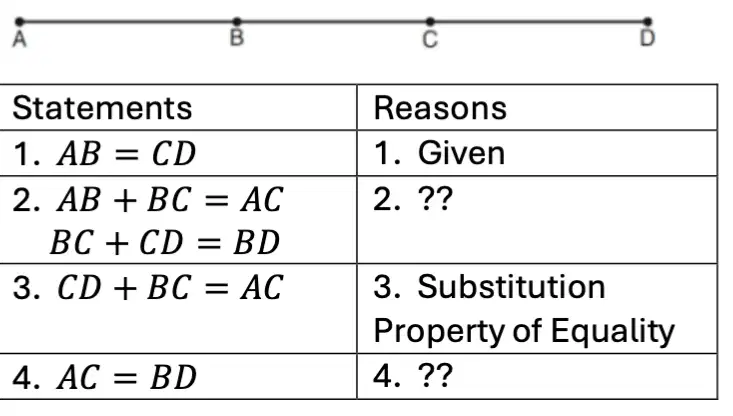
This question has two parts. First, answer Part A. Then, answer Part B. In the diagram, it is given that AB = CD. We want to prove that AC = BD. Part B: The reason for Step #4 is ________.
Definition of congruence
Subtraction Property of Equality
Transitive Property of Equality
Division Property of Equality
Consider the given and partially completed proof. Given: ∠A and ∠B are supplementary angles, ∠C and ∠B are supplementary angles. Prove: ∠A ≅ ∠C. The reasons for Steps 1 through 5 in the proof are below but are out of order. What is the correct order of the steps?
II, IV, I, III, V
II, I, IV, III, V
I, II, IV, III, V
IV, II, I, III, V
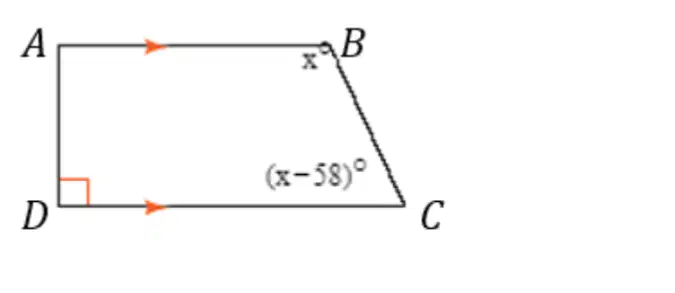
Find the value of x. Then find the measure of each labeled angle. What is the value of x and the measures of ∠A, ∠B, ∠C, and ∠D?
x = 175; m∠A = 90°, m∠B = 121°, m∠C = 59°, m∠D = 90°
x = 177; m∠A = 90°, m∠B = 119°, m∠C = 61°, m∠D = 90°
x = 179; m∠A = 88°, m∠B = 121°, m∠C = 59°, m∠D = 92°
x = 180; m∠A = 90°, m∠B = 120°, m∠C = 60°, m∠D = 90°
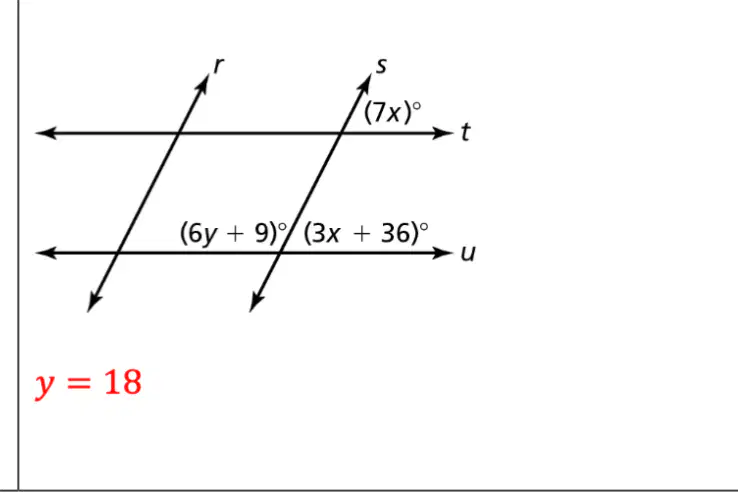
What is the value of y that makes r ∥ u?
12
15
18
24
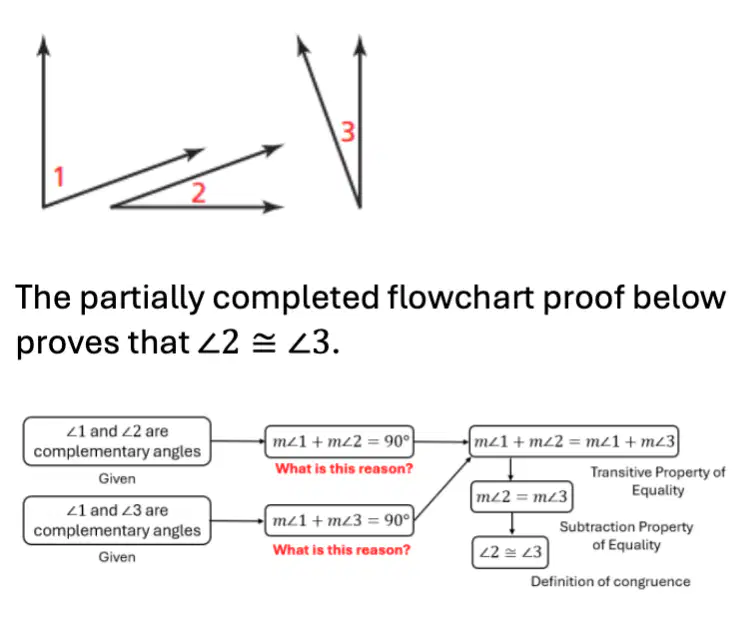
In the diagram below, it is given that ∠1 and ∠2 are complementary angles and ∠1 and ∠3 are complementary angles. The partially completed flowchart proof below proves that ∠2 ≅ ∠3. What is the reason that m∠1 + m∠2 = 90° and m∠1 + m∠3 = 90° in the middle column of the proof?
Angle Addition Postulate
Congruent Complements Theorem
Definition of Complementary Angles
Substitution Property of Equality
This question has two parts. First, answer Part A. Then, answer Part B. Consider the given and partially completed two-column proof below. Given: ∠1 ≅ ∠2 and ∠1 and ∠2 are supplementary. Prove: ∠1 and ∠2 are right angles. Part A: What is the statement for Step #3?
m∠1 + m∠2 = 180°
m∠1 + m∠2 = 90°
m∠2 = 90°
This question has two parts. First, answer Part A. Then, answer Part B. Consider the given and partially completed two-column proof below. Given: ∠1 ≅ ∠2 and ∠1 and ∠2 are supplementary. Prove: ∠1 and ∠2 are right angles. Part B: What is the statement for Step #6?
m∠1 = 180°
m∠1 = 90°
m∠2 = 180°
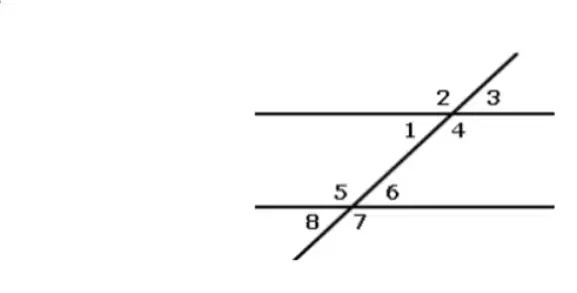
Which statements can be used to prove that the measures of ∠1 and ∠5 have a sum of 180°?
∠1 and ∠8 are congruent as corresponding angles; ∠5 and ∠8 form a linear pair.
∠1 and ∠2 form a linear pair; ∠3 and ∠4 form a linear pair.
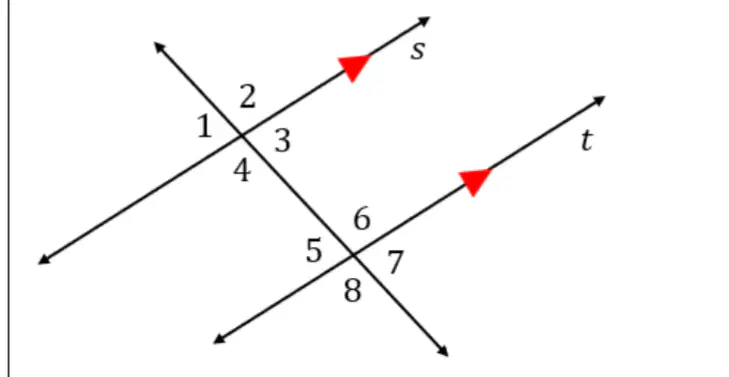
In the figure, s ∥ t. ∠6 is supplementary to which of the following angles? Select all that apply.
∠1
∠2
∠3
∠7
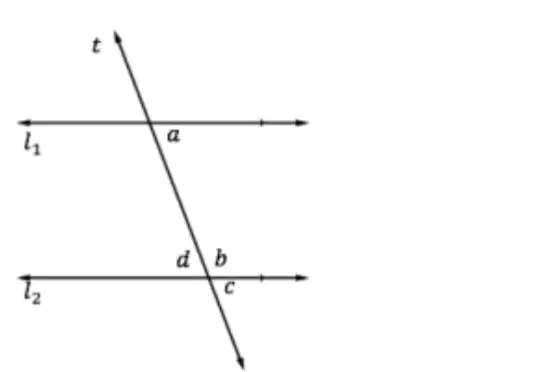
Which of the following is a condition for the figure below that will not prove l1 ∥ l2?
∠a ≅ ∠c
m∠b + m∠d = 180°
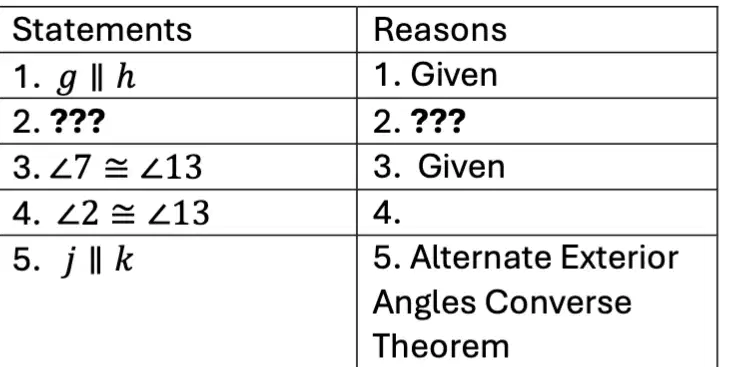
Complete the statement and reason for Step #2 of the two-column proof. Given: g ∥ h, ∠7 ≅ ∠13. Prove: j ∥ k.
Statement: ∠2 ≅ ∠7; Reason: Alternate Interior Angles Theorem
Statement: ∠2 ≅ ∠13; Alternate Exterior Angles Theorem
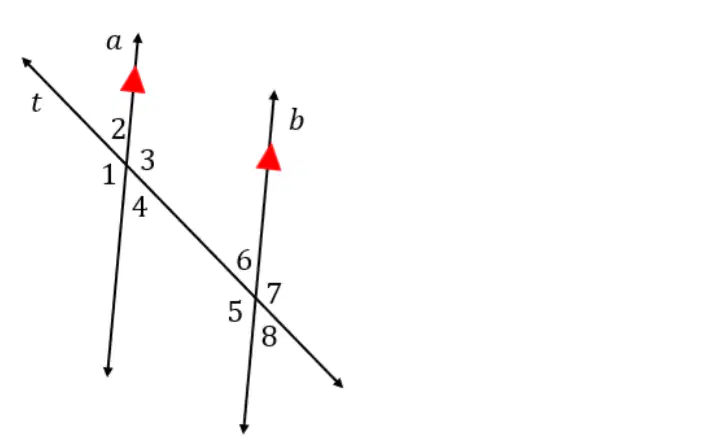
Angles 1 and 5 are ________. Use the diagram of lines a and b parallel, intersected by transversal t.
Corresponding angles
Alternate interior angles
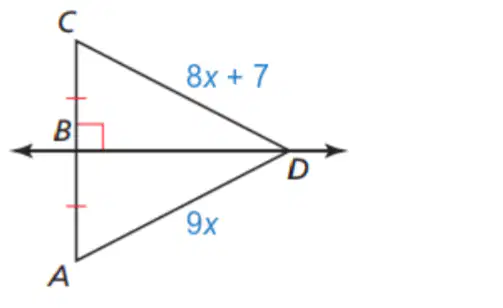
Given that BD is the perpendicular bisector of CA in the diagram, find AD.
63
54
72
45
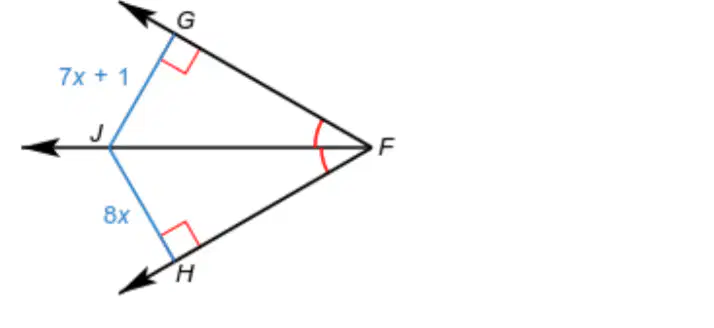
Given that FJ is the angle bisector of ∠GFH in the diagram, find GJ.
8
7
9
10
ΔMNP ≅ ΔSTU. Which of the following statements are true? Select all that apply.
∠M ≅ ∠S
NP ≅ ST
ΔPMN ≅ ΔUST
ΔMPN ≅ ΔUTS
MP ≅ SU
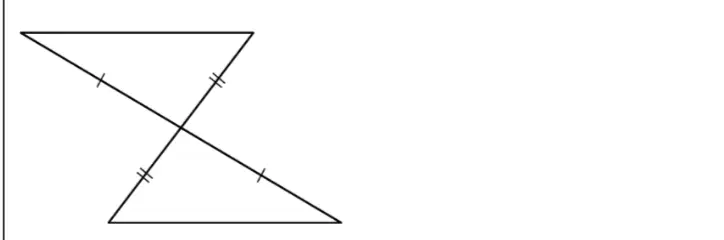
Which theorem can you use to prove that the triangles in the diagram are congruent?
SSS Congruence Theorem
SAS Congruence Theorem
ASA Congruence Theorem
AAS Congruence Theorem
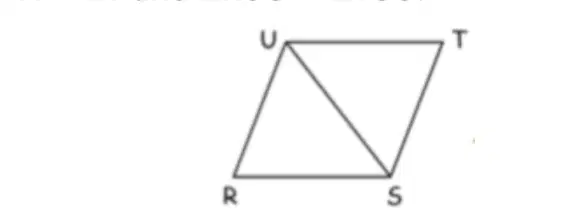
In the diagram, it is given that ∠R ≅ ∠T and ∠RSU ≅ ∠TUS. Complete the congruence statement for the two triangles: ΔRUS ≅ ______.
ΔSUT
ΔSTU
ΔTSU
ΔTUS
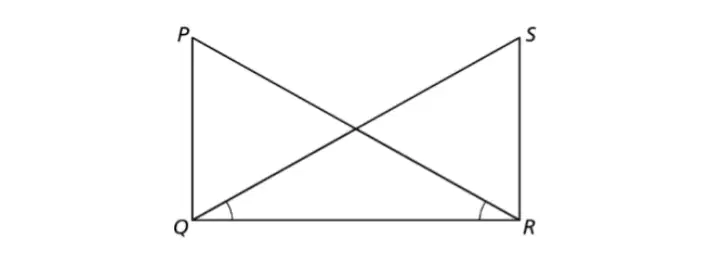
Given the diagram, what additional information do you need to prove that ΔPQR ≅ ΔSRQ by the ASA Congruence Theorem?
∠P ≅ ∠Q
PQ ≅ SR
∠QRS ≅ ∠RQP
SQ ≅ PR
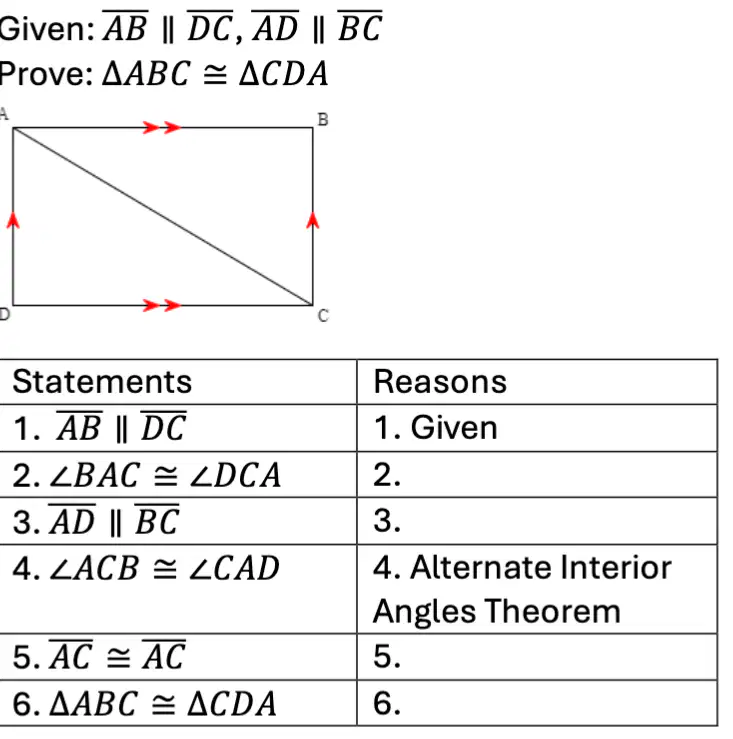
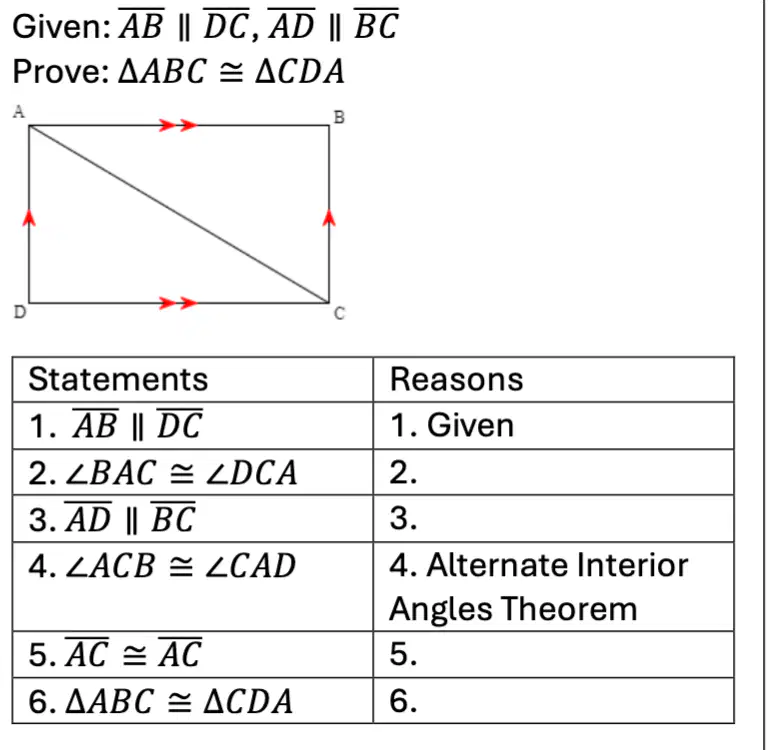
Consider the diagram, given and prove statements, and partially completed proof. Given: AB ∥ DC, AD ∥ BC. Prove: ΔABC ≅ ΔCDA. What is the reason for Step #2 (∠BAC ≅ ∠DCA)? Choose one.
Angle-Angle-Side Congruence Theorem
Angle-Side-Angle Congruence Theorem
Reflexive Property
Alternate Interior Angles Theorem
Given
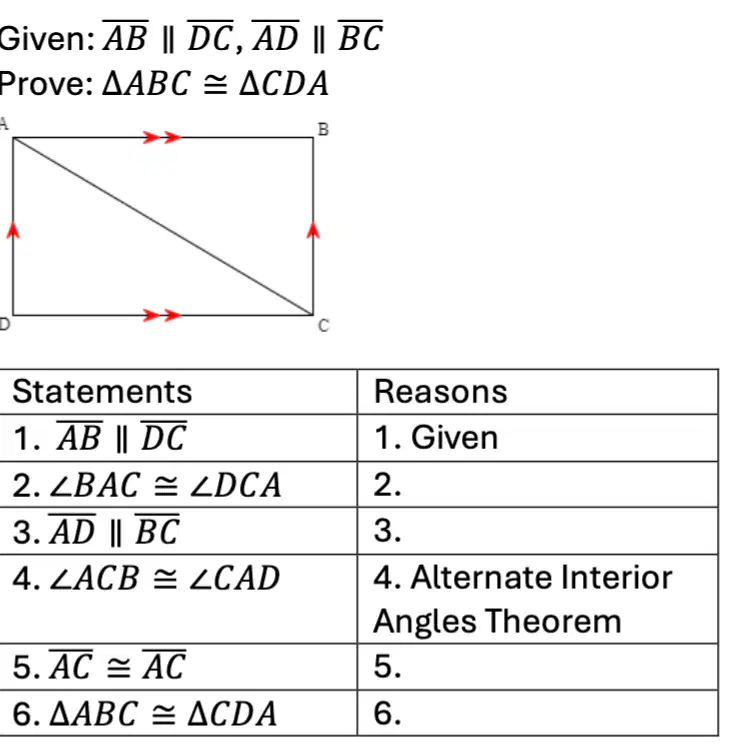
Consider the same proof. What is the reason for Step #3 (AD ∥ BC)? Choose one.
Angle-Angle-Side Congruence Theorem
Alternate Interior Angles Theorem
Side-Side-Side Congruence Theorem
Reflexive Property
Given
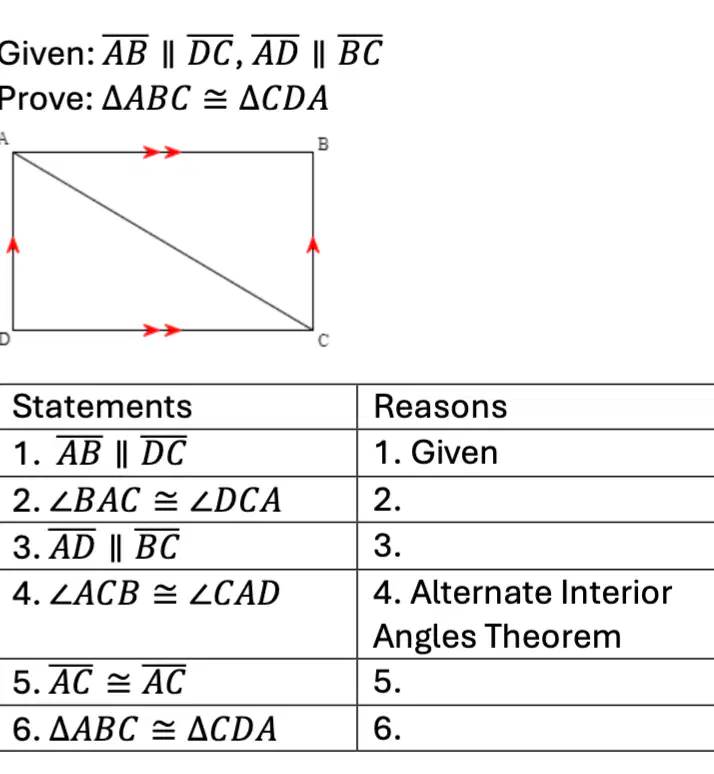
In the same proof, what is the reason for Step #5 (AC ≅ AC)? Choose one.
Angle-Side-Angle Congruence Theorem
Alternate Interior Angles Theorem
Side-Side-Side Congruence Theorem
Reflexive Property
Given
In the same proof, what is the reason for Step #6 (ΔABC ≅ ΔCDA)? Choose one.
Angle-Angle-Side Congruence Theorem
Angle-Side-Angle Congruence Theorem
Side-Side-Side Congruence Theorem
Reflexive Property
Alternate Interior Angles Theorem
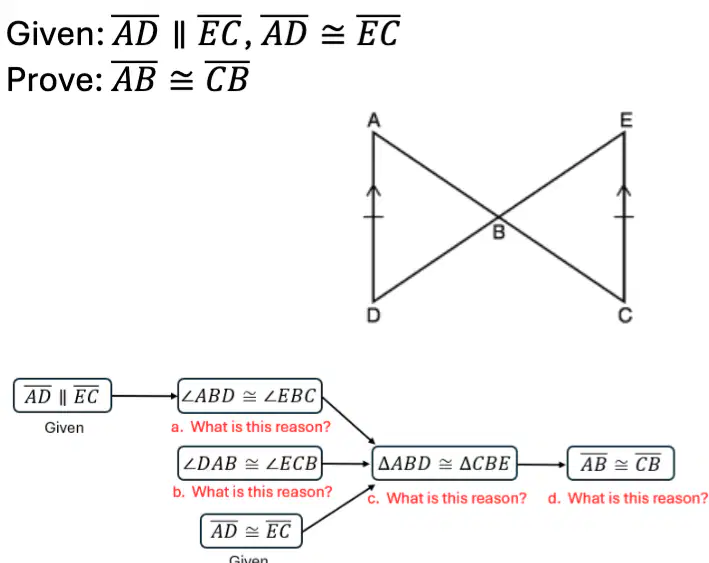
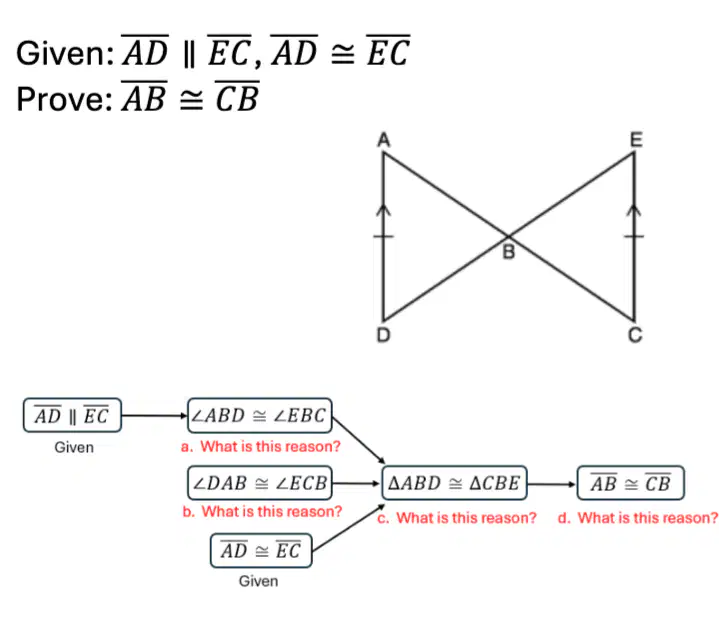
Consider the diagram, given and prove statements, and partially completed flowchart. Given: AD ∥ EC, AD ≅ EC. Prove: AB ≅ CB. What is the reason for step a in the flowchart? Choose one.
Alternate Interior Angles Theorem
Angle-Angle-Side Congruence Theorem
Definition of midpoint
Vertical Angles Congruence Theorem
Corresponding Parts of Congruent Triangles are Congruent
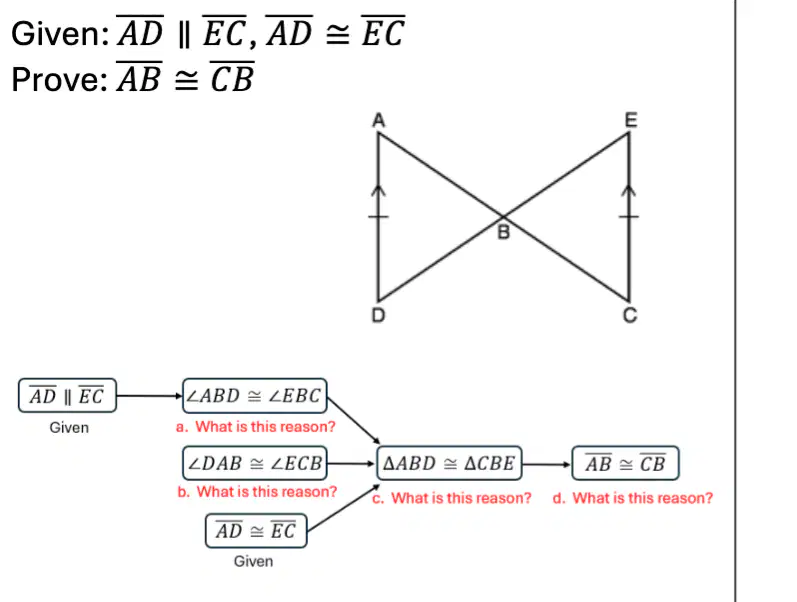
For the same flowchart proof, what is the reason for step b? Choose one.
Alternate Interior Angles Theorem
Angle-Angle-Side Congruence Theorem
Definition of midpoint
Vertical Angles Congruence Theorem
Corresponding Parts of Congruent Triangles are Congruent
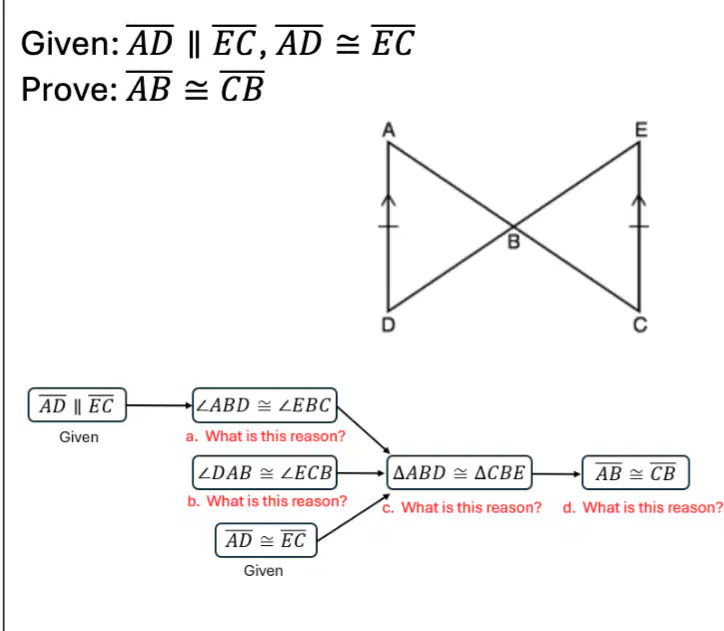
For the same flowchart proof, what is the reason for step c? Choose one.
Alternate Interior Angles Theorem
Angle-Angle-Side Congruence Theorem
Definition of midpoint
Vertical Angles Congruence Theorem
Corresponding Parts of Congruent Triangles are Congruent
For the same flowchart proof, what is the reason for step d? Choose one.
Alternate Interior Angles Theorem
Angle-Angle-Side Congruence Theorem
Definition of midpoint
Vertical Angles Congruence Theorem
Corresponding Parts of Congruent Triangles are Congruent
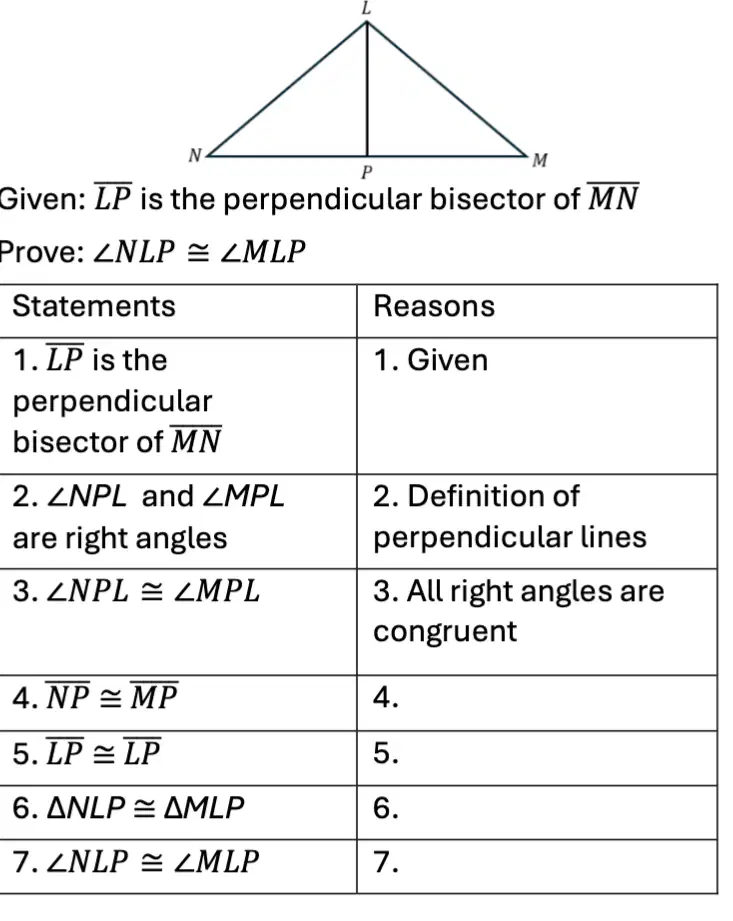
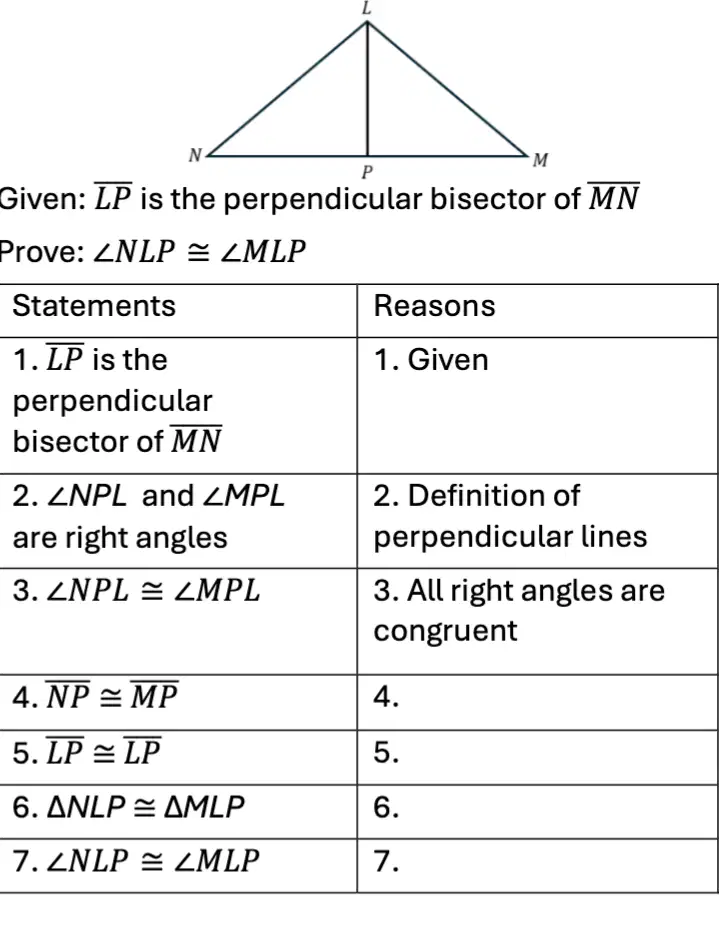
Consider the diagram and two-column proof. Given: LP is the perpendicular bisector of MN. Prove: ∠NLP ≅ ∠MLP. What is the reason for statement 4 (NP ≅ MP)? Choose one from the answer bank.
Definition of bisector
Reflexive Property of Congruence
Side-Angle-Side Congruence Theorem
Corresponding Parts of Congruent Triangles are Congruent
Definition of perpendicular lines
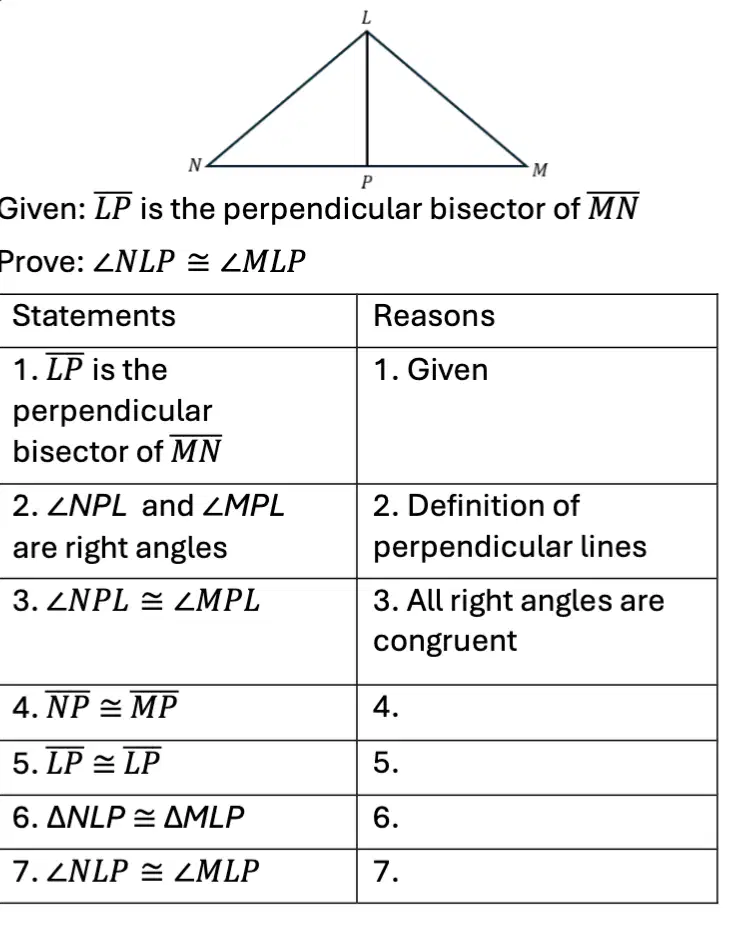
In the same proof, what is the reason for statement 5 (LP ≅ LP)? Choose one from the answer bank.
Definition of bisector
Reflexive Property of Congruence
Side-Angle-Side Congruence Theorem
Corresponding Parts of Congruent Triangles are Congruent
Definition of perpendicular lines
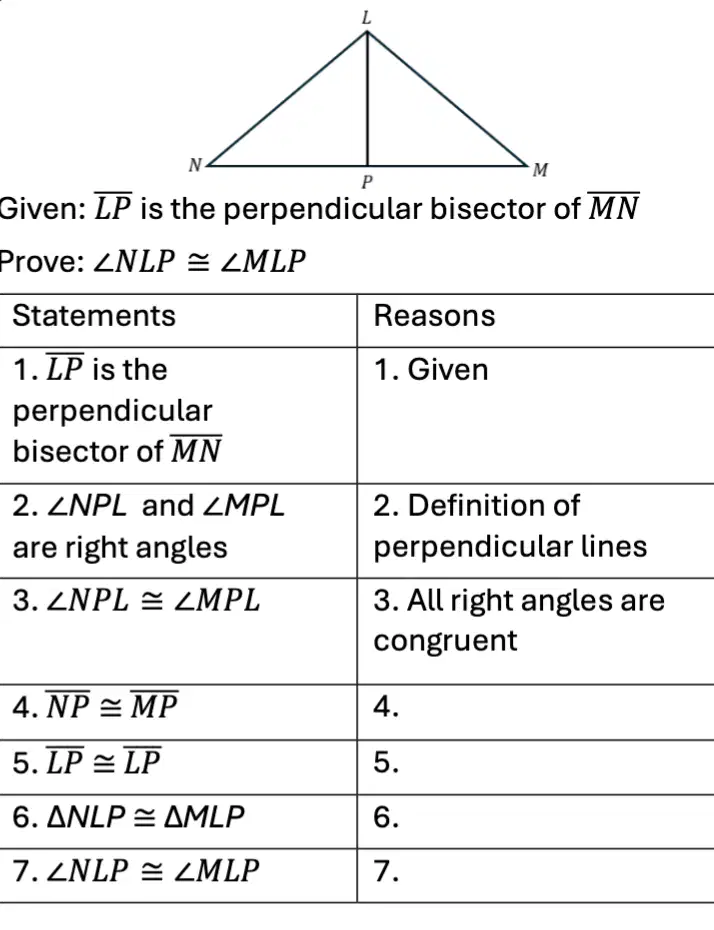
In the same proof, what is the reason for statement 6 (ΔNLP ≅ ΔMLP)? Choose one from the answer bank.
Definition of bisector
Reflexive Property of Congruence
Side-Angle-Side Congruence Theorem
Corresponding Parts of Congruent Triangles are Congruent
Definition of perpendicular lines
In the same proof, what is the reason for statement 7 (∠NLP ≅ ∠MLP)? Choose one from the answer bank.
Definition of bisector
Reflexive Property of Congruence
Side-Angle-Side Congruence Theorem
Corresponding Parts of Congruent Triangles are Congruent
Definition of perpendicular lines
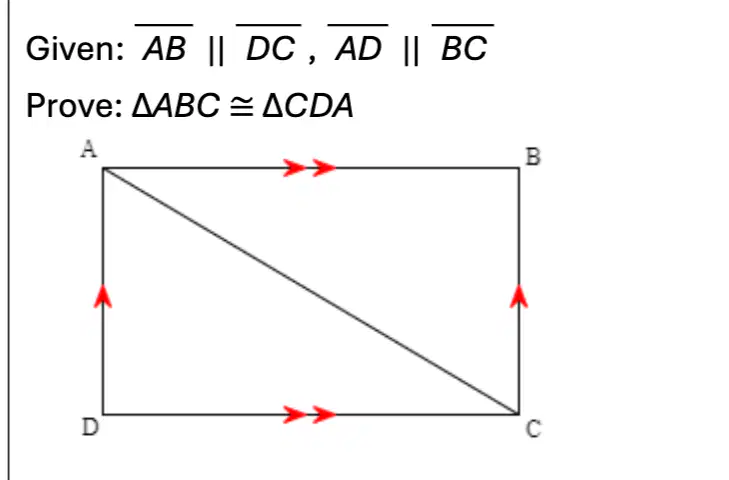
Consider the diagram, given and prove statements, and partially completed proof. Given: AB ∥ DC, AD ∥ BC. Prove: ΔABC ≅ ΔCDA. What is the correct reason for statement 2 (∠BAC ≅ ∠DCA)? Choose one.
Corresponding Angles Theorem
Reflexive Property of Congruence
Side-Angle-Side Congruence Theorem
Angle-Side-Angle Congruence Theorem
Alternate Interior Angles Theorem
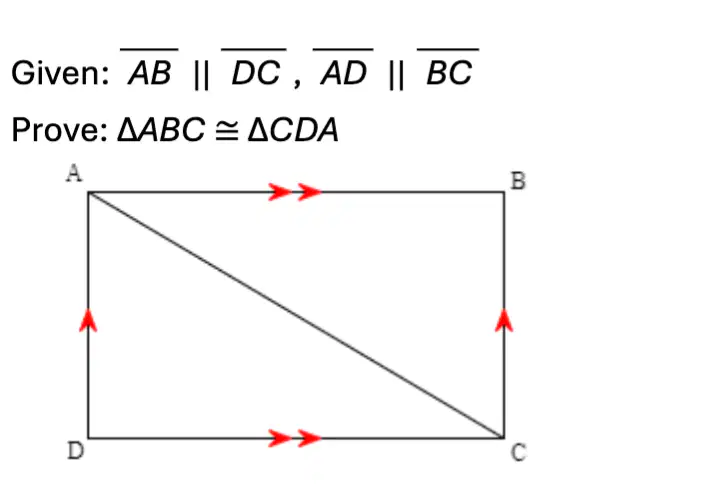
For the same proof, what is the correct reason for statement 4 (∠ACB ≅ ∠CAD)? Choose one.
Corresponding Angles Theorem
Reflexive Property of Congruence
Side-Angle-Side Congruence Theorem
Angle-Side-Angle Congruence Theorem
Alternate Interior Angles Theorem
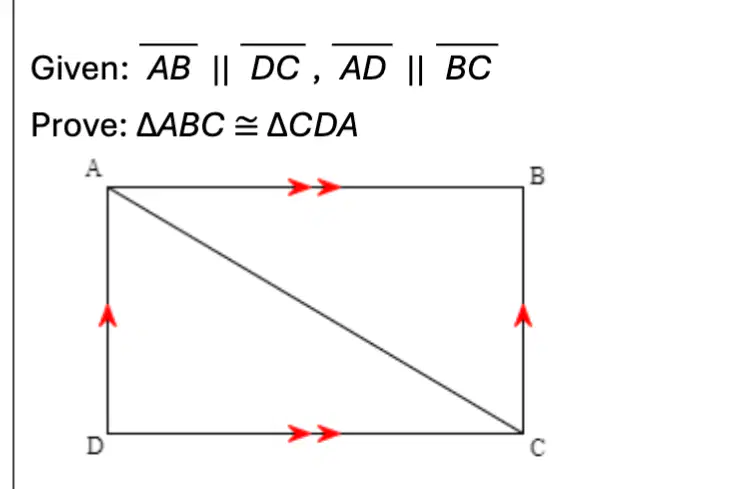
For the same proof, what is the correct reason for statement 5 (AC ≅ AC)? Choose one.
Corresponding Angles Theorem
Reflexive Property of Congruence
Side-Angle-Side Congruence Theorem
Angle-Side-Angle Congruence Theorem
Definition of angle bisector
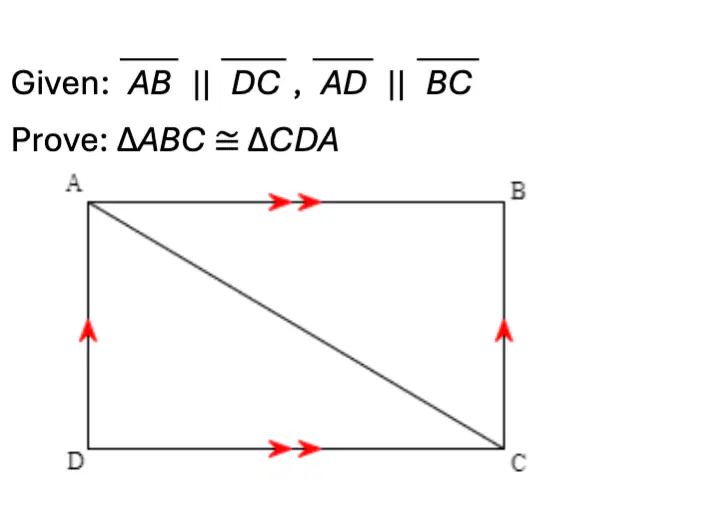
For the same proof, what is the correct reason for statement 6 (ΔABC ≅ ΔCDA)? Choose one.
Corresponding Angles Theorem
Reflexive Property of Congruence
Side-Angle-Side Congruence Theorem
Angle-Side-Angle Congruence Theorem
Definition of angle bisector
ΔABC is shown, where ∠ACD is an exterior angle of the triangle. What is the measure of ∠ACD?
126°
140°
154.5°
160°
The angle measures of ΔABC are ∠A = 35°, ∠B = 42°, and ∠C = 103°. Which of the following statements about the sides of the triangle are true? Select all that apply.
BC < AC
AB < AC
AB > BC
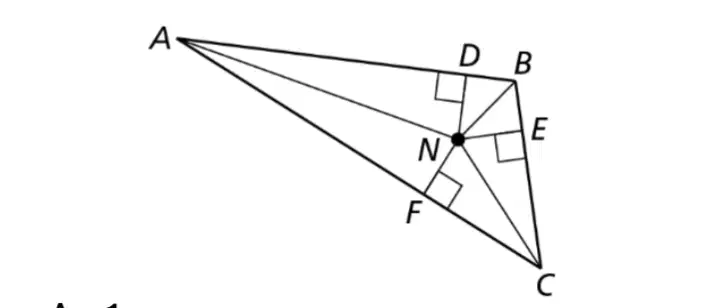
Point N is the incenter of ΔABC. ND = 4x + 5 and NE = 8x − 3. What is NF?
1
2
9
13
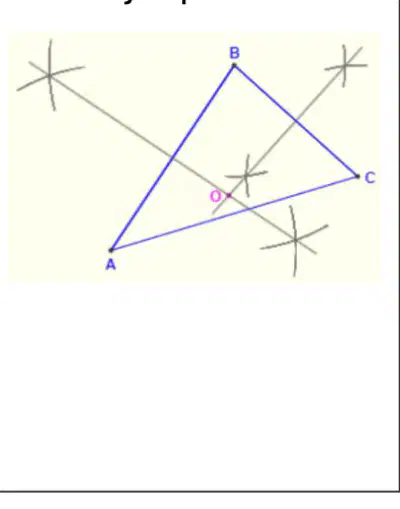
Which point of concurrency is point O?
Circumcenter
Incenter
Centroid
Orthocenter
Which of the following statements is false?
The incenter of a triangle is equidistant from the sides of the triangle.
The circumcenter of a right triangle is on the triangle.
The circumcenter of a triangle is equidistant from the vertices of the triangle.
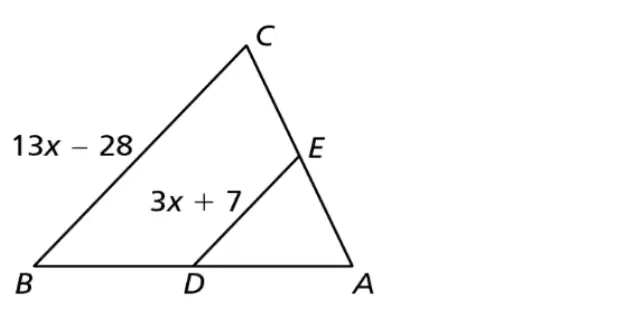
In the diagram, DE is a midsegment of triangle ABC. The side BC is labeled 13x − 28 and the midsegment DE is labeled 3x + 7. What is BC?
6
17.5
35
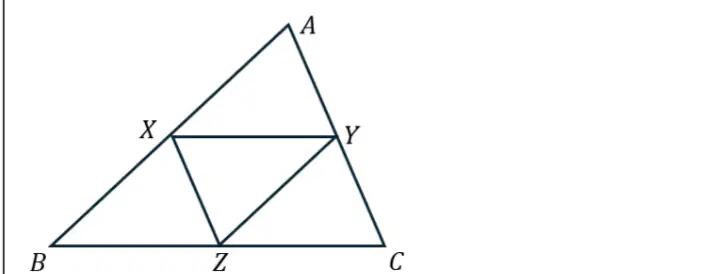
Given triangle ABC, X is the midpoint of AB, Y is the midpoint of AC, Z is the midpoint of BC, BC=17 , and YZ=9 . Select all statements below that are true.
XZ ∥ AC
AB ∥ XZ
XY = 8.5
XY = 9
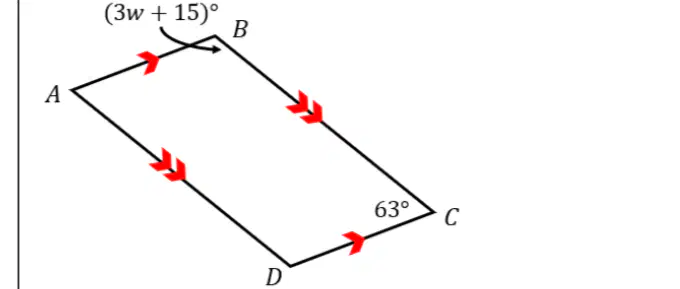
Determine the value of w in quadrilateral ABCD. The figure is a parallelogram with angle B labeled (3w + 15)° and angle C labeled 63°. What is w?
32
34
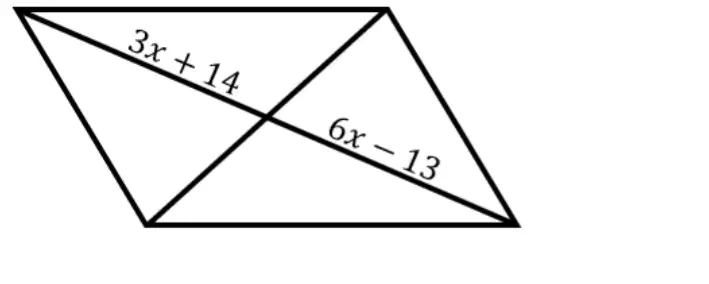
What value of x makes the quadrilateral a parallelogram? Opposite sides are marked with lengths 3x + 14 and 6x − 13.
7
8
9
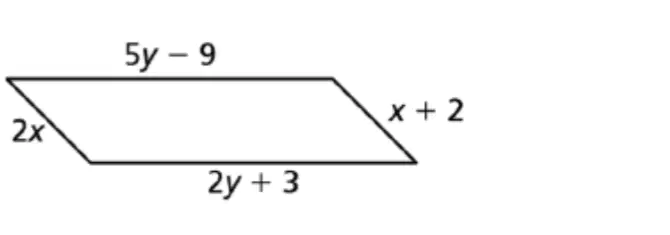
What is the perimeter of the parallelogram? The top side is 5y − 9, the bottom side is 2y + 3, the left side is 2x, and the right side is x + 2.
26 units
28 units
30 units
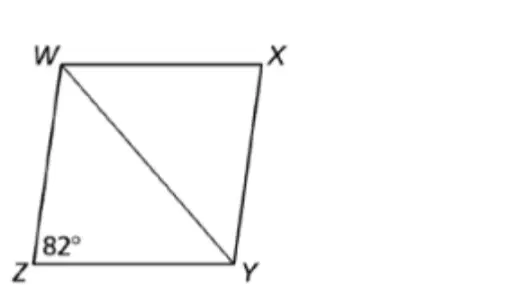
What is m∠WYZ in rhombus WXYZ?
41°
45°
49°
Decide which of the following statements about quadrilaterals are true. Select all that apply.
A square is always a parallelogram.
A rectangle is always a parallelogram.
A rhombus is always a square.
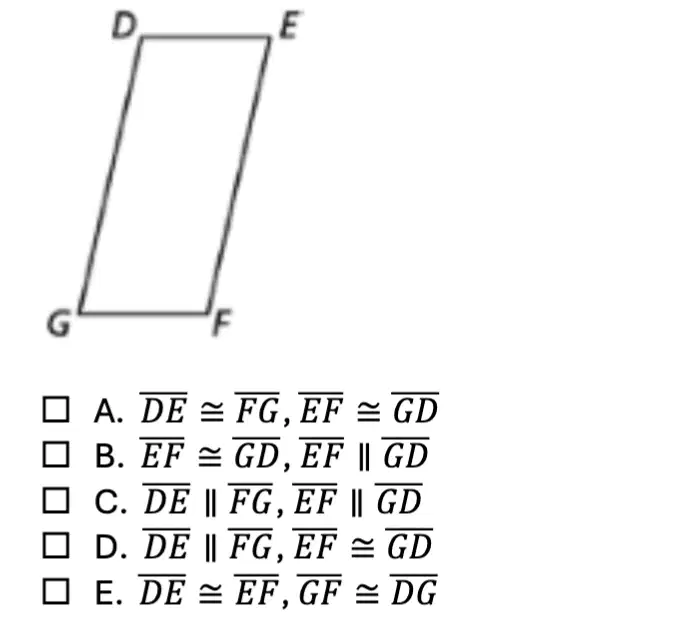
Which of the following provides enough information to prove that the quadrilateral is a parallelogram? Select all that apply.
DE ≅ FG, EF ≅ GD
EF ≅ GD, EF ∥ GD
DE ∥ FG, EF ∥ GD
Which of the following quadrilaterals must have perpendicular diagonals? Select all that apply.
rhombus
square
In the diagram, ABCD is a parallelogram. Which measures are correct? Select all that apply.
CD = 16
EB = 7
m∠ABC = 60°
m∠BCD = 120°
Given WXYZ is an isosceles trapezoid with diagonals WY and XZ. Prove WY ≅ XZ. In the two‑column proof below, select the correct reason for Step #2. Statements: 1. WXYZ is an isosceles trapezoid 2. WZ ≅ XY 3. ?? 4. ZY ≅ YZ 5. ?? 6. WY ≅ XZ. Reasons: 1. Given 2. ??? 3. Isosceles Trapezoid Base Angles Theorem 4. ?? 5. Side‑Angle‑Side Congruence Theorem 6. Corresponding Parts of Congruent Triangles are Congruent. Use the answer choices: A. Transitive Property of Equality B. Subtraction Property of Equality C. Reflexive Property of Equality D. Definition of an isosceles trapezoid E. ∠WZX ≅ ∠WZY.
Transitive Property of Equality
Subtraction Property of Equality
Reflexive Property of Equality
Definition of an isosceles trapezoid
JKLM is an isosceles trapezoid where m∠LK = 118°. Find the measure of each angle: m∠J.
118°
62°
68°
ABCD is an isosceles trapezoid with AD ∥ BC, m∠B = (3x + 21)° and m∠C = (4x + 16)°. What is m∠B?
36°
54°
72°
In the quadrilateral shown, AF ∥ BE ∥ CD. Determine the length of AF and CD.
AF = 8, CD = 32
AF = 10, CD = 30
In the figure below, ∠A ≅ ∠D, ∠B ≅ ∠E, and AB ≅ DE. Part A: Are the triangles congruent? If so, which congruence theorem proves it?
Yes, by Side‑Angle‑Side Congruence Theorem
Yes, by Angle‑Side Congruence Theorem
Given ΔFGH ≅ ΔPRQ, PR = 4x − 6, QP = 3x + 5, and GH = 2x + 6. The perimeter of ΔPRQ is 167 meters. What is the length of HF?
55 meters
57 meters
59 meters
61 meters
Suppose ΔDEF is the image of a translation of ΔABC. If point F is at (−2, 6), write a rule for the translation that translates ΔABC to ΔDEF.
(x, y) → (x + 3, y − 5)
(x, y) → (x − 3, y + 5)
(x, y) → (x + 1, y + 10)
(x, y) → (x − 5, y + 9)
Figure A is translated according to the rule (x, y) → (x + 9, y − 8) to Figure A’. Figure A’ is translated according to the rule (x, y) → (x − 3, y − 4) to Figure A’’. Which of the following is the composition rewritten as a single translation?
(x, y) → (x + 6, y − 12)
(x, y) → (x + 12, y − 4)
(x, y) → (x + 6, y − 4)
(x, y) → (x + 12, y − 12)
ΔABC has vertices A(−3, 2), B(−1, −4), and C(3, 1). After two transformations, the vertices of ΔA′B′C′ are A″(4, 0), B″(2, −6), and C″(−2, −1). Which of the following sequence of transformations maps ΔABC onto ΔA″B″C″?
A translation using the rule (x, y) → (x + 1, y − 2), followed by a rotation 180° about the origin using the rule (x, y) → (−x, −y).
A reflection in the y-axis using the rule (x, y) → (−x, y), followed by a translation using the rule (x, y) → (x + 1, y − 2).
A reflection in the x-axis using the rule (x, y) → (x, −y), followed by a translation using the rule (x, y) → (x + 1, y − 2).
A translation using the rule (x, y) → (x + 7, y − 2), followed by a rotation 90° counterclockwise about the origin using the rule (x, y) → (−y, x).
On the graph below, Figure 1 is the preimage and Figure 2 is the image of Figure 1 after a sequence of transformations. Complete the statement that describes the sequence of transformations that maps Figure 1 onto Figure 2: Figure 1 maps onto Figure 2 by a ______ (blank #1), followed by a ______ (blank #2). Choose the correct transformation for blank #1.
Reflection in the x-axis: (x, y) → (x, −y)
Reflection in the y-axis: (x, y) → (−x, y)
Reflection in the line y = x: (x, y) → (y, x)
On the graph below, Figure 1 is the preimage and Figure 2 is the image of Figure 1 after a sequence of transformations. Complete the statement that describes the sequence of transformations that maps Figure 1 onto Figure 2: Figure 1 maps onto Figure 2 by a ______ (blank #1), followed by a ______ (blank #2). Choose the correct transformation for blank #2.
Translation: (x, y) → (x + 2, y + 3)
Translation: (x, y) → (x + 2, y − 3)
Translation: (x, y) → (x − 2, y − 3)
A reflection over the x-axis maps △ABC to △A′B′C′. Do the preimage and image have the same size and shape? Explain. Choose the correct answer below.
No. A reflection preserves only lengths of sides.
Yes. A reflection preserves both angle measures and lengths of sides.
No. A reflection preserves neither angle measures nor lengths of sides.
No. A reflection preserves only angle measures.
The preimage of a figure before a transformation or sequence of transformations is shown on a coordinate grid. Which of the graphs shows a transformation of the figure that preserves distance and preserves angle measure? Select all that apply.
Graph A
Graph B
Graph C
Graph D
Consider the graphs of Figures 1 and 2 on a coordinate grid. Complete the statement that describes the congruence transformations that map Figure 1 onto Figure 2: Figure 1 maps onto Figure 2 by a rotation of 270° clockwise about the origin followed by a translation of how many units to the right?
1 unit
2 units
3 units
4 units
On the coordinate grid, a single rotation maps △ABC onto △A′B′C′. Complete the statement about the rotation: What is the center of rotation?
The origin
Point A
Point B
On the coordinate grid, a single rotation maps △ABC onto △A′B′C′. Complete the statement about the rotation: What is the degree measure of the clockwise rotation?
90
180
270
On the coordinate grid, a single rotation maps △ABC onto △A′B′C′. Complete the statement about the rotation: What is the equivalent degree measure of the counterclockwise rotation?
90
180
270
ΔABC and ΔDEF are graphed on the coordinate plane below. Which composition of transformations maps ΔABC onto ΔDEF?
A reflection over the x-axis followed by a reflection over the y-axis
A 180° rotation about the origin followed by a reflection over the line y = x
A 90° clockwise rotation about the origin followed by a reflection over the y-axis
A translation 8 units to the right and 1 unit up followed by a 90° counterclockwise rotation about the origin
ΔXYZ with vertices X(4, 8), Y(12, 14), and Z(8, 12) is reflected in the y-axis and then rotated 90° clockwise about the origin. Determine the quadrant the image is located in.
Quadrant I
Quadrant II
Quadrant III
Quadrant IV
The point (−7, 4) is reflected over the line x = −3. Then, the resulting point is reflected over the line y = x. What are the coordinates of the new point?
(−10, −7)
(1, 4)
(4, −7)
(4, 1)
Figure 1 is reflected in the x-axis and then translated four units left. Which figure results?
Figure A
Figure B
Figure C
Figure D
Points A(−2, 1) and B(2, 3) are the endpoints of segment AB. AB is reflected in the line y = −1 and then translated according to the coordinate rule (x, y) → (x + 3, y + 1) to the segment A″B″. Which of the following graphs shows A″B″?
Graph A
Graph B
Graph C
Graph D
ΔABC has vertices A(3, −5), B(1, −4), and C(4, −2). Which graph shows the image of ΔABC after a reflection in the y-axis, followed by a rotation of 270° counterclockwise about the origin?
Graph A
Graph B
Graph C
Graph D
Which congruence transformations map ΔXYZ to ΔX′Y′Z′? Select all that apply.
reflection in the y-axis, followed by a reflection in the x-axis
rotation of 90° counterclockwise about the origin, followed by a reflection in the y-axis
rotation of 270° counterclockwise about the origin, followed by a reflection in the x-axis
reflection in the x-axis, followed by a reflection in the y-axis
The image of ΔABC after a rotation 180° about the origin, followed by a reflection in the line y = −x, is ΔXYZ. Which of the following statements are true? Select all that apply.
∠A ≅ ∠Z
∠C ≅ ∠Y
ΔBCA ≅ ΔZYX
ΔCAB ≅ ΔXYZ
BA ≅ YZ
Consider the figures graphed below. Which of the following are true statements about the figures? Select all that apply.
ΔEDF is congruent to ΔBAC by a clockwise rotation about the origin
Quadrilateral IHGJ is congruent to quadrilateral RNPQ by a reflection in the x-axis
Quadrilateral IHGJ is congruent to quadrilateral RNPQ by a reflection in the line y = −1.5
Prove that ΔABC is congruent to ΔDEF with the given vertices A(3,1), B(4,5), C(2,3), D(−1,−3), E(−5,−4), F(−3,−2). Select the reason that correctly maps ΔABC onto ΔDEF.
The triangles are congruent because ΔABC can be mapped onto ΔDEF by a rotation: (x, y) → (y, −x), followed by a reflection: (x, y) → (x, −y).
The triangles are congruent because ΔABC can be mapped onto ΔDEF by a reflection: (x, y) → (−x, y), followed by a rotation: (x, y) → (y, −x).
The triangles are congruent because ΔABC can be mapped onto ΔDEF by a translation: (x, y) → (x − 4, y), followed by another translation: (x, y) → (x, y − 6).
The endpoints of the hypotenuse of a right triangle are (−1, −4) and (5, 7). Which of the following points could be the third vertex of the right triangle? Select all that apply.
A. (−1, 7)
B. (−4, 5)
The coordinates of the vertices of triangle ABC are A(−1, 3), B(9, 1), and C(−1, −1). Classify the triangle by its sides.
equilateral
isosceles
scalene
The coordinates of the vertices of triangle ABC are A(−1, 3), B(9, 1), and C(−1, −1). Classify the triangle by its angles.
acute
obtuse
right
The three vertices of a parallelogram are (1, 4), (−5, 1), and (−3, −2). Which of the following could be the fourth vertex of the parallelogram? Select all that apply.
A. (0, 0)
B. (3, 1)
You are given four coordinates of the figure ABCD: A(−4, 4), B(−1, 6), C(3, 0), and D(0, −2). Which of the following statements proves that the figure is a rectangle? Select all that apply.
A. The diagonals are perpendicular to each other.
B. The sides have lengths of 3, 4.
A square has a diagonal with vertices (−6, 3) and (1, 2) as shown. Determine the coordinates of the endpoints for the other diagonal of the square.
(−3, −2) and (−1, 6)
(−1, 7) and (−3, −3)
The endpoints of segment AB are A(2, 5) and B(−4, 7). Find the coordinates of the midpoint.
(−1, 6)
(−2, 6)
If segment AB has endpoint A(2, 13) and midpoint M(10, −1), then give the coordinates of endpoint B.
(12, −7)
(8, −3)
You incorrectly found the distance between (−2, −3) and (0, 3). Step 1: d = sqrt((x2−x1)2+(y2−y1)2) . Step 2: d = sqrt((0−(−2))2+(3−3)2) . Step 3: d = sqrt(4+0) . Step 4: d = 2. In which step did you make your mistake?
Step 1
Step 2
What is the distance between (−5, 2) and (−9, −4)? Leave your answer in simplest radical form.
213
20
A city map is placed on a coordinate grid. The post office is located at the point P(5, 35), the library located at the point L(15, 10), and the fire station is located at the point F(9, 25). What is the ratio of the length of PF to the length of PL?
2:3
3:2
2:5
3:5
Find point R on segment ST so that the ratio of SR to RT is 1:2. Points shown on the coordinate grid are S(−6, 8) and T(3, 2).
R (0, 4)
R (−1.5, 5)
R (−3, 6)
R (−5, 6)
This problem has two parts. First, answer Part A. Then, answer Part B. A triangular park is shown in the diagram, created by vertices L, M, and N. Part A: A landscape architect wants to place a fountain at the midpoint of the side represented by MN. What are the coordinates of the location of the bench?
(65, 75)
(70, 70)
(70, 75)
(75, 70)
This problem has two parts. First, answer Part A. Then, answer Part B. Using the same triangular park diagram, Part B: The architect is planning to make a straight path from point L to the fountain at the midpoint of MN. What is the length of the path? Round to the nearest tenth, if necessary.
84.3 yards
86.0 yards
88.6 yards
90.0 yards
Determine which lines through the given points are parallel, perpendicular, or neither. Line 1 passes through (−4, 3) and (0, −5). Line 2 passes through (−1, 2) and (3, 4). Complete: Lines 1 and 2 are _______.
Parallel
Perpendicular
Neither parallel nor perpendicular
Determine which lines through the given points are parallel, perpendicular, or neither. Line 2 passes through (−1, 2) and (3, 4). Line 3 passes through (1, −3) and (3, 1). Complete: Lines 2 and 3 are _______.
Parallel
Perpendicular
Neither parallel nor perpendicular
Determine which lines through the given points are parallel, perpendicular, or neither. Line 1 passes through (−4, 3) and (0, −5). Line 4 passes through (2, 5) and (5, −1). Complete: Lines 1 and 4 are _______.
Parallel
Perpendicular
Neither parallel nor perpendicular
ΔRST has vertices at points R(−5, −9), S(6, −3), T(−1, 6). What are the coordinates of the centroid of ΔRST?
(−1, −1)
(0, −2)
(1, −3)
(0, −3)
A triangular garden is shown in the diagram below, where 1 unit on the graph equals 1 yard. How much fencing will be needed to enclose the garden? Round your answer to the nearest tenth, if necessary.
30.0 yards
32.2 yards
34.1 yards
36.0 yards
DEFG maps out your dog walking route, where 1 unit on the graph equals 1 block length. If you complete one loop, how far do you walk with your dogs? Round your answer to the nearest tenth.
16.0 blocks
18.2 blocks
20.0 blocks
14.5 blocks
What is the first step you would follow to create ∠D so that it would be congruent to ∠C?
Draw a ray and label the endpoint D.
Plot points C and D and draw a line through them.
Plot points C and D and draw a ray through them using C or D as an endpoint.
Draw a segment with endpoints C and D.
How can a compass be used to determine if two segments are the same length?
Open the compass to the length of one of the line segments. Then compare the length of the other line segment to the length indicated by the compass.
Place the compass point at one of the endpoints and open the compass to the length of the line segment. Using the same setting, draw an arc through the other line segment.
Open the compass to the smallest distance between the line segments. Without changing the setting, see if the distance is the same at every point on the line segment.
Place the compass point at one of the endpoints and draw arcs above and below the line segment. Do the same with the other line segment and compare the distance between the arcs.
In the diagram below, ∠FDE was constructed as a copy of ∠BAC. The steps to copy this angle are described below but are mixed up. Place the steps (A–D) in order from Step 1 to Step 4. Choices: A: Draw ray DF. B: Draw an arc through point E that looks like, and has the same radius as, an arc through points B and C. C: Draw horizontal ray DE. D: Draw a small arc centered at E with a radius of the length of BC to intersect the arc through E. Label the intersection point F. Which sequence correctly orders the steps?
C, B, D, A
B, C, A, D
C, D, B, A
B, D, C, A
You want to use a compass and straightedge to construct a copy of segment AB called XY. Fill in the blanks of the explanation of how to make this copy with the given answer choices (may be used more than once). Use the ______ to draw a segment ______ AB. Label one endpoint as X. Set your ______ at the length of ______. Use the ______ to mark point Y on ______. Which choice set correctly completes the instructions?
Straightedge; longer than; compass; segment AB; compass; segment XY
Compass; the same length as; straightedge; segment AB; compass; segment XY
Straightedge; shorter than; compass; the new segment; straightedge; segment AB
Compass; longer than; straightedge; the new segment; compass; segment XY

